
Plants
Cistus ladanifer
Gum rockrose, sticky rockrose, common rockrose, labdanum rockrose; Catalan: estepa, estepa del ládan; Galician.: xara, esteva; Portuguese.: xara, esteva-ordinária

Genus
The gum rockrose belongs to the genus Cistus. Its name derives from the Latin cisthos, itself a description of the Greek name kísthos, kístos; which means <<rockrose>>. The origin of the word is unknown, although in popular etymology it was believed to come from the Greek kístē: << box, basket>> because of the shape of its compartmented fruits. The French botanist Joseph Pitton de Tournefort (1656–1708) described the genus for the first time, and the Swede Carl Linnaeus accepted it with a wider circumscription, in which he included Helianthemum.
Description
The gum rockrose is an evergreen shrub that does not usually exceed 2 m in height, although in good conditions it can reach 3–4 m.

Leaf
The leaves are opposite, grouped in pairs and fused together at the base. They are long, narrow, entire leaves, 10 cm long by 1.5 wide. They have no stipules. When the leaves are young they are impregnated with labdanum, a sticky substance that gives a certain shine.

Flower
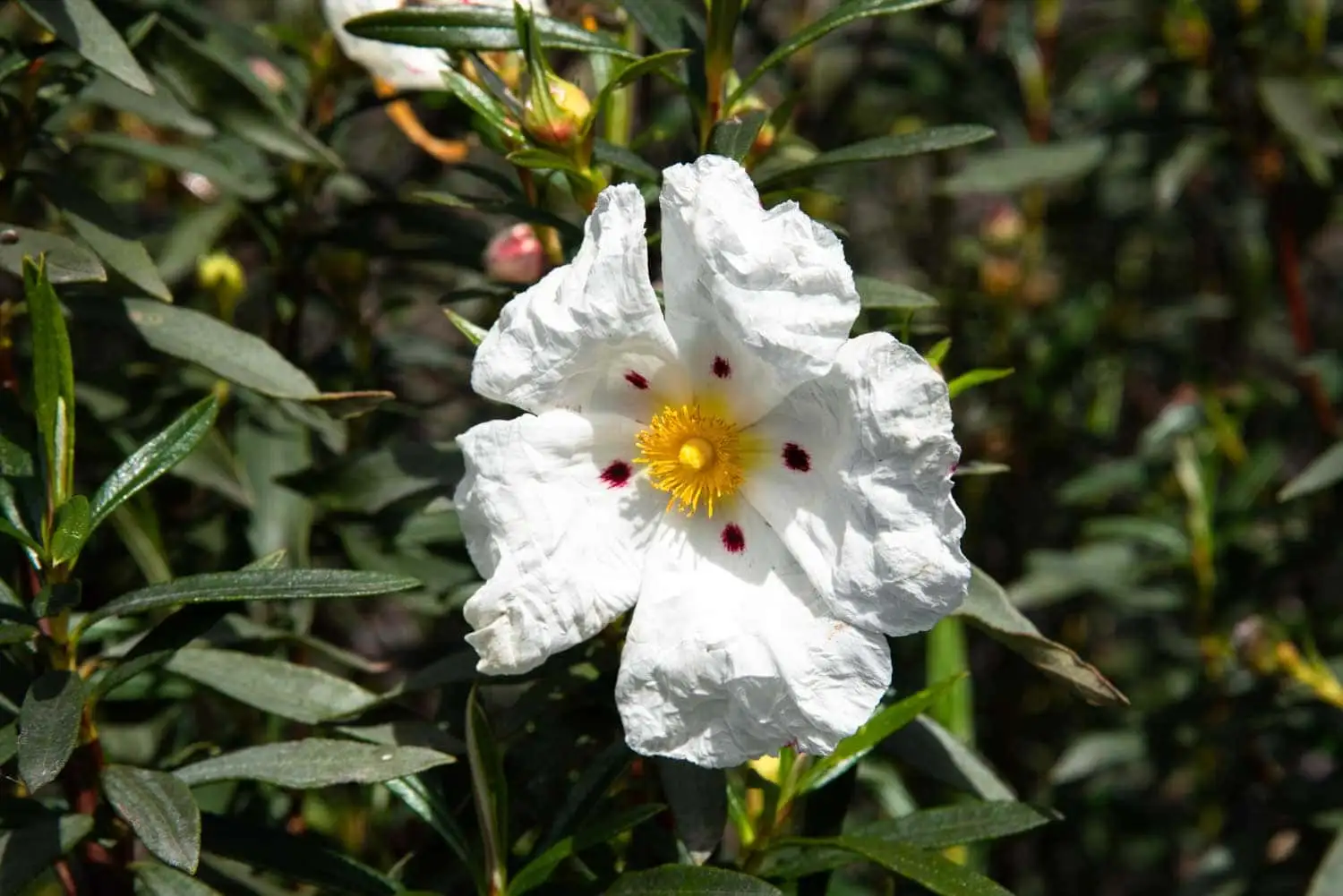
The flowers are a spotless white, quite large, 10 cm across. They have three sepals and five petals that sometimes show a purple blotch at the base (this form is called << five-wounds rockrose>> Cistus ladanifer var. maculatus Dunal ex DC)

Fruit
Its fruit is a globular capsule that holds between seven and 10 compartments, and opens into as many valves when it reaches maturity.
Flowering
It flowers from April to June.
Where it grows
The gum rockrose is a pioneer species in colonising the hills. It usually appears in the scrub of dry, sunny places, especially in holm oak surroundings on siliceous ground, such as granites, quartzites, slates and gneisses. It appears more on degraded and less evolved soils. When we see it we can take it as a sign that the soil is very poor. It extends from sea level, even sprouting in the sands of the coast, up to 1,500 m of altitude. As we have said, it usually accompanies the holm oak, and quickly takes over its space when its woods are burnt or felled and the soil is short of lime. We can buy it in nurseries, together with the laurel-leaved rockrose, widely used in ornamental planting.


Where it lives
The rockrose lives in the western Mediterranean region and also in the Canary Islands. It is most frequent in the siliceous, Mediterranean-climate part of the peninsula (Spain and Portugal), as in Castilla-La Mancha, Extremadura, Andalusia and Sierra Morena. The rockrose becomes scarce as we go north, in areas such as Galicia, Castilla y León and Catalonia.

Observations
The scientific name of the rockrose <<ladanifer>> refers to the sticky resin it produces, labdanum. This substance apparently inhibits the growth of other species. This, together with the fact that it is a pyrophyte (it has features that let it withstand wildfires), makes it easy for it to colonise quickly ahead of other species.
The gum rockrose is a somewhat variable plant. On very basic ground in the Serranía de Ronda specimens of the subspecies africanus appear, present in Morocco. It is distinguished by its more or less stalked leaves.
There is a species of rockrose very similar to the gum rockrose called Cistus palhinhae Ingram or <<Palhinha’s rockrose>>, which we find on the southern coasts of Portugal. It is an endemic of the Algarve and Baixo Alentejo. It is a stunted shrub of 30–50 cm with lanceolate leaves and its fruit has fewer valves (7 at most). It grows as cushion-shaped scrub, in windswept areas of coast, with sandy, stony or limestone soils, from sea level up to 100 metres. It flowers from March to June. Because of the almost continuous transition between this species of southern Portugal and Cistus ladanifer, it is considered a race or subspecies (Cistus ladanifer subsp. sulcatus (Demoly)).
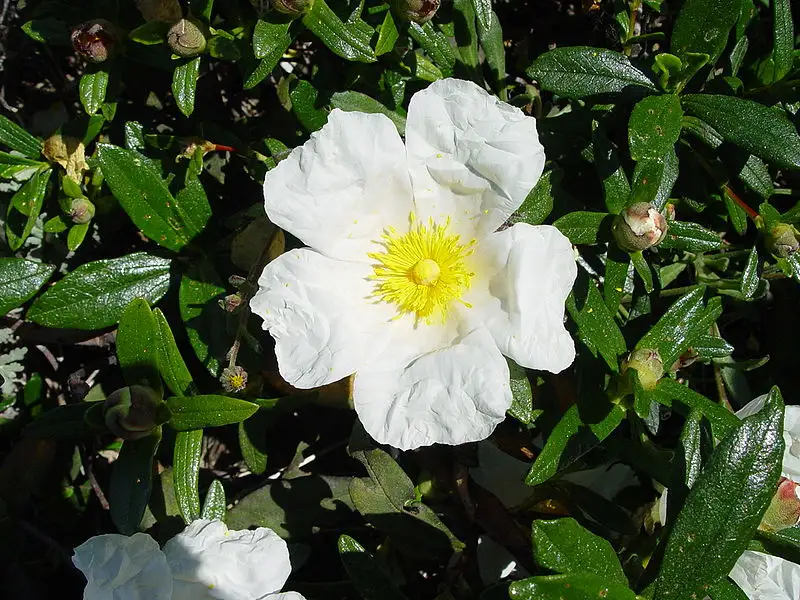
When altitude increases and the Pyrenean oak Quercus pyrenaica replaces the holm oak, the gum rockrose loses ground in favour of a similar rockrose, Cistus laurifolius (laurel-leaved rockrose; Catalan: estepa de muntanya; Basque: estrepa); a species more demanding in moisture. We can tell it apart by its leaves, broader and curlier, like those of the laurel. Also, its flowers are smaller (they appear from May to July), and the bark of its trunk peels off in strips, whereas in the gum rockrose it is smooth and continuous. Its height ranges between 80 cm and 2 m and it grows in rockrose thickets, scrub and low woodland, on slopes or moors that are fairly dry and stony. This rockrose extends widely across the centre of the peninsula, also covering part of Portugal, where there is no Atlantic influence. It also occurs in Italy, the Aegean Sea and Anatolia.
Uses
In the past labdanum had medical uses, since it was credited with sedative properties and was used in the composition of the «royal plaster» or «anti-rupture» to treat hernias and bone fractures. There were several methods of collecting it. The most convenient was to use a flock of goats: they walked through an extensive rockrose thicket, bathing in this substance, which became impregnated in their coats. The drawback of this method was the goaty smell the substance acquired. Another method was to walk about with leather aprons or to put the rockrose in boiling water.
At present it is used in perfumery (naturally not by the goat method) as a perfume fixative, to compensate for the fleeting character of alcohol and keep the aromatic harmony. It has also regained some medicinal prominence as a counter-irritant and antispasmodic, to treat gastritis and gastroduodenal ulcers. Also against rheumatism and neuralgia.
However, the resin is quite toxic and its use is not recommended.Where to find Cistus ladanifer in Cabañeros
The gum rockrose forms extensive patches of single-species rockrose thicket. It can be seen in almost the whole park and on all the routes. Its flowers can be pure white («immaculate») or carry a violet blotch at the base of each petal («maculate»), and feed many insects; among them Dusmet’s hoverfly (Mallota dusmeti), a vulnerable species that in the park breeds in the hollows of trees (newsletters of March–April 2024 and January–February 2025, all the newsletters).

Bibliography
- Vicente García Canseco (Coor.) (1997). Parque Nacional de Cabañeros. Madrid, Spain: Ecohábitat.
- Perea García-Calvo, R., Perea Ruiz-Tapiador, D., Giménez Velasco, G.F. (2015). Vegetación y flora del Parque Nacional de Cabañeros. Volumen I. El paisaje vegetal: ecología, conservación y rutas de interés geobotánico. Madrid, Spain: Editorial Solitario
- Verde, A., Fajardo Diego Rivera, J., Obón, C. (2000). Etnobotánica en el entorno del Parque Nacional de Cabañeros. Organismo Autónomo de Parques Nacionales (National Parks Agency), Spanish Ministry of the Environment.
- Lanzara, P., Pizzetti, M. (1977). Árboles. Barcelona, Spain: Grijalbo.
- Satolalla, F. (1992). Guía de los árboles de la Península Ibérica y Baleares. Barcelona, Spain: Blume.
- Pierre y Délia Vignes (2009). Herbario de Plantas Silvestres. Barcelona, Spain: Larousse.