
Calymenaceans
The most common, above all Neseuretus. The Tristani Beds take their name from its species Neseuretus tristani.
Cabañeros National Park
Tracks, moulds and tiny creatures from the sea that covered Cabañeros more than 450 million years ago.
Start with the tracks7 chapters with drawings · 9 more minutes if you open the full texts
1Trace fossils
A trace fossil is the track of an animal: where it walked, where it rested or how it dug. In Cabañeros almost all of them are on the underside of the quartzite and sandstone beds.1
The most famous trace in Cabañeros is the one trilobites left as they rummaged in the mud. Five types are distinguished in the park.
From above
In section
It walks over the soft bottom and leaves a double furrow, with the scratches of its legs in a V shape.
A layer of fine sand covers the trace at once, and that is what saves it.
The mud turns to slate and the sand to quartzite, much harder.
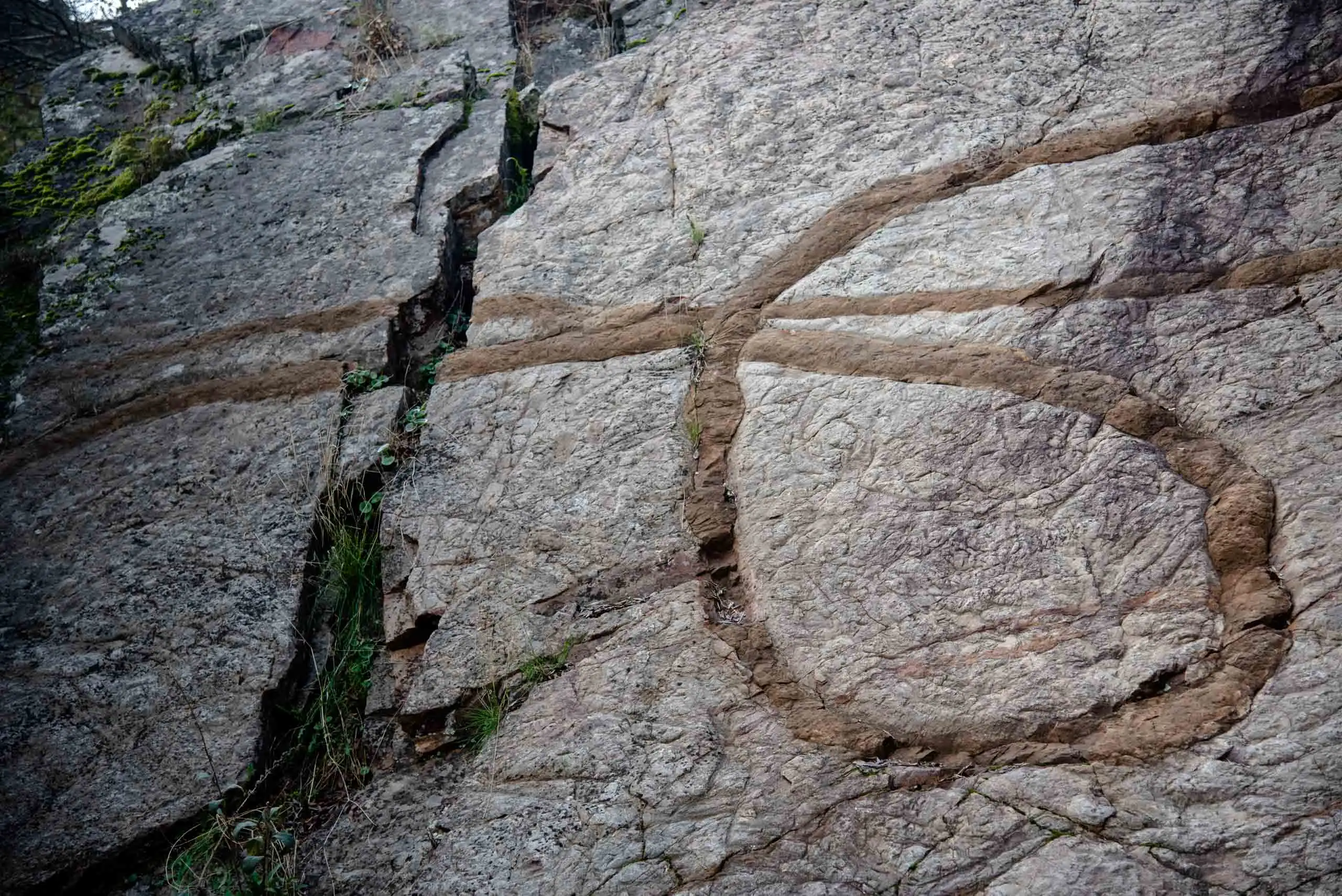
The slate erodes and the base of the quartzite is left in the open, with the mould of the trace in relief. That is a cruziana.
Some tracks stay on the surface of a layer; others cut through the layers, because the animal lived buried in the sea floor or dug into it looking for food.
Cruziana Horizontal. The track of a trilobite dragging its body through the mud: two parallel lobes with oblique scratches. There are five types in Cabañeros.
Rusophycus Horizontal. The oval hollow where a trilobite stayed still, resting.
Planolites Horizontal. Short cylindrical burrows made by worm-shaped animals.
Skolithos Vertical. Straight tubes of animals that lived upright inside the sea floor. Some are more than a metre long and cut through several layers.
Daedalus Vertical. A cone-shaped trace seen inside the quartzite, cut into thin sheets.
They are marks or traces in sedimentary rocks that record biological activity and can show the shape of the organism that produced them. These fossil tracks tend to be preserved in quartzites, sandstones and siltstones. In many cases it is hard to identify the organism that made the track.
In Cabañeros, most trace fossils appear on the underside of the quartzite and sandstone beds, belonging to the Azorejo Sandstones or to the three units of the basal Ordovician. This is because, on the one hand, a track is more likely to be preserved if it is quickly covered by a layer of fine, homogeneous sand; and on the other, once both sediments have turned to rock, the sandstone or quartzite is more resistant to erosion than the original rock (mudstone or slate) in which it was dug. So what we see is a mould in relief, the inverse of the original trace made by the organism, on a particular surface that lies between two different kinds of sediment that respond unequally to erosion. All the trace fossils shown on the horizontal plane result from this process. Fossil tracks can also be found on other planes, such as those belonging to organisms that live buried vertically in the substrate or that dig into it along any path to find food.
2Remains
Remains are shells and carapaces. In Cabañeros nothing of the original is left: it dissolved inside the rock, and what you see is its shape, as a mould.2
1. In the mud. A shell is buried in the very fine mud of the sea floor.
2. It turns to rock. Over time, the mud is pressed together and becomes slate. The shell is still inside.
3. It dissolves. The shell was made of calcium carbonate or phosphate, and in this rock it dissolved. The hollow with its shape is left.
4. It splits. When the stone is split, two faces of the same fossil come out: the internal mould, rounded, and the external one, sunken, which copies the outside of the shell.
These are remains of shells, carapaces, zoaria and so on preserved as moulds in clay rocks, such as slates, once the original material that mineralised them has disappeared in the final phases of diagenesis, the process by which sediment turns into rock.
Most of the remains correspond to trilobites, molluscs or brachiopods. They are skeletons that were originally mineralised in calcium carbonate or phosphate and that later dissolved within the siliciclastic rocks that contain them, because of the chemical differences between the two. That is why the fossils of Cabañeros today represent only the marks or impressions left in the rock by the remains of these organisms before their complete disappearance.
When a rock is opened and a fossil is found, two similar parts of the same fossil appear. One corresponds to the inner face of the remains, that is, a convex internal mould formed when the inside of the cavity of the organic remains was filled; and the other reproduces the outer face, concave, reflecting a cast of the external structure of the organism.
3Microfossils
Palynomorphs are organic-walled microfossils. They can only be seen with an electron microscope, and to get them out the rock has to be broken down with slow chemical processes.
With the naked eye. A piece of slate. There are fossils in here, but you cannot see any.
With a magnifying glass. Grains and thin layers. Still nothing.
Under the microscope. After dissolving the rock with chemicals, a few specks are left.
Under the electron microscope. Now you can see them: acritarchs, like spiky balls, and chitinozoans, shaped like bottles.
These are small fossils that can only be seen with an electron microscope. Finding these fossils requires slow, laborious chemical processes to separate them from the sedimentary rocks.
4Layer by layer
Each rock unit keeps the fossils of its time: from the Pusa Slates, from the transition between the Precambrian and the Cambrian, to the Tristani Beds, from the Middle Ordovician.
Middle Ordovician
Navas de Estena Slates and Retuerta Sandstones: the great site for remains, with more than 250 species.
TrilobitesBrachiopodsMolluscsGraptolitesEchinoderms
Lower Ordovician
Intermediate Beds, Armorican Quartzite and Marjaliza Beds: cruzianas everywhere and, among the remains, a few brachiopods and trilobites.
CruzianaSkolithosDaedalusLingulids
Lower Cambrian
Very rich in tracks: vertical tubes, small cruzianas and the trace of a kind of anemone that appears at the same time as the first trilobites.
SkolithosCruzianaRusophycusAstropolichnus
From the Precambrian to the Cambrian
In the upper part, many tracks of soft-bodied, worm-shaped animals. They are known worldwide because they show what the passage from one era to the next was like in Europe.3
PlanolitesTreptichnusPhycodesGordia
↓ Oldest
The most characteristic trace fossil of the Azorejo Sandstones is Astropolichnus hispanicus: a circle with between 25 and 40 ridges and, in the centre, the hollow where an animal similar to today's anemones anchored itself. It appears at the same time as the oldest trilobites, and so it marks the start of a Cambrian age, the Ovetian.4


1880
«From where specimens could be taken out by the ton»
Daniel de Cortázar, engineer
That is how he described the Espinazo del Can, between Retuerta and Horcajo, because of how many cruzianas there were.5 Today, luckily, they stay where they are.
The fossils of the Tristani Beds look like those of regions that are now very far away. About 460 million years ago they were all on the same continent: Gondwana.6
Sketch: the continents, simplified.
They are the oldest materials in the park, and in their lower half they hold different levels with trace fossils and organic-walled microfossils from the Precambrian and the Cambrian. The Pusa Slates are known worldwide because of their importance for studying this transition between periods on the European continent.
In fact, in the nearby region of La Jara, in the lower part of the unit, Cambrian trace fossils, organic-walled microfossils or Precambrian megafossils coexist. The trace fossils are formed by marks of the sideways movement of arthropods, in which one can see the parallel scratches of Monomorphichnus lineatus or the asymmetrical double-series ones of Diplichnites, and tracks belonging to worm-like beings (worm-shaped), unknown, soft-bodied and agile in movement, such as Cochichnus, Gordia, Neonereites, Phycodes, Planolites, Torrowangea, Treptichnus, and so on. The latter also appear abundantly within Cabañeros in the upper part of the unit.
For their part, the organic-walled fossils present in La Jara, in the lower part of the unit, are cyanobacterial or bacterial acritarchs (Sphaerocongregus) and carbonaceous megavesicles that fossilise in groups with a morphology similar to Beltanelloides. These fossils cover large bedding surfaces in sediments typical of dysaerobic marine environments (containing little oxygen), so they could belong to an undetermined group of chemosynthetic organisms.
It is a unit very rich in trace fossils. Almost all the forms identified in the underlying unit can be found, although traces oblique and perpendicular to the bedding are also found, such as the short tubes of Skolithos, Diplocraterion, and Monocraterion. Two-lobed tracks of small arthropods also appear, such as Cruziana (a crawling track, the kind left by reptiles as they drag themselves along), resting marks Rusophycus, or complex single-lobed tracks (Scolicia, Plagiogmus).

Astropolichnus hispanicus is the most characteristic trace fossil of the Azorejo Sandstones. Similar to the anchoring mark left by a coelenterate behaving like today’s semi-buried sea anemones, this trace fossil has a circular structure with between 25 and 40 radial ridges, from whose centre a cylindrical burrow goes into the sandy substrate. Its presence makes it possible to locate the base of the Ovetian stage of the Lower Cambrian, since it coincides with the presence of the oldest trilobite fossils. This stage together with the Cordubian forms part of the Mediterranean chronostratigraphic scale derived from Spanish stratotypes, which take their names from the Roman names of Oviedo and Córdoba. In turn, the Cordubian represents the basal Cambrian <<“pre-trilobitic”, whose beginning is visible in the upper part of the Pusa Slates and the lower part of the Azorejo Sandstones, and whose end comes when Astropolichnus appear, which mark the start of the Ovetian.


Although the base of the Ordovician is characterised as the dividing line that marks the beginning and abundance of Palaeozoic fossils, in the lower zone associations of trace fossils still appear frequently, among which stands out the crawling track of arthropods –probably trilobites– already mentioned, Cruziana. These are tracks marked by two parallel lobes in relief with oblique ridges that were traced in soft sediments, creating a double furrow, now visible in inverse relief on the underside of the quartzite strata. In Cabañeros 5 different types of Cruziana can be seen.

The distinguished 19th-century engineer Daniel Francisco de Paula Cortázar y Larrubia already recorded in 1880 the abundance of Cruziana in Cabañeros:
In the quartzites <<…fossil impressions […] of Cruzianas are not lacking, there being places where as many specimens as one wishes can be collected, as happens […] above all on the well-known pass, no doubt famous for its fossils, with the name of Espinazo del Can, a place between Retuerta and Horcajo de los Montes, from where specimens could be taken by the ton>>.
The trace fossils of the Lower Ordovician proliferate in the units identified as the Intermediate Beds, the Armorican Quartzite and the Marjaliza Beds, especially where there are alternations of hard and soft strata (heterolithic sections). Apart from the Cruziana, other horizontal tracks are frequently found in the quartzite, such as Monomorphichuns and Diplichnites (scratches made by arthropods), Planolites and Palaeophycus (short cylindrical tracks), Didymaulichnus (a small two-lobed mark with a smooth surface), Rusophycus (an oval resting mark of trilobites) and Arthrophycus (a single-lobed track with a quadrangular section and transverse marks). As for the vertical tracks found in other stretches of the succession, Skolithos (sets of straight tubes that can exceed a metre in length, crossing several strata) and Daedalus (a conical track that appears inside the quartzite, in sections parallel to the bedding plane) stand out.
Fossil remains are uncommon in the quartzite units of the Lower Ordovician because they are hard to preserve. Only in the Intermediate and Marjaliza Beds of the Boquerón del Estena are some lingulids found (an inarticulate brachiopod) together with some unclassified trilobites, the latter from the upper Armorican Quartzite.
In the Middle Ordovician, fairly abundant fossil remains are found in the slaty materials, called Tristani Beds: trilobites, brachiopods (articulate and inarticulate), molluscs (bivalves, cephalopods, gastropods, hyoliths, rostroconchs), graptolites, echinoderms (crinoids, diploporitans, homalozoans, ophiuroids), bryozoans, conulariids and ostracods, with more than 250 species identified. The sites with the greatest presence of fossils are the synclines of the Navas de Estena Slates, of Viñuelas and of La Chorrera. Organic microfossils such as chitinozoans and acritarchs also appear frequently, although in worse condition because of regional metamorphism, and trace fossils developed on the horizontal plane in the Rasos Sandstones and those of Retuerta.
The Tristani Beds have made it possible, on the one hand, to carry out very precise studies of their component units in relation to the Oretanian and Dobrotivian stages, and on the other, to establish biogeographical relationships with regions that are now very far away, such as Afghanistan or Argentina, which in past ages formed a single continent: Gondwana.
5Trilobites
Trilobites are marine arthropods whose shell is split into three lobes, hence the name. They are the most abundant fossil in the slates, and there is a reason: each one moulted many times.
Two grooves along the body split it into three strips: one in the centre and two at the sides.
To grow, the trilobite shed its old shell and came out with a new one. Each moult could stay in the mud, and that is why there are so many.7
The most common, above all Neseuretus. The Tristani Beds take their name from its species Neseuretus tristani.
Asaphellus, Isabelinia and Nobiliasaphus.
Ectillaenus giganteus.
Placoparia.


They are marine arthropods with an articulated carapace divided into three lobes, hence the name. Thanks to the numerous periodic moults of their exoskeleton (exuviae, outer covering or cuticle), they are the most abundant fossil in the slates. The commonest forms in the park are the calymenaceans, especially the genus Neseuretus, one of whose species –Neseuretus tristani–, gave its name to the Tristani Beds, a set of Middle Ordovician materials. There are other groups with a large presence, such as the asaphids (Asaphellus, Isabelinia, Nobiliasaphus), the illaenids (Ectillaenus giganteus) and the cheirurids (Placoparia).


6Their neighbours
More than 250 species have been identified in the Tristani Beds.8 Living alongside the trilobites were brachiopods, molluscs, echinoderms, graptolites and other lesser-known groups.
+250 species in the Tristani Beds
Very abundant. The orthids stand out, with a valve and folds that fan out.
The most common are the diploporid cystoids: pear-shaped, with no stalk and a skeleton of plates with many canals.
Above all bivalves that lived half buried: Redonia, Coxiconcha, almond-shaped, and Praenucula, with a row of tiny teeth.
Colonies that floated in the water. The main one, Didymograptus, is shaped like a tuning fork.
The high presence of brachiopods in Cabañeros should also be stressed, among which the orthids stand out, with one valve and a structure of radiating folds.
The commonest group is the diploporite cystoids, sessile (stalkless), pear-shaped organisms whose skeleton is made of plates with multiple canals.
Bivalves are the commonest in Cabañeros. They lived half-buried in the sediment. Some examples are Redonia, with convex valves and an internal partition near the front end; Coxiconcha, which is almond-shaped; or Praenucula, with several valves hinged by a row of very small teeth.
Finally, the presence of graptolites should not be forgotten in the lower part of the Navas de Estena Slates and in levels close to the underlying Marjaliza Beds. They formed planktonic colonies with a proteinaceous skeleton, and the main species was Didymograptus, tuning-fork shaped.
7Where they are
Some of the fossils of Cabañeros can be seen from the path, above all in the Boquerón del Estena. You look at them, photograph them and leave them where they are.
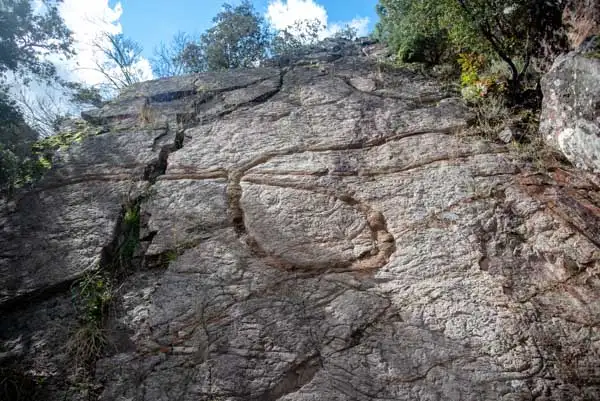
Cruzianas, the anemone traces, ripples and the giant worm of the Boquerón, in the Armorican Quartzite.9
See the trail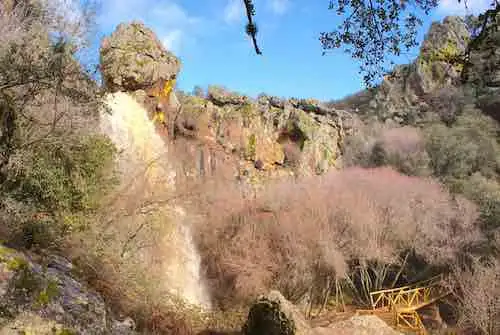
La Chorrera lies in the syncline of the same name, one of those that hold the most fossils in the Navas de Estena Slates.10
See the trailRemember: look and photograph, but do not touch or move them.
↑↓ to move · Enter to open · Esc to close