
26 short answers
Frequently asked questions
The most common questions before visiting Cabañeros, answered in two lines with a link to the page that explains it in full.
The visit
Do I have to pay to enter Cabañeros?
No. Entering the park, walking the trails and visiting the visitor centres are free. The guided walks are free too, although they must be booked. The only paid activity is the 4×4 tours, run by a licensed company. Everything is in Plan your visit.
Do I need to book?
Not for the self-guided trails. You need to book the guided walks (the Gargantilla ones can only be done this way), at the park's administrative centre (926 783 297) or through the National Parks Booking Centre, and the 4×4 tours, with the company that runs them. See the 16 official trails and the 4×4 tours.
Where is the park entrance?
There is no single entrance: you get there through the surrounding villages and each trail has its own starting point. It is best to start at a visitor centre, such as Casa Palillos or the one at Horcajo de los Montes, which the park recommends visiting before you set out. Opening times and locations under visitor centres.
What are the visitor centres' opening times?
Each centre has its own, and they change with the season; some close on certain days. We keep them up to date, with the official times, in Plan your visit. The park recommends phoning first on 926 783 297.
How much time do I need to see Cabañeros?
The park advises getting to know both its landscapes, the raña and the sierras, and combining activities. In one day you have time for a short trail and a visitor centre or a 4×4 tour; with a weekend you can add a mountain trail such as the Boquerón del Estena or El Chorro. Ideas in walking trails and when to go.
Which province is Cabañeros in?
Both: it lies between Ciudad Real and Toledo, in the Montes de Toledo. It has land in six municipalities: Alcoba, Horcajo de los Montes, Navas de Estena and Retuerta del Bullaque, in Ciudad Real, and Hontanar and Los Navalucillos, in Toledo. See the villages of the park.
How do I get there by public transport?
There are buses from Ciudad Real to Alcoba, Horcajo, Pueblonuevo del Bullaque, Retuerta and Navas de Estena, and from Madrid, Toledo or Talavera to Pueblonuevo and Los Navalucillos. Companies and routes under getting there.
Rules
Can I bring my dog?
Yes, on the trails, but always on a lead: animals running loose are not allowed. Dogs cannot go into the visitor centres.
Can I swim in the rivers?
No. Swimming is not allowed in the park's rivers, and the management plan also forbids using soap, sun lotion or other products in the water.
Can I fly a drone?
No. The park's management plan does not allow any flying device over the park, from the ground up to about 2,150 metres. The only exceptions are public aircraft for rescue, surveillance, firefighting or conservation.
Can I camp or sleep in the park?
No: camping and spending the night outdoors inside the park are forbidden. To stay nearby, see where to stay and the villages around the park.
Can I go by bike or on horseback?
By bike, only on two trails: Sierra de Castellar de los Bueyes and Colada de Navalrincón. Horses or donkeys, according to the management plan, only on the paths set aside for them; the park does not publish riding routes, so it is best to ask first on 926 783 297.
Can I light a fire or smoke?
Fire, never: no bonfires and no barbecues. From 1 June to 30 September, the high fire-risk season, smoking is not allowed either. And cigarette ends are rubbish too.
Can I fish, hunt or pick mushrooms?
Fishing and hunting, no: the management plan considers them incompatible with the park. You cannot collect plants, animals, stones or fossils either. Mushroom picking is a regulated use, under the conditions set by the management plan; ask at the park before picking any.
Can I leave the paths?
No. Always stay on the marked paths: for conservation, and because much of the park is private land.
Wildlife and seasons
Where can I see red deer?
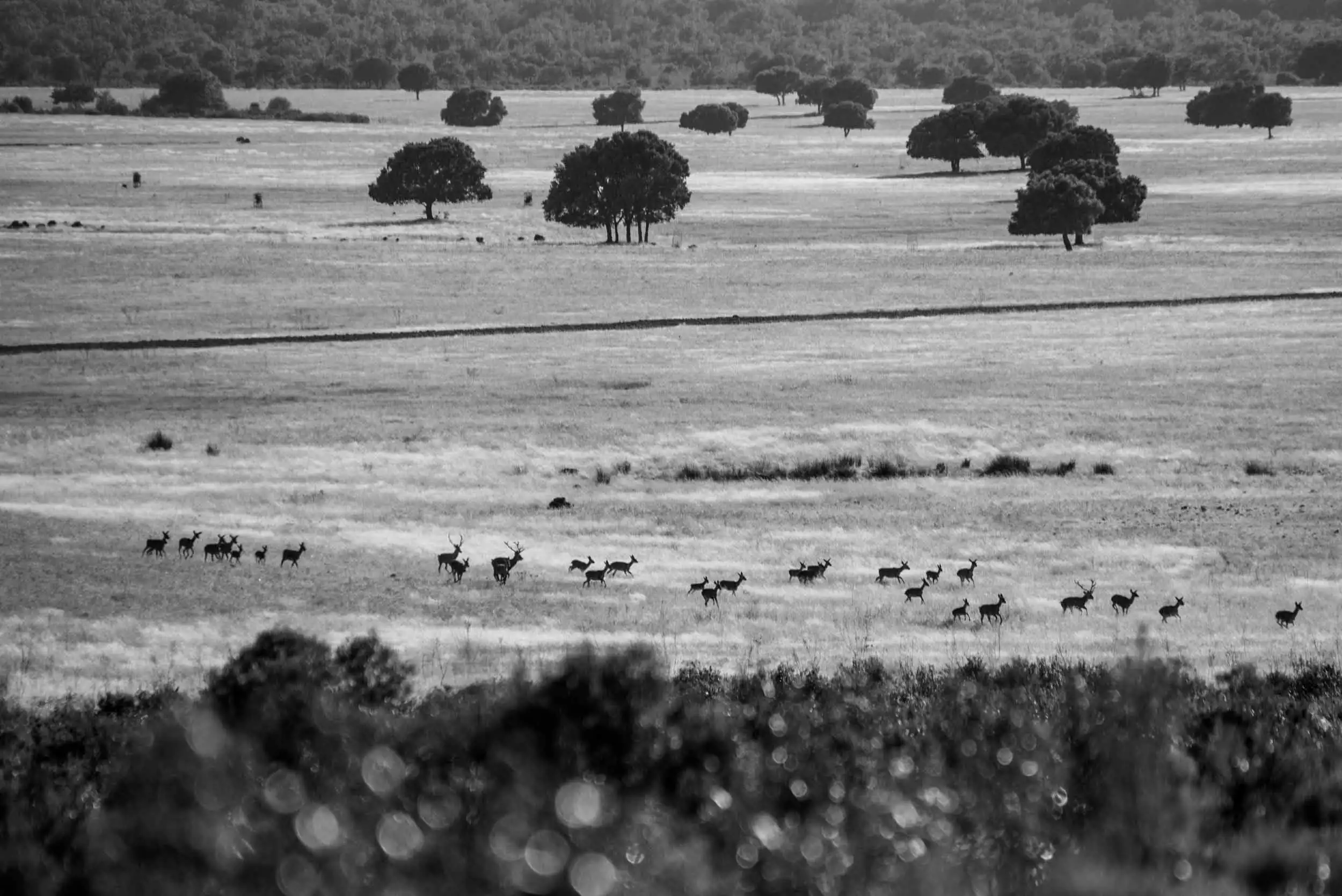
On the raña, the great plain in the middle of the park, especially early in the morning and late in the afternoon. You can see them from the observation hides at Casa Palillos and the stork observatory, on the Colada de Navalrincón or on a 4×4 tour into the raña. See the red deer and where to watch the rut.
When is the rut?
The most intense part usually runs from mid-September to mid-October, although it changes every year with the rain. It is best heard at dawn and dusk. Everything in the red deer rut in Cabañeros.
What is the best time to go?
Every season has something: the rut in autumn, cranes in winter, flowers and birds in spring; in summer, go very early. We explain it month by month in when to go.
What time of day is best for wildlife?
According to the park, the first and last hours of daylight are the best. Bring binoculars.
Can I see the lynx or the imperial eagle?
The Spanish imperial eagle lives in the park and is one of its most valuable species. The lynx is rare and shy, although in 2026 its first litter, of three cubs, was born in the park: the park does not give out places to see it, and that is how it should be. See the Iberian lynx and the birds of Cabañeros.
Trails
Which trails are good with children?
The easiest are the Camino del Acebo y las Fuentes (flat, beside the river), La Encina (1 hour), La Chorrera at Horcajo, suitable from 4 or 5 years old, and the visitor centre trails, half an hour long with no slopes.
Are there wheelchair-accessible trails?
Yes: the botanical and ethnographic trails at Casa Palillos, the Torre de Abraham trail and the boardwalk at the start of the Camino del Acebo, at Navas de Estena. See the visitor centre trails.
Which is the most beautiful trail?
It depends on what you are looking for. The Boquerón del Estena, with its river and fossils, is the best known; El Chorro has waterfalls and the highest peak of the Montes de Toledo, and Gargantilla, with a guide, the best-preserved woodland. All of them in walking trails.
Is there water on the trails?
On most of them there are no springs or places to buy anything, so bring water from home, especially in summer. At Gargantilla there are no springs and no food. One exception is the Camino del Acebo, which passes two springs of untreated water.
Do trails close after heavy rain?
Sometimes, for a few days. The Boquerón del Estena, El Chorro and Rocigalgo and the Colada de Navalrincón were closed in the storms of 2024, 2025 and 2026. If it has rained a lot, phone first on 926 783 297.
What do I do if I have a problem on a trail?
Call 112. On El Chorro, Chorrera Chica and Rocigalgo there are numbered yellow markers with the text «112 SOS»: say which two markers you are between and they will find you sooner. See the El Chorro trail.
Sources
- Decree 69/2021 of 1 June approving the Master Plan for the Use and Management of Cabañeros National Park (DOCM no. 109, 10 June 2021; in Spanish)
- MITECO-OAPN. General information on Cabañeros National Park (PDF, April 2025, in Spanish)
- Cabañeros NP (OAPN). «Desde el parque» newsletter (markers, 2023; closures after rain, 2024-2026; in Spanish)
- MITECO. Cabañeros: routes (in Spanish)
The rules may change: if in doubt, phone the park (926 783 297). Is there a question missing? Write to us.