Skip to content
Cabañeros National Park
Cabañeros
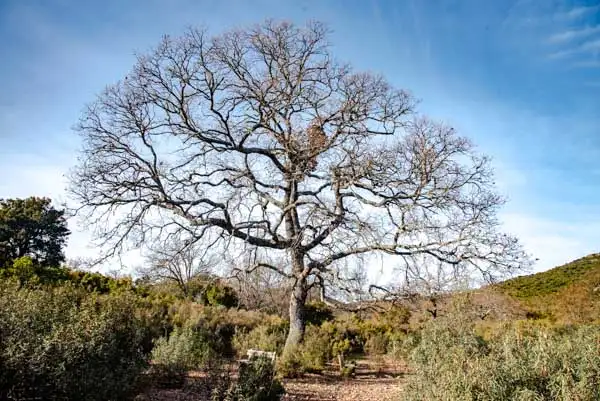
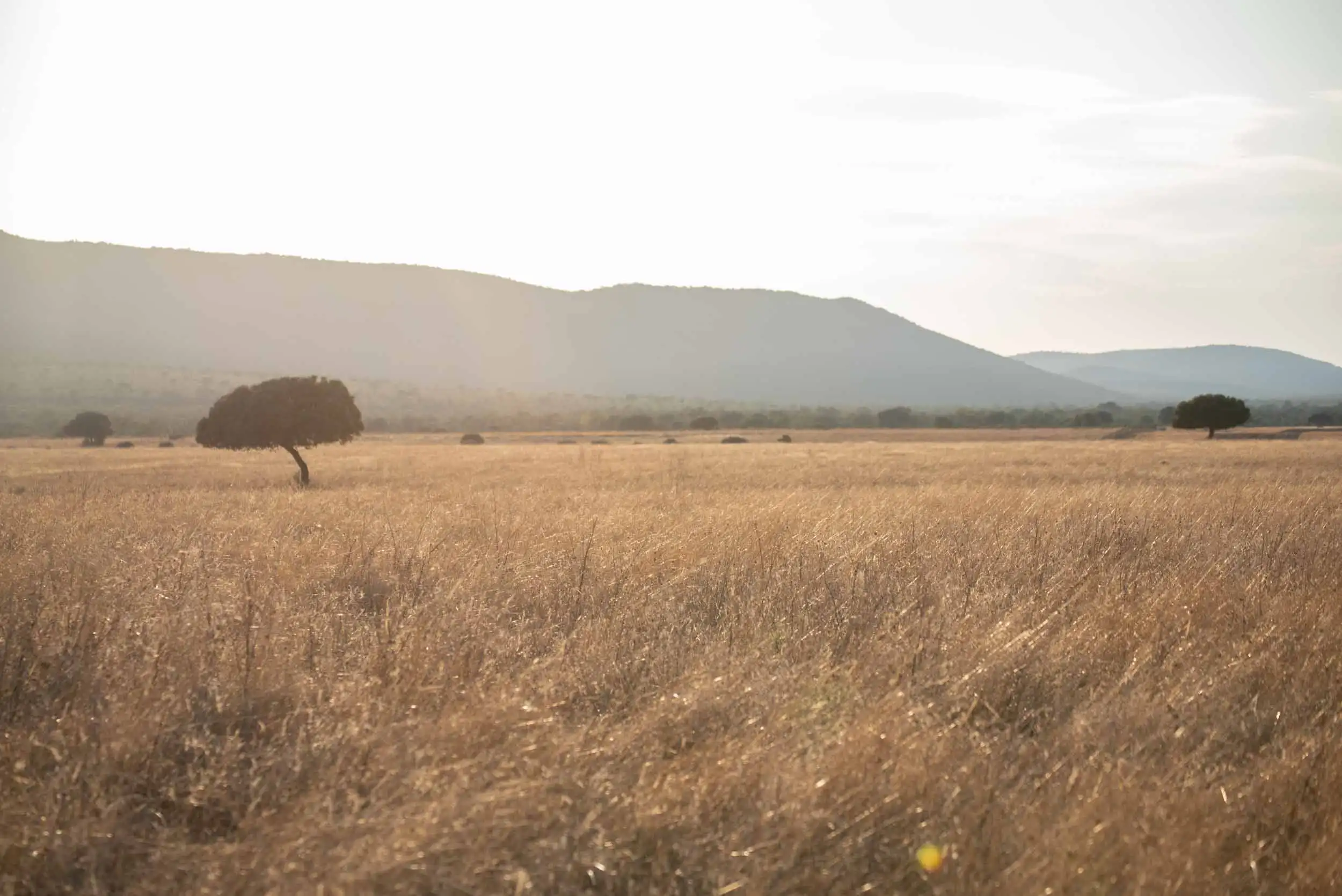
The Cabañeros raña with a lone holm oak and the mountains behind

Cabañeros National Park

Guide to Cabañeros

From when all this was a sea to the rut of each autumn, in eleven chapters and from rock to fish.

Start at the beginning20 minutes of reading, plus however long you spend playing with the drawings

1The rock

When Cabañeros was a sea

Cabañeros lies on the Iberian Massif, the ancient basement that covers the western half of the peninsula. Its rocks are between 600 and 300 million years old and almost all are sedimentary: mud and sand from the floor of seas that no longer exist.

MarMud that will be slateSand that will be sandstoneThe layers bendErosion wears them downThe sea returnsAngular unconformityArmorican QuartziteAnticlineSynclineQuartzite: hard, it staysSlate: soft, it goesRañaMountain rangeValley
  • Pusa Slates
  • Azorejo Sandstones
  • Conglomerates and Intermediate Beds
  • Armorican Quartzite
  • Navas de Estena Slates
  • Retuerta Sandstones
  • Raña
  1. 600 million years ago

    A sea beside Gondwana

    What is now Cabañeros lay under a shallow sea, at the edge of the continent of Gondwana. Mud piled up on the sea floor, which in time gave the Pusa Slates, and on top sand, the Azorejo Sandstones. That sand still keeps ripple marks, the waves left by the surf.

  2. 515 million years ago

    They fold and come out of the water

    At the start of the Cambrian those layers folded and ended up out of the sea. In the open air, rain and rivers wore them down with nothing to protect them: there were as yet no plants on dry land.

  3. 477 million years ago

    The sea returns

    In the Ordovician the sea covered everything again and left new, flat layers on top of the old, twisted ones. That contact is called an angular unconformity, and the Boquerón del Estena is one of the best places in Europe to see it. Among the new layers is the Armorican Quartzite, and trilobites lived on that sea floor.

  4. About 300 million years ago

    The great collision

    Gondwana collided with Laurussia and the Variscan mountain range rose. The thrust folded all the layers into waves, upwards (anticlines) and downwards (synclines), and heat and pressure turned many sandstones into quartzites.

  5. From 250 to 25 million years ago

    Erosion chooses

    For millions of years water and ice wore down the relief. The soft slate crumbled; the quartzite held. That is why the mountains of Cabañeros are quartzite. Between 60 and 25 million years ago, the collision of Iberia with Europe, the one that raised the Pyrenees, also raised the Montes de Toledo.

  6. 2.6 million years ago

    The raña arrives

    The climate went from humid tropical to alternating rainy, cool periods with dry, warm ones. The mountains crumbled into quartzite pebbles that water spread out at the foot of the hills: that is how the raña formed, the park's great plain, where the red deer graze today.

The layers, one by one

  • Pusa Slates in sloping sheets, at the Chorrera de HorcajoMore than 515 million years

    Pusa Slates

    The oldest rocks in the park: greenish-grey siltstones in thin, parallel sheets, up to 600 metres thick.

    Where to see it. On the River Estena, between the Maíllo stream and the ford of the Cuesta de la Vaca, and at the Chorrera de Horcajo.

  • Quartzite towers within the Azorejo Sandstones, beside a trackLower Cambrian

    Azorejo Sandstones

    Yellowish quartz sandstones, heavily bedded, with wave ripple marks and quite a few fossils.

    Where to see it. At the Boquerón del Estena and along the river, as far as the Valdelayegua ravine.

  • Old layers, tiltedNew layers, flatA gap of about 40 million years

    The angular unconformity

    The Cambrian layers, folded and cut flat, and on top those of the Ordovician, flat. Between the two the time is missing when everything was out of the water, wearing away.

    Where to see it. At the Boquerón del Estena, about 250 metres upstream of its confluence with the Maíllo stream: one of the best places in Europe to see it.

  • Hill with the layers of Armorican Quartzite tilted, at the Boquerón del EstenaLower Ordovician

    Armorican Quartzite

    Beds of white quartzite between 1 and 10 metres each. It is the material that raises the mountains of the Montes de Toledo: the culprit behind their heights.

    Where to see it. At the Boquerón del Estena, the Plaza de los Moros and the Rocigalgo area, where it reaches 400 metres thick.

  • Lower Ordovician

    Marjaliza Beds

    Quartzites, sandstones and slates in thin layers. At their base there is a layer full of shells of bivalves buried alive: it was left by a tsunami on the coasts of Gondwana.

    Where to see it. Next to the Armorican Quartzite, on the slopes of the synclines.

  • Middle Ordovician

    Navas de Estena Slates

    Dark, bluish slates, from when the sea reached its deepest. They are the richest in fossils, and one of their ages, the Dapingian, has its worldwide reference section south of Navas de Estena.

    Where to see it. In the synclines of Navas de Estena, La Viñuela and La Chorrera.

  • Middle Ordovician

    Retuerta Sandstones

    Yellowish sandstones with the marks of the storms that stirred the sea floor. They are also called Botella Quartzites.

    Where to see it. At the Morro de Palillos, at 623 metres, near the Pocito stream: its only outcrop in the park.

  • The dry-grass raña to the horizon, seen from Casa PalillosAbout 2.6 million years ago

    The raña

    Quartzite pebbles in a reddish clay, carried down from the mountains. It is usually less than 10 metres thick and reaches 25 in the most distant areas.

    Where to see it. On the great plain in the south-east of the park: the rañas of El Espino, La Viñuela, El Rostro or La Toledana.

  • Slope covered in loose quartzite blocks at El ChorroSlope deposits

    The scree slopes

    Screes of loose blocks at the foot of the quartzite crags. They are torn off by the cold: water gets into the cracks, freezes, expands and splits the rock.

    Where to see it. On the steepest slopes, such as those of the Boquerón del Estena or El Chorro.

The geology of Cabañeros, at leisure

2The fossils

Footprints on the sea floor

All the fossils of Cabañeros are Palaeozoic and of marine origin. Three kinds are distinguished, according to what was preserved and the rock that kept it.

Fossils are historical heritage and protected by law: they must not be touched or moved, however good the intention. Their interest lies in the fossil and its place, and separated they lose almost everything they can tell. In short, do not touch them.

Three kinds of fossil

  1. To the naked eye

    Tracks and traces

    Ichnofossils

    Trails, burrows and resting marks left by an animal as it moved over the sea floor. They are preserved in quartzites and sandstones, and often it is not known who made them.

  2. When the rock splits open

    Shells and carapaces

    Skeletal remains

    Nothing is left of the shell: what is left is its mould in the slate. When the rock splits open, two halves come out, one with the relief of the inside and the other with that of the outside.

  3. Only under the microscope

    Microfossils

    Palynomorphs

    Tiny remains of organic wall. To see them an electron microscope is needed, and they must first be separated from the rock by slow chemical processes.

How a cruziana is made

The most famous trace in Cabañeros is the one trilobites left as they rummaged in the mud. Five types are distinguished in the park.

From above

In section

TodaySlateQuartzite
  1. It walks over the soft bottom and leaves a double furrow, with the scratches of its legs in a V shape.

  2. A layer of fine sand covers the trace at once, and that is what saves it.

  3. The mud turns to slate and the sand to quartzite, much harder.

  4. The slate erodes and the base of the quartzite is left in the open, with the mould of the trace in relief. That is a cruziana.

Cruziana in relief on the quartzite, with the two lobes and the scratches
A real cruziana, at El Chorro de los Navalucillos.
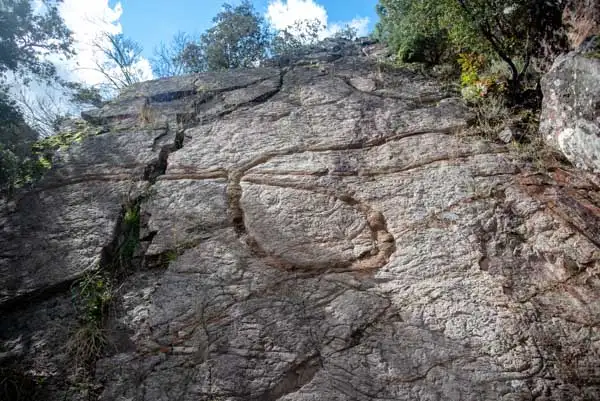
Circular marks in the rock of the Boquerón del Estena
The round marks are the anchoring of some anemone-like animals, at the Boquerón del Estena.

The anemones in the second photo are called Astropolichnus hispanicus: a circle with between 25 and 40 ridges and, in the centre, the hollow of the animal, which lived half-buried in the sand. They coincide with the oldest trilobites, and that is why they serve to date the rocks.

In 1880, the engineer Daniel de Cortázar wrote that on the Espinazo del Can, between Retuerta and Horcajo, cruzianas were so abundant that «specimens could be taken out by the ton». Today, luckily, they stay where they are.

Who lived in that sea

  • Trilobites

    Arthropods with the carapace divided into three lobes, hence the name. They moulted many times and each moult could fossilise: that is why they are the most abundant fossil in the slates.

  • Brachiopods

    Shelled animals, very frequent in the park. The commonest are the orthids, with folds that fan out.

  • Echinoderms

    The commonest, the cystoids: pear-shaped, fixed to the bottom and with a skeleton of plates full of channels.

  • Bivalves

    Molluscs that lived half-buried in the sediment. Coxiconcha is almond-shaped.

  • Graptolites

    Colonies that floated in the water. The main species, Didymograptus, is tuning-fork shaped.

The fossils of Cabañeros, one by one

3Climate and relief

A very long summer

The park's climate is Mediterranean, with continental influence: summer concentrates the drought and the rains come mostly in autumn and spring, in amounts that vary a great deal from one year to the next.

EFMAMJJASOND3,9 °C23,8 °C3 to 5 monthswith hardly any rain
Mean temperatures for December and July at Retuerta del Bullaque; the annual one is 12.4 °C. In gold, the drought of each summer.

How much rain falls in a year

  • less than 200 l/m²A very dry year
  • 586 l/m²The average at Retuerta del Bullaque
  • 737 l/m²2023-2024 at La Alcornoquera
  • more than 1,000 l/m²A very rainy year
One litre per square metre is a millimetre of water: one litre poured over a tile a metre on each side. Data from the park guide (2011) and from the La Alcornoquera station.
  • 2,900 hours of sunshine a year
  • 40 days of frost
  • 75 % humidity in winter
  • 30 % at midday in summer

Ridge, slope and valley

To understand where each plant grows you only need to look at a slope from top to bottom: water runs down and carries the soil with it, which piles up below.

RidgeSlopeValleyDeeper soil the further down

Ridge. At the top, the driest. There is almost no soil, and sun and wind strike full on. Rock and low shrubs.

Slope. In the middle, neither much water nor too little. Holm oaks, cork oaks and rockroses.

Valley. Below, the water and the soil it carries gather: the soil is deeper and more fertile. Ash, alder and the leafiest woods.

Rivers that dry up and rivers that do not

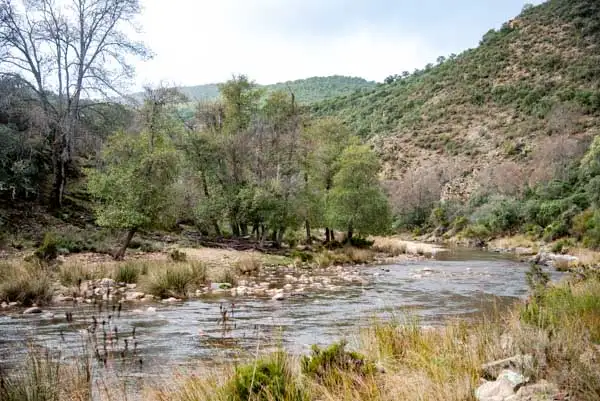
95.5 % of the park drains to the Guadiana and the rest to the Tagus. It has a thousand kilometres of streams that dry up in summer and some fifty of rivers that carry water all year. The two big ones are the Estena, which rises at the Rocigalgo and runs 40 kilometres through the park, and the Bullaque, in the far east.

For every kilometre of river that never dries up, there are twenty of stream that do.

The climate, with data from recent years What to see each month

4The woodlands

Thirsty trees and trees with wet feet

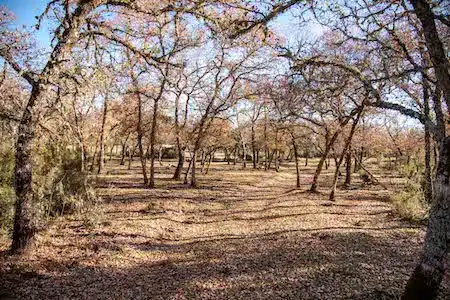
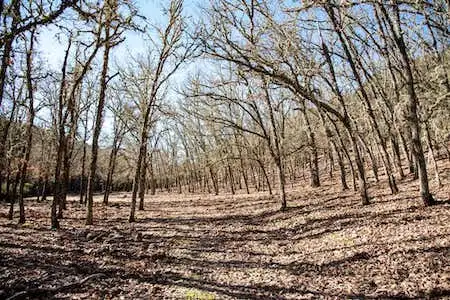
Cabañeros is, without doubt, one of the best representations of Mediterranean woodland on the peninsula. Trees cover a little over half the park, 51 %, and are the most mature stage of its vegetation.

The woods that have always been here

The trees of the river

Riverside woods grow beside the water, and each tree takes its place at its own distance from the channel. Swap the river for a stream in the middle of August and see who holds out.

GroundwaterBirchAshAlderPortuguese laurel
  • AlderWith its roots in the water.Without water all year it cannot cope. That is why there are so few.
  • AshA little further off: groundwater is enough for it.It carries on: its roots reach the moisture below.
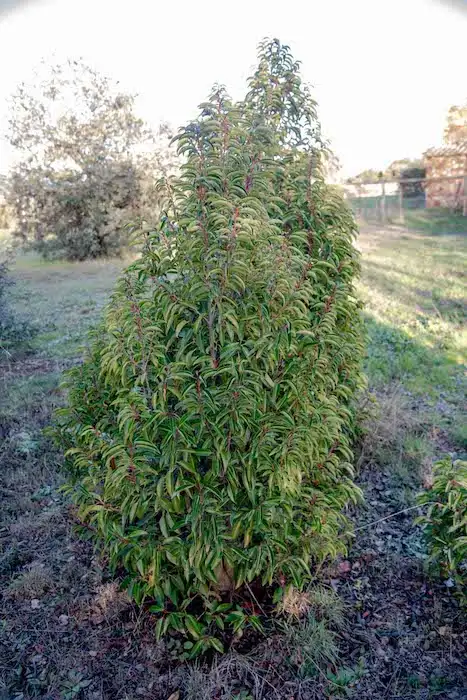
  • Portuguese laurelIn the ravine, in the shade, watching the water.The moisture and the shade of the ravine are enough for it.
  • BirchAt the headwaters and in cool valley bottoms.It withstands low summer flow better than the alder.

Riverside woods

All the woods of Cabañeros The flora of the park

5The scrub

When the woodland goes

Scrub and shrubs occupy 44 % of the park. Most of it grows where there could be woodland and came from its degradation: fires, felling, charcoal-burning and grazing.

The hillside staircase

This is how the hillside recovers when it is left in peace. And this is how it gets stuck. Climbing takes decades; dropping, an afternoon.

PastureThe first to arriveLow and medium scrubTall scrubWoodland

Woodland. Holm oaks, cork oaks and Portuguese oaks: the most mature stage.

The deer hold back the climb: they eat the leguminous shrubs, the saplings and the newly sprouted holm oaks, and the hillside goes no further than scrub. And not all scrub comes from a lost woodland: on the summits and in the peat bogs there are shrublands that have always been like this.

Three scrublands of the park

  • Clump of Adenocarpus argyrophyllus with yellow flowers

    Summit scrub

    At the very top, on the Rocigalgo, at 1,449 metres: cold in winter, wind and sun with no shade. Legumes dominate, such as Echinospartum ibericum, Adenocarpus argyrophyllus and Genista cinerascens.

  • Pink flowers of the cross-leaved heath, Erica tetralix

    Peat bogs and «bonales»

    Soils waterlogged all year, acid and without oxygen, almost always under 10 hectares. Cross-leaved heath, ling and sweet gale. In the district they are called «trampales», «bonales» or «bohonales».

  • Strawberry tree laden with orange fruits

    The Mediterranean «mancha»

    Tall, dense scrub on the slopes: strawberry tree, laurustinus, mock privet, Mediterranean buckthorn and, where it is warmer, mastic. On the raña loose patches remain which in the district are called «manchos».

Each scrubland, on its own page

Scrub and shrublands

6The grasses

Seven ways of being grass

Herbaceous communities occupy some 4,500 hectares, 11.7 % of the park, and their best example is the pasture of the raña. They used to be kept up by the plough and livestock; today, by the deer's teeth.

From dry rock to water

  1. Round leaves of navelwort among moss, at the foot of a rock

    Rock communities

    The ones in the cracks

    They live on crags, with almost no soil. Navelwort, stonecrop and ferns; on the quartzite ridges, the wild pink and a foxglove that only grows in these mountains.

  2. Dry raña pasture with a holm oak and the mountains behind

    Therophyte communities

    The ones that spend the summer as seed

    One-year plants: they sprout with the rains, flower in spring and in summer only the seed remains. They take up the most space, and the raña is their best example.

    1. Summer seed
    2. Autumn sprouts
    3. Winter grows
    4. Spring flowers
  3. Subterranean clover with a white flower

    Xeromesophytic communities

    The ones in the grazing pasture

    Where livestock gathered, their dung made good pastures: the «majadales». Also the «berciales», of «berceo», a grass that grows taller than a metre.

  4. Clumps of round-headed club-rush

    Mesophytic communities

    The ones on the bank

    Beside alder woods, ash woods and birch woods, on soils that never dry out completely. Round-headed club-rush and pennyroyal. They occupy very little: the park is too Mediterranean for them.

  5. Winter and spring: pondSummer: dry ground

    Amphibious communities

    The ones in ponds that come and go

    They live in the «navas», flats of the raña that flood in winter or spring and then dry out. Water crowfoots, Mentha cervina and pennyroyal.

  6. Hygropeat communities

    The ones in the peat bogs

    In «trampales» and «bonales», waterlogged, acid and without oxygen, an insect-catching plant lives among the mosses: the sundew (Drosera rotundifolia). In 2025 a park guide found another, the butterwort (Pinguicula lusitanica). They are threatened by the red deer and the wild boar.

  7. Aquatic plants floating in a backwater

    Aquatic communities

    The ones in the water

    In still water float the white and yellow water lilies, seen on the Bullaque and the Guadiana. On the waterlogged banks, the reed and the bulrushes.

The herbaceous communities The dehesa

7The raña and its people

A hand-made savanna

The raña looks like an African savanna, and it is easy to think it was always like this. It was not: the plain we see is the work of centuries of fire, ploughing, livestock and charcoal. The soil, though, was laid down by geology: it is the one in chapter 1.

The soil of the raña: quartzite pebbles in red claybrowsingDense, shady holm oak woodA «roza»: burning to sowRockrose scrub and scattered holm oaksBread sown on the brown hillsideUp high: no clearings, no livestockCharcoal on the scree slopesThe village's farmlandSheep and «majadal»Goatherds burning old scrub6,000 hectares ploughedGrassland with scattered treesPlantations
  1. Before people

    A closed holm oak wood

    In the low parts of the raña, between 620 and 750 metres above sea level, the vegetation that belongs there is a dense, shady holm oak wood.1

  2. For centuries

    Fire as a tool

    Being flat, the raña was what people used most, and their main tool was fire. The result was a landscape broken into patches and always young: rockrose and heath scrub with scattered holm oaks, Portuguese oaks and wild pears, the ideal place for the rabbit and the lynx.2 The hillside was burned to sow cereal and then abandoned; those clearings came back about every 20 years and reached almost the whole raña.3

  3. From 1246 to 1829

    The rules of Toledo

    The Montes belonged to the city of Toledo. Its ordinances only allowed clearings «to sow bread» in the «monte pardo», the rockrose and heath scrub, and then they had to be left. In the mature woods no trees were cut, and of everything taken out a twelfth was paid to Toledo.4 In the highest third of the mountains neither clearing nor grazing was allowed: that is why the woods are still there.5

  4. From 1829 to 1860

    Pastures and charcoal

    Free of Toledo, the villages shared out land among their residents to cultivate, and as the best and nearest was the rañas, a large part was ploughed.6 In the dehesas, the city's creditors rented the pastures and went on grubbing up and thinning the low scrub to make grassland with trees; charcoal was made from holm oak and heather wood.7 The scree slopes were chosen for the charcoal pits.8

  5. The 40s

    Shepherds, goatherds and charcoal-burners

    After the war, the estates gave work for almost fifteen years to shepherds, goatherds, woodcutters and charcoal-burners.9 Merino sheep, bred for meat, and Retinta and Avileña cattle grazed, and the goatherds burned the old scrub so that it would sprout again.10 Where livestock gathered, their dung made the «majadales», the best pastures.11

  6. The 50s and 60s

    The great clearance

    From the 1950s the scrub was cleared on a grand scale.12 In the early 1960s, the Instituto Nacional de Colonización ploughed 6,000 hectares of the central raña: two years clearing scrub and trees.13 Cereal was sown, and that is where the raña gets its dehesa look.14

  7. Today

    The deer savanna

    That is how the «African» landscape of the raña was left, a grassland with scattered trees,15 covering some 8,000 hectares.16 Now the deer keep it open: they eat the acorns and the seedlings, and prune the holm oaks from below as high as they can reach standing.17 To give it trees back, the park planted 80,000 holm oaks, cork oaks and Portuguese oaks in the winter of 2022-202318 and another 23,731 trees in that of 2024-2025.19

The hillside, by colours

The ordinances of Toledo distinguished three kinds of hillside, and each had different rules.20

The highest point«Monte grueso»«Monte bravo»«Monte pardo»

«Monte pardo». Rockrose and heath scrub. Residents could make clearings to sow bread, and then had to leave them.

«Monte bravo». The mature holm oak woods, alone or with cork oak and Portuguese oak. Their trees could not be cut.

«Monte grueso». The Pyrenean oak woods. They were not cut either.

The very top. Roughly the upper third of the mountains: no clearings and no livestock. That is why it keeps its woods.

The «dozavo»: of every twelve, one for Toledo

It was paid on the bread sown; on the lambs, kids and pigs born; on the calves, foals and mules; and on cheese, wool and swarms of bees.21 It was paid by the residents of the Montes, who owned nothing.

Toledo11 for whoever raises them

What that work left behind

  • A conical hut of branches and straw among the vegetation

    The name of the park

    Cabañeros comes from the conical huts, thatched with the surrounding vegetation, used by shepherds and charcoal-burners. Today the restored ones remain and many «hut floors», the marks of the old settlements.22

  • Charcoal pits in the woods

    In the woods of the mountains you can still see old stumps, paths and charcoal pits from the charcoal-burning of the early 20th century.23

  • The dry-grass raña to the horizon

    More trace near the villages

    People's hand is very evident on the rañas around the villages, less on the distant ones and very little in the mountains.24

  • Slope covered in rockrose scrub

    A tired soil

    Fire, clearings, grazing, felling and charcoal-burning turned many woods into scrub. That impoverishes the soil, and the wood takes longer to come back.25

  • Casa Palillos, with the raña and the holm oaks behind

    The ethnographic trail at Casa Palillos

    Seven stops on life as it was: livestock farming, the vegetable gardens with their waterwheel, the huts, a viewpoint over the raña, beekeeping, charcoal-burning and a threshing floor. It is accessible.26

    Go
  • The ethnographic museum of Alcoba

    In its courtyard there is a hut like those of the shepherds and charcoal-burners, with a miniature charcoal pit and farm tools.27

    Go

The history of Cabañeros, in full The dehesa

8The mammals

Big, small and hidden

Cabañeros has one of the most important mammal communities in Europe: more than forty species, from the deer of the raña to the bats nobody sees.

The Red Deer, from almost none to too many

  1. Early 20th century: The Red Deer is rare in the Montes de Toledo: the mountains are full of people working.
  2. The 50s and 60s: The hillside is abandoned and many estates are fenced to rear big game.
  3. Afterwards: There come to be as many as 60 deer per 100 hectares, more than the hillside can bear.
  4. Today: The park aims for about 12 per 100 hectares, and controls the population by capturing live animals.
60 deer in 100 hectares. Each square is a hectare, roughly a football pitch and a half.
EFMAMJJASONDRutYoungRutYoungOutside, the Red Deerinside, the Roe Deer

The year of the Red Deer and the Roe Deer

In September the stags come into rut and roar all over the mountains: that is the «berrea», when the males, so elusive the rest of the year, let themselves be seen on the raña. In spring they shed their antlers, which grow back in summer, and the young are born.

The Roe Deer does it the other way round: rut in summer, with a dry bark at dusk. And even so its young are also born in spring, because the embryo is paused for some months before it goes on growing.

When and where to hear the rut

The big ones

The rabbit and who eats it

The rabbit is the link between plants and hunters: more than forty species of predator eat it, some specialised in it, such as the lynx and the Spanish Imperial Eagle. In Cabañeros it is scarce and lives in scattered patches, because of disease, the ageing of the scrub and predation. And without the rabbit there is no lynx: the last one was seen in the park in 1992, and it did not return until the releases of 2023.

The carnivores, from most to least abundant

  1. 1

    Fox

    Vulpes vulpes

    It eats mostly carrion of deer and wild boar, which is not lacking here.

  2. 2

    Beech Marten

    Martes foina

    Almost half of what it eats is mammals.

  3. 3

    Common Genet

    Genetta genetta

    It lives on mice, voles and other small mammals.

  4. 4

    Wildcat

    Felis silvestris

    Rabbits and hares are 53.8 % of what it eats.

  5. 5

    European Badger

    Meles meles

    Omnivorous: earthworms, insects, fruits, roots, small vertebrates

  6. 6

    Egyptian Mongoose

    Herpestes ichneumon

    Young rabbits and small mammals; also insects, birds, amphibians, reptiles and fruits

  7. 7

    Iberian Lynx

    Lynx pardinus

    It came back with the releases of 2023 and 2024; in 2026 its first litter was born in the park.

  8. 8

    Eurasian Otter

    Lutra lutra

    Its best population is on the River Estena, as far as the Cíjara reservoir.

The ones that left

  • Bear. Disappeared at the end of the 17th century.
  • Wolf. Left the Montes de Toledo in the 70s.
  • Iberian Ibex. Became extinct last century and has been reintroduced.

The ones that arrived

  • Fallow Deer. Originally from Persia; the Romans already brought it.
  • Mouflon. A small wild sheep from Corsica. It is listed as an invasive species.

The ones almost nobody sees

  • Bats

    They are the great forgotten: more than 16 species have been identified in the park.

  • Hedgehog

    Its spines protect it from everything except car wheels, its main cause of death.

  • Cabrera's Shrew

    There is hardly any record of it. In the mountains it was said to bite livestock and drive its head crazy.

  • Mice and voles

    They make up most of the park's rodent biomass. The genet, for example, lives on them.

The mammals of Cabañeros All the wildlife with its own page

9The birds

Each landscape, its neighbours

Birds that share a habitat form a community. In the park seven are distinguished, from the holm oak wood to the wetlands, and each has its own list of neighbours.

The website has 204 bird pages, each with its map, the animation of how it flies and, almost always, its song. Here they are by habitat: pick one.

Holm oak and cork oak woodland

The sclerophyllous woodland, the hard-leaved one. Robins, blackbirds, chaffinches, serins, dunnocks and linnets, and also warblers, great tits and blue tits.

The birds of this habitat

Pyrenean oak woods

The deciduous woodland has birds with an Atlantic air. Blue Tits, chaffinches and robins are abundant; at lower density, woodpeckers, nuthatches and jays.

The birds of this habitat

Scrubland

Three warblers make up 80 % of the scrub birds. The Red-legged Partridge, always near tracks and firebreaks.

The birds of this habitat

Dehesas (wood pasture)

Few species breed there, but very showy ones. In the south of the park there is a White Stork colony, and jackdaws and sparrows breed in its nests.

The birds of this habitat

Grasslands

In winter, flocks of seed-eating birds. The White Wagtail takes advantage of the bugs left exposed when the earth is turned over.

The birds of this habitat

Rivers

On the Estena, the White-throated Dipper and the Grey Wagtail. At the end of August, some Black Storks take advantage of the fish left in the pools.

The birds of this habitat

Wetlands

Ponds, temporary lagoons and waterlogged banks: snipe, lapwings, herons and, among the vegetation, Cetti's Warbler.

The birds of this habitat

The bird catalogue, with filters The birds of Cabañeros

10Reptiles and amphibians

The ones in the sun and the ones in the puddle

A dozen species of amphibians and nineteen of reptiles live in the park. Six are Iberian endemics: they live nowhere else in the world.

Six that live only here

Iberian endemics: in the whole world, they exist only on the peninsula.

The ones in the sun. Reptiles do not make their own heat: they take it from the sun, and that is why at first light they are seen still on the stones. The Ocellated Lizard is abundant on the raña, beside the piles of stones and in the hollows of old trees.
Autumn: it fillsEnd of spring: it dries up
The ones in the puddle. Amphibians need water to breed, even if only for a few months. The Cuatro Morros lagoon, in the south of the park, forms in autumn and dries up at the end of spring.

With a page of their own

Reptiles and amphibians of Cabañeros

11The fish

The great unknowns

About 75 % of the freshwater fish species of the peninsula are endemic, something no other European fauna matches. And almost nobody knows what they are called.

EuropeIberian PeninsulaPyreneesAfricaStrait of Gibraltar
About 5 million years ago, with the Pyrenees already raised and the Strait of Gibraltar open, the river fish of the peninsula were cut off from those of Europe and those of Africa. They have been evolving on their own ever since.
Spanish MinnowcarpComizo BarbelIberian Arched-mouth NaseSouthern Iberian NaseCalandinoSouthern Iberian Spined Loach
The Estena. Rich in native species, with the Spanish Minnowcarp, one of the most threatened fish in Europe. More than half of its species are in some threat category. The trout disappeared, surely through fishing.
Comizo BarbelCarp, exotic speciesSouthern Iberian Spined LoachLargemouth Bass, exotic speciesSpanish Minnowcarp
The Bullaque. The weakest native species, the Spanish Minnowcarp among them, disappeared. Today nearly half are exotic: carp and goldfish, from Asia; mosquitofish, Largemouth Bass and pumpkinseed, from North America; and the pike.

Native Exotic

The fish with their own page

The fish of Cabañeros

Bibliography

  • Vicente García Canseco (coord.) (1997). Parque Nacional de Cabañeros. Madrid: Ecohábitat.
  • Perea García-Calvo, R., Perea Ruiz-Tapiador, D. y Giménez Velasco, G. F. (2015). Vegetación y flora del Parque Nacional de Cabañeros. Volumen I. El paisaje vegetal: ecología, conservación y rutas de interés geobotánico. Madrid: Editorial Solitario.
  • Rodríguez Fernández, R. (ed.) (2017). Parque Nacional de Cabañeros. Guía geológica. Madrid: Instituto Geológico y Minero de España.
  • Organismo Autónomo Parques Nacionales (2011). Guía de visita del Parque Nacional de Cabañeros (clima, densidad de ciervos).
  • «Desde el parque» newsletters of Cabañeros National Park, from 2023 to 2026 (rainfall at La Alcornoquera, return of the lynx).

Each page linked from the guide has the full explanation and its own sources. Original text of the guide: Mariano Gómez, 2020; redesigned in October 2026.

Notes

  1. 1Organismo Autónomo Parques Nacionales (2011). Guía de visita del Parque Nacional de Cabañeros, «Herbazales», p. 51.
  2. 2Organismo Autónomo Parques Nacionales (2011). Guía de visita del Parque Nacional de Cabañeros, «Herbazales», p. 52.
  3. 3Organismo Autónomo Parques Nacionales (2011). Guía de visita del Parque Nacional de Cabañeros, «La venta y sus consecuencias», p. 31.
  4. 4Organismo Autónomo Parques Nacionales (2011). Guía de visita del Parque Nacional de Cabañeros, «El dominio de la ciudad de Toledo», pp. 27-28.
  5. 5Organismo Autónomo Parques Nacionales (2011). Guía de visita del Parque Nacional de Cabañeros, «La separación del dominio de la ciudad de Toledo», pp. 29-30.
  6. 6Organismo Autónomo Parques Nacionales (2011). Guía de visita del Parque Nacional de Cabañeros, «La separación del dominio de la ciudad de Toledo», p. 29.
  7. 7Organismo Autónomo Parques Nacionales (2011). Guía de visita del Parque Nacional de Cabañeros, «La venta y sus consecuencias», p. 31.
  8. 8Organismo Autónomo Parques Nacionales (2011). Guía de visita del Parque Nacional de Cabañeros, «La venta y sus consecuencias», p. 31, pie de foto.
  9. 9Organismo Autónomo Parques Nacionales (2011). Guía de visita del Parque Nacional de Cabañeros, «Los latifundios cinegéticos», p. 33.
  10. 10«Mamíferos de Cabañeros», on this website, section «El hombre y su relación con los mamíferos», based on Guzmán López-Ocón, J. N. (1997), «Mamíferos», in García Canseco, V. (coord.), Parque Nacional de Cabañeros, Ecohábitat, pp. 225-268.
  11. 11«Comunidades xeromesofíticas», on this website, based on Perea García-Calvo, R. and others (2015), Vegetación y flora del Parque Nacional de Cabañeros, vol. I, Editorial Solitario.
  12. 12Organismo Autónomo Parques Nacionales (2011). Guía de visita del Parque Nacional de Cabañeros, «Herbazales», p. 52.
  13. 13Organismo Autónomo Parques Nacionales (2011). Guía de visita del Parque Nacional de Cabañeros, «La reforma agraria», p. 34.
  14. 14Newsletter «Desde el parque», Parque Nacional de Cabañeros, January–February 2023, p. 8: the raña was put under cereal in the 1960s.
  15. 15Organismo Autónomo Parques Nacionales (2011). Guía de visita del Parque Nacional de Cabañeros, «Herbazales», p. 52.
  16. 16Organismo Autónomo Parques Nacionales (2011). Guía de visita del Parque Nacional de Cabañeros, «Las aves», p. 79.
  17. 17Organismo Autónomo Parques Nacionales (2011). Guía de visita del Parque Nacional de Cabañeros, «Los mamíferos», p. 89.
  18. 18Newsletter «Desde el parque», Parque Nacional de Cabañeros, January–February 2023, p. 8: «Este año estamos plantando 80,000 encinas, alcornoques y quejigos en la raña».
  19. 19Newsletter «Desde el parque», Parque Nacional de Cabañeros, January–February 2025, p. 6: reforestation of the raña.
  20. 20Organismo Autónomo Parques Nacionales (2011). Guía de visita del Parque Nacional de Cabañeros, «El dominio de la ciudad de Toledo», pp. 27-28.
  21. 21Organismo Autónomo Parques Nacionales (2011). Guía de visita del Parque Nacional de Cabañeros, «El dominio de la ciudad de Toledo», p. 28.
  22. 22Ministerio para la Transición Ecológica y el Reto Demográfico, «Parque Nacional de Cabañeros: valores culturales».
  23. 23Organismo Autónomo Parques Nacionales (2011). Guía de visita del Parque Nacional de Cabañeros, «La separación del dominio de la ciudad de Toledo», p. 30.
  24. 24Organismo Autónomo Parques Nacionales (2011). Guía de visita del Parque Nacional de Cabañeros, «La separación del dominio de la ciudad de Toledo», p. 29.
  25. 25«Las formaciones arbustivas: matorrales y arbustedos», on this website, based on Perea García-Calvo, R. and others (2015), Vegetación y flora del Parque Nacional de Cabañeros, vol. I, Editorial Solitario.
  26. 26Organismo Autónomo Parques Nacionales (2011). Guía de visita del Parque Nacional de Cabañeros, «Senda etnográfica», p. 145.
  27. 27Organismo Autónomo Parques Nacionales (2011). Guía de visita del Parque Nacional de Cabañeros, «Museo Etnográfico e información en Alcoba», p. 116.