
Plants
Shrub formations: scrub and shrublands
Introduction
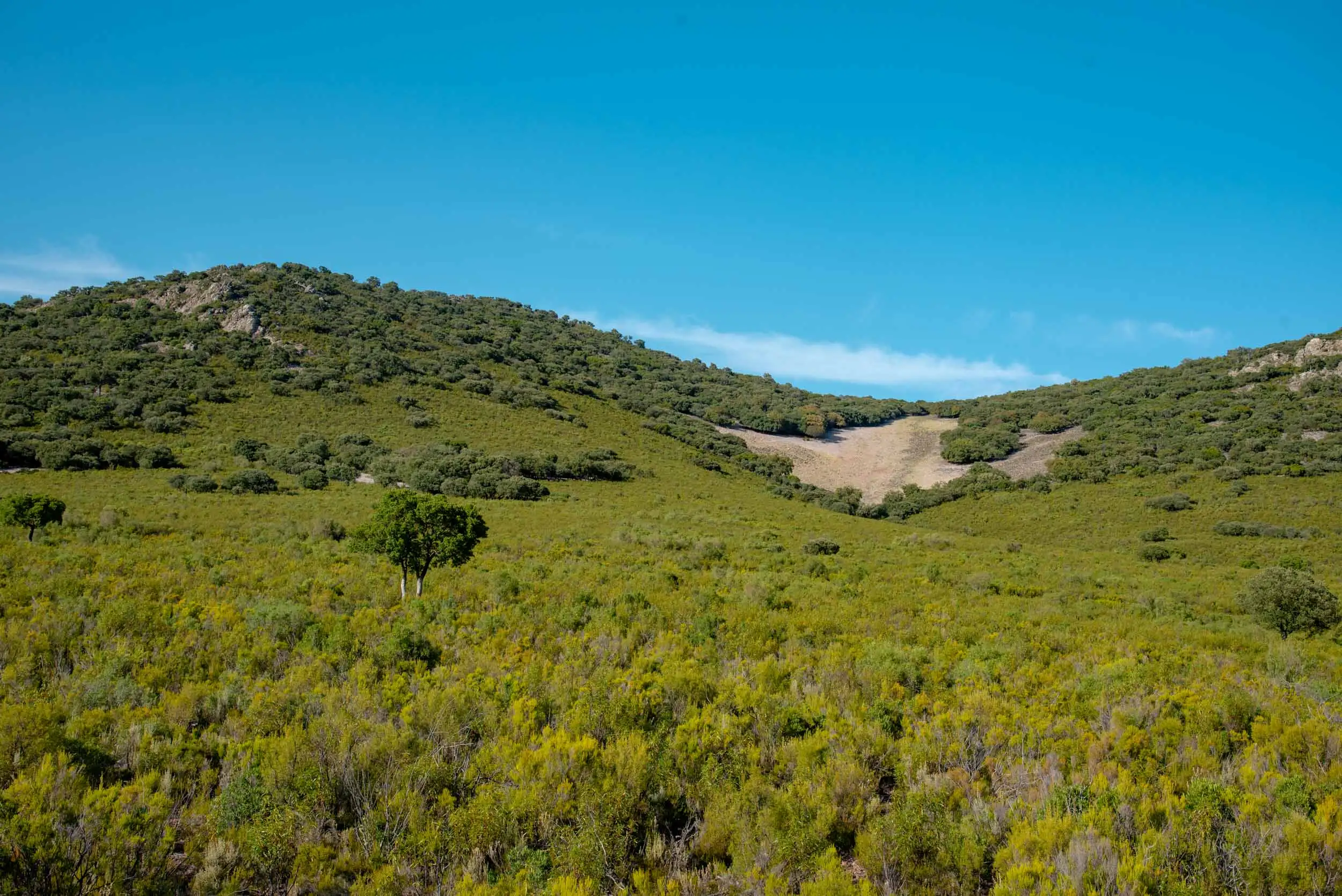
The shrub formations of the Montes de Toledo are the serial stages of the woods. Likewise, though less so and only occasionally, they can form permanent communities where woods fail to establish for various soil or climatic reasons.
Scrub is the most evolved community and mostly comes from the degradation of woods. These disturbances, such as fires, clearing, grazing, felling or charcoal burning, push the woods back towards less evolved communities such as scrub and pastures, which make up the real vegetation in areas that would correspond to a potential vegetation of woods such as cork oak woods, Portuguese oak woods, holm oak woods or ash woods.
Some disturbances such as fires reduce the vegetation cover of the soil, so that material is washed away in any downpour or storm and, as a result, the main soil horizons are lost. This process impoverishes the soil and slows the recovery of the woods.
On the other hand, the constant grazing pressure of deer on the more evolved species, such as leguminous scrub, small trees or seedlings of Quercus, prevents the natural progress of vegetation towards communities of a higher evolutionary level. Even so, there are shrub species –such as the rockrose thickets– that are very stable in present conditions, so it takes a long time before other shrub species begin to join them and, in turn, give way to the first small trees.
Rural abandonment, which reduces cultivation and increases the disappearance of goat herds, leads to a present-day recovery of shrubs and scrub. The first to occupy the herbaceous spaces created by people through their activities are the pioneer colonising scrub such as lavenders, thymes and rockroses. This progressive successional process continues until new woods form.
Shrub formations in Cabañeros
Shrub formations make up 44.4 per cent of the area of the national park. So most of the potential woods of Cabañeros are occupied by their replacement scrub and shrublands.
The tall scrub or shrublands are the most evolved, the closest to the climax. They are made up of strawberry-tree thickets, kermes oak thickets, mastic thickets or broom thickets. Among the less evolved ones, of medium or low height (meso- or nanofruticedas), heathlands, rosemary thickets, lavender thickets, rockrose thickets and thyme patches stand out. Classifying these formations is not easy because of intermediate situations, which sometimes even form climax communities.
There are shrub formations that do not come from the degradation of woods. These communities are called permanent and are formed by some woody species, generally small ones, such as low shrubs and small bushes, which are well enough adapted to bear difficult conditions such as shortage of soil, anaerobic conditions, high salt content or excess acidity.
Types of scrub in Cabañeros
Summit scrub
The summit shrub communities, so called for their location on the highest points of the sierras, are an example of permanent mountain-loving scrub. With a sparse and localised distribution in the Montes de Toledo, they settle on poorly developed soils in harsh climatic conditions, with low winter temperatures, strong winds and high sun exposure.
The main example of this formation lies on the highest peak in Cabañeros, the Rocigalgo massif, at 1,449 m. Legumes are the most representative floristic elements, among which Echinospartum ibericum, Adenocarpus argyrophyllus and Genista cinerascens stand out. José Secall e Inda (1853–1918), a botanist and professor at the Escuela de Montes in El Escorial, cited in 1897 the relict mountain broom Cytisus oromediterraneus (= Cytisus balansae subsp. europeus) on the summits of the Rocigalgo as another possible mountain-loving element (living high in the mountains), very common in the nearby Sierra de Gredos.


At present these legume species are threatened by the teeth of herbivores because they are highly palatable. That is why some areas have been fenced off. The legume community that appears on the summits of the Rocigalgo belongs to the association Adenocarpetum argyrophylli.
In the Sierra de las Villuercas, in the province of Cáceres, the associations Genisto cinerascentis-Adenocarpetum argyrophylli and the subassociation echinospartetosum iberici have recently been proposed (Vicente-Orellana and Galán de la Mera, 2008), showing these supra-Mediterranean mountain-loving communities on the quartzite crests.
Scrub of hygropeat areas
Hygropeat areas are zones of permanent waterlogging where only specialised shrubs, herbs and bryophytes are able to survive in anaerobic conditions and extreme acidity. These ecosystems have been called peat bogs, «trampales», «bonales» or «bohonales».
They tend to occupy very small areas, usually under 10 hectares, and lie in two different topographic situations:
- At the foot of sierra slopes, places without slope where no colluvial deposits have formed. They have poor drainage and a lot of groundwater. For example: the Fuente de las Chinas peat bog.
- On the edges of streams and gullies of the rañas. For example: El Breñoso, the Barranco de Riofrío, La Ventilla.
The Montes Norte de Ciudad Real district, which includes part of Cabañeros National Park, has a good representation of these «bonales», above all near Piedrabuena and La Puebla de Don Rodrigo. These communities contain protected species because of their scarcity and singularity, and there are also peat-loving and Atlantic taxa typical of more northern latitudes.


These species, such as heathers (Erica tetralix, Erica lusitanica, Erica scoparia), gorses (Genista anglica and Genista tinctoria), ling (Calluna vulgaris) or bog-myrtle (Myrica gale) make up highly complex systems in which small mosaics of different woody and non-woody plant communities arise (heathlands, myrtles, mosses, rush beds, sedges and so on). Always according to different gradients, especially of acidity and anoxia, giving rise to a large number of syntaxonomic units (associations and alliances) that live together in small, tessellated spaces.


Inside Cabañeros National Park we can distinguish the alliances Ericion tetralicis and Genistion micratho-anglicae. The Habitats Directive recognises these communities as priority habitats because of their degree of speciation, their high ecological value, their limited representation and their vulnerability.
Mediterranean scrub
This is a formation made up of dense-structured scrub and tall shrubs, with a high diversity of woody species that cover the slopes of the sierras. They can also be found in isolation on the rañas, as patches of vegetation called <<«manchos»>> in the district. The latter are more degraded because they are more accessible to charcoal burning or grazing. They therefore settle on brown forest soils and in the areas least altered by people.
The most characteristic species of Mediterranean scrub are:
- Mock privet (Phillyrea angustifolia)
- Strawberry tree (Arbutus unedo)
- Laurustinus (Viburnum tinus)
- Mediterranean buckthorn (Rhamnus alaternus) in damp areas.
- Mastic tree (Pistacia lentiscus) in warmer areas.
- Climbing species such as Hedera helix or Lonicera implexa.
- And in places where no light reaches and there are few herbs: Ruscus aculeatus or Paeonia broteri.
In general these are very evolved communities, close to the evolutionary series of the sclerophyllous holm oak and cork oak woods and the marcescent Portuguese oak woods. They are therefore the most evolved replacement stage, dominated especially by strawberry trees (Phillyreo angustifoliae-Arbutetum unedonis).
Holm oaks, cork oaks and Portuguese oaks usually appear among the shrubs already mentioned, giving these communities greater variety of cover and acting as a refuge for big-game species such as red deer and wild boar. The trees also shelter threatened species such as the Spanish imperial eagle or the cinereous vulture. The high wildlife presence thins these Mediterranean scrub formations because of palatable, appetising species such as strawberry trees, mock privets or shrubby germander.
Examples of Mediterranean scrub can be found on the Plaza de los Moros route, on the Colada de Navalrincón, where mastic trees and mock privets stand out, and on the Sierra del Chorito, with its extensive strawberry-tree thickets.
Classification of scrub in Cabañeros
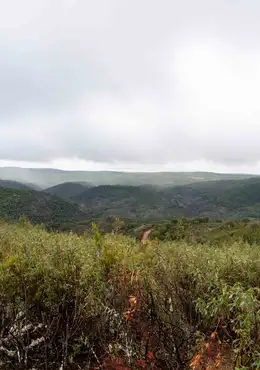 Rockrose thickets
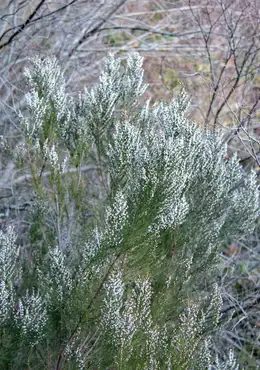 Heathlands
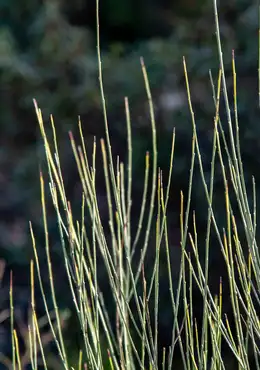 Broom and retama thickets
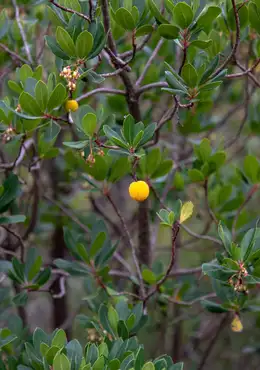 Strawberry-tree thickets
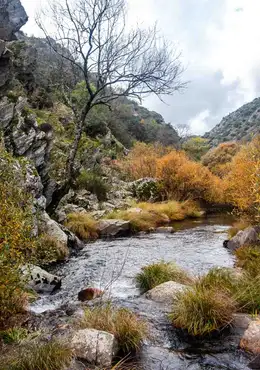 Willow thickets
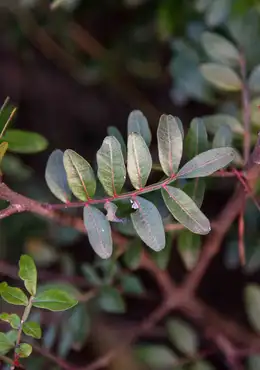 Mastic and kermes oak thickets
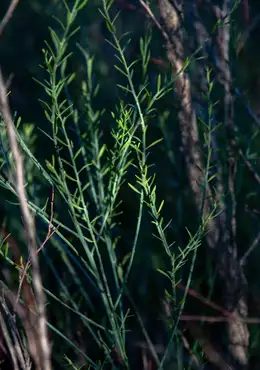 Tamujo thickets
Bibliography
- Vicente García Canseco (Coor.) (1997). Parque Nacional de Cabañeros. Madrid, Spain: Ecohábitat.
- Perea García-Calvo, R., Perea Ruiz-Tapiador, D., Giménez Velasco, G.F. (2015). Vegetación y flora del Parque Nacional de Cabañeros. Volumen I. El paisaje vegetal: ecología, conservación y rutas de interés geobotánico. Madrid, Spain: Editorial Solitario