
Starlight Destination
The night sky of Cabañeros
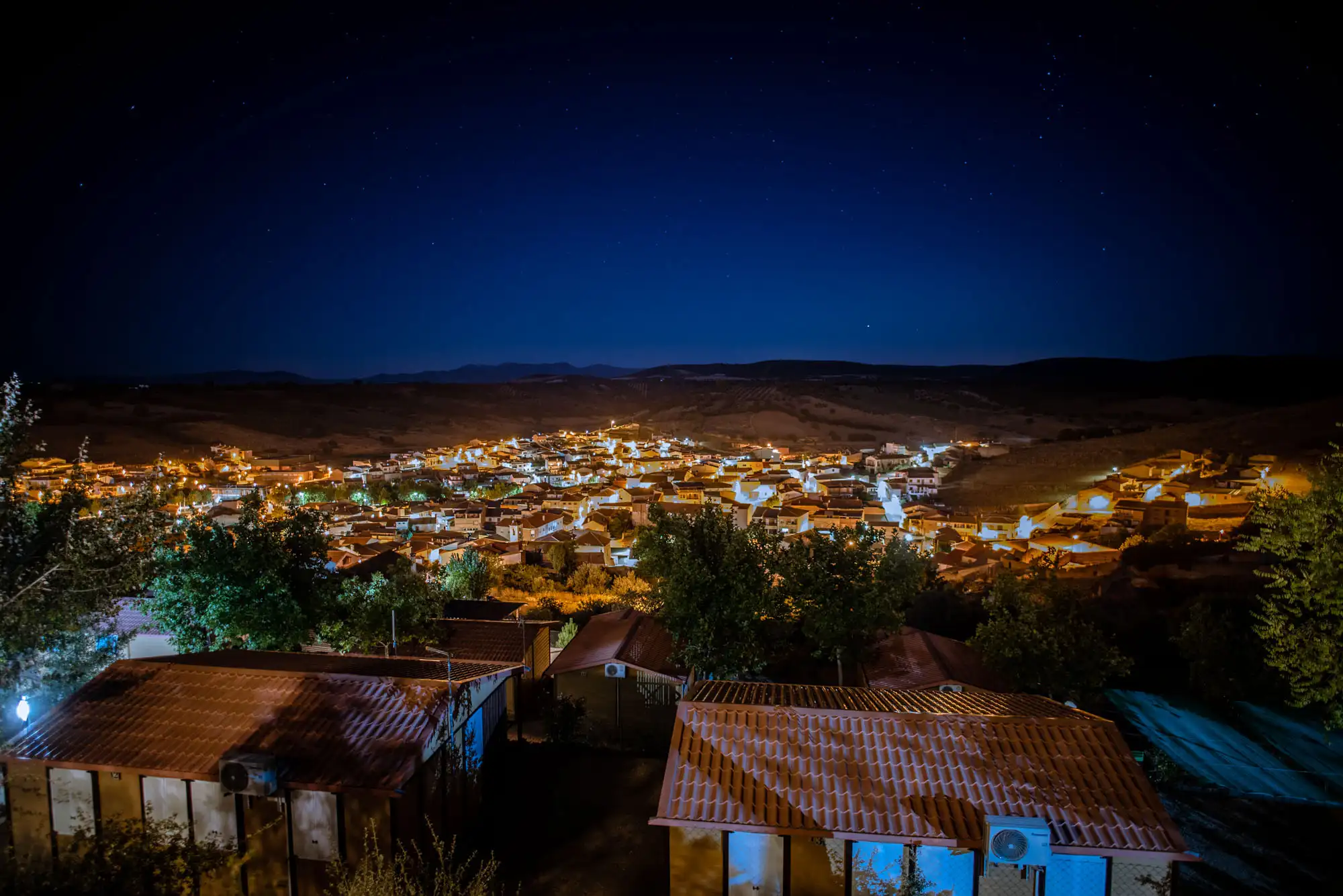
Few villages, small and far from the cities. When night falls, you can still see the stars here.
Starlight
The park and eight nearby villages have been a Starlight Tourist Destination since March 2023.
When
Moonless nights. In summer you can see the Milky Way; in winter the nights are longer, and colder.
Where
At the villages' stargazing viewpoints and at the Alcoba planetarium, which opens during the day.
Inside the park
No overnight stays. Observations inside the park only with an accredited company.
A certified sky
On 28 March 2023, Cabañeros received the Starlight Tourist Destination certificate, which the Starlight Foundation gives to places with high-quality skies that also commit to protecting them. The ceremony took place at the astronomy centre in Alcoba. The label is not only for the park: it is shared by Alcoba, Horcajo de los Montes, Navas de Estena, Retuerta del Bullaque and El Robledo, in Ciudad Real, and Hontanar, Los Navalucillos and Navahermosa, in Toledo. The idea came from the park's European Charter for Sustainable Tourism forum and was paid for by the Tourism Sustainability Plans of the Ciudad Real and Toledo provincial councils.
People knew the sky of Cabañeros was dark long before that. In 2005, the Miguelturra Astronomical Group measured light pollution in the province of Ciudad Real to find the best places to observe, and the park came first, ahead of the Valle de Alcudia and the Campo de Montiel. In July 2023, members of the group and of Las 7 Cabrillas spent a night on the raña photographing the Milky Way and deep-sky objects such as the Andromeda galaxy: it is 2.5 million light years away and, on a dark night, you can see it with the naked eye as a faint smudge between Cassiopeia and Pisces.
Since then the destination has been getting ready. In June 2024 new Starlight guides were trained in Cabañeros, in the 31st edition of the foundation's course, with classroom lessons and practice under the park's sky.
Where to look
You cannot spend the night inside the park, so to look on your own there are the villages, which have viewpoints for exactly that.
Astronomy centre · paid
Alcoba planetarium
The Astronomical Tourist Centre, in the village's old grain silo: a room with a 3D solar system and a large model of Apollo 11, and a dome where the sky is projected in 360°. Guided visits with booking; run by the company Las 7 Cabrillas.
Alcoba de los MontesStargazing viewpoint · free
Horcajo viewpoint
Open-air, with panels that explain the sky. It opened in March 2026 and is one of the seven viewpoints paid for by the Cabañeros Tourism Sustainability Plan.
Horcajo de los MontesStargazing viewpoint · free
Hontanar viewpoint
Next to the municipal swimming pool, on the Toledo side. It has been open since 2025 and was built by the Toledo provincial council with its Montes de Toledo Tourism Sustainability Plan.
HontanarStargazing viewpoints · in progress
The rest of the network
The agreements for the seven viewpoints were signed on 27 October 2025. Besides Horcajo, there will be two in Alcoba (one in Santa Quiteria), two in Retuerta del Bullaque (one in Pueblonuevo), one in El Robledo and one in Navas de Estena.
The villages of the park
The Alcoba silo went from storing grain to storing the whole solar system, and it is the only planetarium in the province of Ciudad Real. It opened in 2023, the visit lasts between an hour and an hour and a half, and you book it at astroturismocabaneros.com.
Activities and festivals
To observe inside the park, or with a telescope and someone to explain what you see, you need to go with a company.
The one that organises most activities is Las 7 Cabrillas, from Alcoba, accredited under the European Charter for Sustainable Tourism in Cabañeros. It runs the planetarium and organises guided observations, night walks under the stars, solar observations and trips that combine the rut with the autumn sky. Dates and places on its website and in the Destino Cabañeros events calendar, where festivals are also announced.
Summer 2023
Astronomical summers
The regional government's programme came to the destination's villages for the first time. Places sold out in a few days and more than 500 people took part, learning to recognise stars and constellations.
6-8 September 2024
1st Astronomy Festival
Planetarium sessions in Alcoba, solar observation with solar telescopes, evening sessions in Navas de Estena, Horcajo and El Robledo, night walks and a talk on the right to starlight. Free, with more than 400 people attending.
16-17 May 2025
Cabañeros respira bosque mediterráneo
A nature festival that ended with a guided night-time observation after the planetarium visits.
18-20 July 2025
2nd Astronomy Festival
Evening sessions, solar observations, 4×4 tours, planetarium, virtual reality and games for children. On the 20th, a special activity for International Moon Day.
12 August 2026
Solar eclipse
For the eclipse, the park opened the ethnographic trail at Casa Palillos. The eclipse happened as evening fell.
The sky calendar
- January. The Quadrantids, early in the month. Together with the Geminids, they are among the meteor showers with the most meteors per hour.
- April and May. The Lyrids, peaking around 22 April, and the Eta Aquariids, around 6 May.
- Summer. The Milky Way crosses the sky from end to end. Looking south, towards Sagittarius, is its brightest part. The Perseids, around 12 August.
- November. The Leonids, in the middle of the month. They are irregular, but some years they match the Perseids.
- December. The Geminids, in the middle of the month, and long nights: it gets dark early and there is plenty of time.
Exact dates for each year are on the astronomy portal of the National Geographic Institute (Instituto Geográfico Nacional).
Tips for the night
- Check the lunar calendar before choosing a date: with a full moon, the faint stars disappear.
- If you can, avoid a white torch; a red light is better, as it does not dazzle. Your eyes need quite a while to get used to the dark.
- Wrap up even in summer: it gets cool at night, and you feel the cold more standing still than walking.
- A pair of binoculars is more than enough for the Moon, star clusters and the smudge of Andromeda.
- Drive slowly at night: deer and wild boar cross the park's roads.
- Camping and staying overnight inside the park are not allowed. To sleep, use the accommodation in the villages.
Quick questions
Why are the stars so clear in Cabañeros?
Because there is hardly any artificial light: few villages, small and far from the cities. In a 2005 study of light pollution in the province of Ciudad Real, the Miguelturra Astronomical Group found Cabañeros to be the darkest place, ahead of the Valle de Alcudia and the Campo de Montiel.
What is a Starlight Destination?
A label from the Starlight Foundation for places with high-quality skies that also take care of their lighting and offer activities to enjoy them. Cabañeros received it on 28 March 2023, together with Alcoba, Horcajo de los Montes, Navas de Estena, Retuerta del Bullaque, El Robledo, Hontanar, Los Navalucillos and Navahermosa.
Can I go into the park at night to see the stars?
You cannot spend the night inside the park. To watch the stars on your own, there are the villages' stargazing viewpoints; inside the park, observations are run by accredited companies, with booking.
How much does the Alcoba planetarium cost?
It is paid, and visits are guided and must be booked in advance. Prices and opening times, which change with the season, are on the Astroturismo Cabañeros website.
What is the best time of year?
Any time with clear, moonless nights. In summer you can see the Milky Way and the Perseids; in winter the sky is very clear, but it is really cold.
Sources and fact-checking
- «Desde el parque» newsletter of Cabañeros National Park, March-April 2023 (Starlight Destination, in Spanish)
- «Desde el parque» newsletter of Cabañeros National Park, July-August 2023 (astrophotography on the raña, the 2005 study and astronomical summers, in Spanish)
- «Desde el parque» newsletter of Cabañeros National Park, September-October 2023 (opening of the Alcoba planetarium, in Spanish)
- «Desde el parque» newsletter of Cabañeros National Park, May-June 2024 (Starlight guide course, in Spanish)
- «Desde el parque» newsletter of Cabañeros National Park, September-October 2024 (1st Astronomy Festival, in Spanish)
- «Desde el parque» newsletter of Cabañeros National Park, May-June 2025 (Hontanar viewpoint and May festival, in Spanish)
- «Desde el parque» newsletter of Cabañeros National Park, July-August 2025 (2nd Astronomy Festival, in Spanish)
- «Desde el parque» newsletter of Cabañeros National Park, September-October 2025 (agreements for the seven viewpoints, in Spanish)
- «Desde el parque» newsletter of Cabañeros National Park, July-August 2026 (eclipse of 12 August, in Spanish)
- Destino Cabañeros, «Astroturismo» (Tourism Sustainability Plan, Ciudad Real provincial council, in Spanish)
- Astroturismo Cabañeros (Las 7 Cabrillas), «Centro astronómico planetario Alcoba» (in Spanish)
- Lanza, «Horcajo de los Montes estrena uno de los siete nuevos miradores estelares de Cabañeros», 3 March 2026 (in Spanish)
- National Geographic Institute, «Lluvias de meteoros» (in Spanish)
Checked on 13 October 2026. Opening times and prices of the planetarium and the activities change with the season: confirm them with the company before you go.