
Plants
Woodlands
Introduction
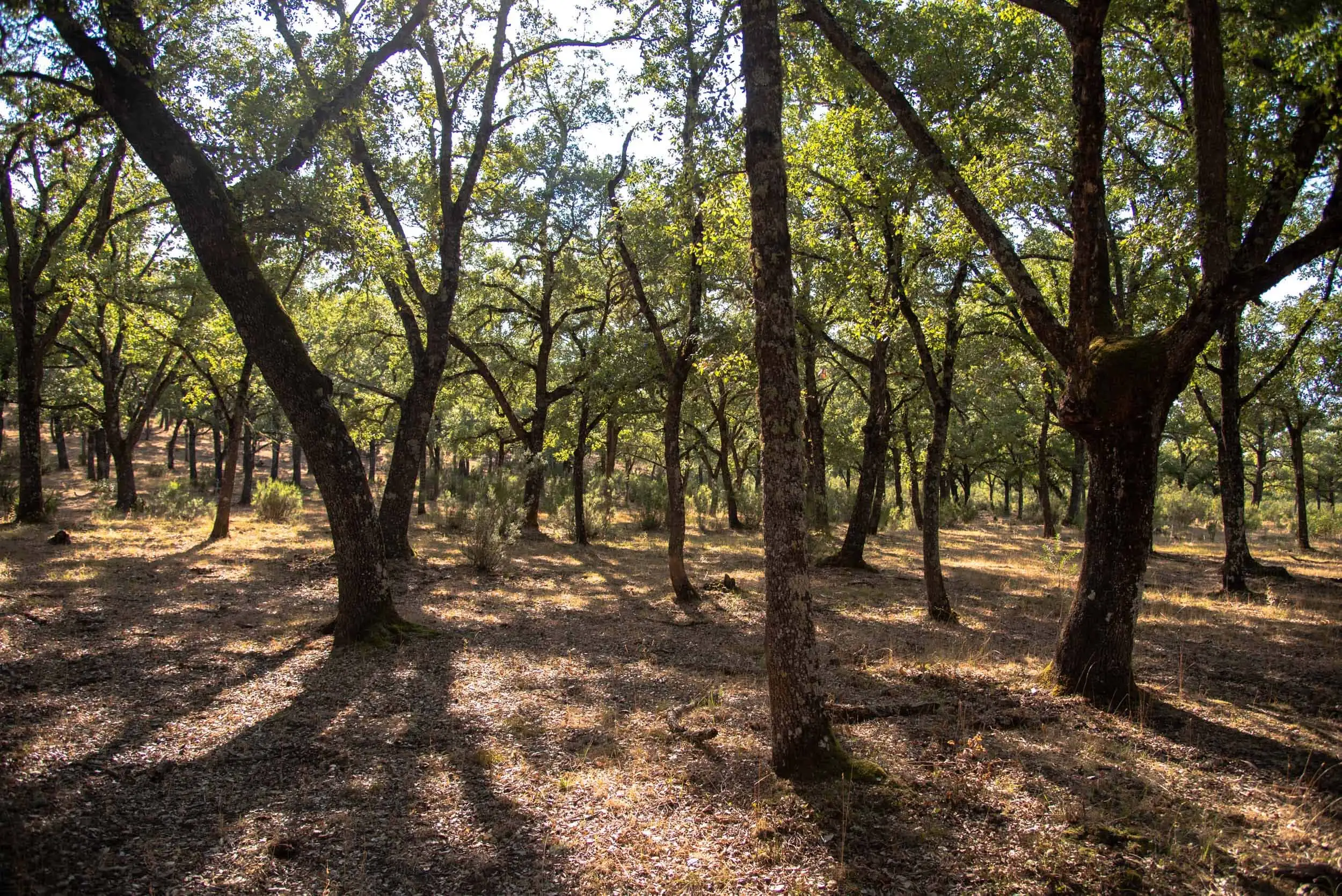
Woods are understood as a set of trees in dense growth. In Cabañeros, it is hard to find a geographical area exclusive to them, since alongside them grow individual trees, shrubs and other herbaceous species. Woods show the most mature and evolved stage of the vegetation.
The tree-covered area of the park covers 51.21%. There are areas where their replacement stages can be seen, where the disturbances –such as fires, charcoal burning or ploughing– caused by people over time stand out. However, people have also favoured certain tree species, achieving a balance in the natural system, as in the case of the dehesas, which hold the best tree samples of many Oretana enclaves.
In Cabañeros, tree formations are divided into:
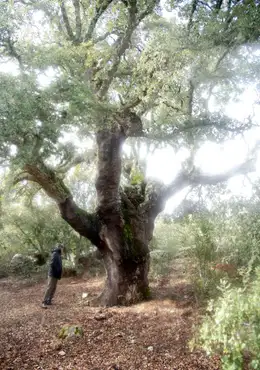
- Climatophilous and edaphoxerophilous woods: holm oak woods, cork oak woods and Pyrenean oak woods stand out.
- Edaphohygrophilous communities or riverside woods: woods with more moisture in the soil, the main ones being ash woods, alder woods and birch woods.
There are also cases such as the Portuguese oak woods, which grow both on shady slopes, where evaporation is lower, and in areas whose topography admits more moisture, even with waterlogging. They have been called climato-temporihygrophilous communities, a hybrid of the climatophilous and edaphohygrophilous communities.
Both the topography of exposure and the two bioclimatic belts that exist in Cabañeros have a direct influence on the woods. The following figure shows an idealised distribution with particularities and disturbances, among them human ones such as ploughing, replanting or fires.
Likewise, intermediate situations that give rise to mixed forms can be seen, as in the case of holm-oak–cork-oak woods or holm-oak–Portuguese-oak woods. The degree of coexistence between different species is due to abiotic factors, such as humidity, temperature or soil. Although human action is also decisive, for example by favouring the possibilities of exploitation, as with holm oaks (firewood, charcoal, better acorns and so on)
This process of favouring sclerophyllous species (hardened, evergreen leaves such as holm oaks and cork oaks) is called sclerophyllisation, and began thousands of years ago with fires and grazing and continues to the present, producing soil loss because of the reduction in water-holding capacity.
Classification of the woods of Cabañeros
The woods of Cabañeros are classified broadly into two: climatophilous woods and riverside woods.
Climatophilous and edaphoxerophilous woods
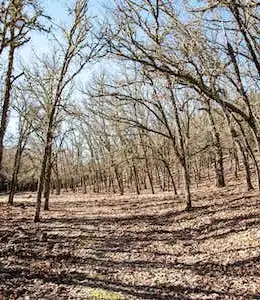
Edaphohygrophilous communities: riverside woods
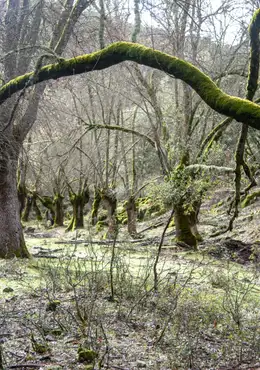
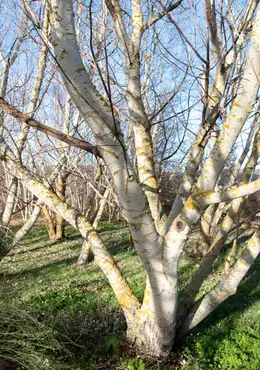
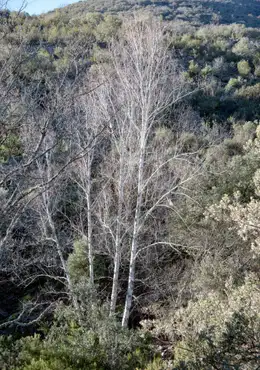
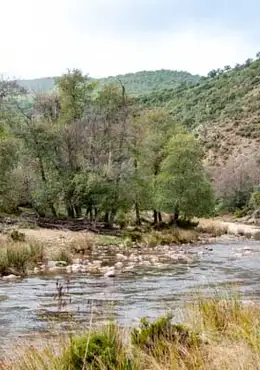
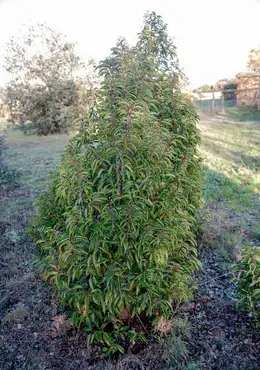
Riverside woods, also called riparian communities (ripa = bank in Latin), receive more water than climatophilous communities. They belong to the edaphohygrophilous communities, whose soils hold more moisture.
The rivers, streams and torrents together with their surroundings such as floodplains and ravines of the park show different riparian communities, which vary according to the geomorphology of the bed, the seasonality or the water table. The running (lotic) waters of Cabañeros are classified as soft waters, given their low content of nutrients such as calcium or magnesium. Humidity falls as we move away from the main channel. Moreover, in this Mediterranean environment, discontinuous channels are frequent, that is, seasonal ones that dry up completely for much of the year.
When downpours are intense during the winter rains or in summer storms, there is an episodic and destructive torrentiality that can cause great floods. This conditions the species that appear, since some withstand floods better than others.
Riverside woods are made up mainly of deciduous species. Some have Euro-Siberian origins and their water needs are made up for by the existence of nearby water tables. Depending on their distance from the river bed, they will have greater soil moisture.
The Mediterranean environment of these types of woods in the Montes de Toledo encourages a mix of sub-Mediterranean sclerophyllous species with Euro-Siberian broad-leaved ones. In this way, they form a dense, linear tree cover that creates a damper, thermally milder microclimate. Woods with these characteristics are called gallery forests, where the only place left without vegetation is the water surface itself. These woods are tall and stand out from the landscape and mark the course of the channel. The area they cover within the park is small, only in the groves, floodplains and ravines near river courses.
Factors that determine the type of formation
- The location of the stretch. It can be the upper stretch: stronger currents, steeper slope and greater erosion of the bed; middle-lower stretch: increased flow, less speed and greater supply of sediment and nutrients.
- The degree of humidity and temperature due to height and exposure. Thus, in upper stretches between 900 and 1,500 metres we will find birches or Portuguese laurel groves; in the middle stretches, ash woods and alder woods; and in the lower stretches, poplar groves and tamarisk groves.
- The permanence of the water.
Made up of alder woods, ash woods, Portuguese laurel groves and birch woods.
Bibliography
- Vicente García Canseco (Coor.) (1997). Parque Nacional de Cabañeros. Madrid, Spain: Ecohábitat.
- Perea García-Calvo, R., Perea Ruiz-Tapiador, D., Giménez Velasco, G.F. (2015). Vegetación y flora del Parque Nacional de Cabañeros. Volumen I. El paisaje vegetal: ecología, conservación y rutas de interés geobotánico. Madrid, Spain: Editorial Solitario