
September and October
The red deer rut in Cabañeros
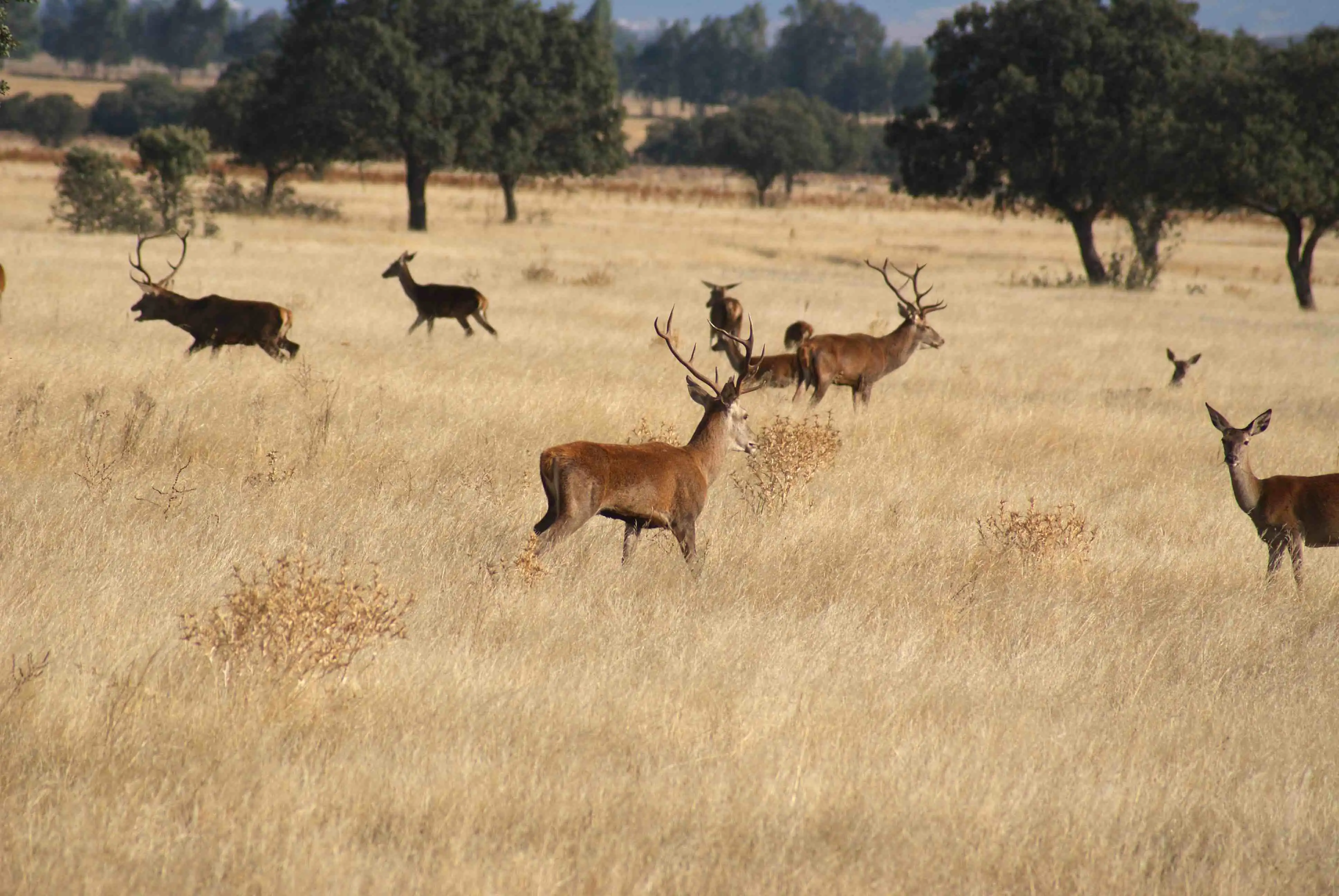
For a few weeks, the hills are full of sound. Hundreds of deer come down to the raña, and the stags fight over the hinds with roars and clashing antlers.
When
At its peak from mid-September to mid-October.
What time
At dawn and dusk, when there is most activity.
Where
You can hear it all over the park, but it is easiest to see on the raña.
Bookings
The 4×4 tours and the accommodation fill up: book early and, if you can, go on a weekday.
A season, not a date
The rut is the red deer's mating season. By summer the stags already have their full antlers and start following the groups of hinds; with the first rains of September they come down from the hills and gather on the raña. During September and much of October they compete for the hinds with deep roars and antler fights.
The most intense part usually runs from mid-September to mid-October, but every autumn is different. In 2022, after a very dry summer, the first roars were heard in mid-September, and the rain in mid-October brought a new peak just as activity was falling. Even after the peak, roaring goes on for several weeks. In 2023 it also began in mid-September, with the first rains, and between 15 September and 15 October more than 14,000 people visited the park; many places to stay in the area were fully booked.
What the rut is like is decided months earlier. The spring of 2024 was very wet, there was plenty of grass, and the deer reached autumn well fed and with good antlers: their size and symmetry show how the year has gone for the animal. What comes next takes its toll: a stag can lose 25% of its weight during the rut.
Afterwards, the deer gather in large herds to eat acorns: in November there are herds of more than 400 animals. They stay on the raña until late December, when the frosts push them back into the hills.
The roar is also a message. To make it, the stag lowers its larynx towards its chest, the same trick tenors use for low notes, which makes the tube the sound travels through longer: the deeper the roar, the bigger the deer, and a dominant stag avoids fights by telling younger males how big he is. The rhythm tells something else, stamina: a tired or hungry stag roars less, and his rivals notice. The landscape plays its part too. On the raña the sound carries for kilometres over flat ground, although it has to compete with the wind and the evening air currents; in the sierras, the cork oak woods and the deep valleys of the Estena and the Bullaque act as a sounding box, and the echo makes the roaring stag seem bigger.
Where to see and hear it
You can hear the rut all over the park, but the best place to see it is the raña, the great holm oak plain in the south.
Visitor centre · free
Casa Palillos
On the edge of the raña, with panoramic views and an observation hide from which, depending on the season, you can see groups of deer. Open every day from 9:00.
Opening times and how to get thereOn foot · free
Colada de Navalrincón
A flat path of 9.5 km (one way) between Torre de Abraham and Casa Palillos, along the Bullaque river. Early and late in the day you can see red deer, wild boar and cinereous vultures. For the rut, the park recommends the first section, starting from Torre de Abraham.
Walking trailsOn foot · free
La Viñuela trail
Thirteen kilometres through the Chorito hills, with a stretch along a firebreak that opens onto the raña. The park lists it among the trails for hearing the rut up close.
The La Viñuela trailGuided · paid
4×4 tour of the raña
The way to get into the raña, where the deer gather. The early morning and late afternoon tours are the best for seeing wildlife.
4×4 toursViewpoint · free
Stork observatory
3 km from Casa Palillos, on the southern edge of the park and looking over the raña. Depending on the season you can see red deer, cranes and vultures.
Viewing points
Outside the park, the Risco de las Paradas is another good spot, according to the park itself. Note: the stretch of the CM-4157 between the Risco and Valdeazores is in poor condition and the park advises not to drive on it.
How to behave
- Do not leave the marked paths, on foot or by car: the raña belongs to the deer.
- No calls or recordings of roars to provoke a reply: disturbing wildlife is forbidden.
- No music and no loud voices. Listening is half the show.
- Use binoculars or a telephoto lens instead of getting closer. A stag in the rut is not a tame animal.
- Dogs always on a lead.
- Camping and staying overnight inside the park are not allowed.
Bookings and what to bring
For the 4×4 tour, book as early as possible: in the middle of the rut the tours fill up. For the park's free guided walks, call 926 783 297.
- Binoculars: they bring the deer closer without you getting closer.
- Layers of clothing: at dawn and dusk autumn gets chilly.
- Water and something to eat if you go on foot.
- The weather forecast, in case it rains: rain also gets the rut going.
Quick questions
When is the red deer rut in Cabañeros?
It starts with the first rains of September. The most intense part usually runs from mid-September to mid-October, but it changes every year with the rain, and you can still hear roaring for several weeks afterwards.
Do I need a guide?
No. You can hear it from Casa Palillos, the stork observatory or self-guided trails such as the Colada de Navalrincón and La Viñuela. The guided 4×4 tour is the way to get into the raña.
How much does it cost?
The visitor centres and the self-guided trails are free. The 4×4 tour is paid; for prices and places, contact the company that runs it.
What is the best time to hear it?
Early in the morning and late in the afternoon, when the deer are most active.
Can I go at night?
You cannot stay overnight inside the park. Some local tourism companies run night trips to watch the rut and the stars: Cabañeros has been a Starlight destination since 2023. More in <a href="/cielo-nocturno-en-cabaneros/">the night sky of Cabañeros</a>.
We also tell the story of this season's rut in a news piece: “The rut in Cabañeros: you hear autumn before you see it” (in Spanish).
Sources and fact-checking
- Cabañeros National Park newsletter, July-August 2022 (in Spanish)
- Cabañeros National Park newsletter, September-October 2022 (in Spanish)
- «Desde el parque» newsletter of Cabañeros National Park, September-October 2023 (in Spanish)
- «Desde el parque» newsletter of Cabañeros National Park, July-August 2024 (in Spanish)
- «Desde el parque» newsletter of Cabañeros National Park, July-August 2025 (in Spanish)
- «Desde el parque» newsletter of Cabañeros National Park, July-August 2026 (in Spanish)
- OAPN. Visitor guide to Cabañeros National Park (2011, in Spanish)
- MITECO-OAPN. General information on Cabañeros National Park (April 2025, in Spanish)
Checked on 13 October 2026. Dates are approximate: they depend on each autumn's rain. Before you go, check with the park or the 4×4 tour company.