
Birds
Birds of Cabañeros
Sorted by habitat, type of flight, size and time of year.
Introduction to the birds of Cabañeros
The populations of different species that live together in the same habitat form organised groups called <<communities>>. The habitat is the place where a community lives and which brings together a series of environmental features (climate, biotic factors, soils, etc.) that affect the development of the life of organisms.

Cabañeros is a small geographical area that holds different bird communities, thanks to its structural richness, which allows different habitats to exist in a limited space. The habitats in the park used to classify the bird communities are:
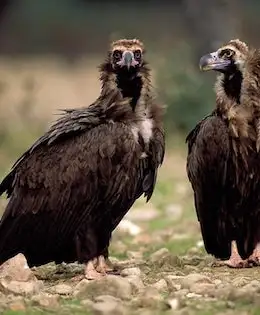
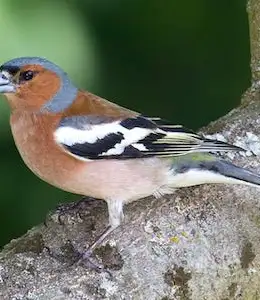
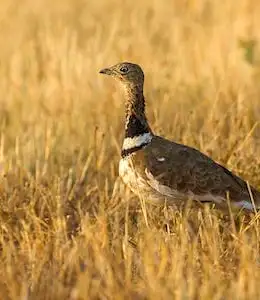
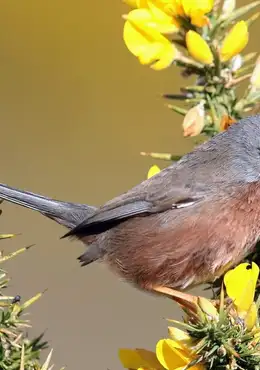
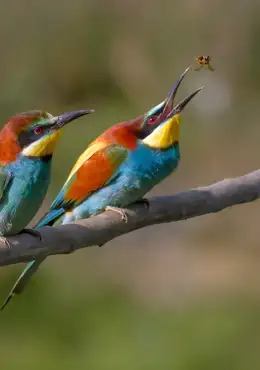
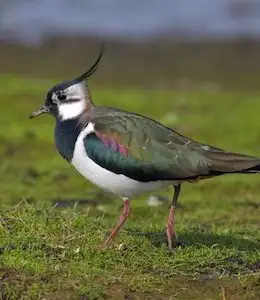

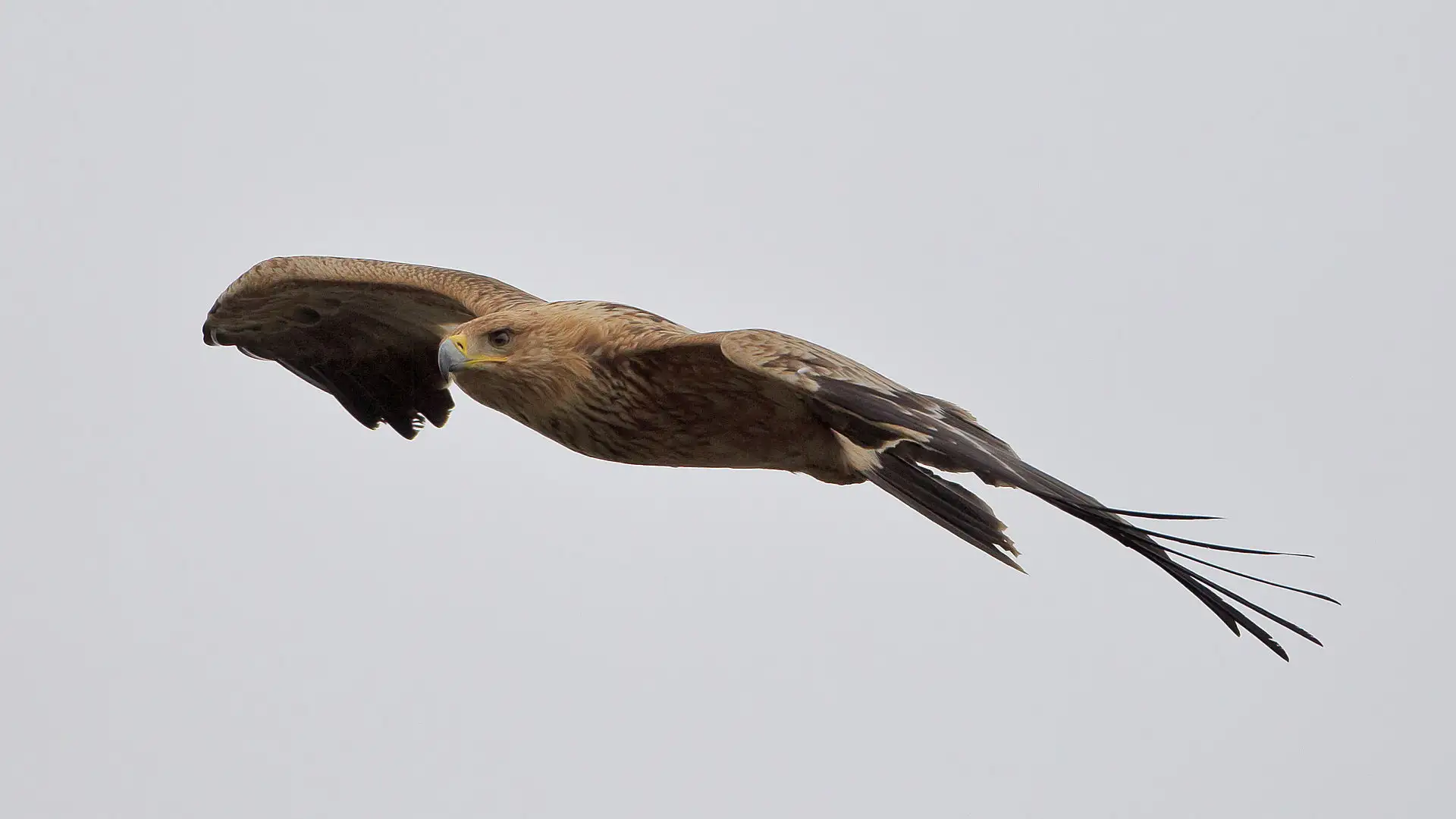
On the one hand, we find birds that occur in very specific habitats, such as a group of woodland birds tied to the sclerophyllous woodland: the Spanish Imperial Eagle (Aquila adalberti), the Cinereous Vulture (Aegypius monachus) and so on. On the other hand, there are some species with a greater capacity for adaptation that live in several habitats, for example the Common Kestrel (Falco tinnunculus).

198 bird species
A total of 198 species have been recorded in Cabañeros. To study them in a clearer and more dynamic way, we will follow the classification of the forestry engineer and former director of the park José Jiménez García-Herrera.
Classification of birds by phenology
The classification takes into account the seasonal changes that affect bird communities.
- Resident: birds with different degrees of sedentary habits, although they are present more than 9 months a year.
- Seasonal: this category is divided into several: winter visitors, summer breeders, migrants passing through and irregular visitors .
| PHENOLOGICAL STATUS OF THE SPECIES | NUMBER OF SPECIES | PERCENTAGE IN % |
|---|---|---|
| RESIDENTS | 82 | 41.41 |
| WINTER VISITORS | 25 | 12.62 |
| SUMMER BREEDERS | 42 | 21.21 |
| SPECIES ON MIGRATION | 32 | 16.16 |
| IRREGULAR PRESENCE | 17 | 8.5 |
The presence of resident birds, including the waterbirds found on the Torre de Abraham reservoir, is higher (36%) than that found in the holm oak woods of León (GARNICA, 1978) and in the woodland of Cazorla (39%) (OBESO, 1987). Summer breeding birds also stand out in the park, at 21.21%, and so do migrant species, whose percentage is similar to the 21.4% found in Gredos (SÁNCHEZ, 1991). However, the percentage of winter visitors in Cabañeros is lower.

The natural predominance of resident species in the Mediterranean environment is attributed, according to HERRERA (1980), to the continuous use of the habitat by this group of species, in the same way as in the tropical habitats of America, Asia and Africa and the Senegalese savanna, and to the similarity of the evolutionary profiles of passerine density (the bird order that includes more than half of the world’s bird species) in tropical and Mediterranean habitats, whose abundance is due to the rainy seasons. This is more common in pioneer habitats, such as grasslands, than in mature ones, that is, woodlands.
The biggest variations in the number of species present in the park are seen in two periods: between March and May, coinciding with the pre-breeding migration; and between August and October, in the post-breeding migration. In the other periods –broadly speaking the winter, between November and February, and the summer period, from May to July– the number of species hardly changes. However, there are notable year-to-year variations linked to the weather of each cycle.

The biogeographical study of Cabañeros on the resident species and with Voous’s faunal types shows a community in which cold environments predominate (around 65%), a high percentage of thermophilous environments (28.6%) and a not insignificant percentage of widely distributed species. However, a quantitative study during the breeding season shows the predominance of thermophilous elements, especially in the raña grasslands.
Percentages of Voous’s faunal types
| FAUNAL TYPES | PERCENTAGE IN % |
|---|---|
| Holarctic | 10.6 |
| European | 12.1 |
| Palearctic | 33.3 |
| Mongolian-Tibetan | 1.5 |
| Old World | 4.5 |
| Cosmopolitan | 3 |
| Mediterranean | 10.6 |
| Palaeoxeric | 1.5 |
| Turkestan-Mediterranean | 7.5 |
| Euro-Turkestan | 7.5 |
| Indo-African | 1.5 |
| Palaeoxeromontane | 4.5 |
| Palaeomontane | 1.5 |
Bird conservation in Cabañeros
According to the categories set by the International Union for Conservation of Nature (IUCN) for Europe (GRAHAM et al, op. cit.), Cabañeros has 79 breeding SPECs (Species of European Conservation Concern, species of global conservation concern) and 1 wintering SPEC, out of the 160 present in Spain. This means that 40 % of the species in Cabañeros National Park fall into these conservation categories:
- SPEC 1: species of global conservation concern, including threatened species.
- SPEC 2: species concentrated in Europe with an unfavourable conservation status.
- SPEC 3: species not concentrated in Europe but with an unfavourable conservation status.
- SPEC 4: species concentrated in Europe with a favourable conservation status.
The 80 SPECs of Cabañeros are distributed as follows:
| Species of European Conservation Concern | Number |
|---|---|
| SPEC 1 | 3 |
| SPEC 2 | 11 |
| SPEC 3 | 36 |
| SPEC 4 | 30 |
The proportion of SPECs in % on the raña and in the woodland.
There is a large proportion of SPECs on the Cabañeros raña, a habitat of human origin, which means that human intervention needs to be kept up to protect the biodiversity present today. It is therefore vital to keep the grasslands under a rotating cycle of intervention, whether by mowing, burning or ploughing, and to adjust the grazing load of wild herbivores. As for woodland management, it is a simpler process that consists of protecting mature woods from harmful factors.
Likewise, in Cabañeros there are two category 1 species found only in Spain: the Spanish Imperial Eagle and Dupont’s Lark.
The imperial eagle is scarce compared with other areas. When the study this page is based on was written there was only one stable breeding pair and another that appeared in the hunting range but bred elsewhere, although things have improved: in 2023 the park already counted 4 breeding pairs (see the imperial eagle). The eagle keeps hunting ranges of between 8,000 and 10,000 hectares, probably because of the low density of its commonest prey, the rabbit. Therefore, for its conservation, the dense foothill scrub would need to be broken into small patches at different stages of vegetation development and scrub corridors created on the rañas nearest to the north.

As for Dupont’s Lark, there is only one record, of an adult killed by a vehicle in July. Its phenological status and the presence of a breeding population are unknown. Neither is its location.

How the health of the park’s birds is monitored
Since 2012 the park has counted its birds twice a year, within the monitoring programmes of the National Parks Network: in spring, the SACRE, with observation points, and in winter, the SACIN, with 15-minute walking transects. The routes, dates and effort are always the same, and since 2018 even the ornithologists, so that any changes that come out are those of the birds and not of the method. The assessment for 2012 to 2024, signed by Ignacio Encabo, coordinator of both programmes, in the park newsletter of May–June 2025: the number of species and the abundance of birds in spring remain stable, a sign that the park has not undergone important ecological changes in over a decade. The only thing that drops clearly is the density of birds in winter, perhaps because, with climate change, fewer and fewer birds come down from northern Europe.
Main measures for bird conservation in Cabañeros
- Keeping up the raña: a distinction must be made between the areas where scrub colonisation is acceptable and those that must be kept as grassland.
- Management of the less developed scrub areas (rockrose scrub and rockrose-heath scrub): the aim is to keep them in regressive or pioneer stages and always to preserve the individual trees.
- Wooded areas: their maintenance and regeneration need to be protected by controlling internal pressures, such as overuse by abnormal densities of herbivores, and external ones, such as human works.
Birds of Cabañeros
Bibliography:
- Jiménez García Herrera, José. (1997). Avifauna. En Parque Nacional de Cabañeros (pp. 192-224). Madrid, España: Ecohábitat.