
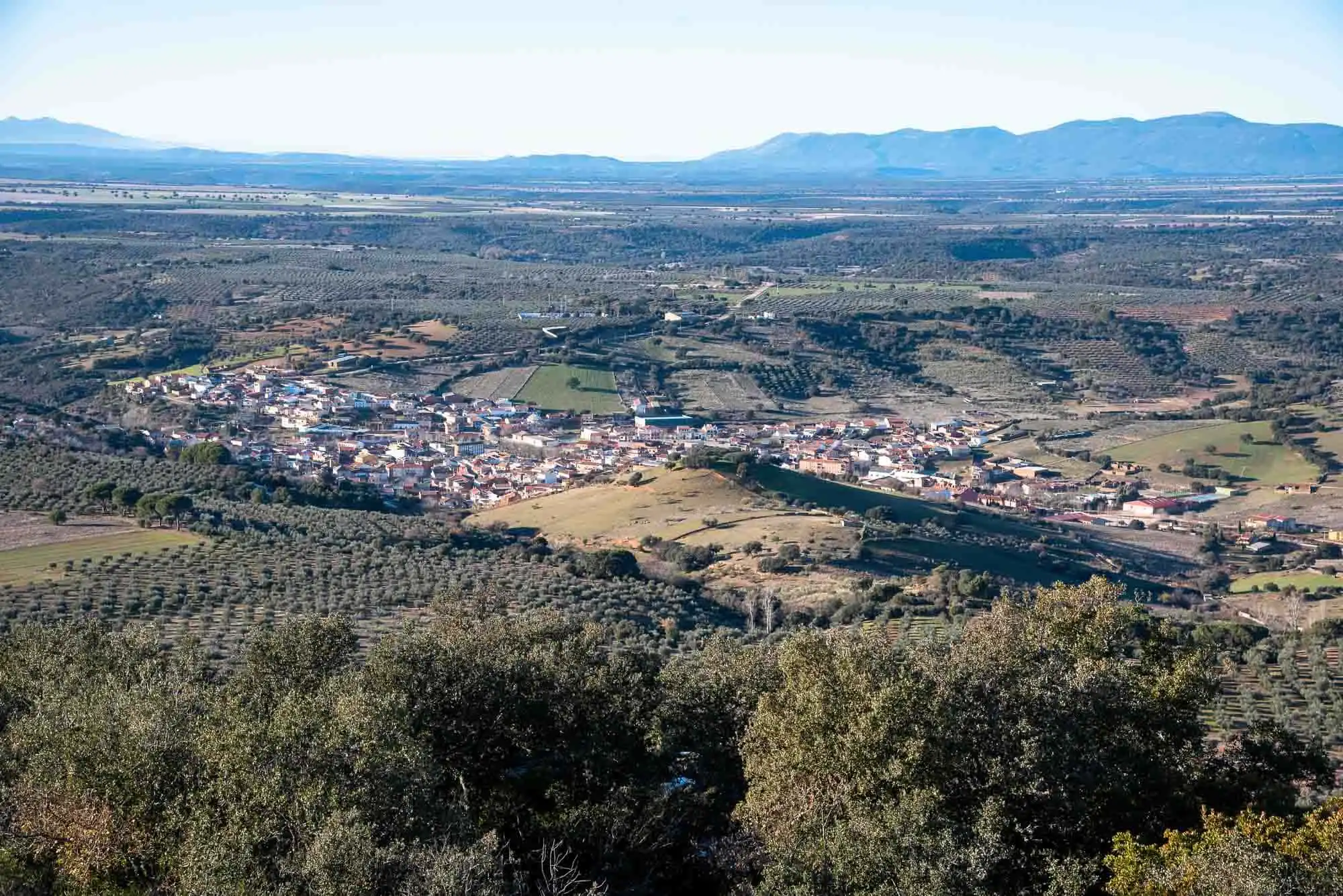
A village named after a river fork
Horcajo owes its name to its site: it was born in a horcajo, the fork formed where two streams meet. The village stands at 582 metres, beside the Cañada Real Segoviana, and part of its land lies inside the National Park.
The area has Bronze Age sites and remains of two Roman roads, but the village itself is more recent. In 1576, when Philip II ordered every place in the kingdom to be surveyed, the people of Horcajo replied that their village was about a hundred and fifty years old. That places it around 1426, deep in the Montes de Toledo.
What to see
- Parish church of San Antonio Abad. According to the town council it dates from the 16th century; one of its sides, in Mozarabic style, is the most unusual part of the building. The park guide points out the Arabic elements of its buttresses.
- Ethnographic Museum. Half an hour well spent: it shows how wine and honey were made by hand, and keeps an oak-wood wax press and a collection of farm tools, kitchen and hunting equipment, plus photographs of the villagers of the past. It is free, opens on Saturday and Sunday mornings and serves as the municipal information point.
- Hermitage of the Virgen de Guadalupe. 1.5 km along the road to Alcoba, in the Sierra de los Moros. Its pyramid shape stands out among rockroses and rosemary, and a mosaic of the Virgin covers the façade. You can get there on foot, by bicycle or by car.
- La Chorrera. At the edge of the park, a waterfall more than fifteen metres high in a damp corner where willows, hollies, birches and ferns grow. The regional government declared it a Protected Landscape.
- The astronomical viewpoint. It opened in March 2026, in the open air and with panels explaining the sky. It is one of seven viewpoints being installed in the villages of the park, which is a Starlight Destination; more in the night sky of Cabañeros.
- Towards Anchuras, the Laguna de la Raña and, before crossing the bridge over the Estena river, the Pilón. The Laguna de la Raña is a Natura 2000 wetland, with birds, amphibians and aquatic plants; the Spanish Herpetological Association recently studied its amphibians with the Guadiana River Basin Authority and the regional government.


