
Plants
Mastic and kermes oak thickets
Characteristics of mastic and kermes oak thickets
- These are dense, tangled shrubs with green leaves, and they grow in the warmest parts of the sierras of the Montes de Toledo.
- They do not grow taller than 2 metres and their presence inside Cabañeros National Park is residual, although they are much more common in the surrounding sierras.
- They are resprouting plants, useful for protecting stripped soils that suffer recurrent fires.
- Their fruits are important for wildlife.
Habitat and distribution of mastic trees
They occur in the warmest places, such as the foot of sunny slopes where there is more radiation. The more specific mastic thickets lie in areas that suffer occasional disturbance, where the mastic tree, thanks to how easily its stump resprouts, dominates the area. They can be seen at:
- The edges of the road from Pueblonuevo del Bullaque to Los Cortijos.
- The Colada de Navalrincón route.
- In areas of infrequent fires, living alongside Halimium atripicifolium and Cistus monspelinsis.

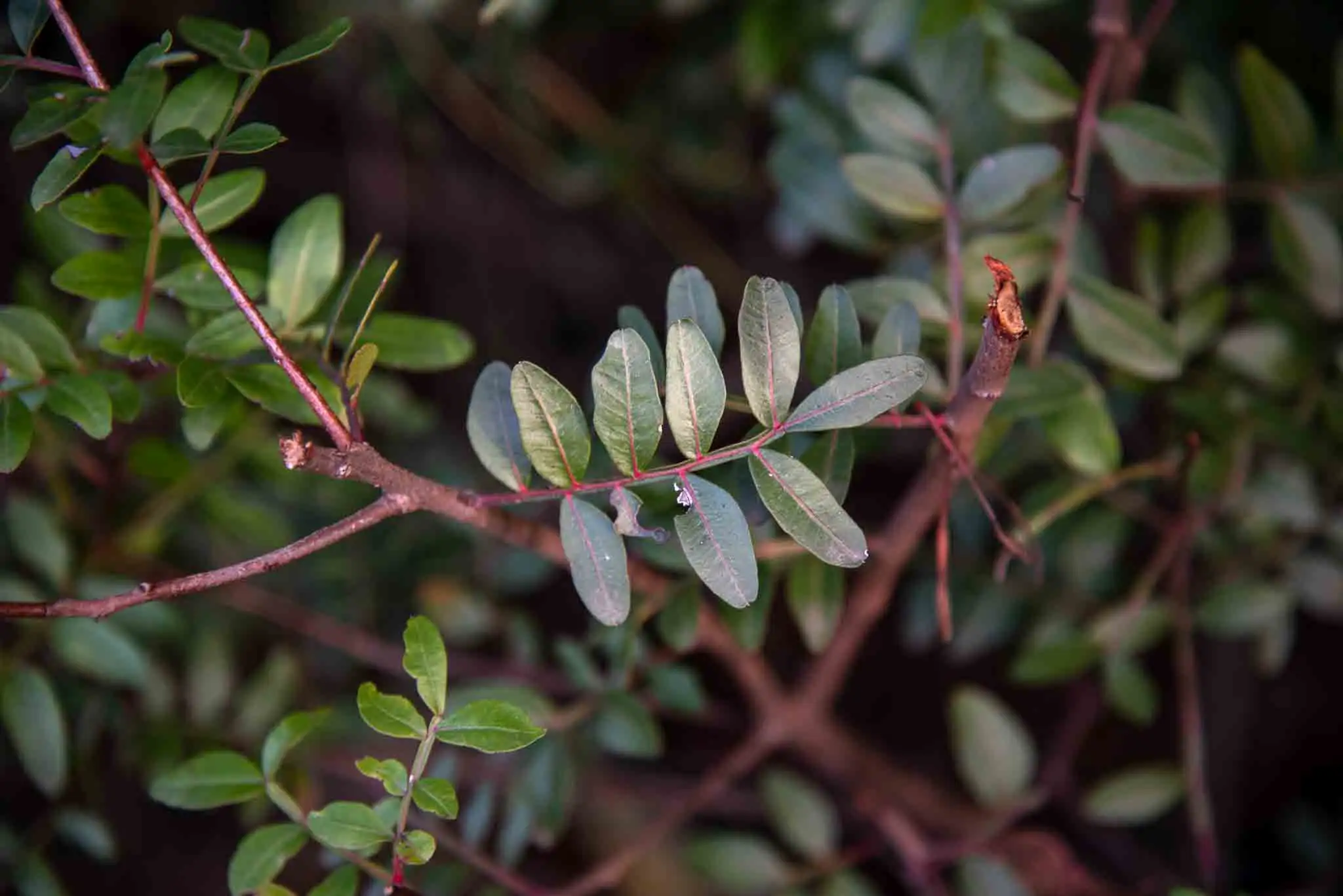
Leaf types of the mastic tree
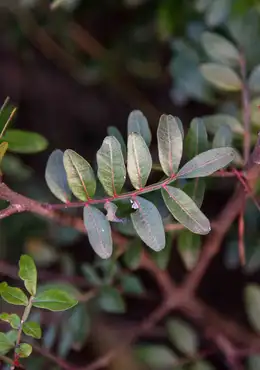
- Leathery, evergreen leaves –unlike its relative the terebinth (Pistacia terebinthus), which has deciduous ones–, hairless and compound of 2–7 pairs of leaflets (paripinnate). The leaves are arranged alternately on the branches, although the leaflets appear more or less opposite on the leaf stalk, which has small side extensions as if it were slightly winged. The leaflets also have an edge that is smooth, are elliptical or lanceolate, shiny, dark on the upper side, somewhat paler on the underside and often ending in a small point that does not prick.

Species that accompany mastic trees in Cabañeros
Mastic trees usually go with species typical of Mediterranean scrub.
- Myrtus communis.
- Phillyrea angustifolia.
- Cistus monspeliensis.
- Rosmarinus officinalis.
- Pistacia Terebinthus.
- Halimium atripicifolium and Cistus monspelinsis in areas of infrequent fires.
Characteristics of kermes oak thickets
- These are dense, tangled and thorny shrublands (prickly leaves).
- A species similar to the holm oak.
- The kermes oak thicket is the replacement stage of mesomediterranean holm oak woods in the warmest and driest places of the Montes de Toledo.
- They belong to the association Hyacinthoido hipanicae-Quercetum cocciferae. This pre-climatic association is residual in Cabañeros, where Mediterranean scrub and strawberry-tree thickets are the pre-climatic shrublands par excellence of these holm oak woods.


Habitat and distribution of kermes oak thickets
- They appear in dry, sunny places, on surfaces where the soil is often stripped bare.
- In Cabañeros and its surroundings they are scarce because of excess rain (>600 mm a year) and soil moisture, where the kermes oak cannot compete with holm oaks, cork oaks or Portuguese oaks.
- There are isolated individuals on the Colada de Navalrincón, with mastic trees, terebinths and mock privets.
- In the easternmost part of the Montes de Toledo, where soils are dry and shallow, kermes oak thickets appear, as in the Sierras de los Yébenes and in the nearby limestone veins of Los Navalucillos and Navahermosa.
- On southern hills in Porzuna and Piedrabuena.
- In microthermal conditions –not above 900 metres, where they are mostly replaced by holm oaks–, as on the shady slopes of Hontanar or in Los Navalucillos, there are isolated individuals living alongside the holm oaks, with which they can even hybridise.
Species that accompany kermes oak thickets in Cabañeros
- Thorny, heat-loving species: (Rhamnus oleoides, Asparagus albus, Olea europaea subsp. europaea var. sylvestris)
- Shrubby legumes (Adenocarpus telonensis)
- Rockrose family (Cistus albidus, C. monspeliensis and Halimium umbellatum)
- Junipers (Juniperus oxycedrus) in stony areas.
News from the park
In autumn the mastic tree bears a fruit that turns from red to black, one of the colours of the season in the park’s low scrub, as the September–October 2024 newsletter recalled (in Spanish).
Shrub formations: scrub and shrublands
 Rockrose thickets
 Heathlands
 Broom and retama thickets
 Strawberry-tree thickets
 Willow thickets
 Mastic and kermes oak thickets
 Tamujo thickets
Bibliography
- Vicente García Canseco (Coor.) (1997). Parque Nacional de Cabañeros. Madrid, Spain: Ecohábitat.
- Perea García-Calvo, R., Perea Ruiz-Tapiador, D., Giménez Velasco, G.F. (2015). Vegetación y flora del Parque Nacional de Cabañeros. Volumen I. El paisaje vegetal: ecología, conservación y rutas de interés geobotánico. Madrid, Spain: Editorial Solitario