
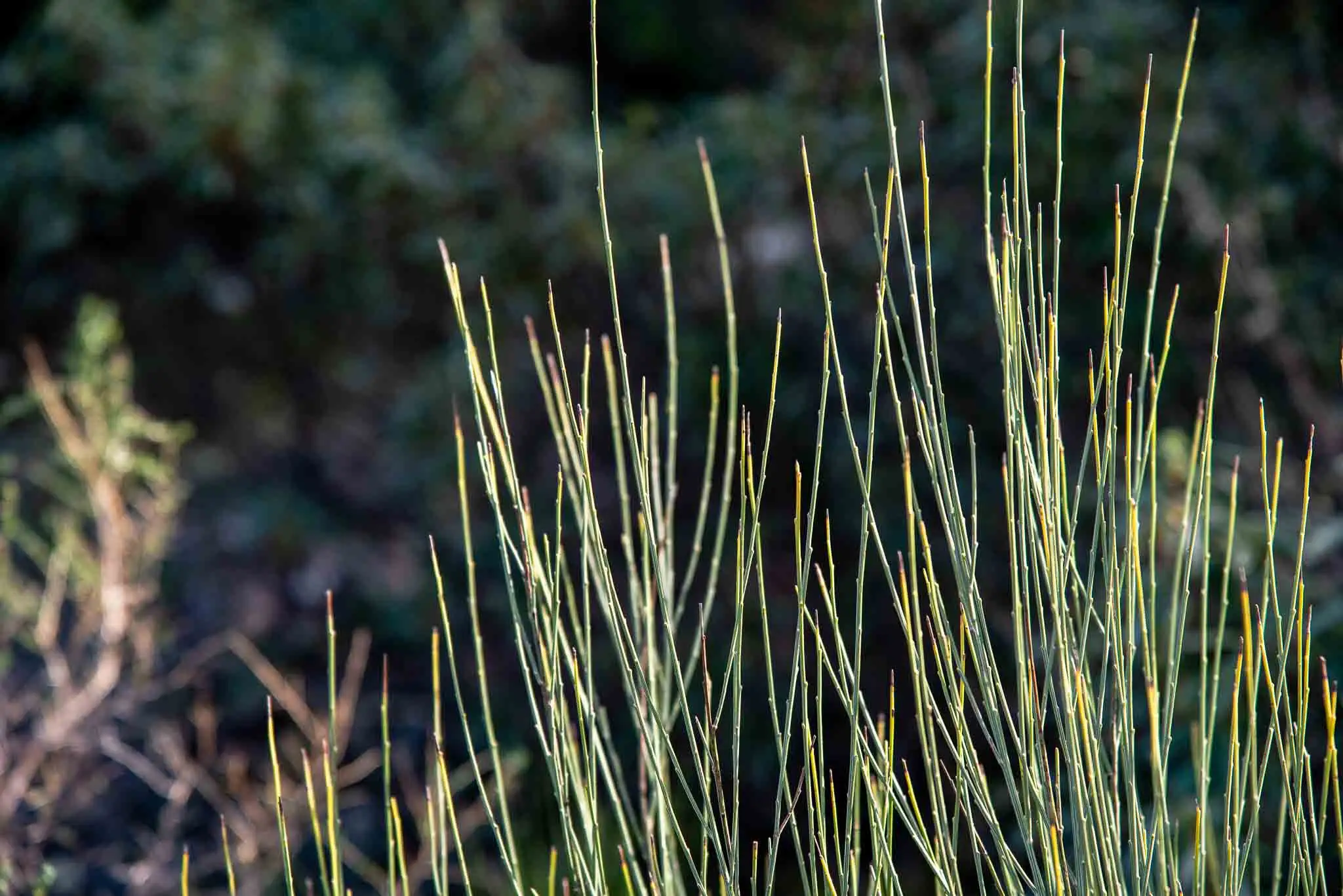
Plants
Broom and retama thickets
Characteristics of broom thickets
- These are medium-sized shrub stands that do not exceed 3 metres in which species of the genus Cytisus predominate.
- They are legumes that have been popularly called: brooms, «piornos», «iniestas» or «retamas».
- They form more evolved succession stages than rockrose thickets, thyme patches and lavender patches.
- The broom thickets formed by the «marihuela» or white broom (Cytisus multiflorus) are the most extensive in the territory, and are also a species endemic to the west and centre of the peninsula.


Habitat and distribution of broom thickets
- The white broom (Cytisus multiflorus) tends to lie in flat or foothill areas with granitic ground.
- The black broom (Cytisus scoparius) forms smaller stands in cooler damp areas at higher altitude, especially in the mountains, settling on the fringes of Pyrenean oak woods, holm oak woods and Portuguese oak woods.
- The Moorish broom (Cytisus striatus) usually lies on cool soils of the Montes de Toledo, without forming large stands. It even appears on the quartzite crests at very high ground, among the rocks, using the moisture of runoff water.
- The «piornos» of Cytisus can be found, among many other places, on the Plaza de los Moros route and at La Chorrera, both in Horcajo de los Montes, and at the Torre de Abraham.
Leaf types of broom thickets
- White broom (Cytisus multiflorus): simple and linear-lanceolate, those on the lower part trifoliate and practically sessile.
Characteristics of retama thickets
- The most famous are those dominated by the common retama (Retama sphaerocarpa). It is a medium-to-tall shrub that easily reaches 2.5 metres in height and with very deep roots of up to 14 metres.


Habitat and distribution of retama thickets
- They are usually found in dry, sunny areas where there are clearings in holm oak woods, on loose, flat soils.
- It covers large areas of the Toledo Granite Plateau, near San Pablo, Mazarambroz and Menasalbas, where the soil is looser.
- In Cabañeros, because its soils are more compact and shallower, we hardly find this species, although other retama-like legumes such as Cytisus and Genista stand out. (Genista florida, in Pyrenean oak woods and Euro-Siberian woods; and Genista cinerascens, on quartzite crests.
Photos of broom and retama thickets


Shrub formations: scrub and shrublands
 Rockrose thickets
 Heathlands
 Broom and retama thickets
 Strawberry-tree thickets
 Willow thickets
 Mastic and kermes oak thickets
 Tamujo thickets
Bibliography
- Vicente García Canseco (Coor.) (1997). Parque Nacional de Cabañeros. Madrid, Spain: Ecohábitat.
- Perea García-Calvo, R., Perea Ruiz-Tapiador, D., Giménez Velasco, G.F. (2015). Vegetación y flora del Parque Nacional de Cabañeros. Volumen I. El paisaje vegetal: ecología, conservación y rutas de interés geobotánico. Madrid, Spain: Editorial Solitario