
Plants
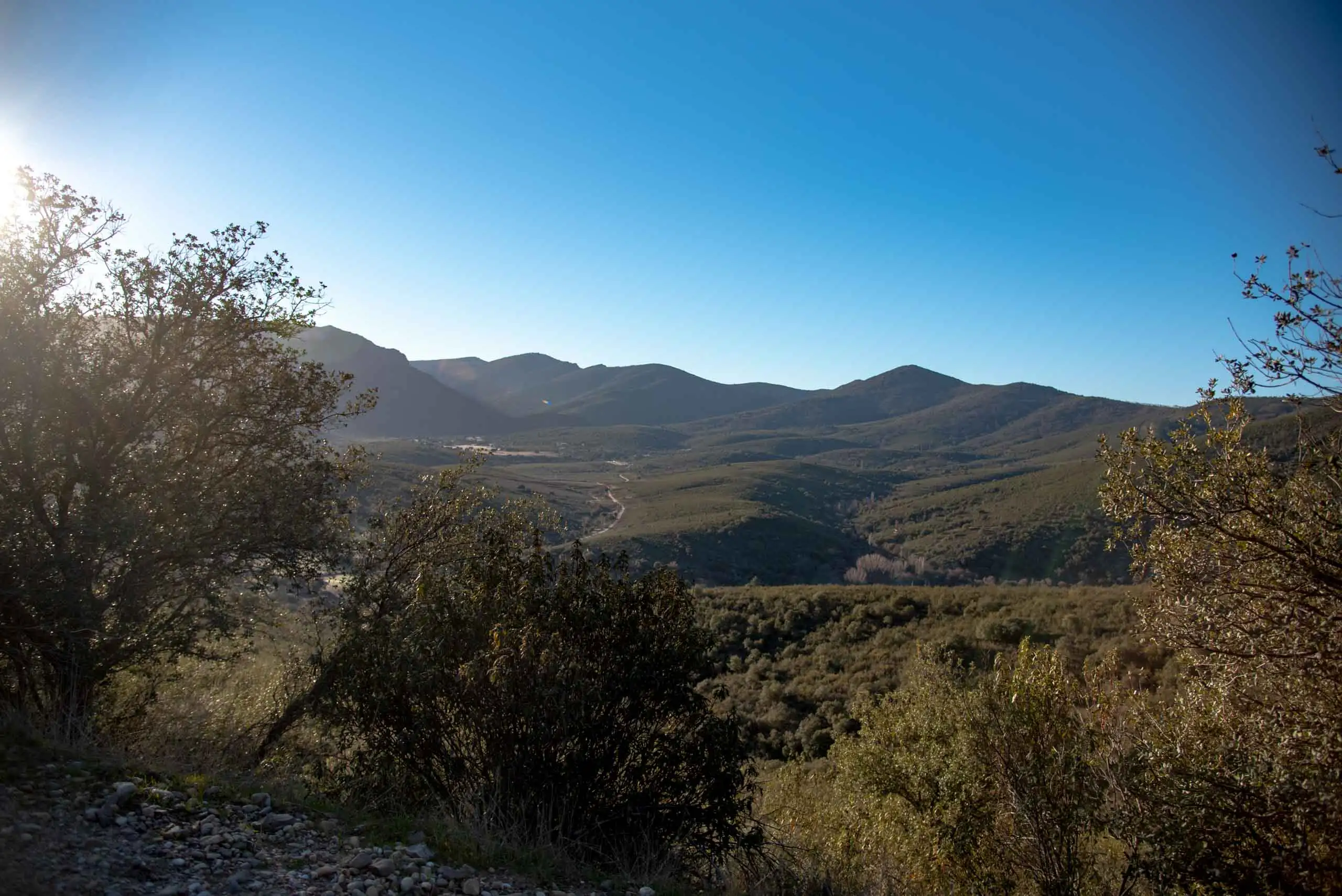
Holm oak woods
Characteristics of holm oak woods
- Formations made up of holm oaks or «chaparros» (species with a very wide ecological valence that tolerate limestone and siliceous substrates).


Location
- From sea level in warm settings to middle-high mountains and inland plateaus in continental conditions.
- Xeric environments.
- Spain has the best representation of Mediterranean holm oak woods. They cover 3/4 of the present forest area, favoured by human disturbance (sclerophyllisation).


Leaf type of the holm oak
- The holm oak has persistent, evergreen leaves with a dark green, leathery upper side. Its underside, velvety to the touch, is covered in a dense whitish down (soft hairs that cover some plant organs). In spring its flowers appear, grouped in hanging clusters (catkins)
- The leaves are leathery, evergreen and wrapped in a thick cuticle covered in hairs. They are persistent, alternate, with a dark green upper side and underside covered in a dense whitish down, of velvety appearance. The flowers appear in spring grouped in hanging sprigs (catkins) of yellow-ochre colour, and its fruits (acorns) can be sweet or bitter.


Holm oak woods of Cabañeros
- Type: Quercus ilex L. subsp. ballota (Desf.) Samp. (= Quercus rotundifolia Lam.).
- They belong to the Luso-Extremaduran biogeographic subprovince.
- Siliceous holm oak woods (settled on quartzites and slates).
- The largest representative communities of the Montes de Toledo.
- Also in areas with less rainfall and greater continentality.
- Typical of the dry-subhumid mesomediterranean belt.
- They cover most of the centre and east of the Montes de Toledo (in the west, with more humidity and warmth, the cork oak wood gains ground).
- They form the most evolved and widespread stage together with cork oak woods and Portuguese oak woods, which share habitat.
- In any corner of the mountains and rañas you can find holm oaks, groves of «chaparros» or serial scrub (replacement stages) that after a hypothetical progressive succession would give rise to mature holm oak woods.
- Single-species holm oak formations: the holm oak woods of El Chorro (Los Navalucillos), on very steep slopes and surrounded by pedrizas.

Species that accompany them in Cabañeros
- In warmer settings, they are usually accompanied by thermophilous shrub species such as the mastic tree (in the middle and lower Bullaque, eastern end of the park) or myrtle, food of red deer that is in regression in the park. They also appear alongside strawberry trees, which occupy 7% of the park’s tree formation.
- Shrubby germander (Teucrium fruticans) and the Montpellier cistus (Cistus monspeliensis)
- Prickly juniper (Juniperus oxycedrus subsp. badia (=Juniperus oxycedrus var. lagunae) in stony, dry, continental areas. Visible on the upper part of the slopes of the Estena Route or at the Milagra hermitage in Navahermosa.
- Portuguese oaks: they cover a significant area on shady slopes and in the mixed dehesas of the rañas.
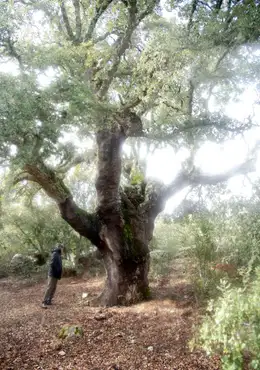
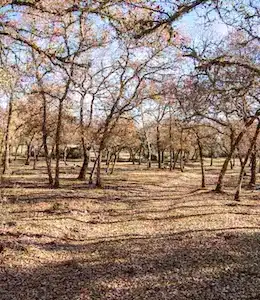
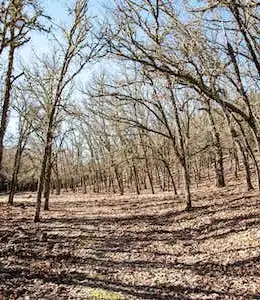
Photos of holm oak woods and holm oaks


News from the park
- New holm oaks on the raña. In winter 2022–2023, 80,000 holm oaks, cork oaks and Portuguese oaks were planted over about 290 hectares of the raña, from acorns collected in the park itself. The usual figure is about 40,000 plants a year.
- The holm oak wood against the heat. In 2026 WWF España volunteers help the CSIC to study how many acorns the holm oak wood produces and how climate change affects it, collecting and processing samples in the laboratory.
- Life in the hollows. In the hollows of old trees lives a world of saproxylic beetles, those that feed on dead wood and return its nutrients to the soil. A study in which the University of Alicante takes part has compared the communities of these beetles in the hollows of Pyrenean oaks, ash trees and holm oaks of the park between 2009–2010 and 2021–2022, to predict how vulnerable they are to global warming, which is felt more in the Mediterranean than anywhere.
Sources: park newsletters of January–February and July–August 2023 and March–April 2026 (all the newsletters) (in Spanish).
Climatophilous and edaphoxerophilous woodland
Bibliography
- Vicente García Canseco (Coor.) (1997). Parque Nacional de Cabañeros. Madrid, Spain: Ecohábitat.
- Perea García-Calvo, R., Perea Ruiz-Tapiador, D., Giménez Velasco, G.F. (2015). Vegetación y flora del Parque Nacional de Cabañeros. Volumen I. El paisaje vegetal: ecología, conservación y rutas de interés geobotánico. Madrid, Spain: Editorial Solitario