
Plants
Ash woods
Characteristics of ash woods
- Made up of the ash (Fraxinus angustifolia).
- More frequent and widespread than alder woods.
- They occupy areas with quite a lot of groundwater moisture although they do not require roots soaked in water.
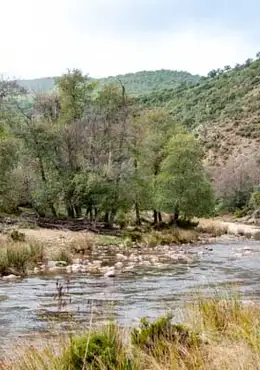
- They can form single-species dehesas further from the river bed, as happens in the valley of the Milagro river (El Molinillo) or the Bullaque river (Retuerta del Bullaque), creating formations that are more hydrophilous than riparian.
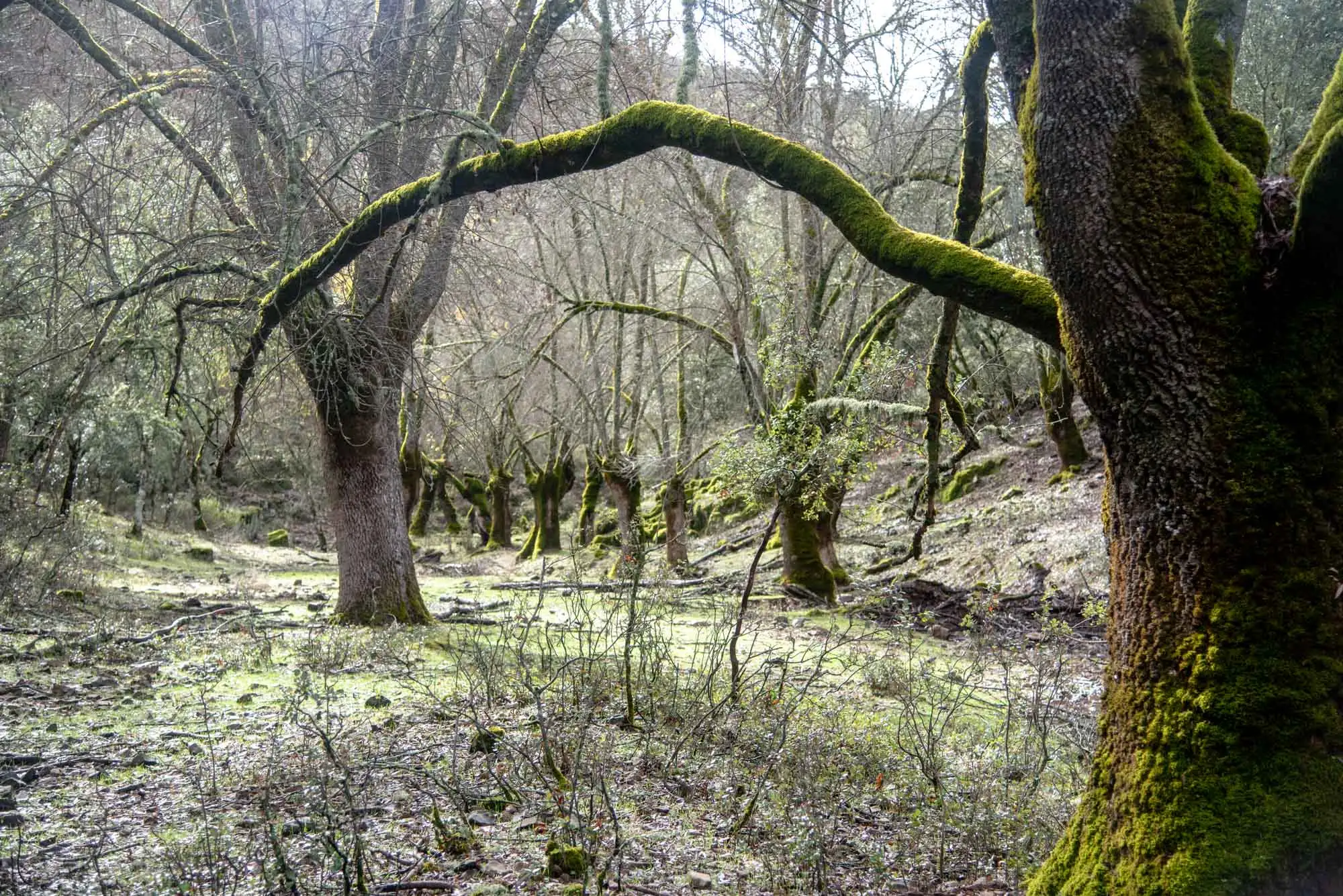
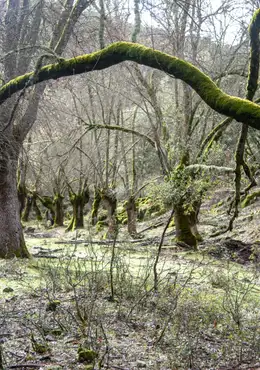
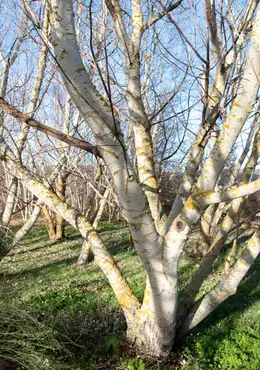
- A palatable species that people have historically favoured to feed livestock. For that reason, almost all the large specimens of the Montes de Toledo have been pollarded («trasmochados», over-pruned). At present, as pollarding no longer takes place, the ash trees have developed a broad crown that breaks apart easily because of the imbalance between crown and trunk.
- Its natural regeneration is threatened by wild herbivores (cervids).
- They can form mixed dehesas with Portuguese oaks.
- They let in more light than alder woods and poplar groves.


Habitat and distribution of ash woods in Cabañeros
- They are present in middle and lower stretches where there is hardly any soil and when the seasonality and erosion of the course do not let them anchor their roots well.

Leaf type
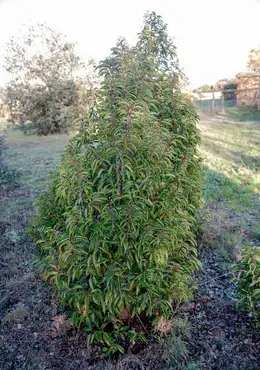
- The leaves are deciduous, opposite —although a few alternate ones sometimes appear— and compound generally of 7–11 leaflets —always an odd number (imparipinnate)— which are lanceolate, generally 10–30 mm wide and serrated, but with spaced teeth. The buds are brown or light brown, unlike Fraxinus excelsior L., with which it can be confused.
Species that accompany ash woods in Cabañeros
- The greater entry of light allows coexistence with shrub species such as brambles (Rubus ulmifolius), butcher’s-broom (Ruscus aculeatus) and hawthorns (Crataegus monogyna).
- Herbaceous species favoured by continuous grazing (short-grass pastures and meadows) usually predominate, which attract herbivores in summer.
- In valleys and foothills Portuguese oaks and Pyrenean oaks can appear, marking the transition towards climatophilous zones.
Photos of ash trees


News from the park
In the hollows of old ash trees, as in those of Pyrenean oaks and holm oaks, lives a world of saproxylic beetles, those that feed on dead wood and return its nutrients to the soil. A study in which the University of Alicante takes part has compared the communities of these beetles in the hollows of Pyrenean oaks, ash trees and holm oaks of the park between 2009–2010 and 2021–2022, to predict how vulnerable they are to global warming, which is felt more in the Mediterranean than anywhere. Source: park newsletter of July–August 2023 (in Spanish).
Edaphohygrophilous communities: riverside woods
Bibliography
- Vicente García Canseco (Coor.) (1997). Parque Nacional de Cabañeros. Madrid, Spain: Ecohábitat.
- Perea García-Calvo, R., Perea Ruiz-Tapiador, D., Giménez Velasco, G.F. (2015). Vegetación y flora del Parque Nacional de Cabañeros. Volumen I. El paisaje vegetal: ecología, conservación y rutas de interés geobotánico. Madrid, Spain: Editorial Solitario