
Plants
Poplar groves
Characteristics of poplar groves
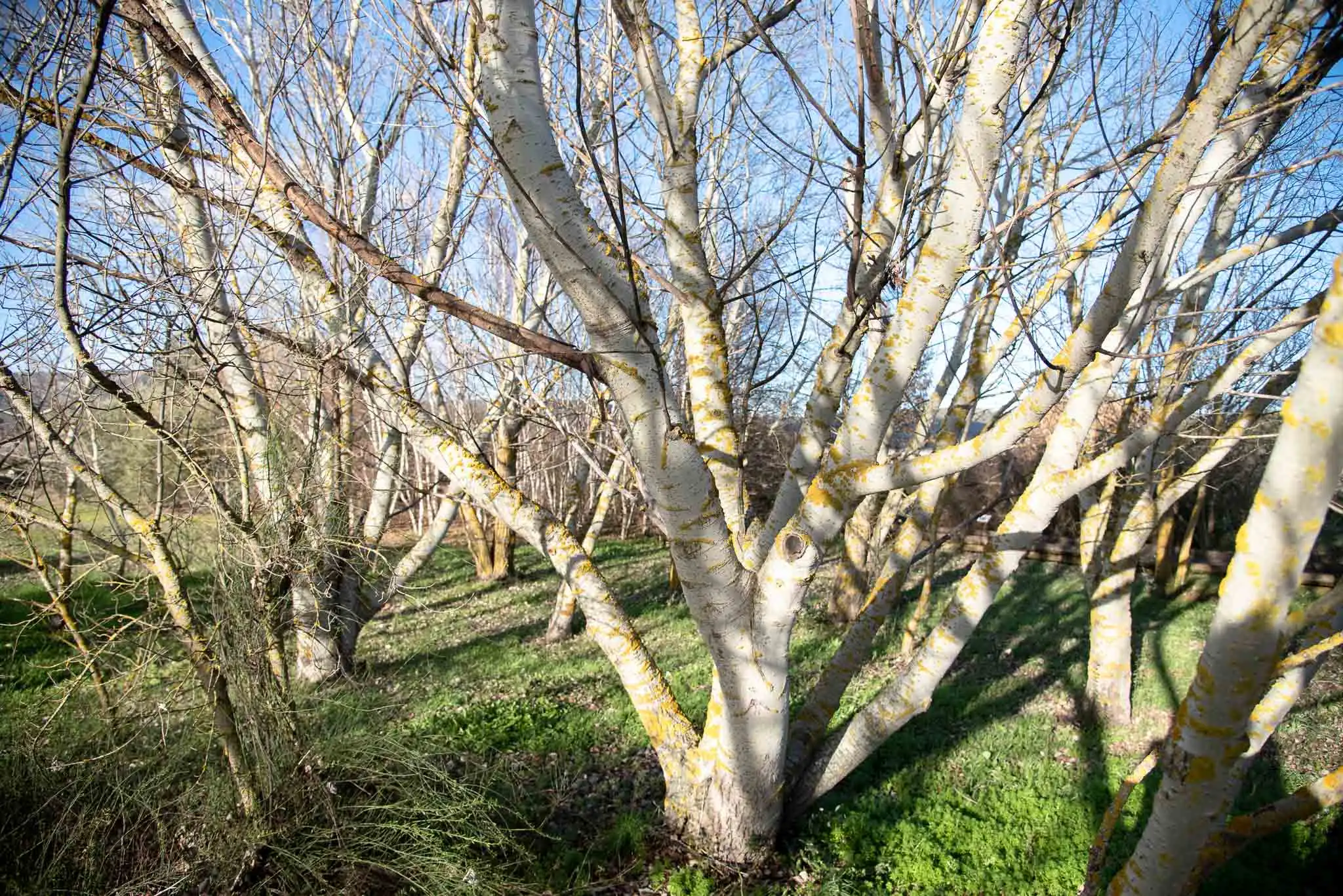
- Poplar groves, or «povedas», are stands of poplars, species belonging to the genus Populus.
- Many of them have been planted by people beside rivers and streams where different hybrid varieties have been introduced.
- Among the hybrid species it is worth highlighting: Populus x canadensis, an artificial hybrid between Populus deltoides and Populus nigra, which has been grown to obtain paper pulp.
- The native poplar species in the Montes de Toledo are the white poplar (Populus alba) and the black poplar (Populus nigra).
- Populus alba is of medium height, whereas Populus nigra and Populus x canadensis can reach 30 m in height.


Habitat and distribution of poplar groves in Cabañeros
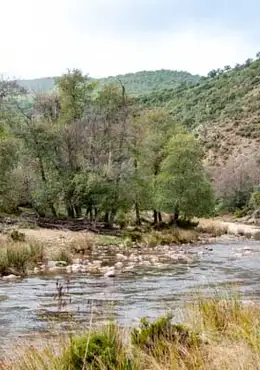
- All poplar groves, whatever their main species, form linear stands tied to the middle and lower stretches of rivers in areas with a lot of moisture. Consequently, most grow on the lower Bullaque river, on the outskirts of the national park, and on other large rivers such as the Tagus and the Guadiana.
- The Populus alba stands tend to be found in warmer, less cool settings such as the bank of the Tagus.
- The Populus nigra stands need more coolness and can therefore climb to higher altitudes.
- There is a small stand of Populus x canadensis on the Alcobilla river, near El Robledo, possibly of human origin for ornamental growing.
Leaf type of the poplars
- White poplar=Populus alba: alternate, broad and very variable in shape (toothed-angular or palmate-lobed), symmetrical or not, light green on the upper side and with a characteristic whitish or silvery down on the underside.
- Black poplar=Populus nigra: leaves simple, deciduous, alternate (this feature is best seen in the middle part of the branches, since at the ends they sometimes appear very close together), rhomboid or triangular, finely serrated on the margin, intense green on the upper side and with a long leaf stalk that looks flattened.
- Canadian poplar, hybrid poplar=Populus x canadensis: broad, large leaves, triangular or broadly deltoid, with a straighter base, broadly wedge-shaped or truncated. The margin is serrated or scalloped (finely wavy), often has some cilia when sprouting and generally has glands at the base of the blade. The leaf stalk is very long and flattened sideways.

Species that accompany birches in Cabañeros
- Willows
- Hawthorns
- Ferns.
- Salix salviifolia usually lives alongside Populus alba.
Edaphohygrophilous communities: riverside woods
Bibliography
- Vicente García Canseco (Coor.) (1997). Parque Nacional de Cabañeros. Madrid, Spain: Ecohábitat.
- Perea García-Calvo, R., Perea Ruiz-Tapiador, D., Giménez Velasco, G.F. (2015). Vegetación y flora del Parque Nacional de Cabañeros. Volumen I. El paisaje vegetal: ecología, conservación y rutas de interés geobotánico. Madrid, Spain: Editorial Solitario