
Plants
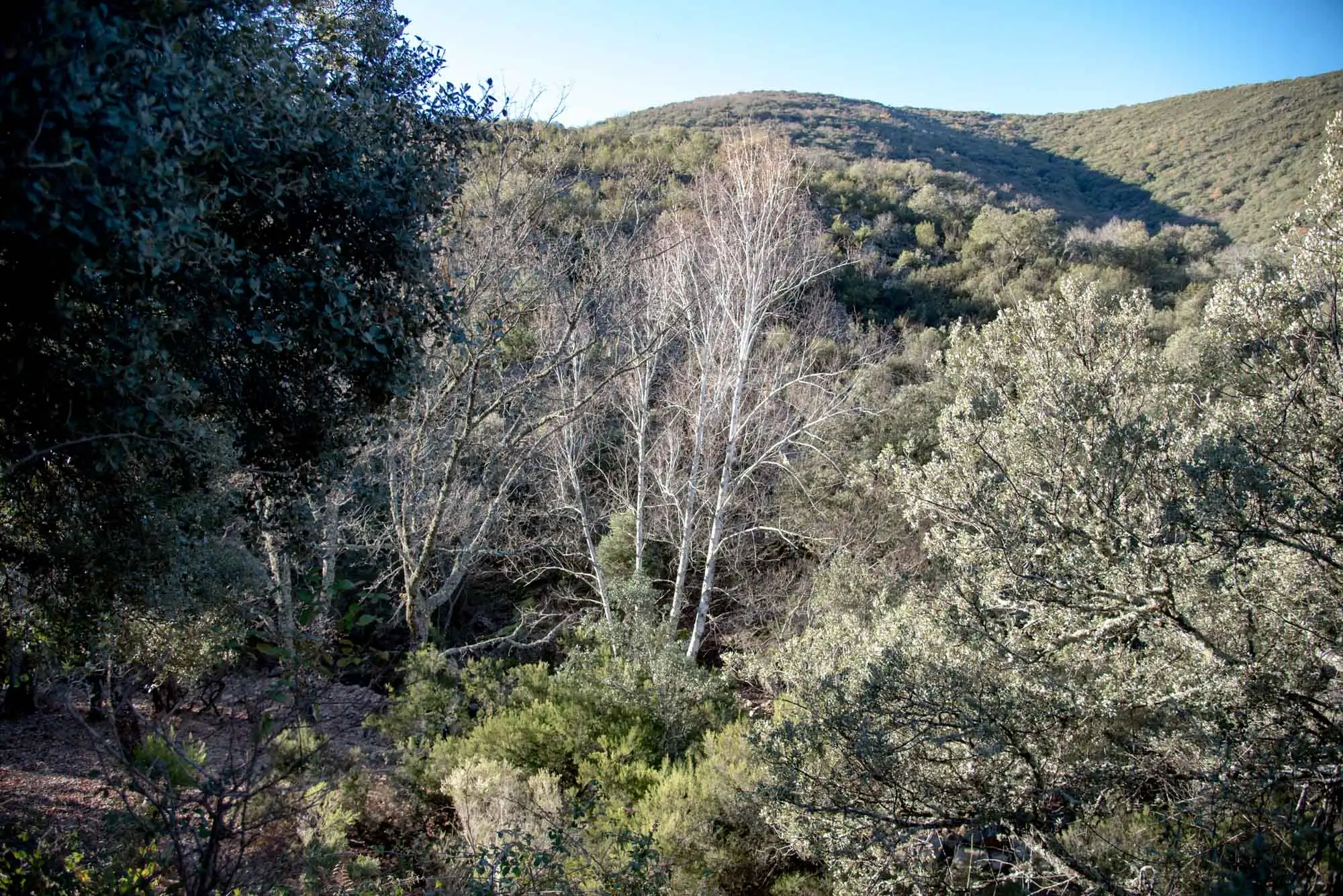
Birch woods
Characteristics of birch woods
- They covered large areas all over Europe after the glaciations thanks to their colonising ability.
- Their long isolation within the peninsula produced speciation, giving rise to new taxa, some of them endemic to the region. Later, with the improvement of climate and soil, birches were pushed back to more isolated enclaves by the appearance of more competitive species such as the beech family (oaks and beeches). They are therefore true relics of the age of the glaciations.
- The birches of Cabañeros are species of Euro-Siberian distribution, very abundant in the north of the peninsula and scarcely present in the south.
- Today, birches, together with the Portuguese laurel groves, are secondary woods that must be protected for their high floristic, cultural and ecological value.
- Unlike alders, birches withstand summer low water better, and so do not need to keep their roots in water all year.
- The Betula parvibracteata birch woods of the Montes de Toledo are considered a meso-supra-Mediterranean edaphohygrophilous and fluvial series (Galio broteriani-Betulo parvibracteatae S.). Their replacement stages are made up of bramble thickets (Clematido campaniflorae-Rubetum ulmifolii).
- On the valley floors, the replacement stages correspond to heathland with bog myrtle (Erico tetralix-Myricetum gale).
Birch species in Cabañeros

It was traditionally believed that only the species Betula pendula grew in the Montes de Toledo. However, the latest studies have shown the existence of a population of Betula pubescens, specifically Betula pubescens subsp. celtiberica (Rothm. & Vasc.) Rivas-Mart., which turns out to be the southernmost population of Betula pubescens in Spain known so far.
However, Betula pendula is the dominant species in Cabañeros, specifically the taxon Betula pendula subsp. fontqueri var parvibracteata (Peinado, G. Moreno & M. Velasco). It is a species endemic to the Montes de Toledo whose main feature is the great reduction of its bracts (Sánchez del Álamo et al., 2009). Given its high degree of fragmentation, its difficulty in regenerating and its small area of occupancy, it is considered a critically endangered taxon in the Red List of Spanish Vascular Flora (Moreno 2009).
Habitat and distribution of birch woods in Cabañeros
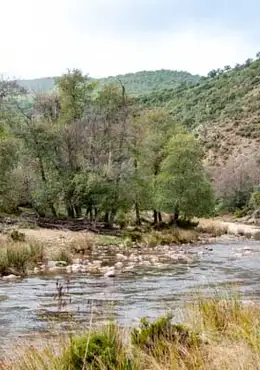
- They lie on valley floors at a surprising altitude of about 600 metres and at the heads of rivers at heights above 1,000 metres. They are areas tied to permanent watercourses and damp soils.
- The Betula pubescens subsp. celtiberica birch wood of La Ventilla is the most striking unit, in the Bullaque river basin, with 806 adult individuals.
- The valley-floor birch woods lie in places where water stagnates, with peaty soils, in areas with little slope where debris tends to block the river course and the soil is damper.
- The headwater birch woods can be found in intricate, shady and sometimes rocky ravines, whose soils are shallow, where the ash cannot anchor its roots. Some examples can be seen at the Boquerón del Estena and on the El Chorro route.
Leaf type
- Leaves are alternate, serrated, almost rhomboid in shape —sometimes slightly heart-shaped or triangular— and ending in a fine point.
Species that accompany birches in Cabañeros
- Alder buckthorns (Frangula alnus)
- Ferns (Pteridium aquilino and Osmunda regalis)
- Peat-loving species such as Erica tetralix, Myrica gale, Genista anglica and Sphagnum spp.
- Water-loving herbaceous species: Molina caeruela, Stachys officinalis, Teucrium scorodonia and Brachypodium sylvaticum.
- The headwater birch woods live alongside maples (Acer monspessulanum), wild service trees (Sorbus torminalis), hollies (Ilex aquifolium) and yews (Taxus baccata).
News from the park
A study by the universities of Bern, the Polytechnic University of Madrid and Murcia (Morales and others, 2023) recalls that the birches of Cabañeros (Betula pendula subsp. fontqueri) are among the southernmost in Europe. They live in the «trampales» or «bonales», acid peat bogs where the carnivorous Drosera rotundifolia also grows, and they are squeezed by grazing and the number of ungulates; the sediments also show repeated fires over the last 4,000 years. Source: park newsletter of January–February 2023 (in Spanish).
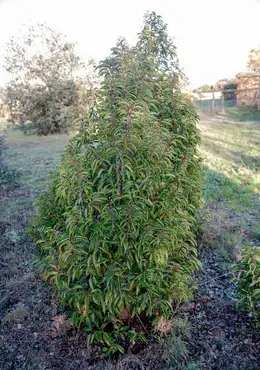
Edaphohygrophilous communities: riverside woods
Bibliography
- Vicente García Canseco (Coor.) (1997). Parque Nacional de Cabañeros. Madrid, Spain: Ecohábitat.
- Perea García-Calvo, R., Perea Ruiz-Tapiador, D., Giménez Velasco, G.F. (2015). Vegetación y flora del Parque Nacional de Cabañeros. Volumen I. El paisaje vegetal: ecología, conservación y rutas de interés geobotánico. Madrid, Spain: Editorial Solitario