
Birds
Birds of the sclerophyllous woodland
A short introduction to the sclerophyllous woodland: holm oak, cork oak and Portuguese oak woods
In Cabañeros, the sclerophyllous woods are of a mixed character; stands clearly dominated by a single species are found only where people have intervened.


- Holm oak wood with wild pears: found on the rañas and usually turned into dehesa. The holm oak (Quercus ilex) and the Iberian wild pear (Pyrus bourgaeana) dominate, together with a shrub layer made up of rockroses (Cistus ladaniferus), gorse (Genista europaea), mock privet (Phyllyrea angustifolia), heather (Erica australis), and so on.
- Holm oak wood with Portuguese oaks: at the same altitude, though with more moisture. The main species are the holm oak and the Portuguese oak (Quercus faginea). In the shrub layer the strawberry tree (Arbutus unedo), the heather (Erica scoparia), the rockrose (Cistus ladaniferus) and other species predominate.
- Cork oak wood with holm oaks: found between 700 and 1,000 m of altitude and on sunny slopes. Holm oaks and cork oaks (Quercus suber) stand out, sometimes also the wild olive (Olea europaea). Among the shrubs appear the poplar-leaved rockrose (Cistus populifolius), the strawberry tree, heathers and so on.
- Cork oak wood with Portuguese oaks: also between 700 and 1,000 m of altitude but on shady slopes. Its dominant tree species are cork oaks and Portuguese oaks, although holm oaks are present. Around the pedrizas appear the wild service tree (Sorbus torminalis) and the maple (Acer monspelliensis). Among the shrubs, the terebinth (Pistacia therebinthus), strawberry trees, rockroses and heathers stand out.
- Portuguese oak–strawberry tree scrub and strawberry tree scrub: in fact these are degraded forms of the cork oak woods already described. They look like shrub formations with isolated trees.
Around these mature woods appear plant communities at different serial stages. They show the action of nature and the marks of human disturbance.
Birds of the sclerophyllous woodland in Cabañeros
The sclerophyllous woodland has great diversity. Its most abundant species are:
- European Robin (Erithacus rubecula)
- Common Blackbird (Turdus merula)
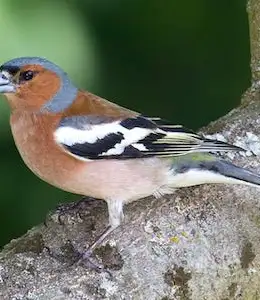
- Common Chaffinch (Fringilla coelebs)
- European Serin (Serinus serinus)
- Dunnock (Prunella modularis)
- Common Linnet (Carduelis cannabina)
- Warblers (Sylviidae, a family of passerine birds made up mainly of small insect-eaters)
- Tits (Paridae, a family of passerine birds)


Features of the woodland in winter in Cabañeros
- The number of species falls because the group of seed-eating birds is absent.
- The percentage of insect-eating birds rises (25%), as a result of milder temperatures that allow arthropods to live on the ground and on trunks and branches.
- Most of these birds are small.
- Because of the lower cover and biomass of the herbaceous layer, the number of seed-eating species is low (13.88%).
| TROPHIC STRUCTURE OF THE WINTERING BIRD COMMUNITY | NUMBER OF BIRD SPECIES | PERCENTAGE % |
|---|---|---|
| Predators | 10 | 27.27 |
| Insect-eaters | 9 | 25 |
| Fruit-eaters | 1 | 2.77 |
| Seed-eaters | 5 | 13.88 |
| Omnivores with a high winter intake of fruit | 8 | 22.20 |
| Strict omnivores | 3 | 8.33 |
| TOTAL | 36 |
Insect-eating birds become quite important within the community of winter visitors in the mature woodland. They are birds whose diet is based on insects found in bark, leaf litter and so on, and which are seasonally fruit-eaters. In this season they depend on the fruits produced by the blackberry (Rubus sp.), mock privet (Phillyrea angustifolia), laurustinus (Viburnum tinus), wild service tree (Sorbus torminalis), myrtle (Myrtus communis), mastic tree (Pistacia lentiscus), wild olives (Olea europaea) and strawberry trees (Arbutus unedo). To this group belong the Eurasian Blackcap (Sylvia atricapilla), the European Robin, the Spotless Starling (Sturnus unicolor) and the Song Thrush (Turdus philomelus).


In autumn, while small-fruited species ripen and there are plenty of small insects, a famous migratory passage of some seasonally fruit-eating species takes place, such as the Common Redstart (Phoenicurus phoenicurus) and the European Pied Flycatcher (Ficedula hypoleuca). Later, with the start of the olive harvest –one of the most important food resources–, this group of birds is replaced by other, larger seasonally fruit-eating species, such as the Song Thrush (Turdus philomelus).


The winter community present in the serial stages, such as scrub, is shaped by the influence and intensity of grazing by ungulates (mammals that walk on the tips of toes that have turned into hooves, for example goats) on fruit-producing vegetation, such as the mastic tree and mock privet, which are more accessible because of their lower height.
In winter these communities tend to visit the ground, because of the lack of food linked to the leaf system. There is, however, one very striking exception in this season, the group of fruit-eating, mixed-diet birds, which eat fruit at this time. By contrast, in the other seasons –spring, summer and autumn– the birds tend to visit the branches and twigs.
The breeding birds
- There are quite a few species, 54 in all.
- The proportion of birds of prey is high (14%)
- The percentage of insect-eating species is similar to that of the raña, at 40.74 per cent.
- Medium-sized and large species make up 18.1 per cent.
| TROPHIC STRUCTURE OF THE BREEDING BIRDS | NUMBER OF SPECIES | PERCENTAGE IN % |
|---|---|---|
| Predators | 14 | 25.92 |
| Insect-eaters | 22 | 40.73 |
| Fruit-eaters | 1 | 1.85 |
| Seed-eaters | 8 | 14.81 |
| Omnivores | 9 | 16.66 |
| TOTAL | 54 species |
In general, the breeding passerine communities present in the mature woodland are insect-eaters. They also tend to feed in the scrub layers, on trunks and in the canopy, and are much more diverse than on the rañas. Within this community the following stand out:
- Great Spotted Woodpecker (Dendrocopos major)
- Cetti’s Warbler (Cettia cetti)
- Western Orphean Warbler (Sylvia hortensis)
- Eurasian Wren (Troglodytes troglodytes)
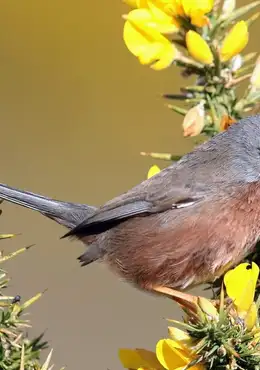
- Western Subalpine Warbler (Sylvia cantillans)
- Spotted Flycatcher (Muscicapa striata)
- Short-toed Treecreeper (Certhia brachydactyla)
- Eurasian Golden Oriole (Oriolus oriolus)


There is also in this area a group of mixed-diet generalists that feed both in trees and shrubs and on the ground:
- Eurasian Blue Tit (Parus caerulus)
- Great Tit (Parus major)
- Common Blackbird (Turdus merula)
- European Robin (Erithacus rubecula)


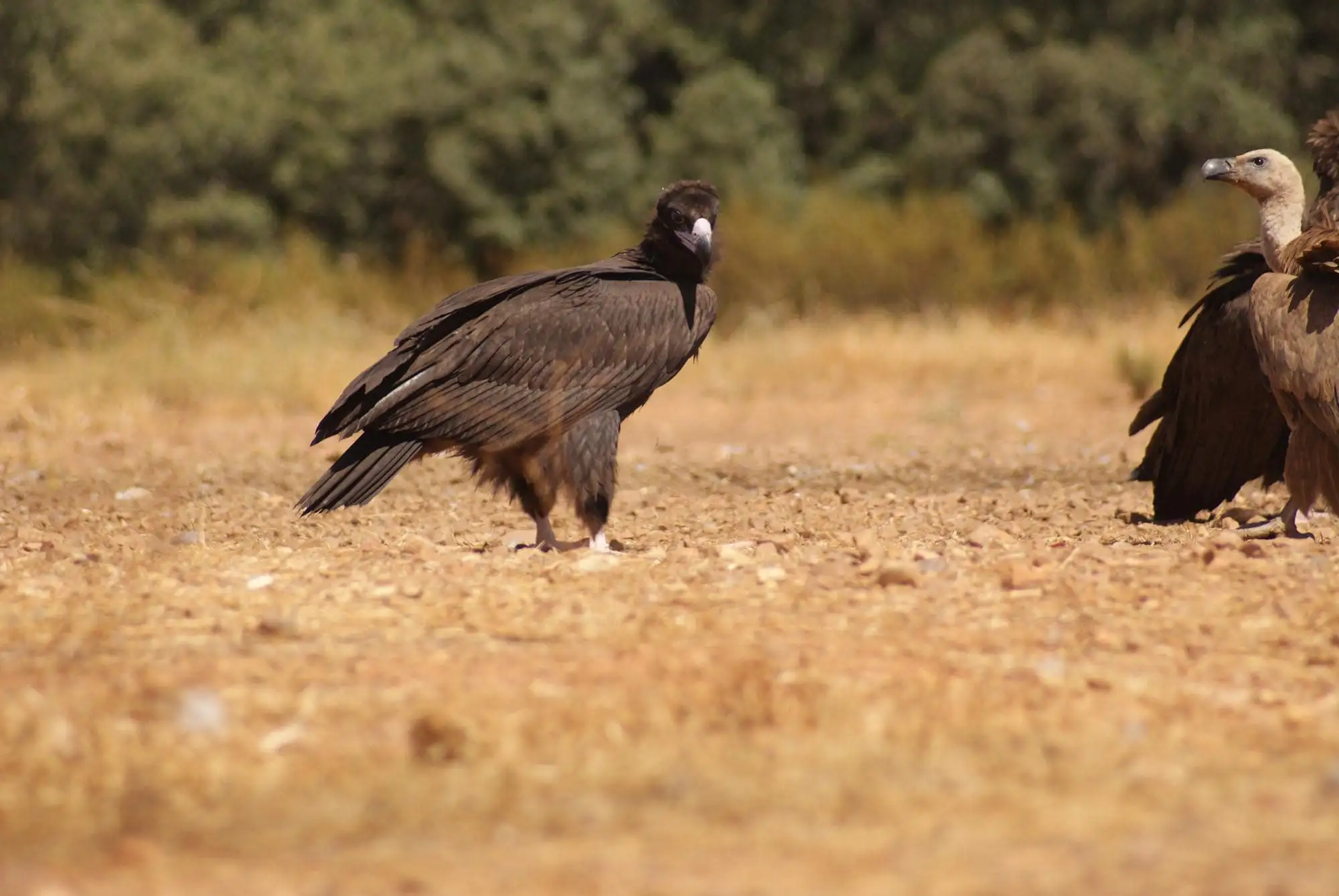
In the wooded mountains, among the breeding communities species of great interest such as the Cinereous Vulture stand out. Also other birds of prey such as:
- Spanish Imperial Eagle (Aquila adalberti)
- Golden Eagle (Aquila chrysaetos)
- Booted Eagle (Hieraaetus pennatus)
- Short-toed Snake Eagle (Circaetus gallicus), a summer species.


All are resident species except the Short-toed Snake Eagle which, because its food depends on reptiles, is present only in summer. It can be seen that the number of predators is at its maximum, 14 species. The presence of the Black Stork, which nests in wooded areas, should also be stressed.

The vulture of the woodland
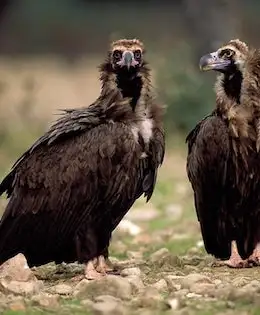
The Cinereous Vulture, formerly known in the area as <<abanto>>, is one of the species that leads the conservation of Cabañeros National Park. It is a threatened species according to the International Union for Conservation of Nature, and Cabañeros holds the most important breeding nucleus in the world.

Since the 1990s, the park’s breeding population has stabilised at between 100 and 120 pairs. That is why the proportion of the population that breeds is high. Nevertheless, the number of pairs that breed successfully is closely tied to the weather, above all to the continuity of rain at hatching time.
In December the courtship flights decorate the sky and nest building begins. The nests play a fundamental social role, since the pair goes to sleep in them even outside the breeding season. Also, the Cinereous Vulture, without being strictly a colonial species, builds its nests in a concentrated way. The territory each pair actively defends covers about 1 hectare, which means that nest density is not very high. The average distance in Cabañeros is 370 metres (JIMÉNEZ, 1991).
In December the courtship flights decorate the sky and nest building begins. The nests play a fundamental social role, since the pair goes to sleep in them even outside the breeding season. Also, the Cinereous Vulture, without being strictly a colonial species, builds its nests in a concentrated way. The territory each pair actively defends covers about 1 hectare, which means that nest density is not very high. The average distance in Cabañeros is 370 metres (JIMÉNEZ, 1991).

The advantage of grouping is thought to be better food finding, because of the social behaviour of <<local enhancement>>, which works by increasing the efficiency of use of the hunting ranges. This reaches its greatest extent in summer, when the vulture uses the scrub areas to find its prey (JIMENEZ, 1991). Its kleptoparasitism (a form of feeding in which an animal takes advantage of prey or food that another animal has caught) towards other species should also be noted, especially towards the Tawny Eagle (Aquila rapax). In Cabañeros National Park it has also been observed towards the imperial eagle.
Quite the opposite of the Griffon Vulture (Gyps fulvus), which, besides being more sociable and much less aggressive when feeding, eats medium and large carrion in open areas.

The chicks hatch in mid-April, weighing about 170 grams. The adults look after the young during the first 100 days, protecting them from sun and rain with their wings and bringing them food and water in the crop (a swelling of the bird’s oesophagus, shaped like a membranous bag, where food is stored to soften it before being ground in the gizzard). The food is semi-digested prey, mostly rabbits, which the vulture regurgitates in the nest and then tears up so that the chick can swallow it easily. The chick manages to take its first flights at the end of August or in mid-September.
More birds of Cabañeros
Bibliography:
- Jiménez García Herrera, José. (1997). Avifauna. En Parque Nacional de Cabañeros (pp. 192-224). Madrid, España: Ecohábitat.