
Birds
Birds of the rivers in Cabañeros
The Estena river

It is a river that rises on the high summits of the Rocigalgo massif, at more than 1,400 metres and right inside Cabañeros National Park, and leaves it at an altitude of 500 metres. It has the usual features of fast mountain rivers: a steep gradient, and it rarely dries up completely, as it survives in pools during the summer. Its vegetation is a riparian wood in which alders, Portuguese oaks and ash trees are common, with isolated yews in its highest part.

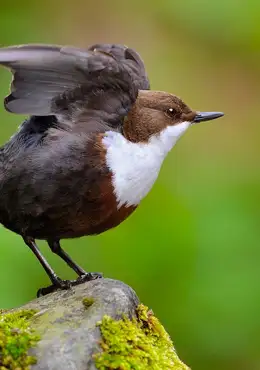
Among its typical birds stand out some regular prowlers found on the stones that stick out of the water:
- White-throated Dipper (Cinclus cinclus)
- Grey Wagtail (Motacilla cinerea)


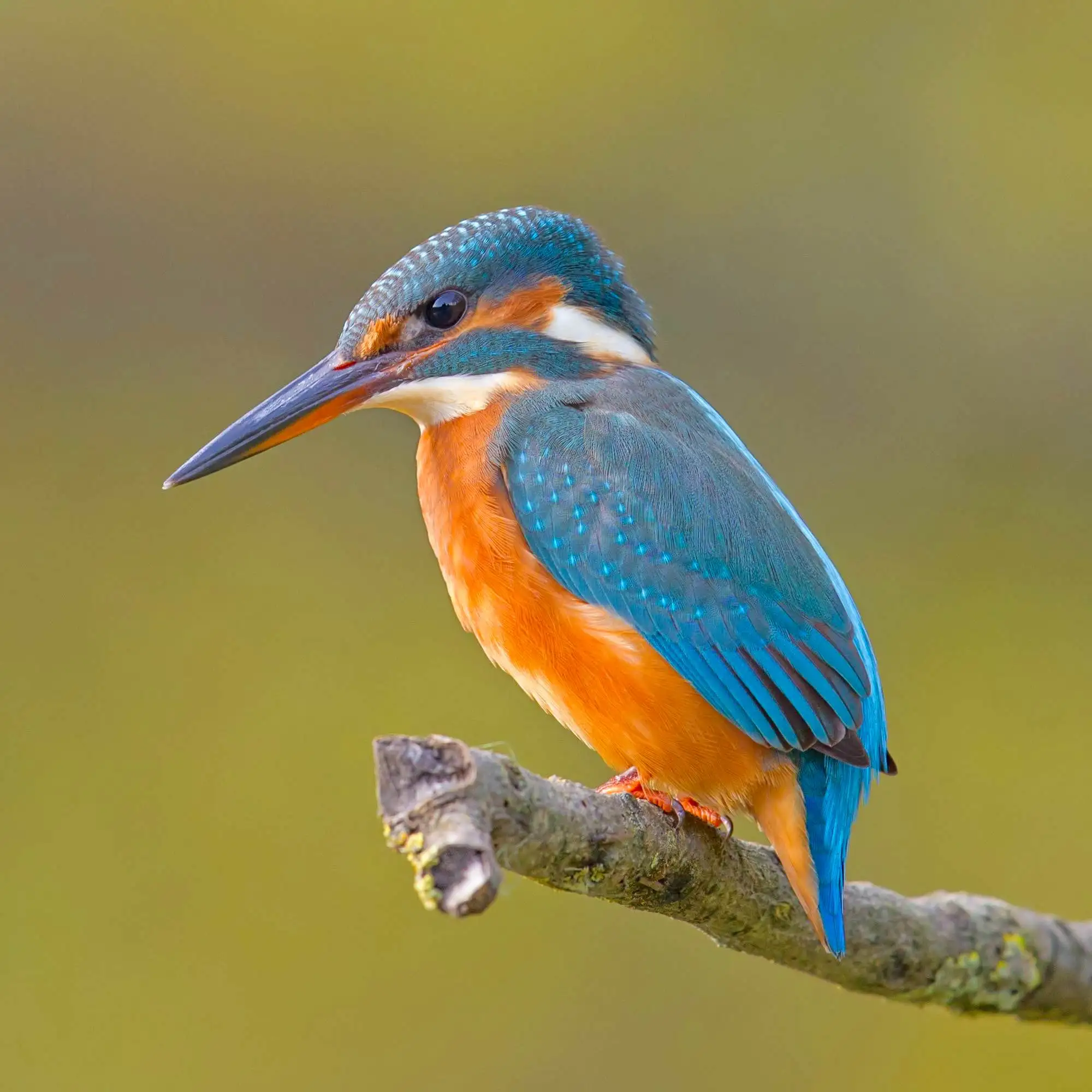
At the end of August a small group of Black Storks (Ciconia nigra) can be found which, in post-breeding gathering, take advantage of the aquatic fauna left concentrated in the pools. The presence of the Common Kingfisher (Alcedo atthis) in autumn and winter is also worth noting.


The Bullaque river
The Bullaque, a tributary of the Guadiana, rises inside the Montes de Toledo, very close to the park, and skirts its eastern edge. Part of its course is in the Natura 2000 network.
It is a river that brings together a large set of plant communities. Unlike the Estena, it has a slow flow that moves over a plain, the Alcoba-Porzuna basin, which includes the Cabañeros raña. Around it, where the water table is shallower, Pyrenean oak and Portuguese oak woods can be found living with laurustinus, brambles, clematis, wild roses and the odd dogwood (Cornus sanguinea).
Near the channel there are ash woods together with willows, alder buckthorns and bog myrtle. Likewise, while in some stretches of the river reed (Phargmites australis) and bulrush (Typha latifolia) formations appear on the banks, in others Molinia caerulea subsp. arundinacea predominates.
The community of floating plants is made up of water lilies and floating-leaved plants (Nuphar lutea, Myriophyllum alterniflorum, Ludwigia palustris, Hydrocotyle vulgaris, Potamogeton poligonifolius…)
The bird community of the Bullaque is completely different from that of the Estena. The following can be found as breeders:
- Black Stork (Ciconia nigra)
- Common Kingfisher (Alcedo atthis)
- Mallard or (Anas platyrhynchos)
- Common Moorhen (Gallinula chloropus)


There is even a record of the White-headed Duck (Oxyura leucocephala).

Although species tied to fast water are missing, a community related to marsh vegetation appears, for example:
- Little Bittern (Ixobrychus minutus), present in the reed beds.
- Eurasian Penduline Tit (Remiz pendulinus), scarce in the willow groves.


Dry rivers count too
In summer many of the park’s channels look dry, but they are still useful: they act as corridors for the animals that cross the park. This is what the RIMED-FAUNA project studies, run by the Organismo Autónomo Parques Nacionales with the park and the Complutense University of Madrid, directed by M.ª del Mar Sánchez Montoya: how wildlife uses temporary rivers through the year and how climate change affects it. Its cameras filmed the lynx Uvita jumping a stream with her three cubs (the lynx in Cabañeros). Sources: park newsletters of May–June 2023 and July–August 2026 (in Spanish).
More birds of Cabañeros
Bibliography:
- Jiménez García Herrera, José. (1997). Avifauna. En Parque Nacional de Cabañeros (pp. 192-224). Madrid, España: Ecohábitat.