
Plants
Amphibious, hygropeat and aquatic communities
Amphibious communities
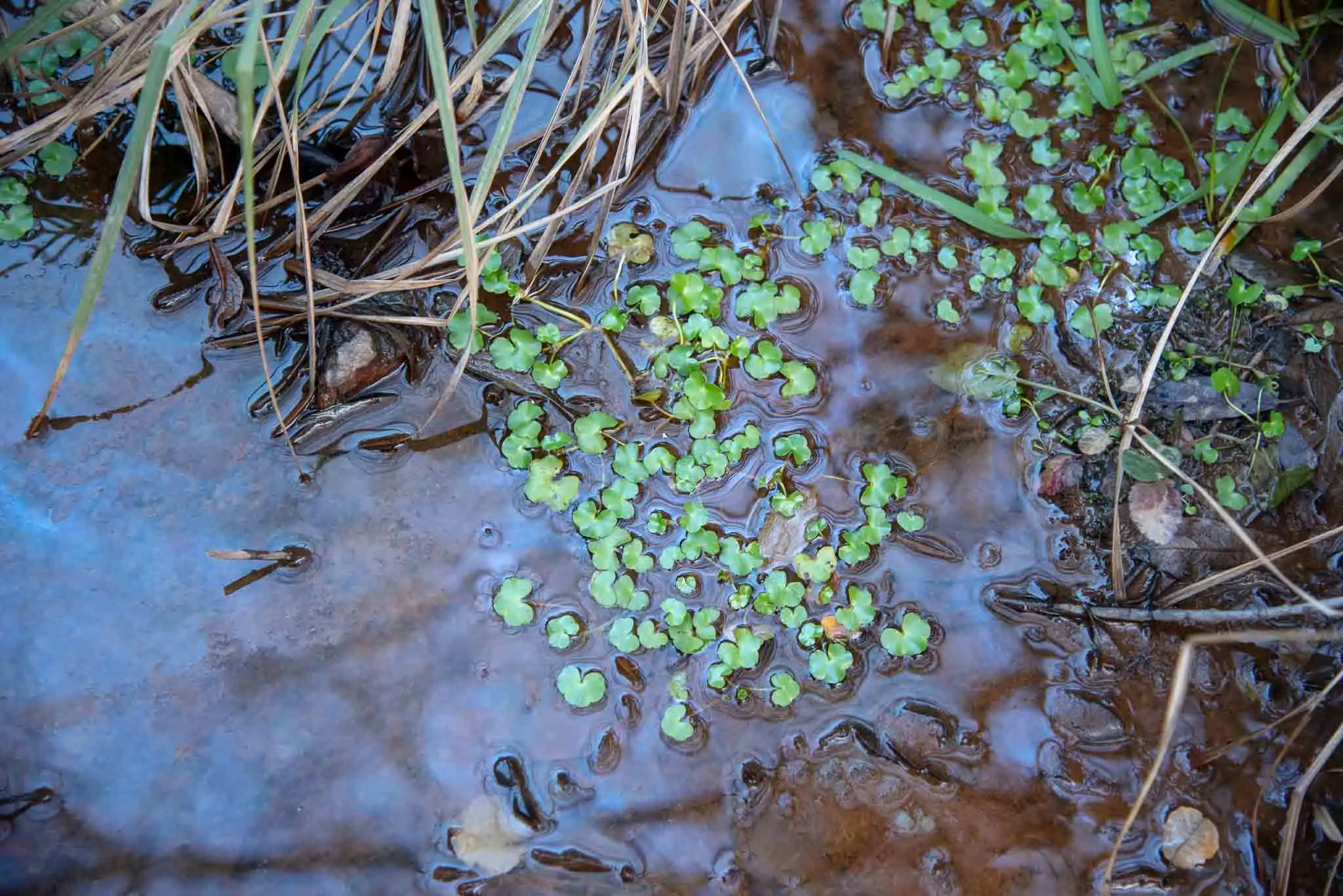
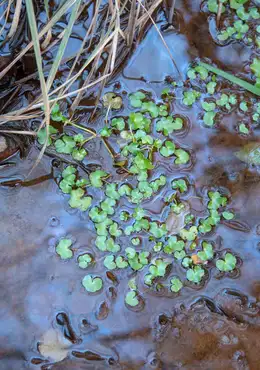
- They are found in places where seasonal waterlogging occurs, in winter or spring, which hold a different composition of species depending on how long the waterlogging lasts.
- These flat places, found in the raña valleys and showing a certain hydromorphy, are called <<«navas»>> or <<«navajos»>>, and often give their name to many villages and estates in the area.
- Where waterlogging is prolonged, until the end of spring, species of the genus Ranunculus dominate, especially Ranunculus peltatus, and other water-loving species such as Mentha cervina (= Preslia cervina) Baldelia ranuncoloides, Littorella uniflora or Callitriche brutia.
- When waterlogging lasts less time, communities made up of annual species and small geophytes arise. This is the case of the grass Newoschischkinia pourretii (= Agrostis pourretii) or pennyroyal (Mentha pulegium). On the banks of these small ponds showy-flowered species can appear, such as jonquils (Narcissus junquilla) or orchids (Orchis laxiflora, Serapias lingua).
Hygropeat communities
- In the hygropeat zones, with a high degree of acidity and anoxia, herbaceous species arise that live alongside shrub species specialised in this environment and the bryophytes of the genus Sphagnum.
- Some of them are relict and singular in character, among which the carnivorous plants stand out, for example: the round-leaved sundew (Drosera rotundifolia) and the butterwort (Pinguicula lusitanica).
- There are other typical herbs such as Potentilla erecta, Anagallis tenella, Carex echinata and purple moor-grass (Molinia caerulea).
- At present, most of these communities are threatened by the strong grazing pressure of wild ungulates, specifically red deer and wild boar, which find these places very appealing, as they serve as wallows and drinking points in the hot months.
Aquatic communities: hydrophytes and helophytes
- Hydrophytes: communities that cover the surface of calm, permanent water bodies. Some are very striking, such as those made up of white and yellow water lilies (Nymphaea alba and Nuphar lutea), visible on the Bullaque and Guadiana rivers. By contrast, runnels of calm, shallow water are covered by pondweed (Potamogeton spp.), duckweeds (Lemna minor and Lemna gibba), and, occasionally, an invasive species, of American origin, which spreads through backwaters colonising the warmer waters –mainly the Guadiana river basin–, called: Azolla filiculoides.
- Helophytes: these communities are characterised by having roots immersed in flooded mud with part of the stem emerging from the water. They lie where water stays stagnant, as in backwaters of streams and rivers and on the edges of ponds. Macrophytes such as the common reed (Phragmites australis) and the bulrushes or reedmaces –species of the genus Typha– dominate these communities, and usually form alternating single-species stands depending on their ecology: in the case of the reed, it tolerates better a lack of moisture in the soil. Other species that live in these environments are the yellow flag (Limniris pseudacorus (=iris pseudacorus) and the lake club-rush (Schoenoplectus lacustris subsp. (=Scirpus lacustris).
- Communities tied to river courses or riparian: with scarce presence, these communities lie on surfaces of high plant diversity. Among them the stony beds stand out, communities formed by large tussock sedges that settle in rivers and streams of the mountains of the central and western sector of the Montes de Toledo, also in Cabañeros. They appear in permanent or semi-permanent clean-water courses and the dominant species is Carex elata subsp. reuteriana (=Carex broteriana), which appears with other Carex, some cyperaceae of other genera (Cyperus longus), rushes, for example Luzula forsteri; or rubiaceae, such as Galium broterianum, cited in birch woods. In Cabañeros, they can be located on the Estena river, on streams such as La Calanchera and near the El Chorro–Rocigalgo route.
News from the park
- A new carnivorous plant for the park. In 2025 a park guide found Pinguicula lusitanica, a small carnivorous plant with pink or lilac flowers that lives in peat bogs and quaking bogs and catches insects with its sticky leaves. It is listed as «near threatened» on the Red List of Spain.
- Peat bogs with a lot of history. A palaeoecological study of 2023 (Morales and others) has reconstructed the history of the park’s «trampales» or «bonales», acid peat bogs with the carnivorous Drosera rotundifolia and some of the southernmost birches in Europe: there were repeated fires over the last 4,000 years, and today they are under pressure from grazing and the number of ungulates.
Sources: park newsletters of January–February 2023 and March–April 2025 (all the newsletters) (in Spanish).
Photos of amphibious, hygropeat and aquatic communities

Herbaceous communities
 Mesophytic communities
 Xeromesophytic communities
 Therophyte communities
 Amphibious, hygropeat and aquatic communities
 Rock communities
 Dehesas
Bibliography
- Vicente García Canseco (Coor.) (1997). Parque Nacional de Cabañeros. Madrid, Spain: Ecohábitat.
- Perea García-Calvo, R., Perea Ruiz-Tapiador, D., Giménez Velasco, G.F. (2015). Vegetación y flora del Parque Nacional de Cabañeros. Volumen I. El paisaje vegetal: ecología, conservación y rutas de interés geobotánico. Madrid, Spain: Editorial Solitario