
Plants
Therophyte communities
Characteristics of therophyte communities
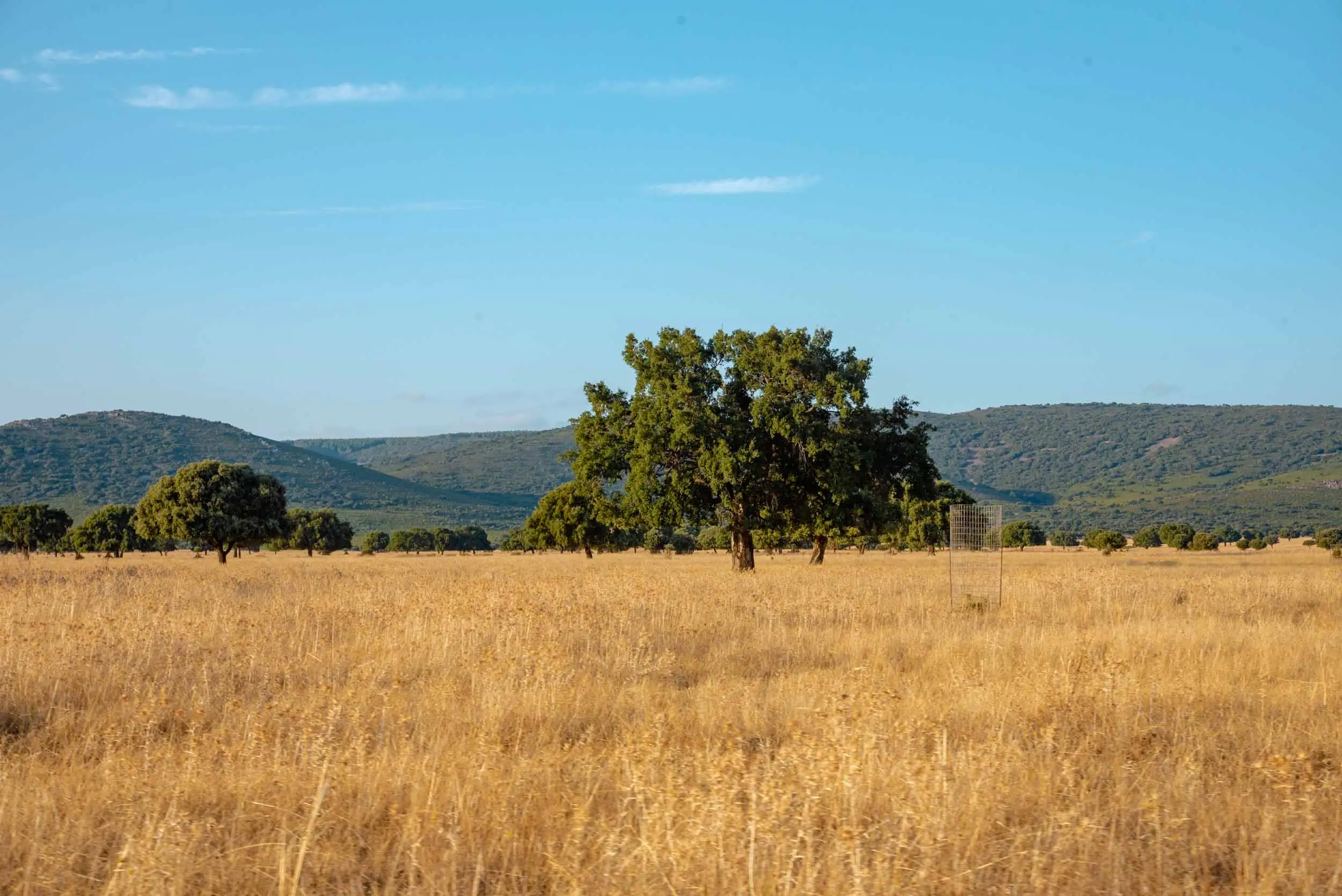
- Therophyte herbaceous communities are characterised by annual species that spend the summer season as seeds.
- They are the communities that occupy the most space in Cabañeros.
- Their best representation is found on the raña.
- Short-cycle species that flower in spring and wither at the end of it predominate, depositing their seeds to get through the least favourable stage: summer.
- In Cabañeros 46 species of seeds have been found, with a density of 19,217 seeds per square metre (Ferrandis et al., 1999). According to this study, the species with the greatest presence is Logfia minima, followed by various grasses.
- The seed bank that dominates the raña is made up mainly of therophytes, with more than 85 per cent of the seeds and almost 70 per cent of the species. It is followed by the hemicryptophyte bank and then, in smaller quantity, some scrub species, especially Cistus ladanifer, one of the first woody species that can potentially take over these communities after the end of human activity, such as ploughing in 1989.
Types of therophyte communities
Characteristics of non-nitrophilous therophyte communities
- These are communities with hardly any cover.
- They develop quickly, drying out between May and June.
- They have low nutritional quality, which reduces their grazing interest. For that reason they are classed as pastures.
- They occupy an important area within the park as they are the last replacement stage of holm oak and cork oak woods, which are the commonest woods.
- These communities belong to the alliance Tuberarion guttatae, whose name comes from the spotted rockrose: Tuberaria guttata, very abundant in Cabañeros.
- In the park, the association Trifolio cherlerii-Plantaginetum is especially dominant.
- The Montes de Toledo, in general, have the essential climatic and soil characteristics for this kind of pasture to develop easily: a certain warmth (mesomediterranean belt), fairly prolonged summer droughts, poor siliceous soils low in nitrogen, and so on.
Habitat of non-nitrophilous therophyte communities
- They lie in dry foothill areas, scrub clearings and dehesas, always forming climatophilous or edaphoxerophilous communities.
Non-nitrophilous therophyte species
- Grasses: Briza maxima, Vulpia myuros, Anthoxanthum aristatum.
- Rockrose family: Tuberaria guttata.
- Composites: Tolpis barbata, Filago carpetana (=Evax carpetana), Andryala integrifolia.
- Legumes: Ornithopus compressus, Trifolium cherleri.
Subnitrophilous therophyte communities
- Originating from a high nitrogen content in the soil, they have quite a presence in Cabañeros National Park.
- The nitrogen comes from the droppings of livestock and big game, organic and inorganic fertilisers, rubble tips and vulture feeding stations.
- On soils where there is a small increase in nitrogen, subnitrophilous species appear, creating therophytic grasslands of the order Thero-brometalia.
- They differ from the non-nitrophilous ones (Tuberarion guttatae) in that they show complete cover and their phenology is a little later.

Habitat of subnitrophilous therophyte communities
- They lie mainly in areas that have stopped being cultivated or are in a rest period, called fallows and «posíos».
- They abound in the dehesas on the rañas, such as the famous raña of Cabañeros, and especially in areas subject to very occasional cultivation.
Subnitrophilous therophyte species in Cabañeros
- Grasses, crucifers and composites abound, many of them arable weeds (growing in sown fields), such as wall barley (Hordeum murinum subsp. leporinum), goatgrasses (Aegilops geniculata, Aegilops triuncialis), «churramamas» (Scorzonera angustifolia), medusahead (Taeniatherum caput-medusae).
- A few, but some, legumes such as clovers (Trifolium stellatum, Trifolium cherleri).
Nitrophilous therophyte communities
- These communities are the product of greater nitrophily and have a more ruderal, less arable-weed character.
- They belong to the order Sisymbrietalia officinalis and form mosaics with species of other families such as Compositae, Boraginaceae, Cruciferae and Plantaginaceae. Within this order the alliance Hordeion leproni stands out, whose character is clearly Mediterranean.
- Because of the narrowed landscape of Cabañeros, the late and showy flowering (in summer) makes these taxa stand out.
Habitat of nitrophilous therophyte communities
- They occupy small, localised areas within Cabañeros.
- They are found on disturbed ground, vulture feeding stations, track edges and around farmhouses.
Nitrophilous therophyte species in Cabañeros
- Purple viper’s-bugloss (Echium plantagineum)
- Wall-rockets (Diplotaxis spp.)
- Plantains (Plantago logopus)
- Various composites (Bellis annua, Filago carpetana (=Evax carpetana), Logfia minima, Anthemis spp.)
- Some grasses (Hordeum murinum subsp. leporinum, Bromus hordeaceus, Bromus madritensis, Avena sp.)
- In places of high nitrophily spiny communities appear such as thistle patches, that is, communities of thistles. Species such as Sylibun marianum, Galactites tomentosus, Centaurea melitensis or Carthamus lanatus stand out.
Herbaceous communities
 Mesophytic communities
 Xeromesophytic communities
 Therophyte communities
 Amphibious, hygropeat and aquatic communities
 Rock communities
 Dehesas
Bibliography
- Vicente García Canseco (Coor.) (1997). Parque Nacional de Cabañeros. Madrid, Spain: Ecohábitat.
- Perea García-Calvo, R., Perea Ruiz-Tapiador, D., Giménez Velasco, G.F. (2015). Vegetación y flora del Parque Nacional de Cabañeros. Volumen I. El paisaje vegetal: ecología, conservación y rutas de interés geobotánico. Madrid, Spain: Editorial Solitario