
Plants
Dehesas
Characteristics of the dehesas
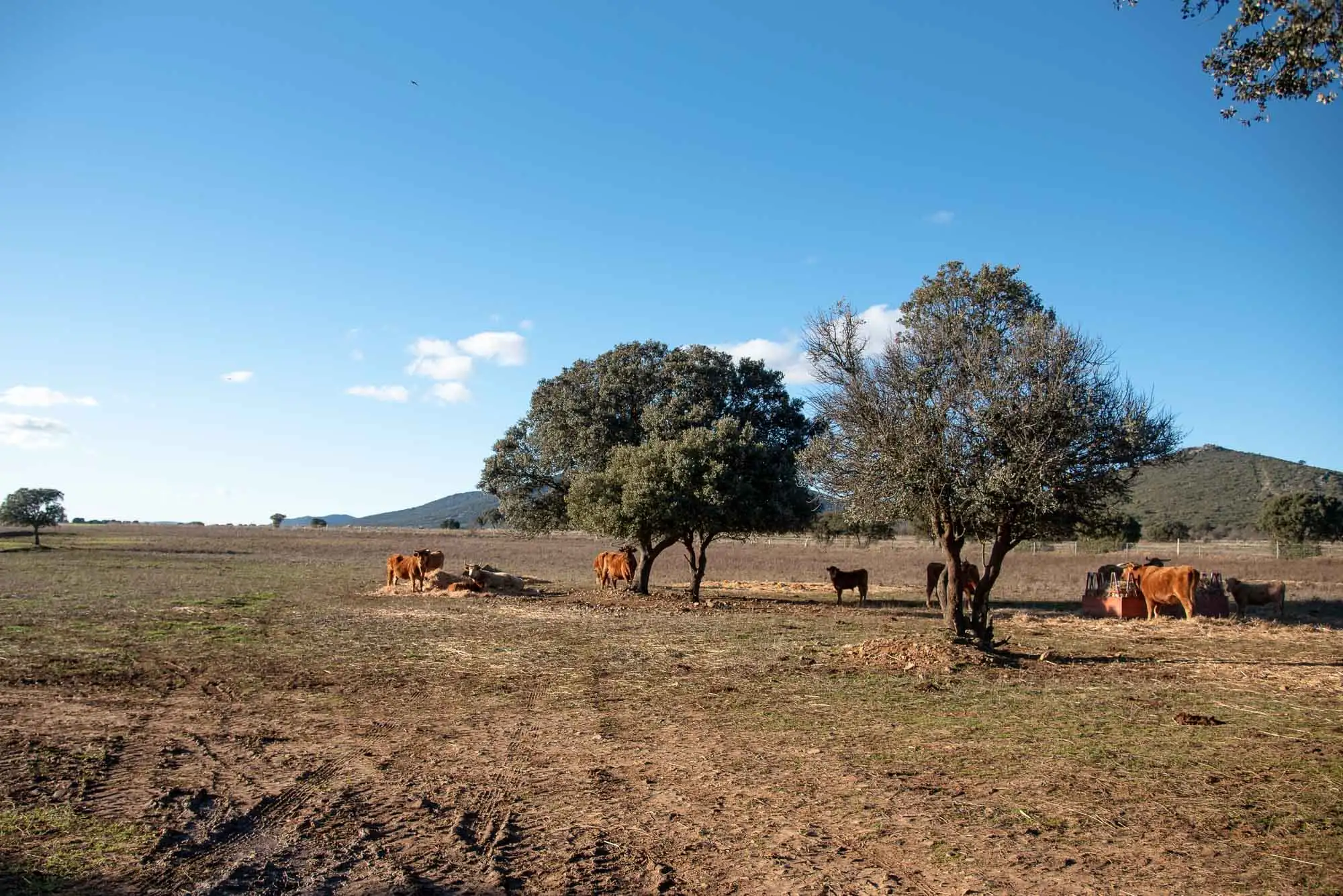
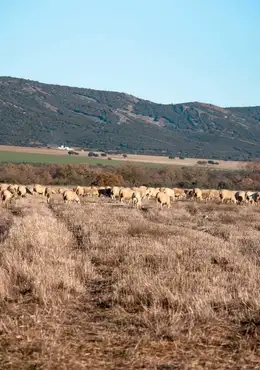
- Dehesas are wooded lands made up of two layers: the tree layer and the herbaceous layer. They usually have little tree cover and are agro-silvo-pastoral systems: agro-, because cereals and legumes are habitually grown; -silvo-, because of the appearance of isolated trees, such as Quercus; and -pastoral, because of the existence of natural pastures that livestock and big game consume, such as «vallicares», «posíos» and «majares».
- Dehesas cover 19 per cent of the area of Cabañeros and 29 per cent of the Montes de Toledo.
- We can distinguish, broadly, two types of dehesa: dehesas on crops and dehesas on pasture
- The dehesas on crops: are those subject to cultivation every 3 or 4 years, whose established cycle is called <<«tercios»>> or <<«cuartos»>>, depending on how the crop is rotated over 3 or 4 fields of tillage. If cultivation is by «tercios», it consists of putting one field to fallow, another to crop and the last to stubble. If it is by «cuartos», the added field goes to «posío», with an extra year of rest between the stubble and the fallow, when herbaceous species from the soil seed bank invade the land. The length of the cycle generally depends on soil fertility, although there are other factors such as European subsidies, rural abandonment or the promotion of hunting. In any case, cereals are usually sown, especially oats, barley and rye, sometimes combined with a legume, for example vetch or bitter vetch. The present trend is to devote these crops to feeding livestock or game, often without harvesting much of the sown fields. Changes in the Common Agricultural Policy (CAP) play a fundamental role in the type of crop and its intensity.
- The dehesas on pasture, by contrast, are not subject to cultivation; it is the livestock itself, together with game –deer above all– that controls the woody vegetation and favours the existence of a stable community of herbs, especially in the western half of the Montes. In Cabañeros, these dehesas, which for many years were dehesas on crops, are located on the raña. Cultivation ended in 1989 and the dehesas began to settle on therophytic grasslands, kept by the herbivore pressure of the red deer.
- The commonest tree species in the dehesas is the holm oak (Quercus ilex subsp. ballota = Quercus rotundifolia), the Portuguese oak on moister soils, the cork oak in the warmest areas and, lastly, the Pyrenean oak, in the coldest places. There are mixed dehesas in which these Quercus species intermingle, forming mixed dehesas of up to 4 species. The Portuguese oak dehesas with terebinth (Pistacia terebinthus) in some neighbouring valleys are worth noting.
News from the park
- Trees for the raña. The raña, about 8,000 hectares in the south-east of the park, was planted with cereal in the 1960s, hence its dehesa look. To give it trees back, in winter 2022–2023 80,000 holm oaks, cork oaks and Portuguese oaks were planted over about 290 hectares, from acorns collected in the park itself, and in 2024–2025 another 23,731 native trees: holm oak, Portuguese oak, oak, strawberry tree and terebinth.
- The raña in flower. In spring 2024 the raña turned purple with viper’s-bugloss (Echium plantagineum) and lavender, with the yellow of dandelions and daffodils and the white of daisies and asphodels.
Sources: park newsletters of January–February 2023, March–April 2024 and January–February 2025 (all the newsletters) (in Spanish).
Photos of dehesas in Cabañeros


Herbaceous communities
 Mesophytic communities
 Xeromesophytic communities
 Therophyte communities
 Amphibious, hygropeat and aquatic communities
 Rock communities
 Dehesas
Bibliography
- Vicente García Canseco (Coor.) (1997). Parque Nacional de Cabañeros. Madrid, Spain: Ecohábitat.
- Perea García-Calvo, R., Perea Ruiz-Tapiador, D., Giménez Velasco, G.F. (2015). Vegetación y flora del Parque Nacional de Cabañeros. Volumen I. El paisaje vegetal: ecología, conservación y rutas de interés geobotánico. Madrid, Spain: Editorial Solitario