Wingspan compared with a person with arms outstretched.
Length
68–83 cm
Wingspan
1.8–2.2 m
Weight
2.5–4.8 kg
Social life
In pairs, territorial; resident
Lifespan
Record of almost 20 years in the wild (a bird ringed in Spain)
Conservation status
LC
NT
VU
EN
CR
EW
EX
Global (IUCN)
Vulnerable
Spain
Endangered with extinction in the List of Wild Species under Special Protection, and Endangered in the Red Book of the Birds of Spain
When to see it
Resident
Months of the year when it is present
J
F
M
A
M
J
J
A
S
O
N
D
In Iberia
yes
yes
yes
yes
yes
yes
yes
yes
yes
yes
yes
yes
Breeding season
yes
yes
yes
yes
yes
yes
yes
yes
no
no
no
no
Song or voice of the Spanish Imperial Eagle
It often gives barking calls, «oc-oc-oc», especially during courtship flights, which can be confused with the croaks of the Common Raven. The recording we hear is of those barks, with the noise of the countryside in the background.
Barking callsSpanish Imperial Eagle
0:00 / 0:13
10 kHz5
The sonogram draws the sound: time runs from left to right, and the higher a trace sits, the higher the note.Recording by Grabación aportada por el autor de la web, Wikimedia Commons (Uso con permiso del autor).
Flight of the Spanish Imperial Eagle
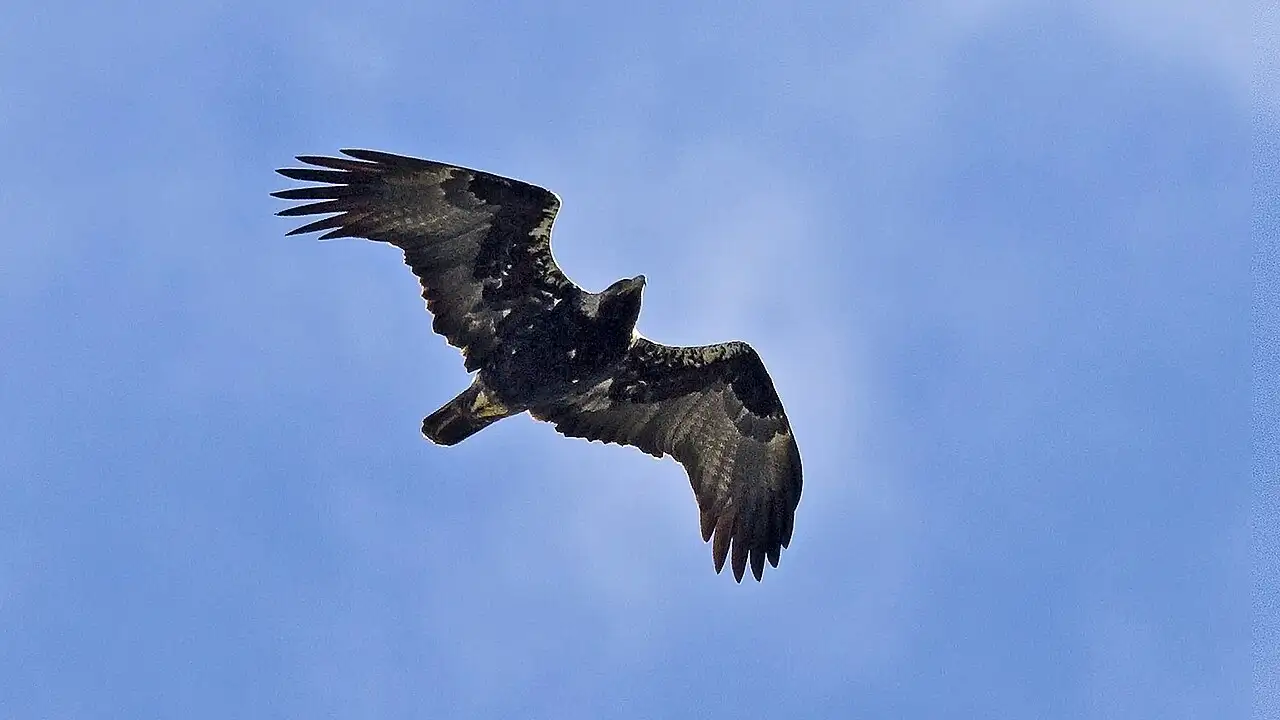
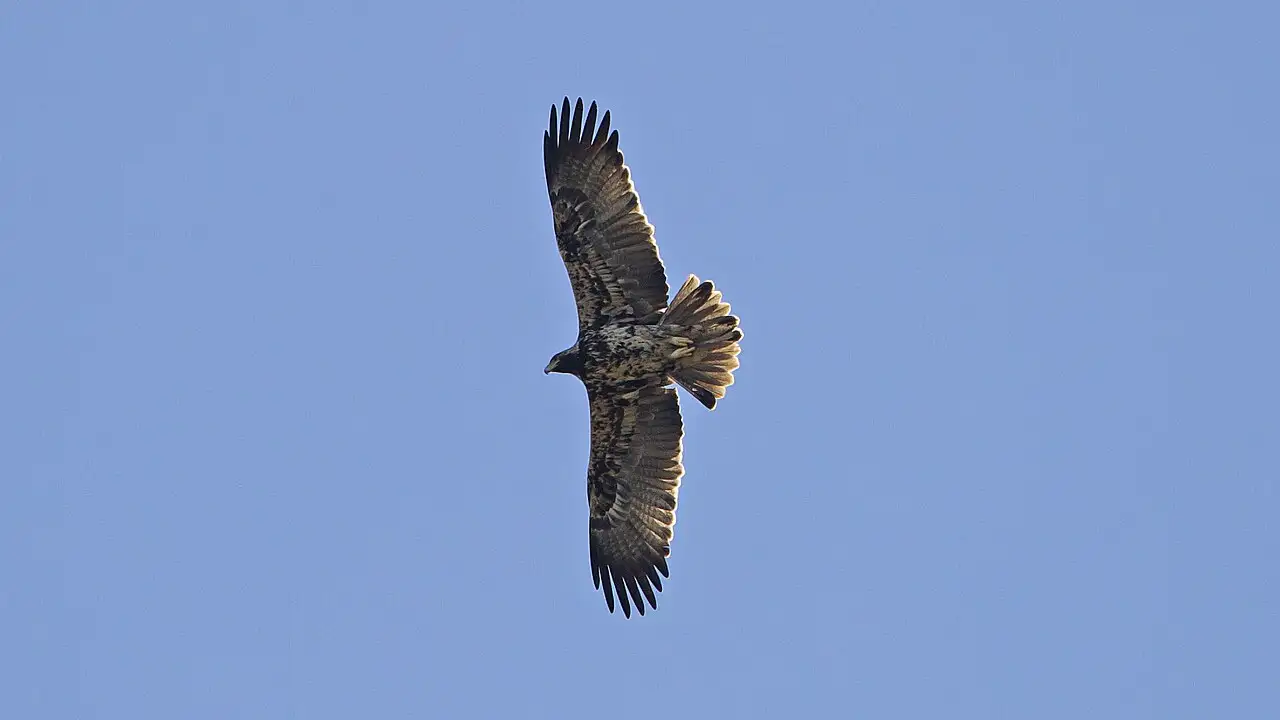
It has long, relatively rectangular wings and a long tail, though not as long as the Golden Eagle’s, and somewhat narrow, which it generally keeps closed. In flight the white shoulders and the pale tail base stand out against the rest of the dark plumage.
Flight typeThermal glider, with long, almost rectangular wings
It climbs in circles with long, relatively rectangular wings and the tail closed. In flight the white shoulders and the pale base of the tail stand out against the dark plumage.
It ranges over the scrub and the plains looking for rabbits, its almost exclusive prey. Young birds sometimes follow groups of vultures to find their food.
When it spots a rabbit or a reptile, it descends and catches it. During courtship it gives barks, «oc-oc-oc», which are confused with the Raven's.
Photo gallery of the Spanish Imperial Eagle
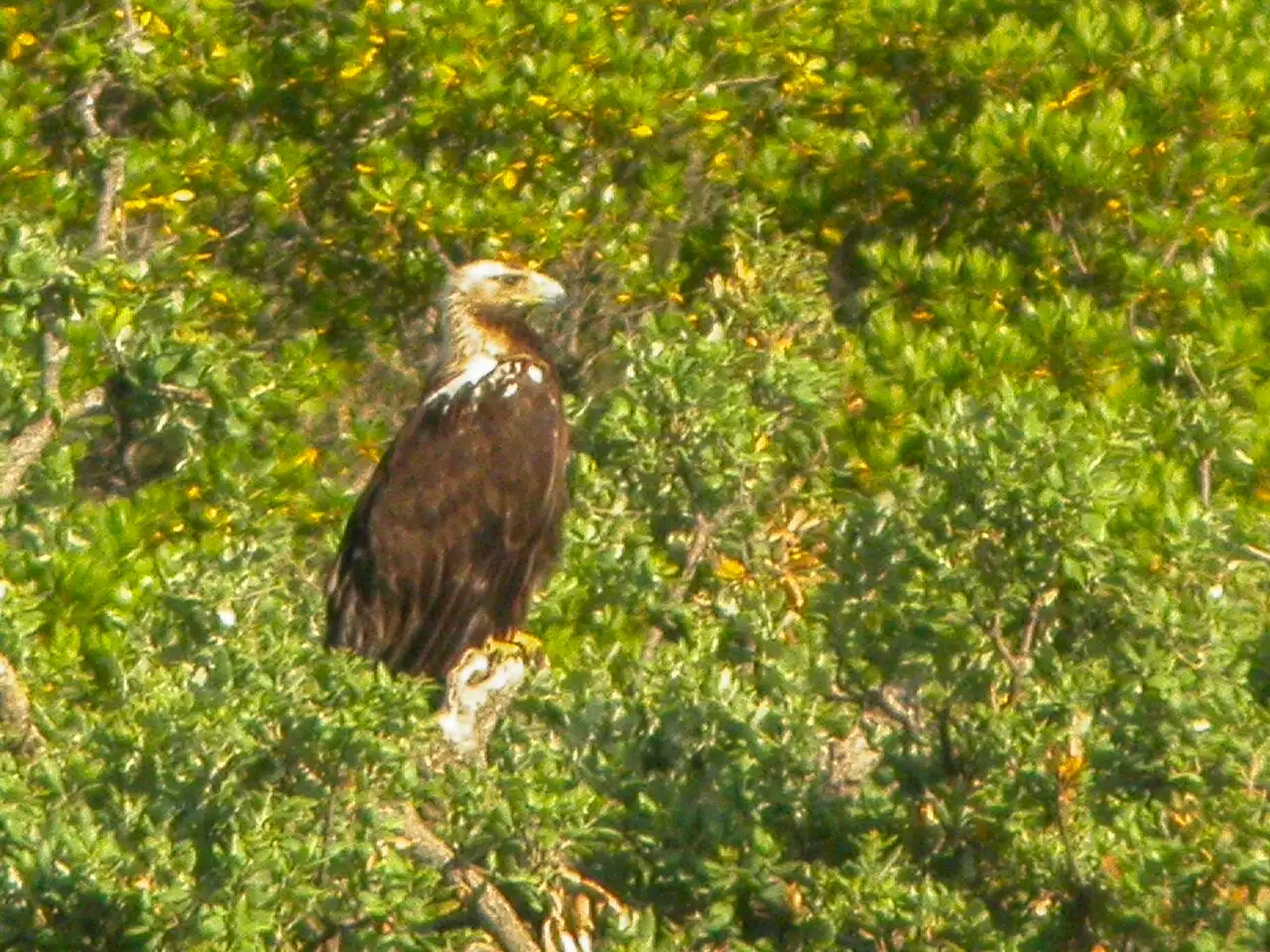
Adult Spanish Imperial Eagle perched on a bush in the scrub, in profile, with very dark brown body and pale napePhoto: Francesco Veronesi from Italy, CC BY-SA 2.0Photo 1 of 4
Adult Spanish Imperial Eagle in flight, very dark, with broad, outstretched wingsPhoto: Juan Lacruz, CC BY-SA 4.0Photo 2 of 4
Spanish Imperial Eagle in flight seen from below, with long wings and tail spreadPhoto: Juan Lacruz, CC BY-SA 4.0Photo 3 of 4
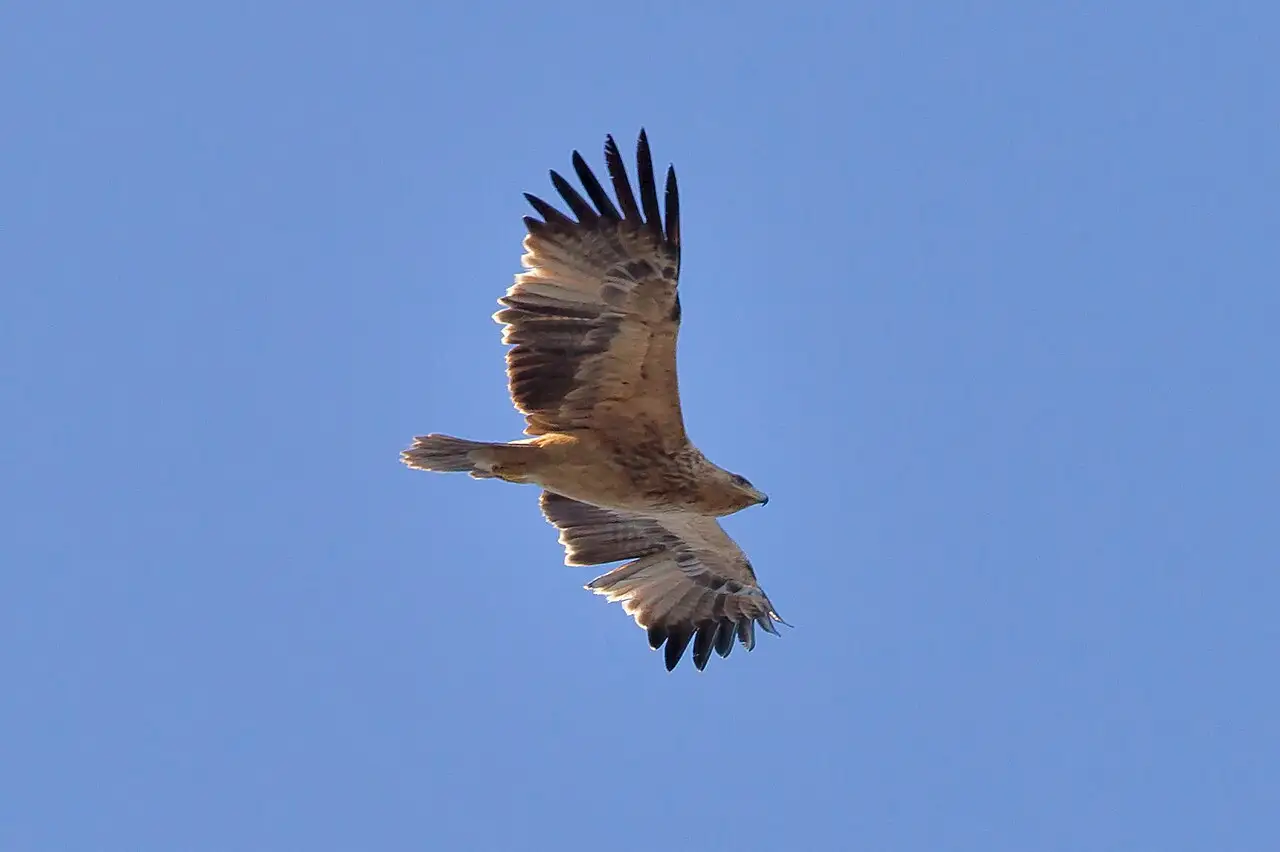
Young Spanish Imperial Eagle in flight, with pale reddish plumage and dark wingtipsPhoto: Juan Lacruz, CC BY-SA 3.0Photo 4 of 4
1 / 4
Identification of the Spanish Imperial Eagle
It is a large bird of prey. The adult is an overall very dark brown, with whitish shoulders and a pale nape and sides of the head, and a very powerful bill. In flight the white shoulders and the base of the tail, pale against the rest of the dark plumage, stand out. The wings are long and relatively rectangular, and the tail long (though not as long as the Golden Eagle’s) and somewhat narrow, which it usually keeps closed.
Adult
Very dark brown, with white shoulders and pale nape.
Young and sub-adult
The young bird of the year is reddish brown, with dark flight feathers.
After successive moults it looks more and more like the adult, which happens from the age of five, and passes through an intermediate stage, the «damero» (chequerboard), with a checkered pattern of pale and dark feathers.
Habitat and distribution of the Spanish Imperial Eagle
It has a Palaearctic distribution, but lives only on the Iberian Peninsula, above all in Spain, and a few birds have reached North Africa. In Spain it occupies the south-western quadrant: it breeds in the Central System, the Montes de Toledo, Extremadura (Monfragüe, the Llanos de Trujillo, the Alcántara reservoir, the Coria sierras and Tierra de Barros), the Almadén–Guadiana sierras, Sierra Madrona and eastern Sierra Morena, the Sierra Morena of Seville and Córdoba, and Doñana and the Guadalquivir marshes, and appears increasingly in lowland areas of the two plateaus.
It uses a great variety of habitats, from mountain pine woods to dunes and marshes, but its highest densities are in territories of gentle or flat topography with good tree cover, though not dominant, and abundant rabbits. The last populations have been confined to sierras with plenty of scrub, often in large private hunting estates free of human disturbance. It is resident, and its winter distribution coincides with that of the breeding season. Marked birds have made it possible to distinguish three relatively isolated population cores: the southern (Doñana), the central (Montes de Toledo, Tierra de Barros and Sierra Morena) and the north-western (Central System and Extremadura sierras). Young birds disperse mainly towards south-west Madrid, the Tagus and Tiétar valleys, the Campo de Montiel and the districts of Llerena and Azuaga.
Areas where it is regularly recorded since 2010Squares of about 25 km where it is recorded regularly (occasional passage records are left out). Data from GBIF.org (16,732 records, retrieved October 2026); outline from Natural Earth.
Etymology of the Spanish Imperial Eagle
«Aquila» is the Latin name for the eagle, and «adalberti» recalls Adalbert of Bavaria, the prince to whom the German naturalist Christian Ludwig Brehm dedicated the species.
Population of the Spanish Imperial Eagle
Almost the whole European population is in Spain: in 2011 almost 330 breeding pairs were counted, 119 of them in Castilla-La Mancha, 71 in Andalusia, 48 in Extremadura, 48 in Castilla y León and 37 in Madrid. In Portugal 7 pairs were counted that same year. The species was on the brink of extinction and has been recovering in recent decades, from about 30 pairs in the 1960s. It is listed in the Red Book of the Birds of Spain as «Endangered», appears as «Endangered with extinction» in the List of Wild Species under Special Protection and the IUCN considers it «Vulnerable». The main threat is the high juvenile mortality linked to people: the poison used illegally on hunting estates, electrocution on power lines (which has dropped a lot), the shortage of rabbits through myxomatosis and rabbit haemorrhagic disease, habitat destruction and fragmentation, and organochlorine and lead contamination. The first advances came with its protection in the 1970s, and with programmes to correct dangerous power lines, anti-poison campaigns and supplementary feeding; it is covered by a Strategy for the Conservation of the Spanish Imperial Eagle.
Nest of the Spanish Imperial Eagle
It places it in large trees, such as cork oaks, pines or eucalyptus, at a height of 10 to 25 metres. Both sexes build it, though the female more, as a structure of branches that can reach 240 centimetres across and 180 high.
Courtship and breeding of the Spanish Imperial Eagle
The breeding period covers about eight months. The first copulations are seen at the end of January, and most layings take place between the end of February and the end of March, even in late April. They are one to four eggs, normally two or three, whitish with small ochre marks. Both sexes incubate for about 44 days, and hatching is usually at the end of April. Siblicide between nestmates is frequent, and accounts for the loss of 26 % of chicks, in relation to the food available. The chicks spend about 77 days in the nest and then disperse over long distances, although they tend to return to the place of origin. First breeding comes at three or four years, and the average is 1.2 chicks that fly per pair per year.
Diet of the Spanish Imperial Eagle
It is highly specialised in hunting rabbits and its survival is closely tied to that of this prey, although it also catches reptiles and birds.
Curious facts about the Spanish Imperial Eagle
It is one of the most emblematic and threatened birds of our fauna, and it was on the brink of extinction: in the 1960s about 30 pairs were left, and today there are more than 300. And almost all those in the world live in Spain.
The Spanish Imperial Eagle in Cabañeros
The habitat pages of this website list it among the breeding raptors of the sierras with sclerophyllous woodland vegetation in Cabañeros, together with the Golden Eagle, the Booted Eagle and the Short-toed Snake Eagle. In the grasslands, in winter, young birds appear that follow groups of vultures to find their food.
There are few. In 2023 the park had 4 breeding pairs within its limits, which that season raised 2 chicks. The park watches them closely, and has sometimes had to lend them a hand. That same spring, a chick fell from its nest near Retuerta del Bullaque: after a check-up at the El Chaparrillo recovery centre, environmental rangers put it into a nearby nest and the adults accepted it. And in summer a very weak young bird turned up at the Puntal del Rostro, in the middle of the raña, which also ended up at El Chaparrillo (the park suspected it was one of the two chicks of the year). Cabañeros was also among the first sites to stream an Imperial Eagle nest live online.
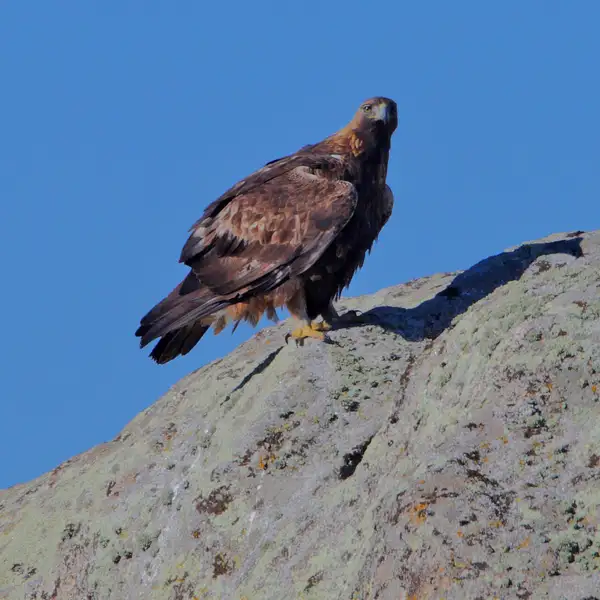
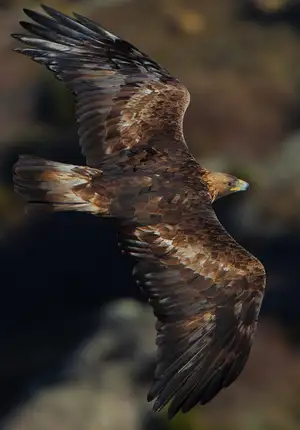
The largest of the Iberian eagles, very dark brown with golden tones on the front of the wings, the nape and the neck, and with a long tail. The young bird is almost black, with white patches on the wings and a broad white area on the tail.
Photo: Juan Lacruz, CC BY-SA 3.0
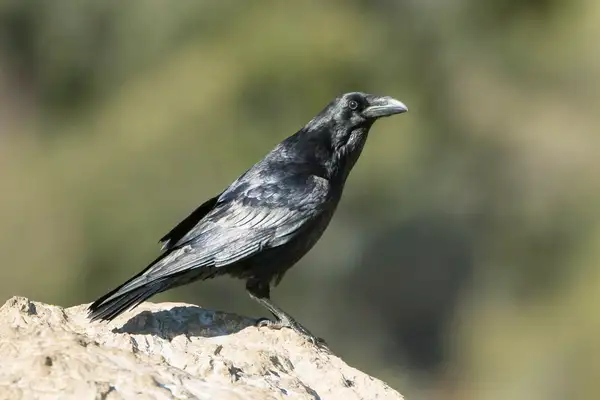
Common Raven
Corvus corax
How to tell them apart
It does not look like it by sight: it is an enormous bird, with black plumage with metallic sheen and a thick bill. It is mentioned because its croaks can be confused with the Imperial Eagle’s barking calls.
Photo: Francesco Veronesi, CC BY-SA 2.0
Other birds
Birds related to the Spanish Imperial Eagle or sharing its habitats in Cabañeros.



 Same family
 Same family
 Same family
 Same family
 Also in sclerophyllous woodland
 Also in sclerophyllous woodland
 Also in sclerophyllous woodland
 Also in sclerophyllous woodland






