Monogamous, although sometimes a male breeds with two females; it nests alone or in loose colonies
Lifespan
Record of 20 years and 2 months in the wild (a bird ringed in the Channel Islands)
Conservation status
LC
NT
VU
EN
CR
EW
EX
Global (IUCN)
Least Concern
Spain
Vulnerable (VU) in the 2021 Red Book of the Birds of Spain; on the List of Wild Species under Special Protection, but not in the Spanish Catalogue of Threatened Species
When to see it
Summer visitor
Months of the year when it is present
J
F
M
A
M
J
J
A
S
O
N
D
In Iberia
no
yes
yes
yes
yes
yes
yes
yes
yes
yes
no
no
Breeding season
no
no
yes
yes
yes
yes
yes
yes
no
no
no
no
Song or voice of the Barn Swallow
It consists of a musical, hurried twittering, made of linked warbles with a characteristic ending: a harsh «prrr». It is a very songful bird and gives frequent calls, above all a high «uit, uit».
SongBarn Swallow
0:00 / 0:26
10 kHz5
The sonogram draws the sound: time runs from left to right, and the higher a trace sits, the higher the note.Recording by AviCanto, Wikimedia Commons (Vídeo de YouTube, con atribución).
Flight of the Barn Swallow
With an agile, fast, acrobatic flight, it occupies the lower layers of the airspace, below martins and swifts. The Spanish birds that winter in the Gulf of Guinea return gradually, with a lag of up to three months between north and south.
Flight typeAgile, fast and acrobatic, at low height
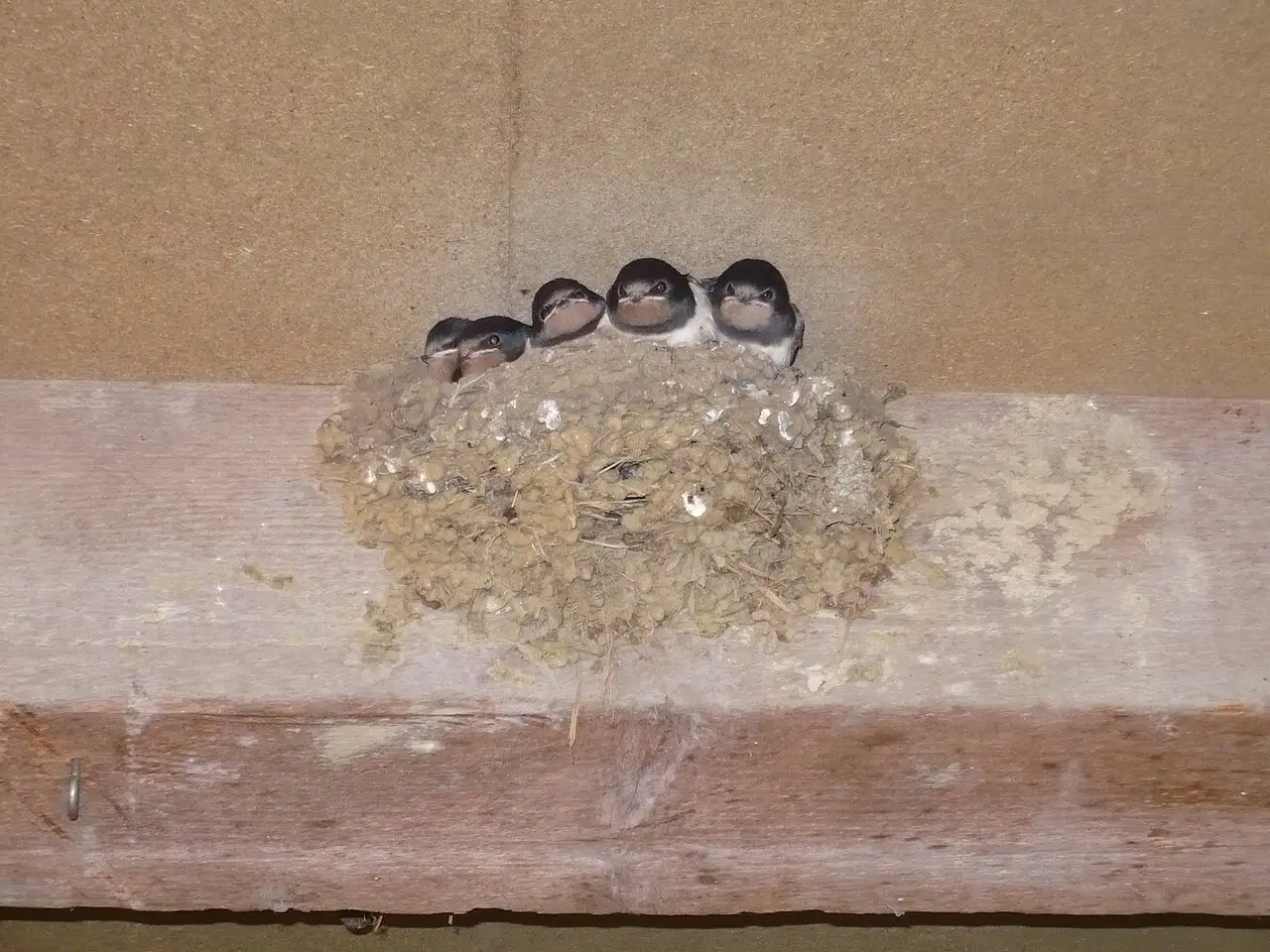
It nests in country and urban buildings, such as stables, porches, patios and terraces, in a nest of mud pellets stuck to a wall and under cover.
With an agile, fast, acrobatic flight, it occupies the lower layers of the airspace, below martins and swifts, and chases flies, mosquitoes and other insects, sometimes in small groups, at low height and not far from the nest.
It nests alone or in loose colonies, and is faithful to the breeding site and to its mate; nests are repaired and reused for several years.
Photo gallery of the Barn Swallow
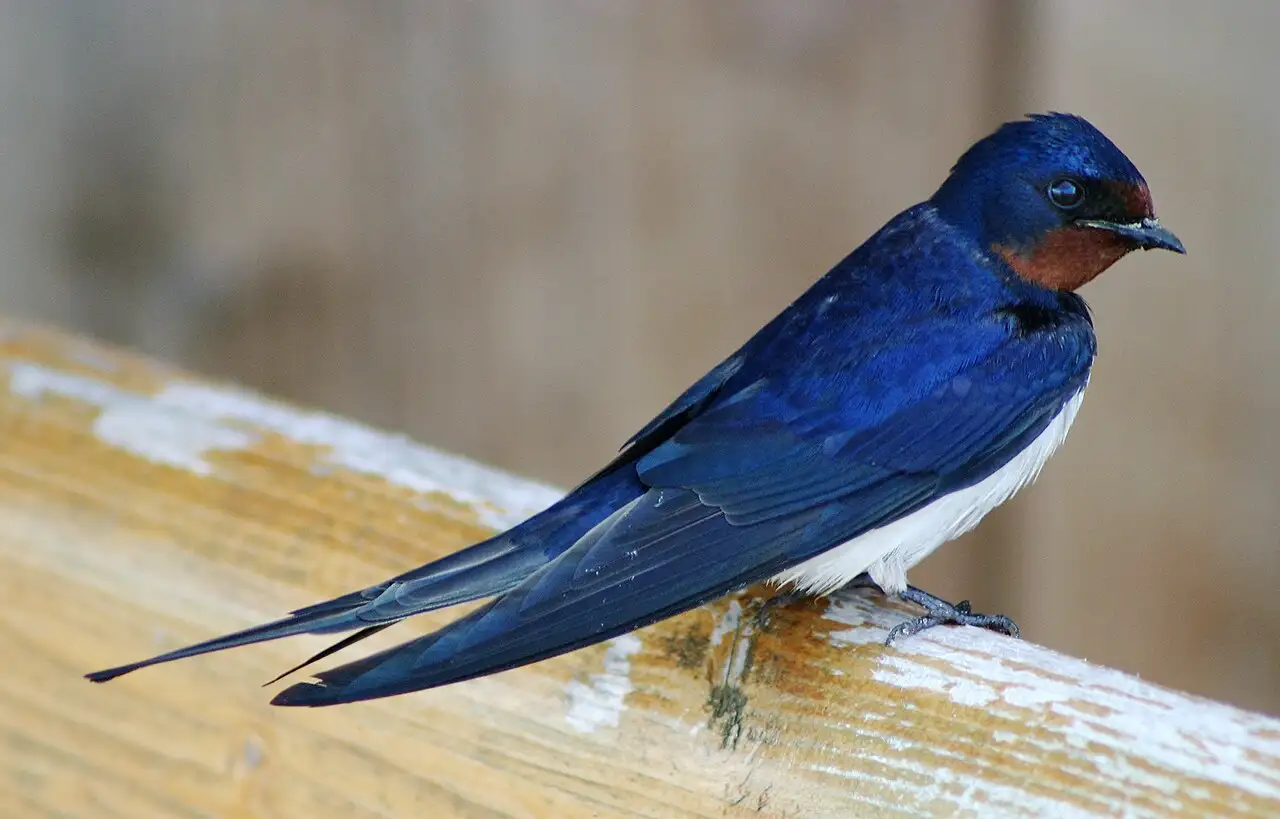
Barn Swallow perched in profile on a wooden beam, with metallic blue back, red forehead and throat and long tailPhoto: Malene Thyssen, CC BY 2.5Photo 1 of 4
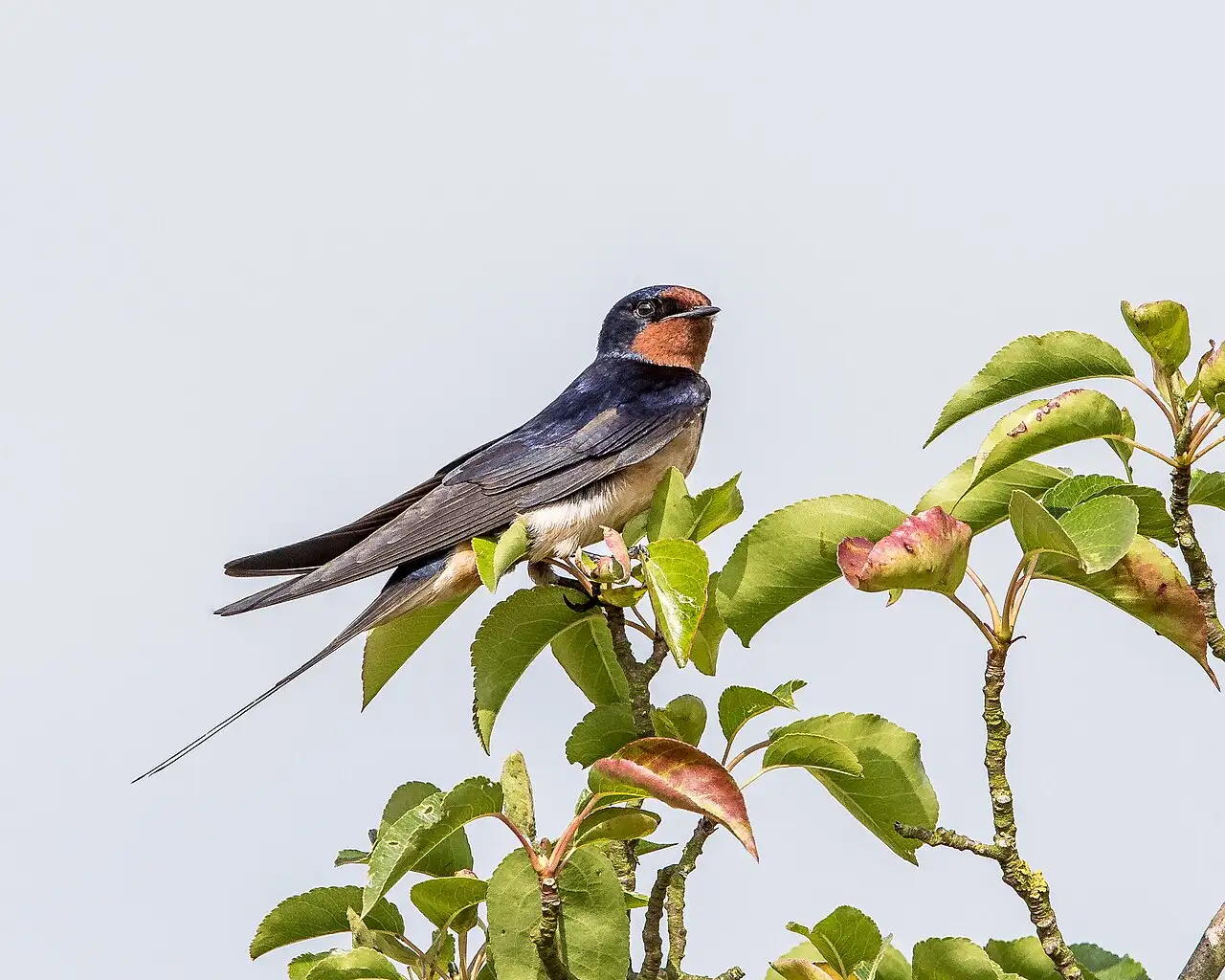
It is a delicate, graceful, aerodynamic bird, black with metallic blue sheen above and cream-white on the underparts. It has a red forehead and throat and a black collar. The long, pointed wings show white tones on the front underside. Its very long, forked tail is black, with small white ovals when spread. It has short, unfeathered legs, a very wide mouth and a short, flat, black bill.
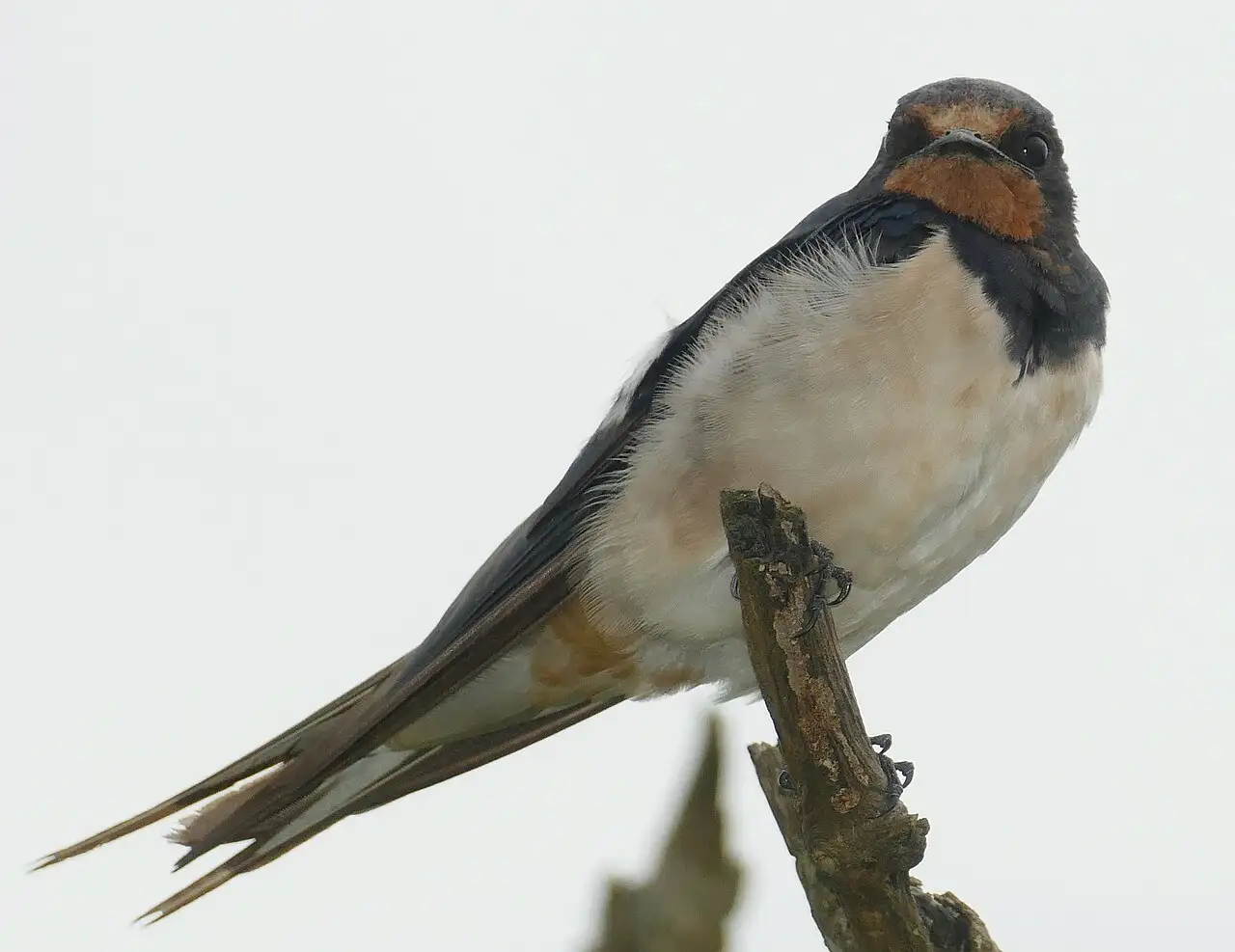
It shows latitudinal variation in body size and tail length, which are smaller towards the south. Although both sexes are alike, the female is less bright, whiter below and with a shorter tail. Young birds have dull black tones, an orange forehead and throat and a much shorter tail.
Adult
Metallic blue sheen above and cream-white below.
Red forehead and throat, with a black collar.
Very long, forked tail.
Young bird
Dull black tones, with orange forehead and throat.
Much shorter tail.
Habitat and distribution of the Barn Swallow
It is the most widespread member of its family: it breeds over much of North America and Eurasia, except in Arctic areas and deserts. In winter it occupies South America, Africa, southern Asia and northern Australia. Of complex taxonomy, eight subspecies are recognised. In Spain the only one present is «rustica».
It is widely distributed in the breeding season and on passage across the whole Peninsula, the Balearics, Ceuta and Melilla. It winters in very small numbers in the south, mainly in the lower Guadalquivir. In the Canaries, where it is common on passage, it has recently been found breeding on Gran Canaria.
It nests preferably in country buildings, but also urban ones, such as stables, porches, patios and terraces. It feeds in all kinds of environments, although it is more usual near water and in meadows and crops; on migration it prefers wetlands, above all coastal ones. Despite being undemanding, in Spain it is more numerous in areas of medium and low altitude, and breeds up to 1,600 metres.
Spanish birds winter in the Gulf of Guinea and return gradually to the breeding area. In Andalusia and Extremadura they usually begin to be seen in January, with a mass arrival from February; in the centre and east of the Peninsula they do so a month later, and on the northern plateau and the Cantabrian fringe they do not become common until April. The older males return first and, in recent decades, a return some three weeks earlier has been confirmed. Spanish swallows leave the breeding areas from July, in the south, to early September, while passage birds usually move, following the Mediterranean coast, in September and October. From June they gather at roosts, made up at first mostly of juveniles.
Areas where it is regularly recorded since 2010Squares of about 25 km where it is recorded regularly (occasional passage records are left out). Data from GBIF.org (887,997 records, retrieved October 2026); outline from Natural Earth.
Etymology of the Barn Swallow
According to Wikipedia, «Hirundo» is the Latin word for «swallow», and «rusticus», «of the countryside». In other languages it is called «oreneta vulgar» in Catalan, «anduriña común» in Galician, «enara arrunta» in Basque and «barn swallow» in English1.
Population of the Barn Swallow
According to the 2021 European Red List of Birds, the European population is estimated at 51,900,000–89,500,000 mature individuals, with a decreasing trend. In Spain a negative long-term trend has also been observed: the III Atlas of Breeding Birds estimates the Spanish population at some 9,000,000 individuals in 2018, which indicates a marked decline of more than 51 % in the period 1998–2018. Even so, no significant changes were detected in its occupation of the territory between the II and III Atlas, which may indicate that it occupies the same territories, but with a smaller population each year. The largest populations are in Andalusia, Castilla-La Mancha and Castilla y León.
Among the main threats are the indiscriminate use of pesticides in intensive farming practices, which reduces the amount of insects it feeds on; the deliberate removal of nests on the pretext of droppings, together with the difficulty of nesting on modern buildings; the depopulation of the rural environment, because abandoned buildings do not offer enough shelter; road deaths and collisions with buildings and wind turbines during migration; and climate change, which brings forward the arrival in spring by nearly a month compared with the last century, while extreme cold spells in that season increase its mortality. Among the conservation measures is the SOS-Nidos campaign, which seeks to prevent disturbance and the removal of nests.
Nest of the Barn Swallow
The nest, built by both sexes in some 10 days, is an open cup of mud pellets, stuck to a wall and under cover. Nests are repaired and reused for several years. It nests alone or in loose colonies, and is faithful to the breeding site and to its mate.
Courtship and breeding of the Barn Swallow
The breeding period is variable: in the south it begins in March and in the north as late as May, and ends in July and August. It normally makes two clutches, sometimes three. Although it is a monogamous bird, a male sometimes breeds with two females at once, and paternity outside the pair is frequent: a third of the chicks. Clutch size falls over time; in Badajoz, the average is five eggs in the first clutch, 4.5 in the second and four in the third. The eggs, cream with reddish spots, are incubated by the female for about 15 days. The pair feeds the chicks very frequently, until they fly, at 20–25 days. In each nest seven or eight young usually fly each year.
Diet of the Barn Swallow
The diet, insect-eating, varies between places and seasons. The most-eaten prey are flies and mosquitoes; it also hunts flying ants, wasps, bugs and small beetles. It catches them in acrobatic chasing flights, sometimes in small groups, at low height and not far from the nest.
Curious facts about the Barn Swallow
It is one of the best-known and best-studied birds: swallows have been key to unravelling aspects of migration, sexual selection and breeding in birds. Its arrival, ever earlier, is considered a herald of spring, and in 2014 SEO/BirdLife named it Bird of the Year. The length of the males’ tail is a sexual-selection trait: the longer it is, the sooner they pair up and the more chicks they raise. It lives at least 15 years; the longest-lived ringed bird, according to EURING, reached 20 years and 2 months1.
The Barn Swallow in Cabañeros
The habitat pages of this website do not mention it. GBIF.org records 456 observations of the Barn Swallow in Cabañeros and its surroundings.
Where to see the Barn Swallow in Cabañeros
In Cabañeros and its surroundings, from February to October.
When
From February to October: it arrives between January and April, depending on the area, and leaves from July until October.
What time
In good light, near water and in meadows and crops.
Where
On country and urban buildings with mud nests stuck to the walls.
What to look for
Look for the red forehead and throat, the forked tail and its low, acrobatic flight.



 Same family
 Same family
 Same family
 Same family
 Same order
 Same order
 Same order
 Same order






