It breeds in hollows and can make two clutches a year; the female incubates and both parents feed the chicks
Lifespan
Record of 10 years and 11 months in the wild (a bird ringed in Germany)
Conservation status
LC
NT
VU
EN
CR
EW
EX
Global (IUCN)
Least Concern
Spain
Least Concern (LC) in the 2021 Red Book of the Birds of Spain, after being Vulnerable in 2004; Vulnerable (VU) in the National Catalogue of Threatened Species
When to see it
Summer visitor
Months of the year when it is present
J
F
M
A
M
J
J
A
S
O
N
D
In Iberia
no
no
yes
yes
yes
yes
yes
yes
yes
yes
yes
no
Breeding season
no
no
no
yes
yes
yes
yes
no
no
no
no
no
Song or voice of the Common Redstart
It is sweet, melancholy and soft, similar to the Black Redstart’s. It has two parts: a short, rising first part, followed by a longer one, alternating soft trills with some imitations.
SongCommon Redstart
0:00 / 0:20
10 kHz5
The sonogram draws the sound: time runs from left to right, and the higher a trace sits, the higher the note.Recording by AviCanto, Wikimedia Commons (Vídeo de YouTube, con atribución).
Flight of the Common Redstart
It shows an agile, slightly undulating flight. When perched, it has the habit of insistently flicking its tail. In Spain it is a long-distance migrant, with wintering areas south of the Sahara.
Flight typeAgile and slightly undulating
It leaves a branch or a hole in an old tree in mature, thinned woodland, in an agile, slightly undulating flight.
It chases insects and spiders, above all larvae and adults of butterflies and beetles, and perches again.
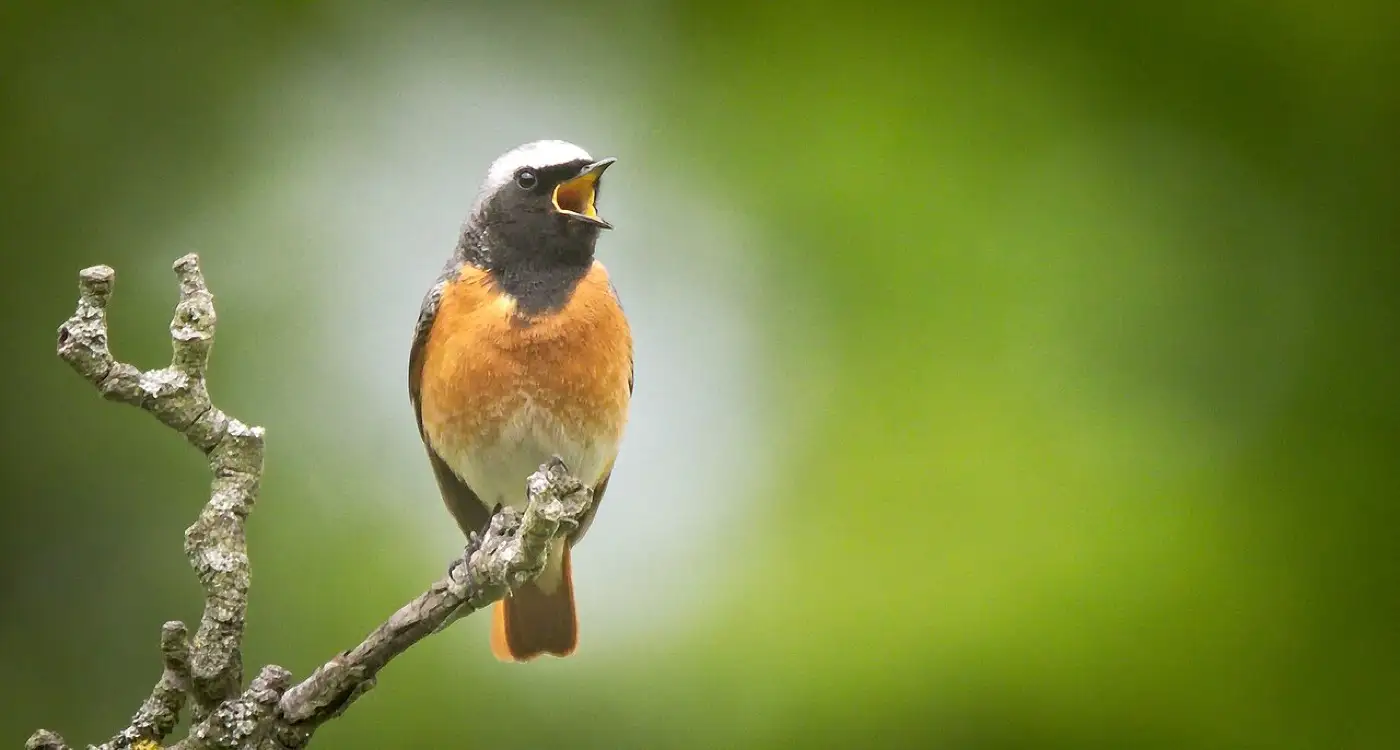
Perched, it has the habit of flicking its red tail insistently, and sings, sweet and melancholy, in two parts.
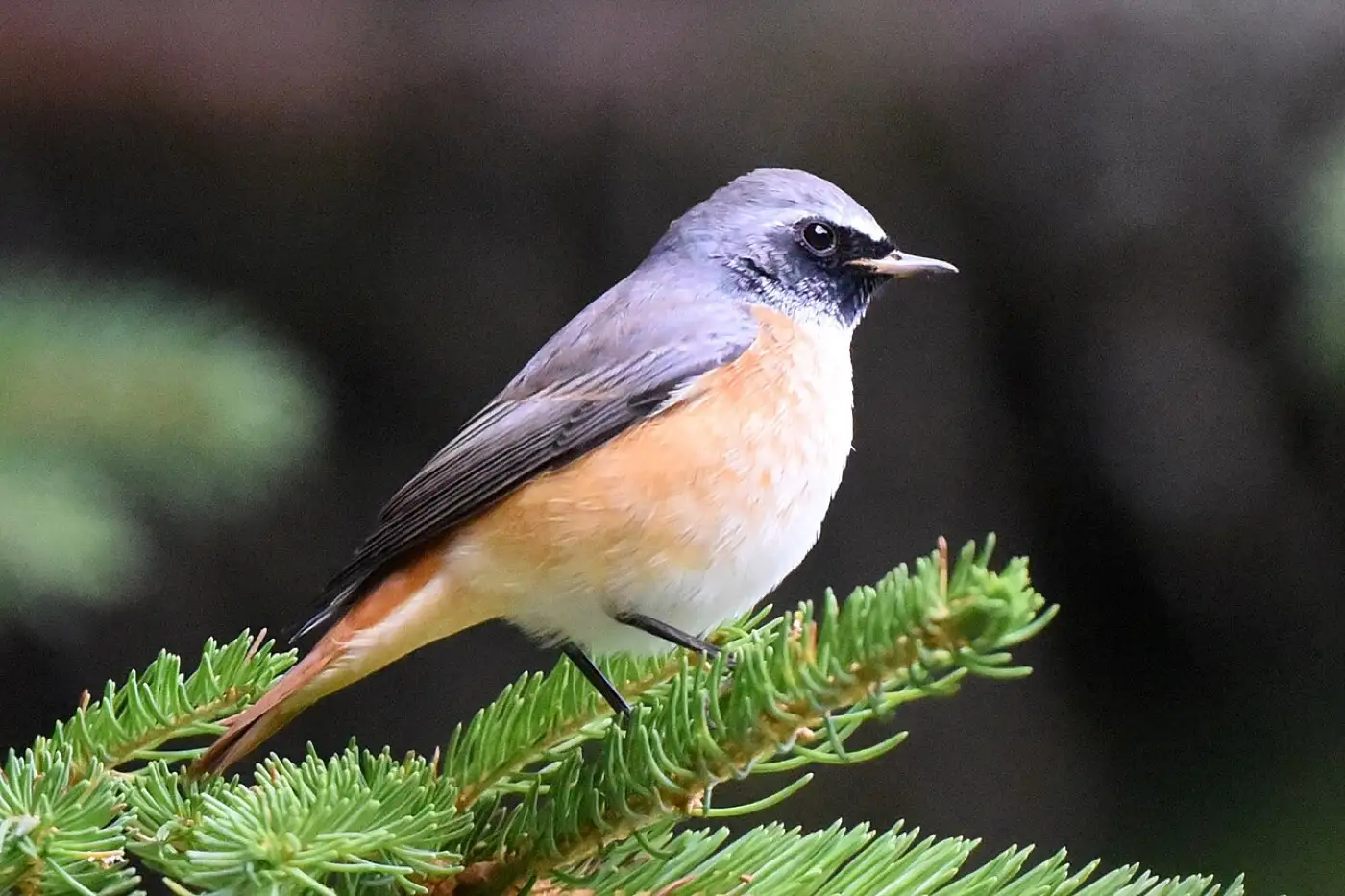
Male Common Redstart in profile on a fir branch, with grey back and pale orange breastPhoto: Pierre-Marie Epiney, CC BY-SA 2.0Photo 3 of 4
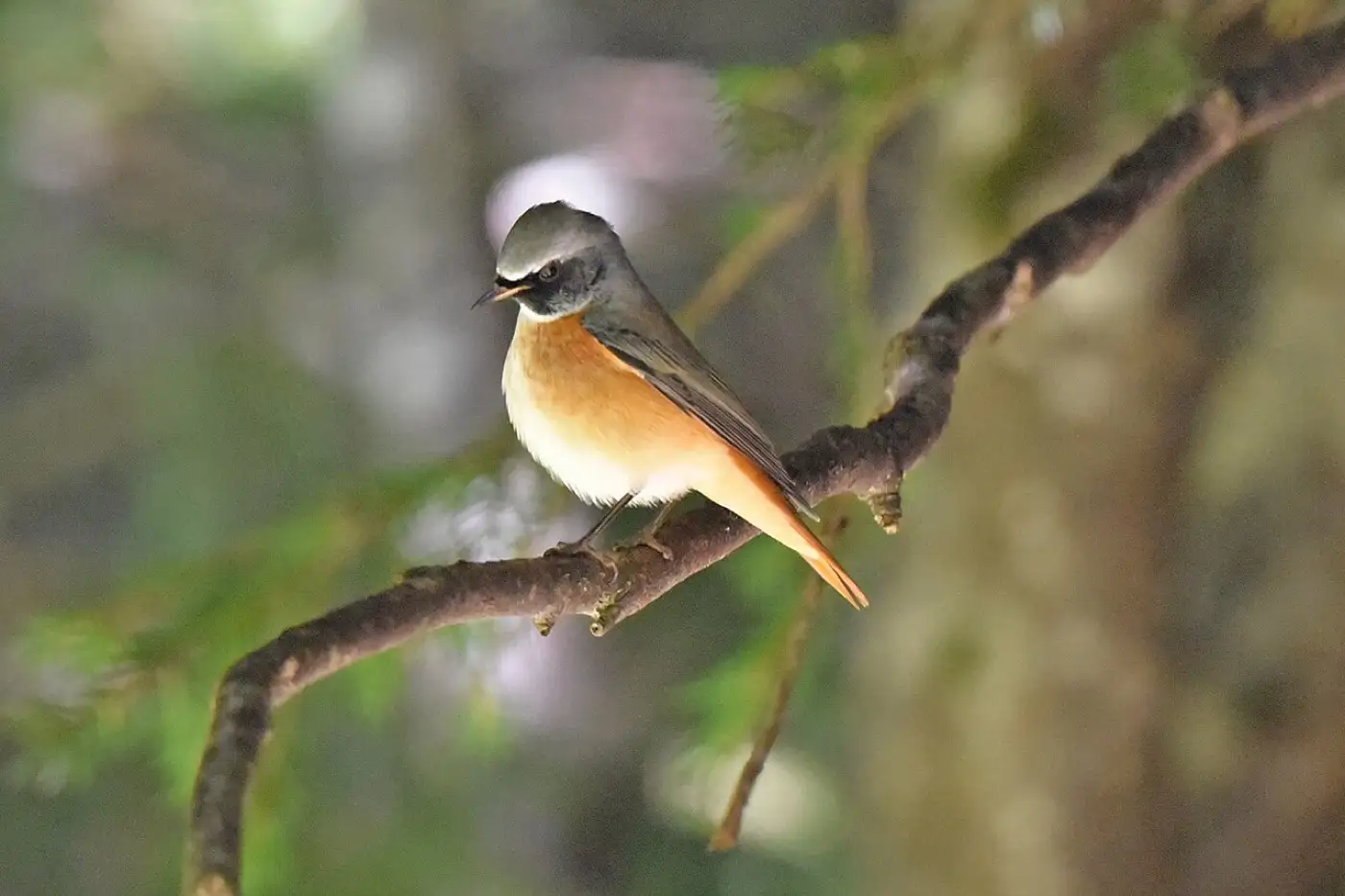
Male Common Redstart on a branch among fir branches, with red tail and orange breastPhoto: Pierre-Marie Epiney, CC BY-SA 2.0Photo 4 of 4
1 / 4
Identification of the Common Redstart
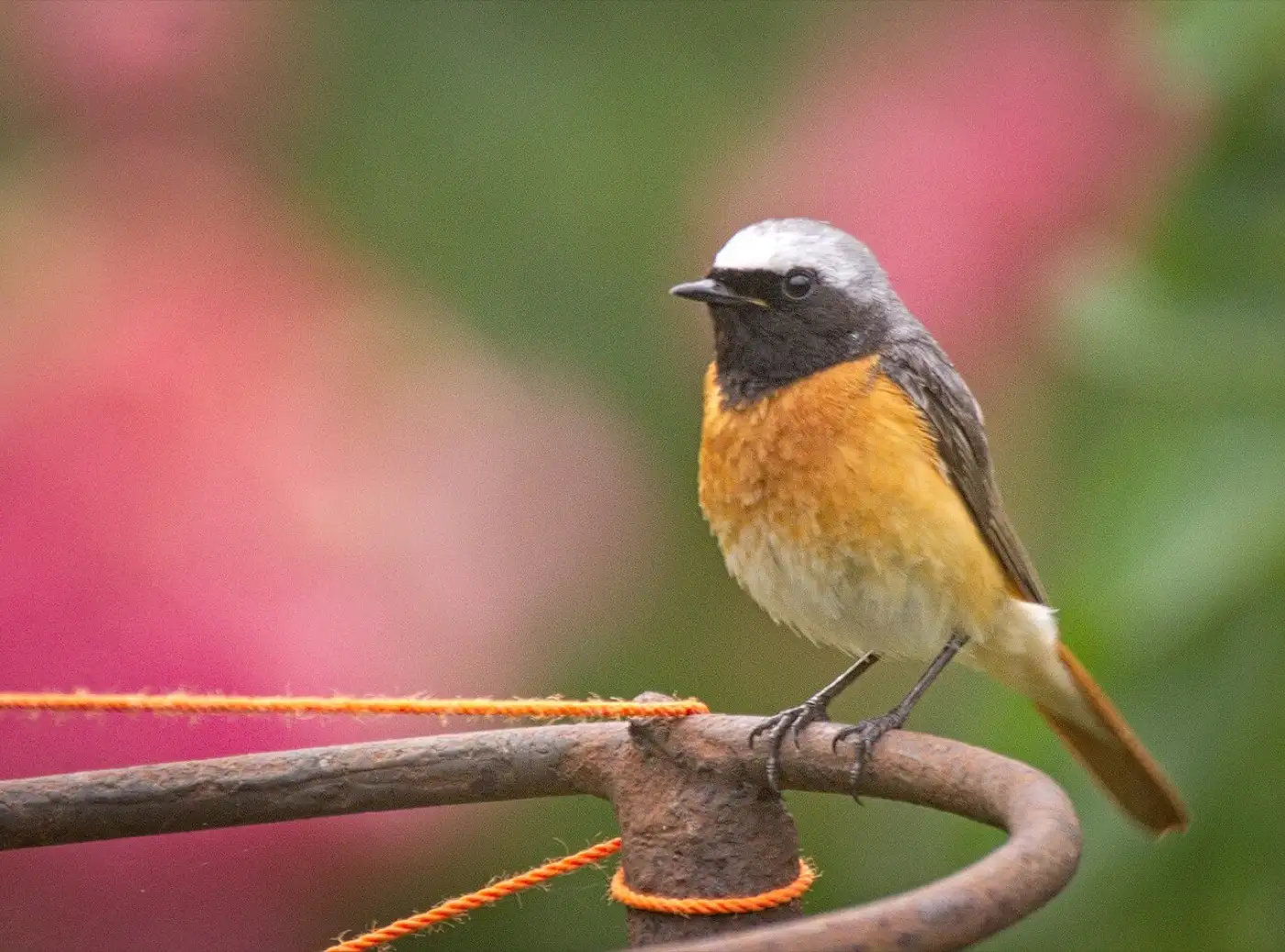
The Common Redstart is a small thrush-family bird, with a characteristic and striking rufous tail. The male wears a showy, colourful pattern: reddish-orange breast, black throat, grey upperparts and white forehead. The female and young birds have greyish-buff underparts, paler than in the Black Redstart. When perched, this bird has the habit of insistently flicking its tail.
Male
Reddish-orange breast, black throat, grey upperparts and white forehead.
Rufous tail.
Female and young birds
Underparts greyish buff, paler than in the Black Redstart; rufous tail.
Habitat and distribution of the Common Redstart
It is widely distributed across the whole of Europe as far as Lake Baikal, and more localised in southern Europe, the Maghreb and the Near East. It has two subspecies, and «phoenicurus» is the one of western Europe and Spain.
As a breeder, in Spain it has a very fragmented distribution. It appears continuously and extensively from Zamora to Soria, along the Cantabrian coast and range; other smaller cores are in the Iberian System, the western Central System and western Sierra Morena, and it is seen occasionally in the Maestrazgo and in some inland sierras. It is absent from the Balearics, the Canaries, Ceuta and Melilla, where it can be seen on spring migration.
It is strictly woodland: it breeds in mature, though not dense, woods where hollows to nest in abound. In Spain it inhabits mid-mountain areas with adequate forest cover. The best densities are reached in oak woods (oak and holm oak dehesas), beech, conifer or mixed woods; in pine woods it is scarcer, but also occupies them, above all if there are nest boxes. It occurs from sea level (Cantabrian coast) to 1,800 metres, with its optimum altitude between 800 and 1,200 metres.
In our country it is a summer visitor and long-distance migrant, with wintering areas south of the Sahara; occasionally some birds winter in the south of the peninsula and on the Atlantic coasts. It is common throughout Spain during migration passages: the pre-breeding one is detected from late March to early June, peaking in April, and the post-breeding one from late August to early November, with peaks in September and October.
Areas where it is regularly recorded since 2010Squares of about 25 km where it is recorded regularly (occasional passage records are left out). Data from GBIF.org (48,468 records, retrieved October 2026); outline from Natural Earth.
Etymology of the Common Redstart
«Phoenicurus» comes from the ancient Greek «phoînix», «red», and «-ouros», «tailed»: the red-tailed one, just like its Spanish name.
Population of the Common Redstart
According to the 2021 European Red List of Birds, the European population is estimated at about 15 million individuals, with an increasing trend, and the Spanish one, according to the Third Atlas of Breeding Birds in Spain, at about 360,000 birds. It suffered a marked decline between 1960 and 1985, attributable to droughts in the Sahel; since then it has recovered, but without returning to the earlier figures. According to the SACRE programme, for 1998–2018 the trend is stable for Spain as a whole, and on a European scale the trend is favourable for 1980–2017, with a significant 30 % increase from 2007. The Iberian population has grown 91 % compared with that of 19981.
Nest of the Common Redstart
The nest is a small cup of leaves and moss, lined with feathers, set inside a hollow in a tree, wall or bank or among roots.
Courtship and breeding of the Common Redstart
The breeding period runs from late April to early July, with the possibility of two clutches a year. The clutch consists of 3–10 bluish eggs, which the mother incubates for 12–14 days. The chicks are fed by both parents, can fly at 14–15 days and become independent two weeks after leaving the nest.
Diet of the Common Redstart
It feeds on insects and spiders, with a clear preference for larvae and adults of butterflies, moths and beetles. At the end of summer and in autumn, during migration, it can eat a large quantity of small fruits.
Curious facts about the Common Redstart
It has a name that says it all: «colirrojo», red-tailed. It suffered a marked decline from droughts in the Sahel, in its wintering area, between 1960 and 1985 and has recovered since without reaching earlier levels.
The Common Redstart in Cabañeros
This website’s page on the sclerophyllous woodland speaks of its «famous migration passage» in autumn through the woods of Cabañeros, together with the European Pied Flycatcher: both are seasonally fruit-eaters when small-fruited species ripen and small insects abound. Afterwards, with the olive harvest, other larger fruit-eaters, such as the thrush, replace them.
Where to see the Common Redstart in Cabañeros
In the sclerophyllous woods of Cabañeros, during the autumn passage.
When
From March to November; in Cabañeros, above all on the autumn passage (September and October).
What time
Throughout the day, in woods with small fruits and insects.
Where
In mature, thinned woods; on migration, also in parks and gardens.
What to look for
A little red-tailed bird that never stops flicking it from a branch.
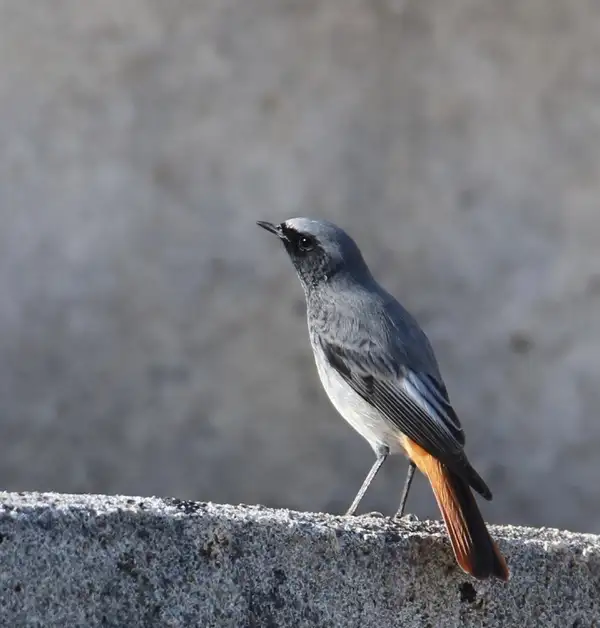
They are similar in song and appearance1. The Black Redstart male has a black breast and face, the rest of the body dark and a white patch on the wings; the tail and rump are also red. It is more ground-dwelling and perches more upright.
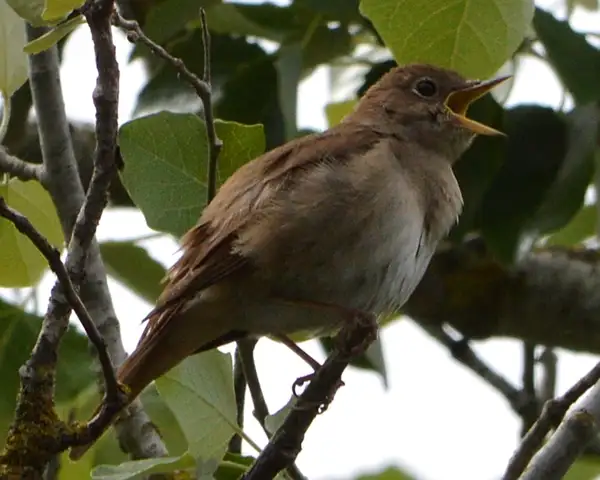
They are similar in appearance1. The Common Nightingale also has a rufous tail, but the body is brown and without the orange breast or white forehead of the Common Redstart.
Photo: Ryan Hodnett, CC BY-SA 4.0
Other birds
Birds related to the Common Redstart or sharing its habitats in Cabañeros.



 Same family
 Same family
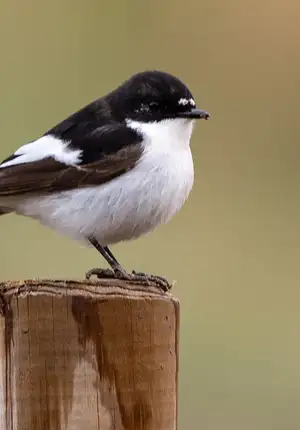 Same family
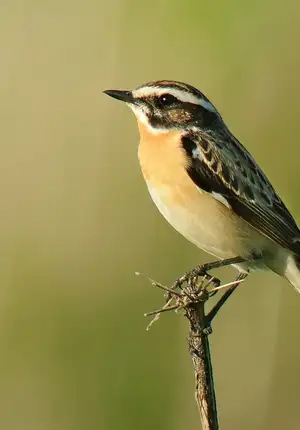 Same family
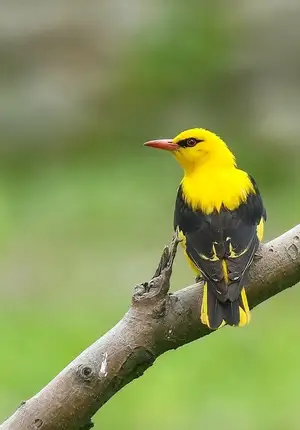 Also in sclerophyllous woodland
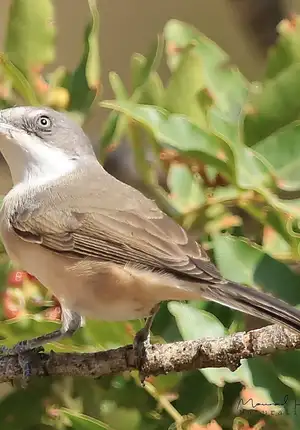 Also in sclerophyllous woodland
 Also in sclerophyllous woodland
 Also in sclerophyllous woodland






