Gregarious: it breeds in dense colonies and forms roosts that sometimes gather thousands of birds, normally mixed with swallows
Lifespan
Record of 10 years and 1 month in the wild according to AnAge and EURING (a bird ringed in Sweden); EURING also lists a figure of 21 years in the Channel Islands that is out of line
Conservation status
LC
NT
VU
EN
CR
EW
EX
Global (IUCN)
Least Concern
Spain
Least Concern (LC) as a breeder in the Red List of Birds of Spain; on the List of Wild Species under Special Protection, but not in the Spanish Catalogue of Threatened Species
When to see it
Summer visitor
Months of the year when it is present
J
F
M
A
M
J
J
A
S
O
N
D
In Iberia
no
yes
yes
yes
yes
yes
yes
yes
yes
yes
no
no
Breeding season
no
no
yes
yes
yes
yes
yes
yes
yes
no
no
no
Song or voice of the Sand Martin
It gives frequent calls of the «schrr» or «chirrrp» type, like those of other martins but harsher, and its song is a sequence of repeated calls. The recording is from a colony in Switzerland, so the chatter of many birds can be heard at once; we have trimmed the bass.
Calls from a colonySand Martin
0:00 / 0:26
10 kHz5
The sonogram draws the sound: time runs from left to right, and the higher a trace sits, the higher the note.Recording by Pascal Christe, xeno-canto XC1010747 (Siselen, Berna, Suiza) (CC BY-SA 4.0).
Flight of the Sand Martin
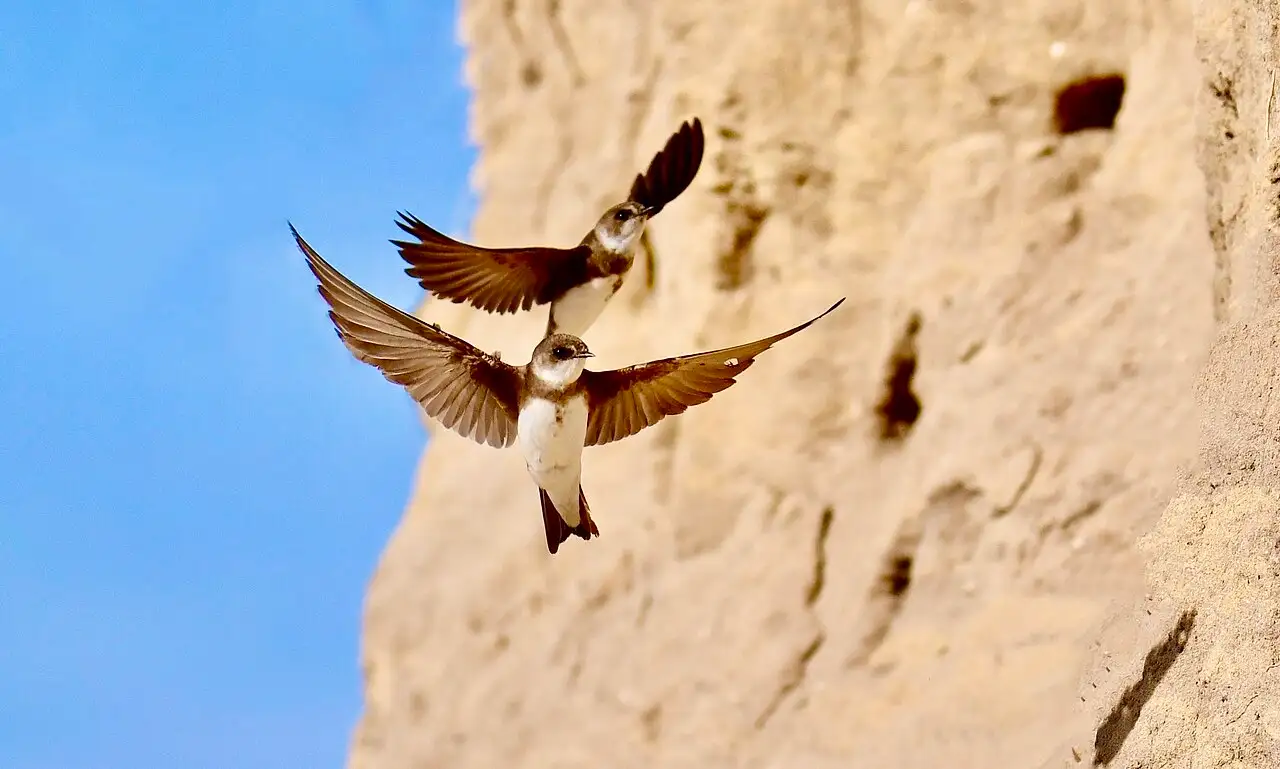
It catches its insects in chases at low height, above all near water, alone or in small groups.
Flight typeChases at low height, above all near water
It sets its dense colonies almost exclusively in sand or clay banks of rivers and gravel pits, where it digs a tunnel in which it nests.
It chases flying insects, above all near water and at low height, alone or in small groups, and near the nest.
It is usually seen in groups, both in flight and perched on banks and wires, and is more tied to water than other martins and swallows.
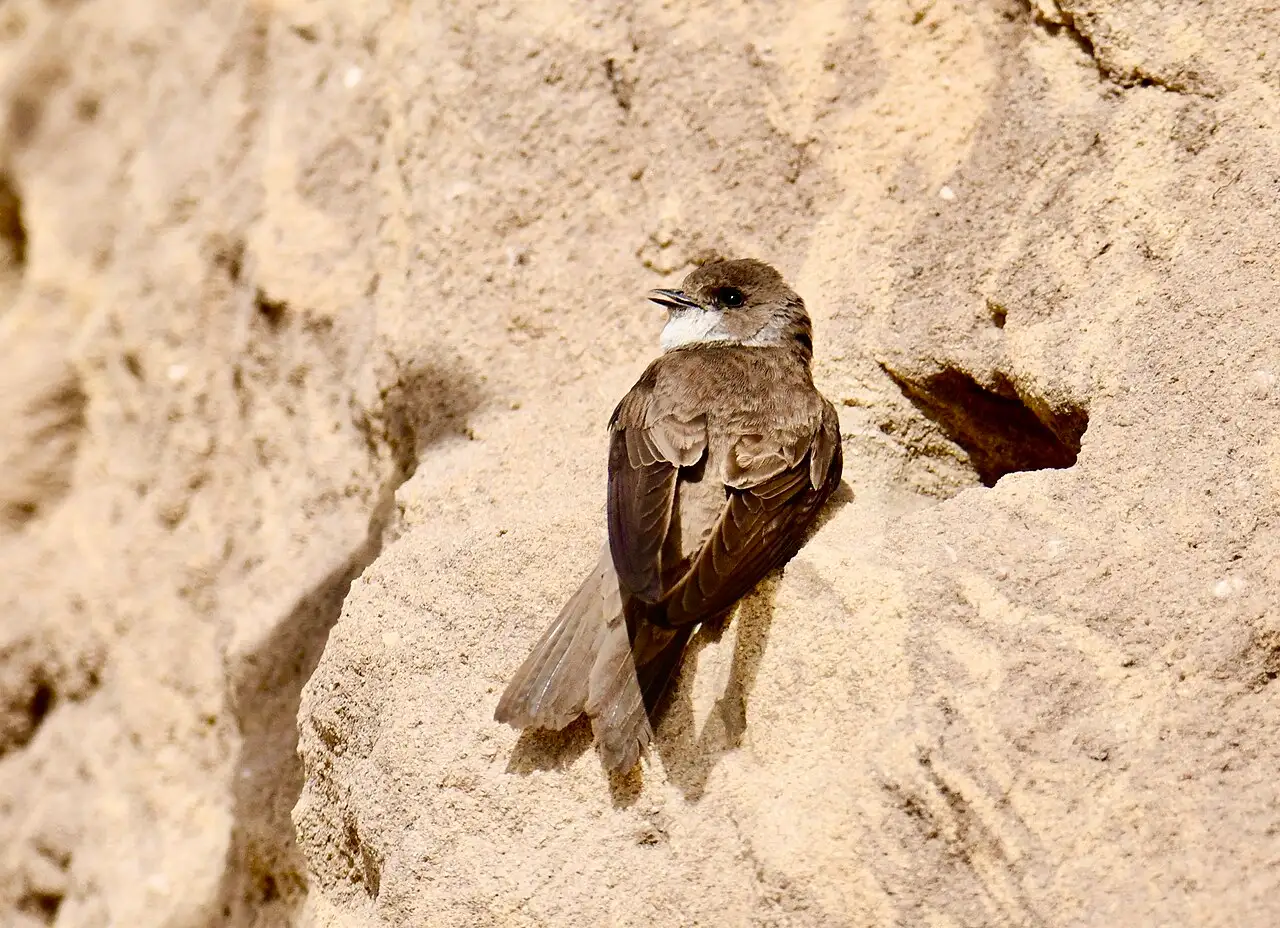
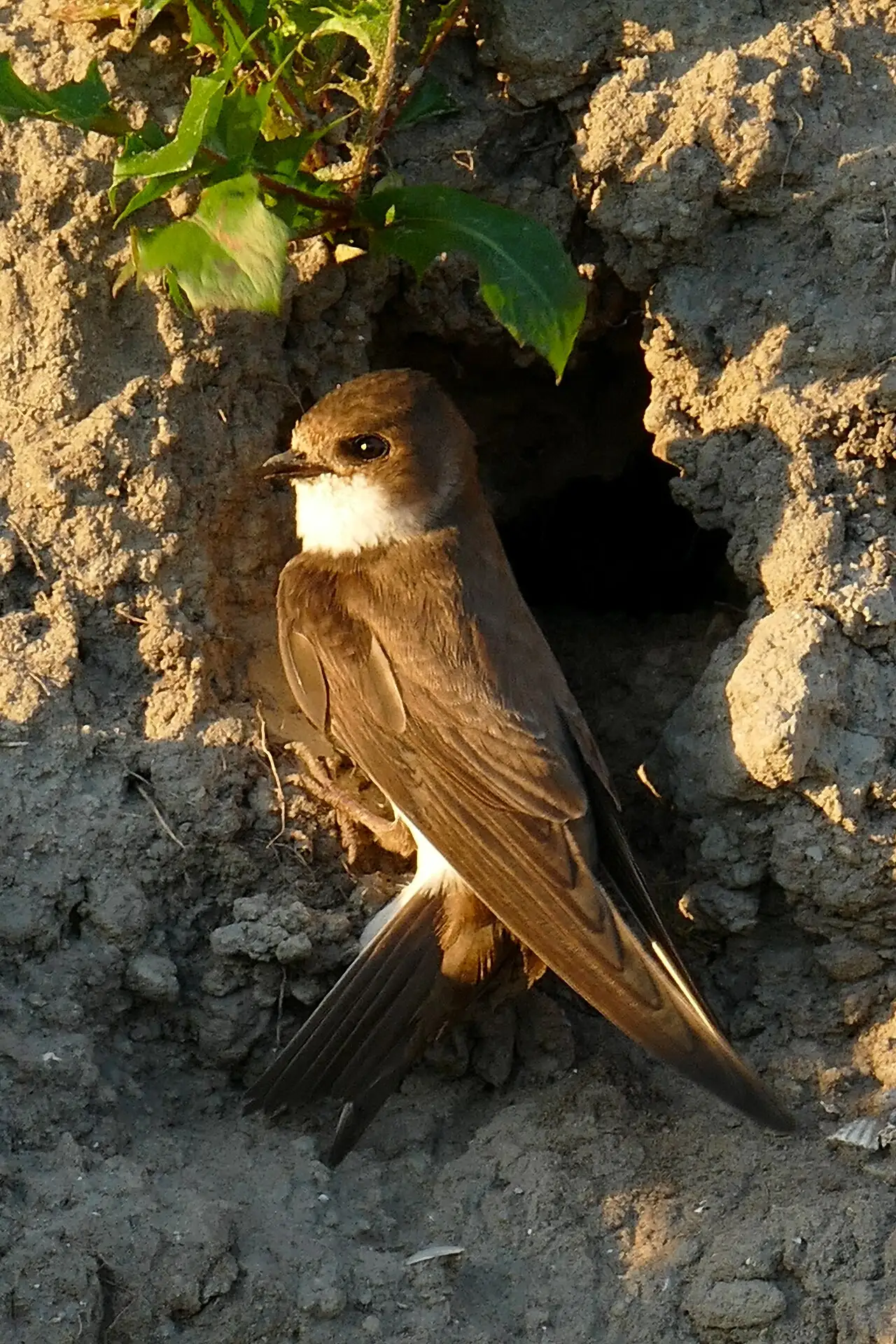
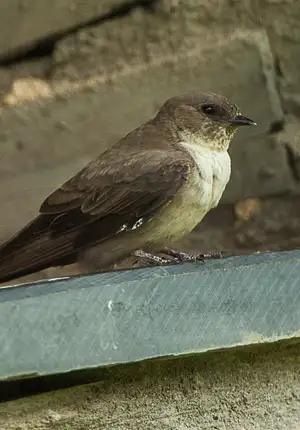
The Sand Martin, which is also called «avión zapador», is the smallest of our martins and swallows, though only slightly smaller than the rest1. It shows matt brown upperparts and whitish underparts, with sharp boundaries between the two, and has long, pointed wings, which in flight stand out for their darker front underside. The tail is short and slightly forked, the legs are short and unfeathered, the mouth very wide and the bill short, flat and black. The broad brown cross band on the breast is characteristic. Both sexes are alike.
Adult
Back matt brown and underparts whitish, with sharp boundaries.
Broad brown breast band.
Short, flat, black bill.
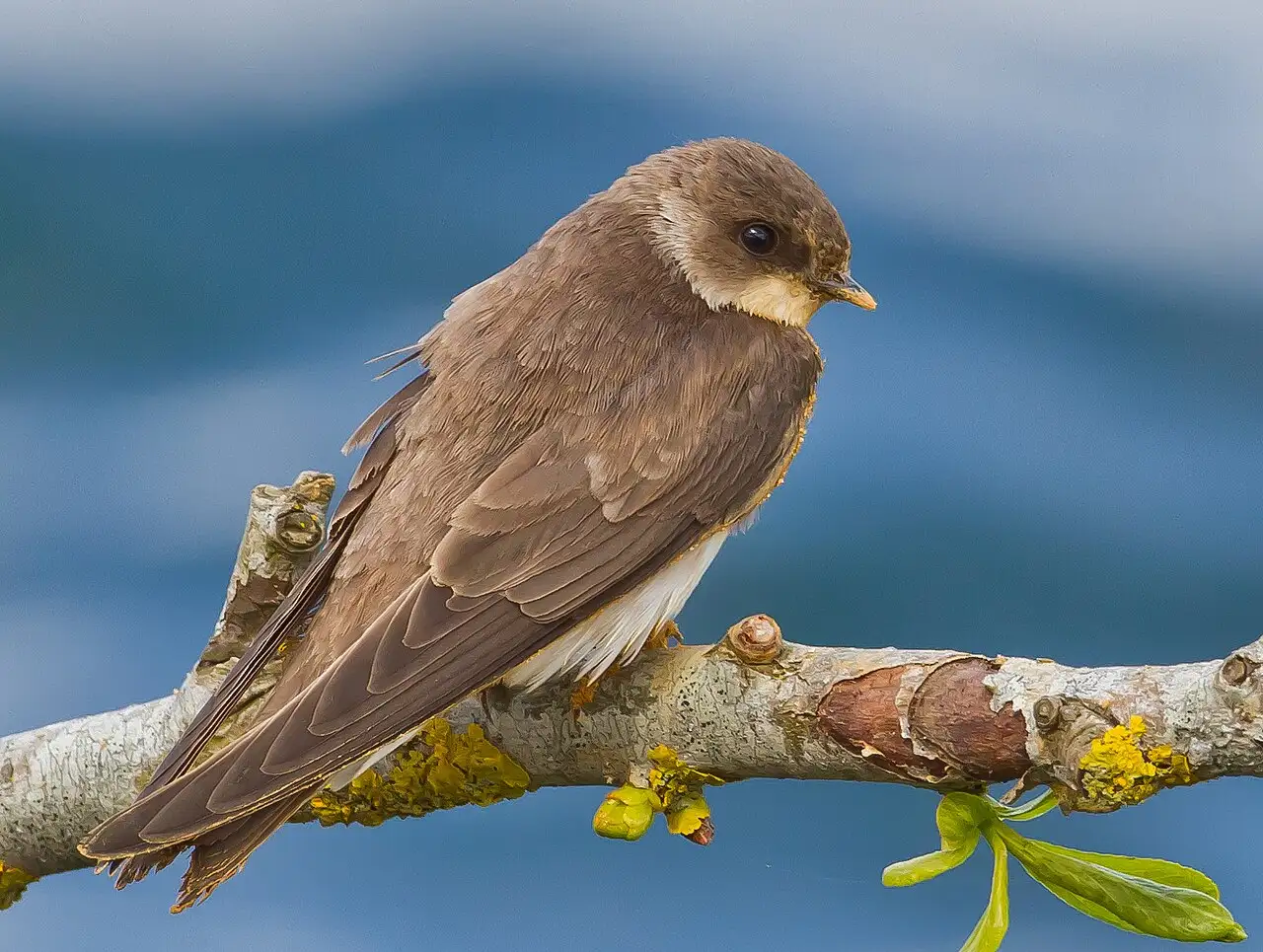
Young bird
Very like the adult, but with the head, neck and lower belly tinged cream-rufous.
The feathers of the back and head have pale edges.
Habitat and distribution of the Sand Martin
After the Barn Swallow, it is the most widespread hirundine in the world. As a breeder it occupies temperate, boreal and Arctic latitudes of Eurasia and North America, and as a winter visitor it is found in South America, sub-Saharan Africa and south-east Asia. Five subspecies are recognised and the only one present in Spain at all seasons is «riparia».
It breeds on the peninsular territory, with no breeding recorded in the Balearics or the Canaries. It is abundant above all in the basins of the Duero, the Tagus and the upper Ebro, becomes scarcer in the Guadiana basin and the north-east of the country, and its presence is scattered across the rest of the Peninsula. On migration it is seen throughout the territory, including the Canary Islands.
To nest it needs sand or clay banks, an unstable substrate that forces it to change site almost every year. It settles on the banks of wide watercourses and in gravel pits, which in some regions are practically the only environment it uses; sometimes it nests in stone walls, harbour breakwaters and artificial sand heaps. It is more common on lowland banks below 500 metres altitude, although it breeds from sea level to 1,650. The roosts before migration it usually sets up in marsh vegetation.
Spanish birds winter mainly in the Sahel. They return to Spain between February and April, and the older males are the first to come back; they leave the Peninsula between August and October, with a peak in September. After breeding they form roosts, sometimes of thousands of individuals and normally mixed with swallows.
Areas where it is regularly recorded since 2010Squares of about 25 km where it is recorded regularly (occasional passage records are left out). Data from GBIF.org (129,619 records, retrieved October 2026); outline from Natural Earth.
Etymology of the Sand Martin
According to Wikipedia, Linnaeus described it in 1758 with the name «Hirundo riparia», and the epithet «riparia» means «of the riverbank» and derives from Latin «ripa», «bank». It is also called «avión zapador»; in other languages it is «oreneta de ribera» in Catalan, «andoriña das barreiras» in Galician, «uhalde-enara» in Basque and «sand martin» in English1.
Population of the Sand Martin
In the 2021 European Red List of Birds the European breeding population is estimated at between 13,400,000 and 19,800,000 mature individuals, with a decreasing trend. There are no reliable published data for the Spanish population, which is little known and subject to strong fluctuations. The SACRE common bird monitoring programme suggests an overall stable trend, although with very high uncertainty.
It must have been a more common species in the past, before the systematic destruction of our rivers by channelling and the building of reservoirs, and before the decline caused by the droughts of the sub-Saharan region in the seventies and eighties. As it depends largely on gravel pits, their management is crucial; the main threat is the destruction of colonies in full breeding in active gravel pits, although in theory it is easy to avoid. Other problems are the abuse of pesticides and the poor state of rivers and wetlands.
Nest of the Sand Martin
The nest, started by the male and finished in some five days by both members of the pair, is a tunnel of 50 to 100 centimetres that ends in a breeding chamber. It usually builds new nests every year, habitually in the upper third of the bank and very close together. It breeds in colonies of variable size, with 50 to 200 nests on average, although sometimes they gather several thousand.
Courtship and breeding of the Sand Martin
The breeding period runs between March–April and August–September, and it makes two clutches a year. Although it is monogamous, paternity outside the pair is frequent: a third of broods and between 15 and 25 % of chicks. It lays four or five white eggs which both sexes incubate for some 14 days. The chicks, fed very frequently, peep out of the nest mouth at 15 days and fly at about 19 to 22.
Diet of the Sand Martin
The diet is based on small flying insects; the most-eaten items are flies, mosquitoes, bugs, wasps, ants and mayflies. It catches them in chases at low height, above all near water, alone or in small groups, and also near the nest.
Curious facts about the Sand Martin
Spain is a stopover during the migration of an important part of the very abundant European population1. AnAge gives a maximum longevity of 10 years and 1 month, the same as EURING (a bird ringed in Sweden), but EURING also lists a Sand Martin checked in the Channel Islands at 21 years, a figure that is out of line with everything else.
The Sand Martin in Cabañeros
The habitat pages of this website do not mention it, and we have not found any other published source on it in the Park. GBIF.org records 21 observations of the Sand Martin in Cabañeros and its surroundings.
Where to see the Sand Martin in Cabañeros
In Cabañeros and its surroundings, between February and October, beside rivers, reservoirs and gravel pits with sand or clay banks.
When
From February to October: it is a summer visitor, and breeds between March–April and August–September.
What time
By day, over the water; colonies form on the banks.
Where
On the banks of wide watercourses, gravel pits and sand or clay banks.
What to look for
Look for the brown breast band and its small size; look at the holes in the banks.



 Same family
 Same family
 Same family
 Same family
 Same order
 Same order
 Same order
 Same order





