It nests alone or in small colonies, averaging 5 nests and a maximum of 40; in winter it meets at roosts, sometimes of thousands of birds
Lifespan
Record of 8 years and 7 months in the wild (a bird ringed in Spain and recaptured by the ringer)
Conservation status
LC
NT
VU
EN
CR
EW
EX
Global (IUCN)
Least Concern
Spain
Least Concern (LC) in the Red Book of the Birds of Spain; on the List of Wild Species under Special Protection, but not in the Spanish Catalogue of Threatened Species
When to see it
Resident
Months of the year when it is present
J
F
M
A
M
J
J
A
S
O
N
D
In Iberia
yes
yes
yes
yes
yes
yes
yes
yes
yes
yes
yes
yes
Breeding season
no
no
no
no
yes
yes
yes
yes
no
no
no
no
Song or voice of the Eurasian Crag Martin
It consists of a simple sequence of soft chained trills. It is less vocal than other swallows and gives several very simple calls: «prrt» or «güiii».
SongEurasian Crag Martin
0:00 / 0:25
10 kHz5
The sonogram draws the sound: time runs from left to right, and the higher a trace sits, the higher the note.Recording by Bicheando Natura, YouTube (Vídeo de YouTube, con atribución).
Flight of the Eurasian Crag Martin
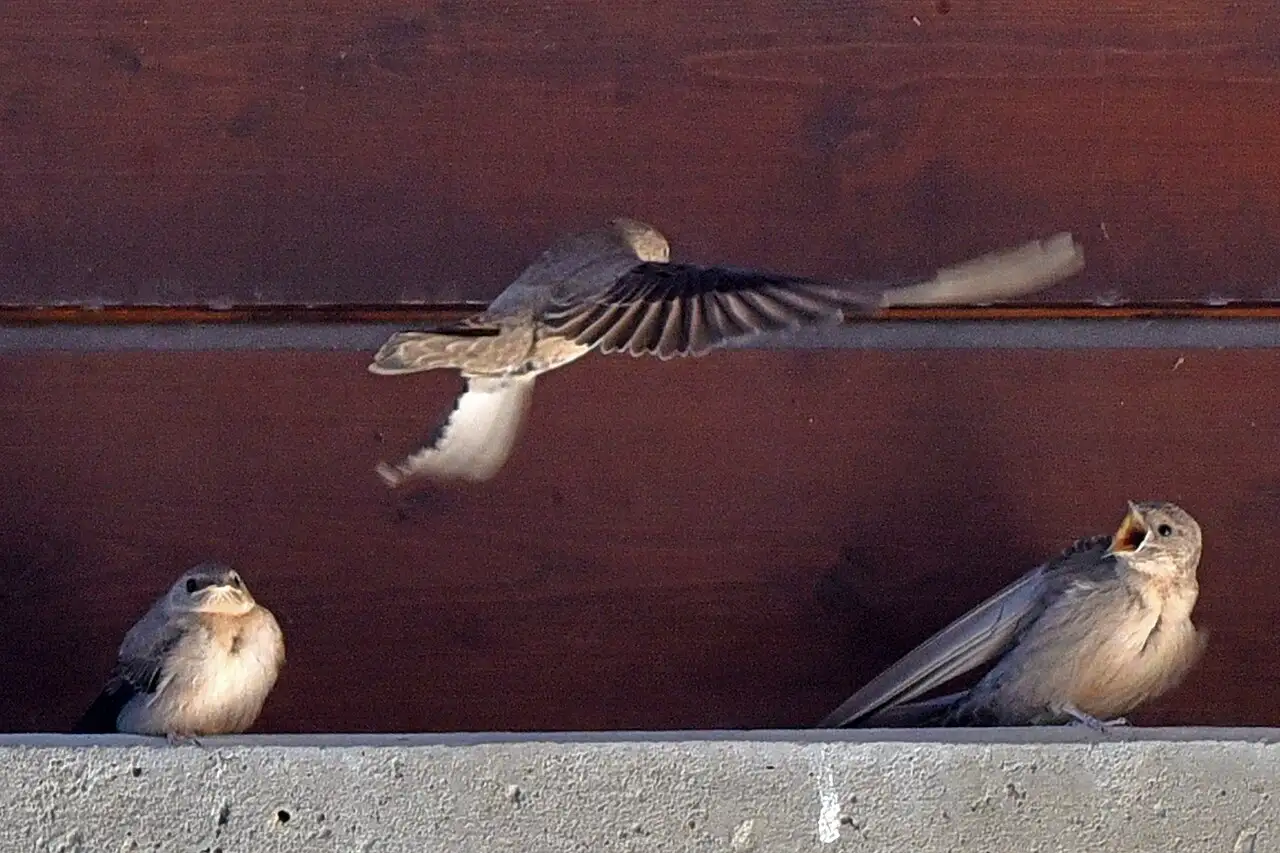
Its most usual appearance is that of a brown bird flying, with incessant comings and goings, beside crags and cliffs. The long, pointed wings stand out in flight for the almost black colour of the underside and front; the tail, short and unforked, shows a line of white spots, visible only when it is spread.
Flight typeGlides and slow flights beside the cliffs
It leaves the nest, an open cup of mud in a crevice or under a ledge, with ceaseless comings and goings beside crags and cliffs.
It hunts small flying insects with glides and slow flights near cliffs; in winter, above all on sunny slopes.
It usually hunts alone or in small groups and does not go far from the nest or roost, where in winter thousands of birds sometimes gather.
Photo gallery of the Eurasian Crag Martin
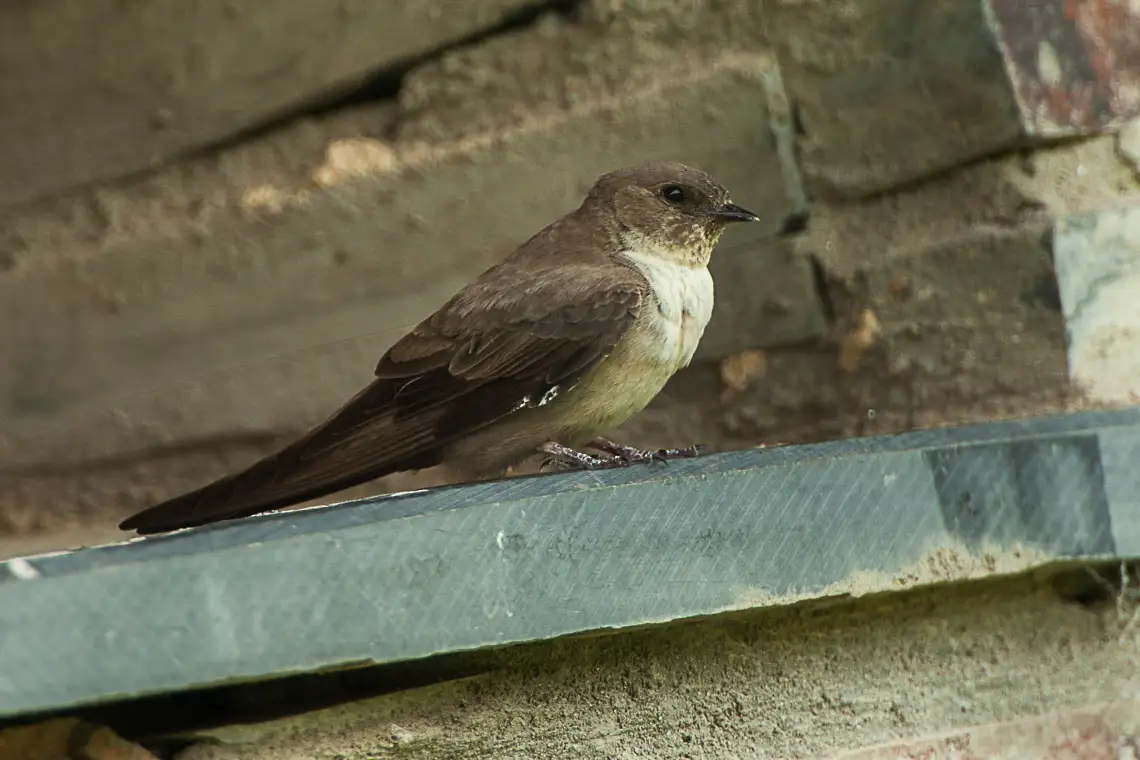
Eurasian Crag Martin perched on a beam under an eave, in profile, with brown plumage, paler throat and breast and long wingsPhoto: Francesco Veronesi from Italy, CC BY-SA 2.0Photo 1 of 4
Three Eurasian Crag Martins under a wooden eave: one in flight and two perched, one of them with its bill openPhoto: Pierre-Marie Epiney, CC BY-SA 2.0Photo 2 of 4
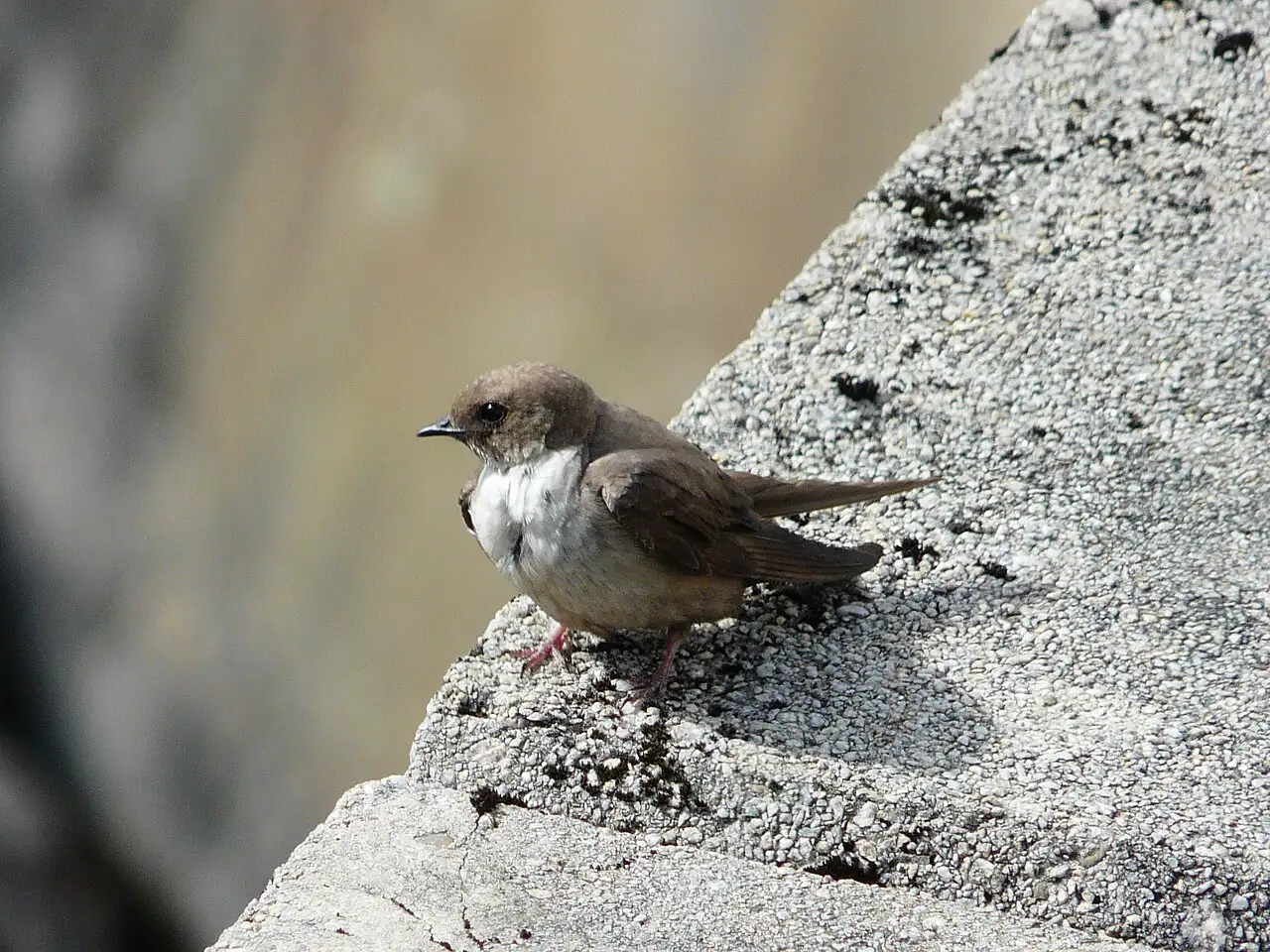
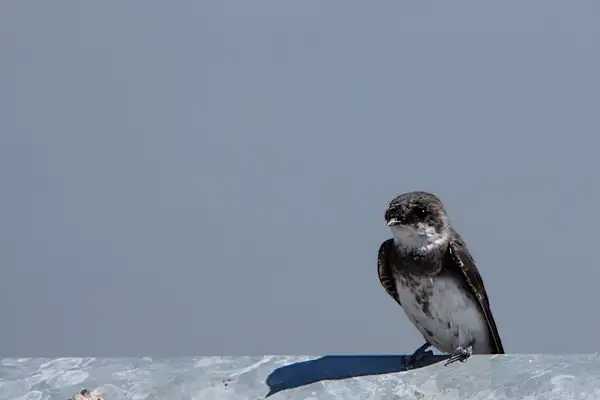
Eurasian Crag Martin from the front on the concrete edge of a dam, with pale throat and pink legsPhoto: Père Igor, CC BY-SA 4.0Photo 4 of 4
1 / 4
Identification of the Eurasian Crag Martin
The Crag Martin is the biggest Spanish swallow, though only a little bigger than the others. It has a generally low-contrast brown look, with matt brown upperparts and pale brown underparts, with diffuse boundaries between the two. Its long, pointed wings stand out in flight for the almost black colour of the underside and front. The tail, short and unforked, shows a line of white spots, visible only when it is spread. It has short, unfeathered legs, a very wide mouth and a short, flat, black bill. The throat is almost white, with some dark streaks.
It is told from the Sand Martin because the latter has a broad brown band across the breast. Both sexes are alike. Young birds, very similar to adults, have feathers edged with cream and a paler throat, with diffuse mottling. Although it is usually seen in flight and in groups, it is not unusual to see it perched, especially at winter roosts and resting places.
Adult
Matt brown above and pale brown below, with diffuse boundaries.
Underside of the wings almost black; tail short, unforked, with white spots.
Throat almost white, with some dark streaks.
Young bird
Feathers edged with cream and a paler throat, with diffuse mottling.
Habitat and distribution of the Eurasian Crag Martin
As a breeder it occupies a narrow band of Eurasia running from the Mediterranean basin to China. In winter it appears in small areas of India and Africa. It has no subspecies.
In Spain it occupies the Peninsula, Mallorca and Ceuta, always absent from flat areas (both plateaus and the plains of the big rivers), although it can also occupy steep river courses, infrastructure and rural and urban buildings. In winter it leaves the coldest and mountain areas to concentrate mainly on the Mediterranean coast between Cádiz and Castellón.
It occupies rugged areas of any altitude, especially limestone crags, and breeds from sea level to 2,500 metres. In smaller numbers it nests on human constructions, normally dams, bridges, tunnels and buildings inside and outside towns. In winter it descends in altitude, although it can stay up to 1,000 metres, and usually settles near water, on the coast or inland.
Although it is described as resident in Spain, it is really a partial migrant that leaves areas of harsher winter climate and heads, through altitudinal and medium-range movements, to coastal and river areas (the Mediterranean coast from Cádiz to Castellón, the Balearics and the inland wetlands of the south-west of the peninsula). Part of the Spanish population moves to North Africa, and Spain receives winter visitors from central Europe. The migratory flow at the Strait is noticeable between February and April and between September and November, with peak influx in March and October.
Areas where it is regularly recorded since 2010Squares of about 25 km where it is recorded regularly (occasional passage records are left out). Data from GBIF.org (233,449 records, retrieved October 2026); outline from Natural Earth.
Etymology of the Eurasian Crag Martin
According to Wikipedia, «Ptyonoprogne» comes from the Greek «ptýon» («fan»), from the shape of the spread tail, and from Procne, the girl in Greek mythology who was turned into a swallow, and «rupestris» means «of the rocks», from the Latin «rupes». In other languages it is called «roquerol» in Catalan, «andoriña dos penedos» in Galician, «haitz-enara» in Basque and «Eurasian crag martin» in English1.
Population of the Eurasian Crag Martin
In the 2021 European Red List of Birds the European breeding population is estimated at between 420,000 and 816,000 mature individuals, with a stable trend. The Spanish population is not well quantified, although it makes up a notable fraction of the European contingent, and the size of the winter population is completely unknown, when it forms roosts, sometimes of a few thousand birds.
It suffers no important threats. Possible problems include the indiscriminate use of pesticides and the removal of breeding sites during infrastructure construction; the poor state and destruction of wetlands, especially coastal ones, in winter could also affect it. The tendency to nest in urban areas has favoured its expansion on flat ground.
Nest of the Eurasian Crag Martin
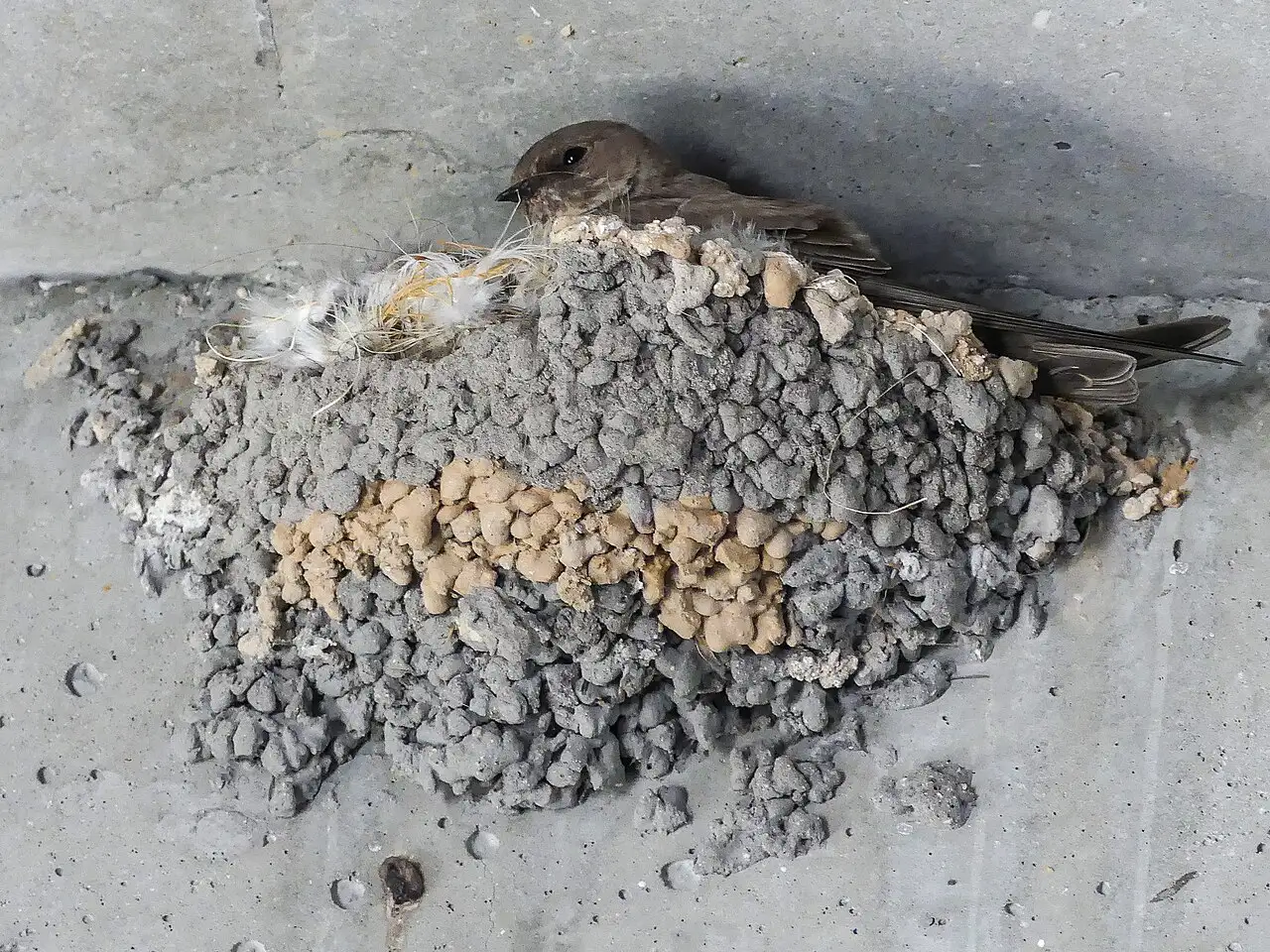
The nest, built by both sexes in 10–20 days and very similar to the Barn Swallow’s, is an open cup of mud set in a crack or under a ledge. It is repaired and used for several years. It nests alone or in small colonies averaging 5 nests and a maximum of 40, sometimes mixed with Red-rumped Swallow, House Martin or Alpine Swift.
Courtship and breeding of the Eurasian Crag Martin
The breeding period runs between May and August, and it makes two clutches a year. In the nests it lays three or four white eggs with reddish spots, which the female incubates almost entirely for about 15 days. The chicks, fed very frequently, fly at about 25 days old.
Diet of the Eurasian Crag Martin
Its diet is based on small flying insects, above all flies, mosquitoes and small beetles. It catches them with glides and slow flights near the cliffs, and in winter above all on sunny slopes. It usually hunts alone or in small groups and does not stray far from the nest or the roost.
Curious facts about the Eurasian Crag Martin
It is the only resident swallow in Spain. According to Wikipedia, the biggest known winter roost of the species was recorded in the Gorham’s Cave complex, in Gibraltar, with a maximum of 12,000 birds. According to EURING, the ringed bird that lived longest, in Spain, reached 8 years and 7 months; oiseaux.net cites 8.7 years.
The Eurasian Crag Martin in Cabañeros
The habitat pages of this website do not mention it. GBIF.org records 95 observations of the Eurasian Crag Martin in Cabañeros and its surroundings.
Where to see the Eurasian Crag Martin in Cabañeros
In Cabañeros and its surroundings, all year.
When
All year: it is the only swallow that stays in winter, although it comes down from the mountains to coasts and wetlands.
What time
In good light, beside crags, cliffs and escarpments, and on dams and bridges.
Where
In flight, with incessant comings and goings, and perched at winter roosts and ledges.
What to look for
Look for the brown swallow with a short, unforked tail with white spots, and the almost black wings below.



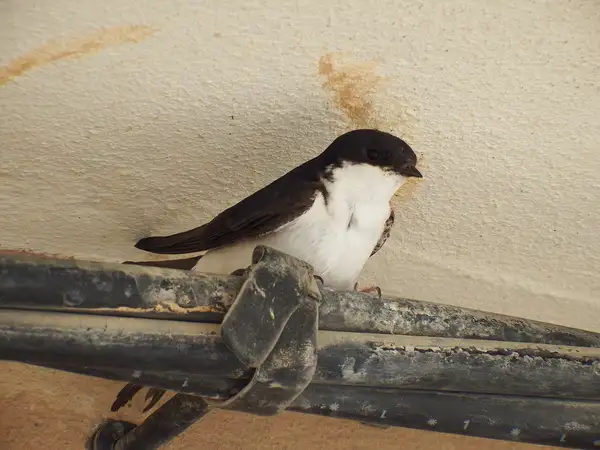
 Same family
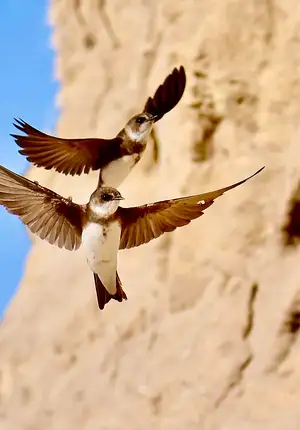 Same family
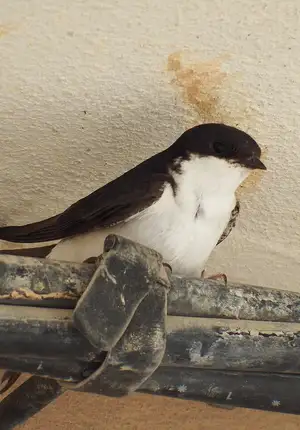 Same family
 Same family
 Same order
 Same order
 Same order
 Same order





