It breeds alone or in small scattered colonies and is faithful to the breeding site; it hunts alone or in small groups, sometimes with other swallows and martins
Lifespan
Record of 9 years in the wild according to AnAge; not on the EURING longevity list
Conservation status
LC
NT
VU
EN
CR
EW
EX
Global (IUCN)
Least Concern
Spain
Least Concern (LC) as a breeder in the Red List of Birds of Spain; on the List of Wild Species under Special Protection, but not in the Spanish Catalogue of Threatened Species
When to see it
Summer visitor
Months of the year when it is present
J
F
M
A
M
J
J
A
S
O
N
D
In Iberia
no
no
yes
yes
yes
yes
yes
yes
yes
yes
no
no
Breeding season
no
no
no
yes
yes
yes
yes
yes
yes
no
no
no
Song or voice of the Red-rumped Swallow
Its song is a short, sweet twitter, of less volume than the Barn Swallow’s. It also gives the typical calls of swallows, although in some ways they recall those of some sparrows and buntings.
CallsRed-rumped Swallow
0:00 / 0:16
10 kHz5
The sonogram draws the sound: time runs from left to right, and the higher a trace sits, the higher the note.Recording by Aves Córdoba, Vídeo de YouTube «Golondrina dáurica» (Vídeo de YouTube, con atribución).
Flight of the Red-rumped Swallow
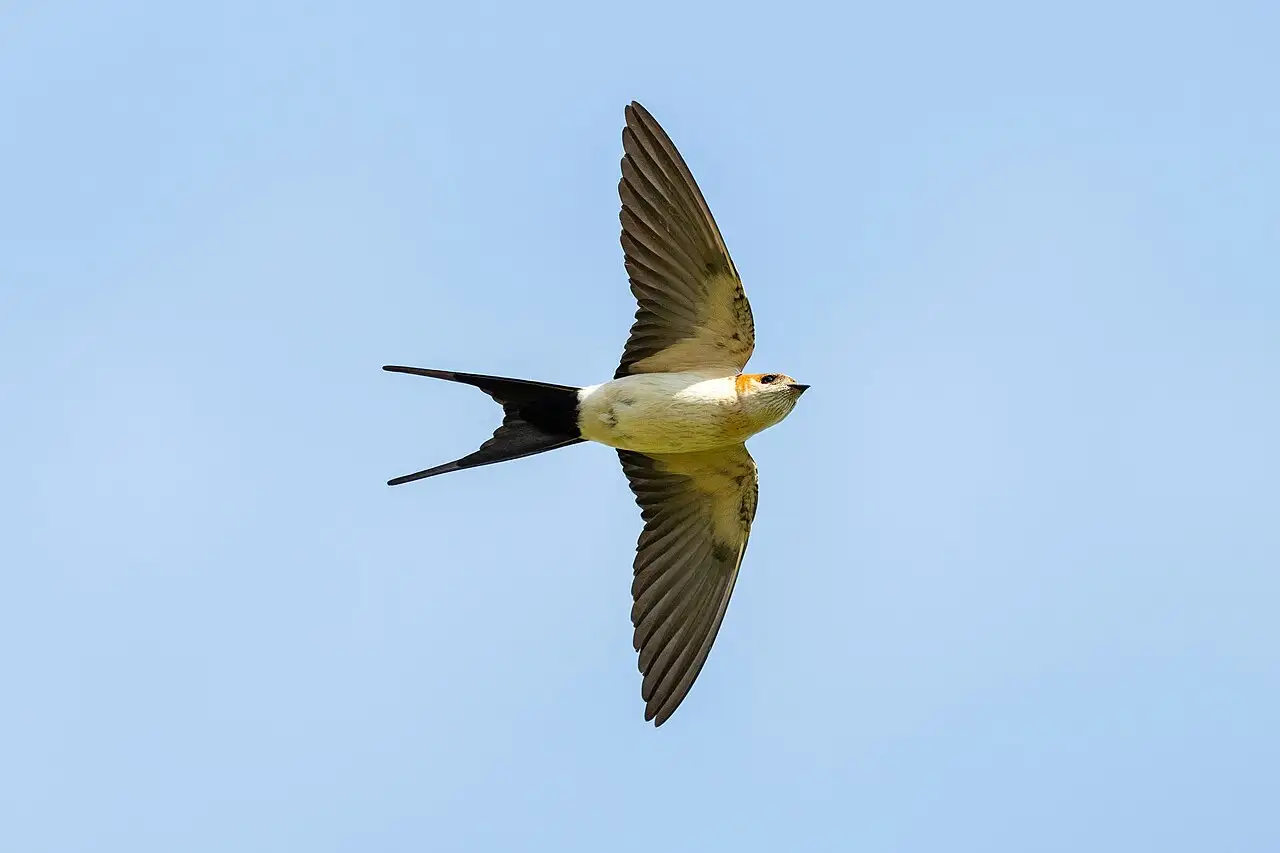
It has an agile, fast, acrobatic flight. It hunts with chasing flights that are slower and more gliding than the Barn Swallow’s.
Flight typeAgile, fast and acrobatic, slower and more gliding than the Barn Swallow's
It is often seen near bridges and rock faces, in warm areas of Mediterranean vegetation tied to watercourses.
It hunts flies, mosquitoes, flying ants and small beetles in acrobatic chasing flights, slower and more gliding than the Barn Swallow's.
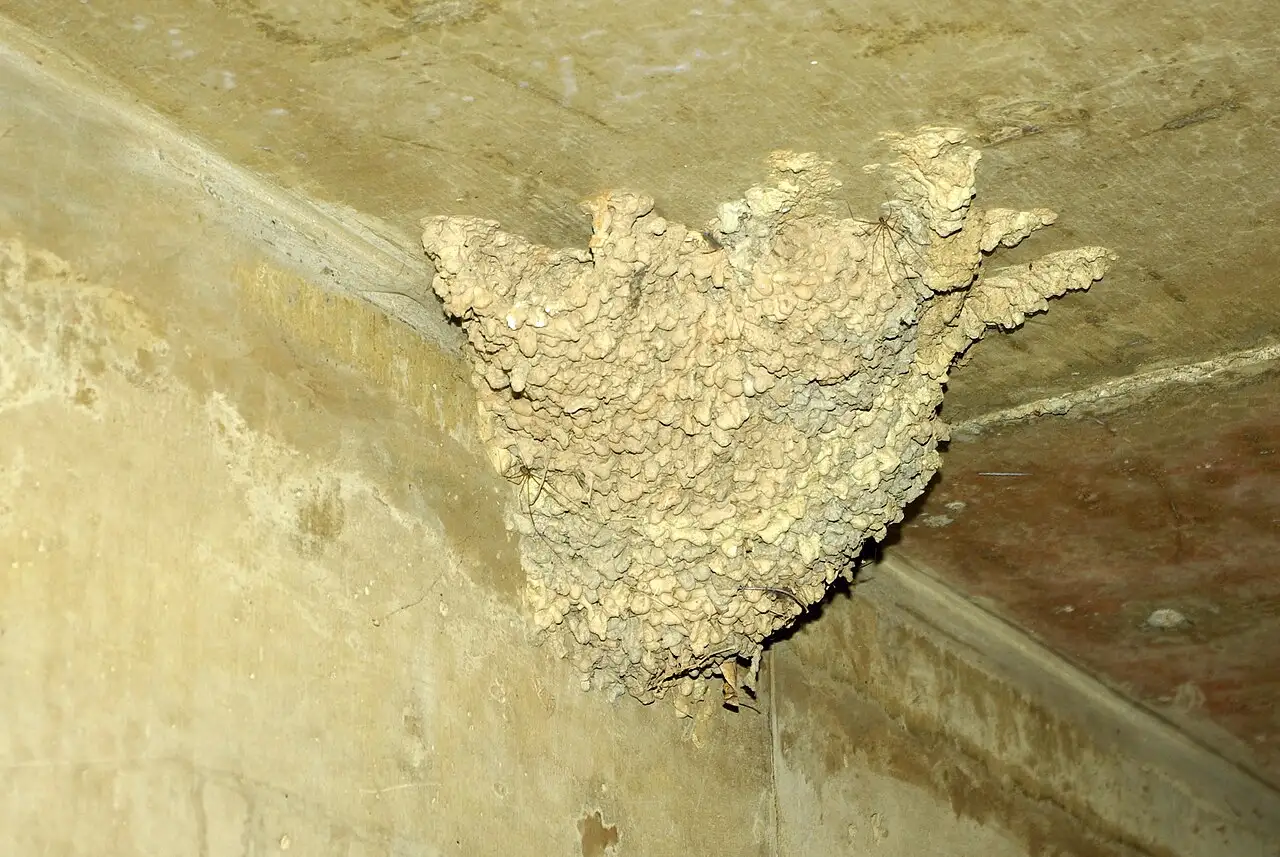
Its nest is a hemisphere of mud pellets with an entrance tunnel, stuck under a roof, an eave or a rocky overhang.
Red-rumped Swallow nest made of mud pellets and stuck under a concrete roof, with its entrance tunnelPhoto: David Perez, CC BY 4.0Photo 4 of 4
1 / 4
Identification of the Red-rumped Swallow
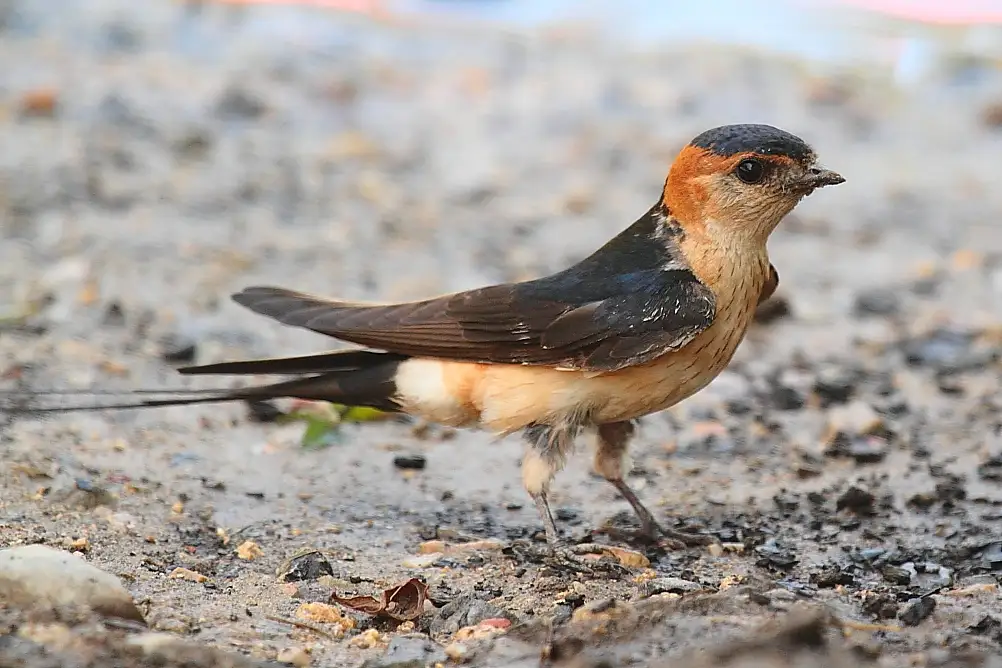
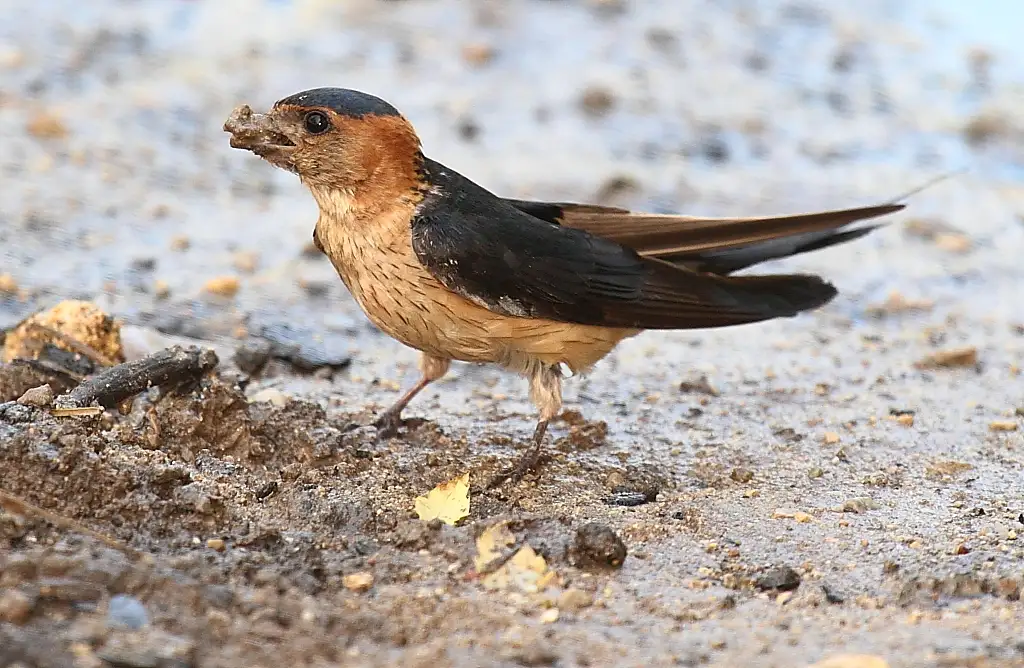
Similar in appearance to the Barn Swallow, it has a black back with bluish sheen and a dirty white belly, with orange flanks and some faint streaks. Its most characteristic features are the orange nape and face, the same colour as the rump. The long, pointed wings also show orange tones on the front underside, and the very long, very forked tail is uniform black above and below. It has short, unfeathered legs, a very wide mouth and a short, flat, black bill. The two sexes are alike. It is often seen near bridges and rock faces.
Adult
Nape, face and rump orange.
Back black with bluish sheen; belly dirty white with orange flanks.
Black tail, very long and very forked.
Young bird
Back dull black, with the feathers edged in white.
The orange areas are less intense, and the rump sometimes looks white.
Habitat and distribution of the Red-rumped Swallow
It breeds over much of Asia and in small areas of Africa and southern Europe, where it continues to spread north. There are sedentary populations, but most are migratory, and the European ones winter in Africa. Ten subspecies are recognised, and taxonomic revisions based partly on the shape of the nest place it in the genus «Cecropis». In Spain the subspecies «rufula» lives, with little streaking on the breast and belly, which some lists now treat as a separate species.
It occupies the Peninsula, Ceuta and Melilla, and is spread almost uniformly across Andalusia, Extremadura, Madrid, Toledo, Ciudad Real, Ávila, Salamanca and Zamora, with scattered cores across the rest, above all along the Mediterranean coast. It also breeds in Galicia, Asturias, Cantabria, Mallorca and Menorca. The first Spanish record is from 1921, in Cádiz, and since then its expansion has been steady, very intense between 1950 and 1980.
It prefers warm areas of Mediterranean vegetation, woods and dehesas, scrub and grasslands, tied above all to rivers and with rock faces to breed on. For that it also makes itself at home on country structures, above all bridges, underpasses beneath roads and abandoned rural buildings, and where it is most abundant it begins to occupy houses in villages and small towns. It is more numerous between 500 and 1,000 metres, although nests at 1,600 have been recorded.
Spanish birds winter in Africa, presumably in the west of the Sahel. The first return in February, and the mass arrival is in March and April. They leave the nests in August and September, gather in small groups and cross the Strait mainly between the second half of September and the first half of October.
Areas where it is regularly recorded since 2010Squares of about 25 km where it is recorded regularly (occasional passage records are left out). Data from GBIF.org (181,361 records, retrieved October 2026); outline from Natural Earth.
Etymology of the Red-rumped Swallow
According to Wikipedia, the genus «Cecropis», created by Friedrich Boie in 1826, comes from ancient Greek and means «Athenian woman», and the epithet «daurica» refers to Dauria, a mountainous region east of Lake Baikal, in Russia. The western population, which is ours, was described in 1835 as «Hirundo rufula», from Latin «rufulus», «reddish». In other languages it is called «oreneta cua-rogenca» in Catalan, «anduriña dáurica» in Galician, «enara ipurgorria» in Basque and «red-rumped swallow» in English1.
Population of the Red-rumped Swallow
In the 2021 European Red List of Birds the European breeding population is estimated at between 2,860,000 and 6,680,000 mature individuals, with a stable trend. The Spanish population is calculated at around 1,100,000 birds, with its best areas in Andalusia, Castilla-La Mancha and Extremadura, and the SACRE programme shows moderate growth between 1998 and 2018.
No conservation problems are known for it, although it would be affected by the general threats of pesticide abuse, air pollution, disturbance during breeding and the destruction of nests.
Nest of the Red-rumped Swallow
Both sexes build it in some 10–15 days: a hemisphere of mud pellets with an entrance tunnel, like an igloo turned upside down. They almost always stick it horizontally under a roof, an eave or a rocky overhang, and repair and reuse it for several years. It breeds alone or in small scattered colonies, and is faithful to its breeding site.
Courtship and breeding of the Red-rumped Swallow
The breeding period begins in mid-April and ends in September. It normally makes two clutches, sometimes three, and the number of eggs falls from one to the next: in Extremadura the average is 4.5 eggs in the first, 3.8 in the second and 3.6 in the third. The eggs, cream with reddish spots, are incubated by both sexes for some 15 days. The chicks leave the nest at about 27 days, and on average 3.5 chicks fly per brood.
Diet of the Red-rumped Swallow
It eats flies, mosquitoes, flying ants, wasps, bugs and small beetles, which it hunts in acrobatic chasing flights, slower and more gliding than the Barn Swallow’s. It usually hunts alone or in small groups, sometimes alongside other swallows and martins.
Curious facts about the Red-rumped Swallow
Its presence has opened the door to another African colonist, the White-rumped Swift, which breeds in its nests1. And that it was the shape of the nest, among other reasons, that led to its separation from the genus «Hirundo» of the Barn Swallow.
The Red-rumped Swallow in Cabañeros
The habitat pages of this website do not mention it, and we have not found any other published source on it in the Park. GBIF.org records 45 observations of the Red-rumped Swallow in Cabañeros and its surroundings.
Where to see the Red-rumped Swallow in Cabañeros
In Cabañeros and its surroundings, from March to October, near bridges, rock faces and country houses.
When
From March to October: it is a summer visitor, and breeds from mid-April to September.
What time
By day, hunting insects in flight.
Where
In warm areas of dehesas, scrub and grasslands, near rivers, and by bridges, underpasses beneath roads and country buildings.
What to look for
Look for the orange nape and rump and the uniform black tail; look for its mud nest with a tunnel.



 Same family
 Same family
 Same family
 Same family
 Same order
 Same order
 Same order
 Same order





