EURING lists a bird ringed in the Czech Republic that lived 7 years and 11 months
Conservation status
LC
NT
VU
EN
CR
EW
EX
Global (IUCN)
Least Concern
Spain
Least Concern (LC) as a breeder in the Red Book of the Birds of Spain; on the List of Wild Species under Special Protection, but not in the Spanish Catalogue of Threatened Species
When to see it
Summer visitor
Months of the year when it is present
J
F
M
A
M
J
J
A
S
O
N
D
In Iberia
no
no
yes
yes
yes
yes
yes
yes
yes
yes
no
no
Breeding season
no
no
no
no
yes
yes
yes
yes
no
no
no
no
Song or voice of the Tawny Pipit
It is a simple, repetitive song of just two notes: a monotonous series, «chir-li», which it repeats every few seconds for a minute or more, in flight or from a perch1. It also gives simple calls of one or two high notes, «chiip», «chuuií», «siip». The recording (song) is by Jordi Calvet and was made in L’Anoia (near Rubió), Barcelona, Catalonia (xeno-canto XC241647, quality A). It lasts 9 seconds and is a trimmed section of the original, without repeating or lengthening, from which we have removed the bass below 300 Hz, reduced the background noise and adjusted the volume; neither pitch nor speed has been changed.
It is a bird that rarely flies and prefers to move on foot1; it does sing, though, in flight or from a perch. It arrives from March, peaking in April, and the autumn passage runs from late July to mid-October, peaking in September.
Flight typeWalks on the ground; sings in flight or from a perch
A territorial bird usually seen alone and on the ground: it rarely flies and prefers to move on foot.
The song, delivered in flight or from a perch, is a monotonous series of two or three notes, «chir-li», repeated every few seconds for a minute or more.
It feeds on the ground by pecking and chasing, tearing apart larger prey.
Photo gallery of the Tawny Pipit
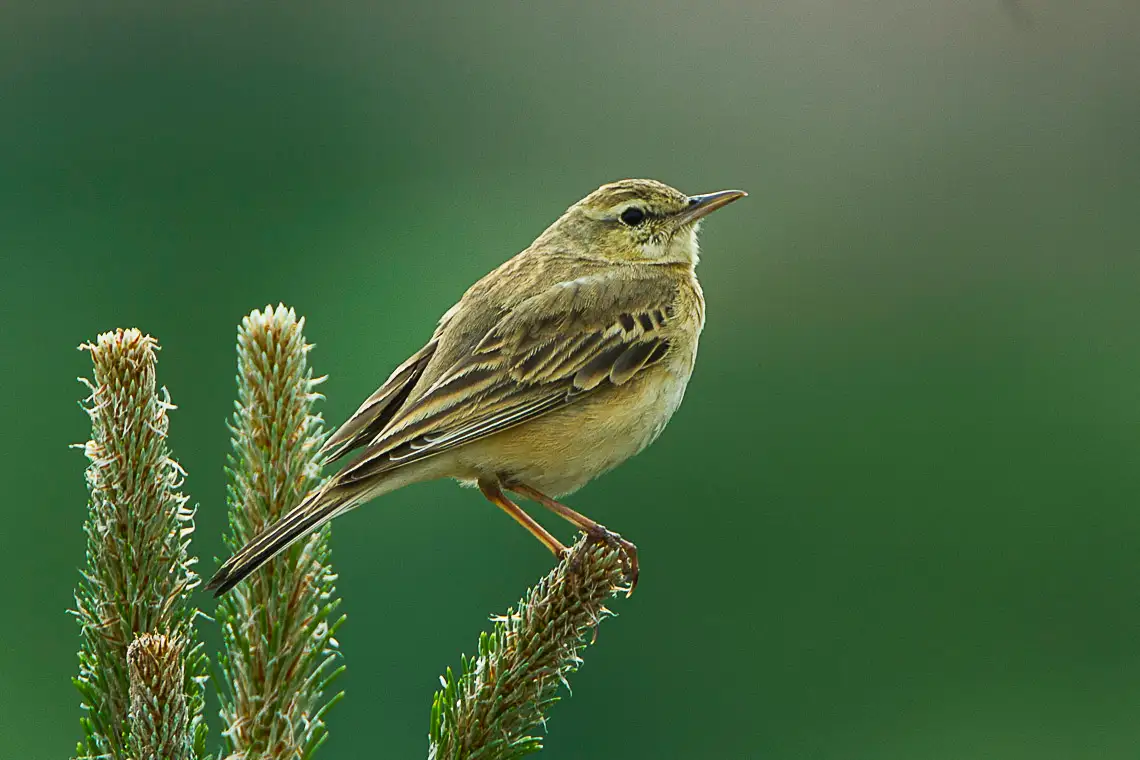
Tawny Pipit in profile, perched on the tip of a plant, with sandy grey back and cream underparts, against a blurred green backgroundPhoto: Francesco Veronesi from Italy, CC BY-SA 2.0Photo 1 of 5
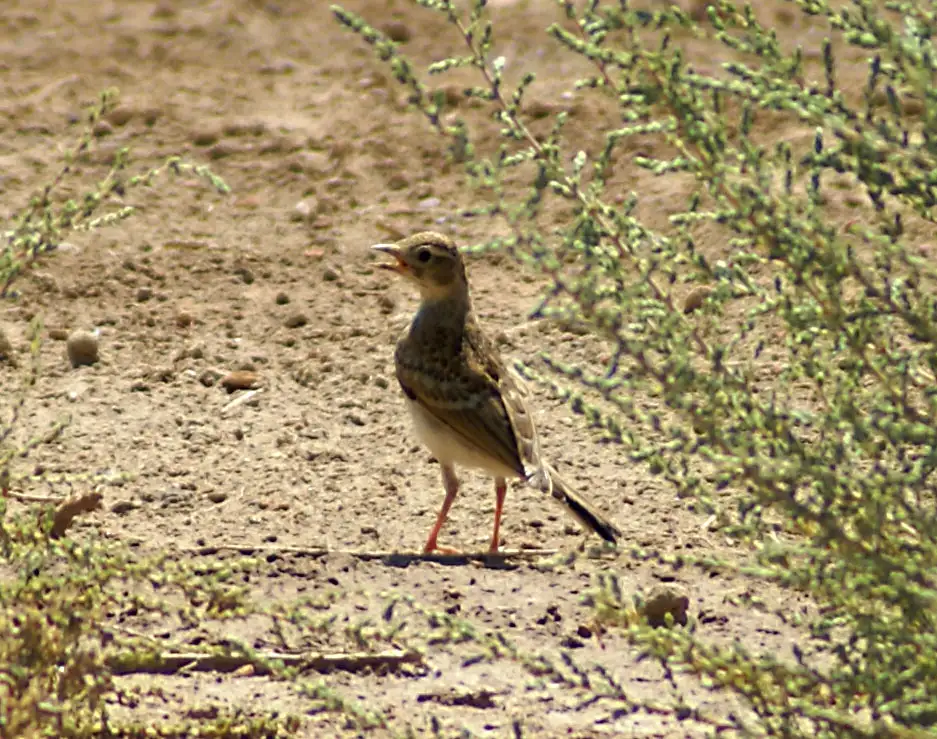
Tawny Pipit upright on stony ground beside a bush, with bill open, pale eyebrow and thin orange legsPhoto: putneymark, CC BY-SA 2.0Photo 2 of 5
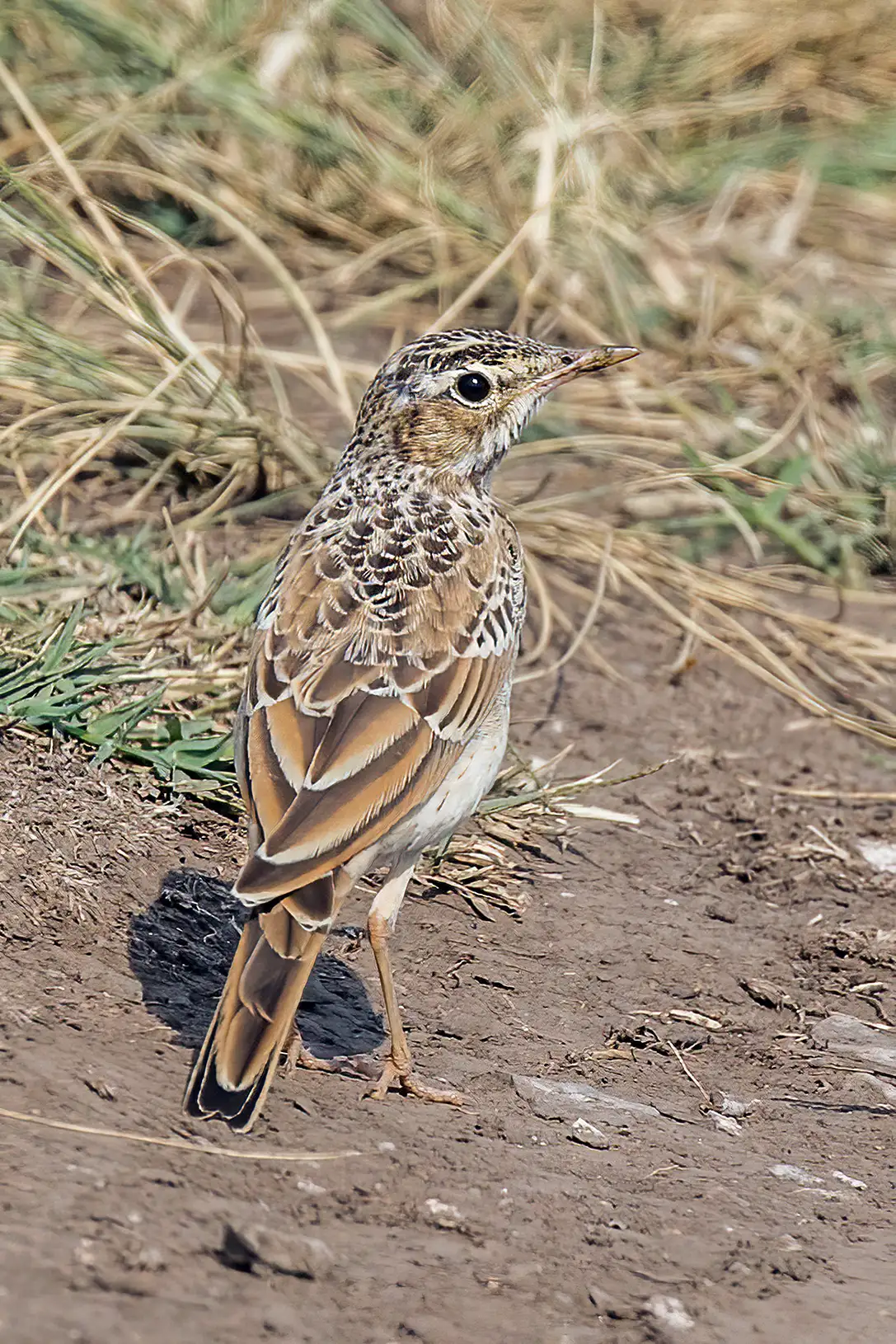
Young Tawny Pipit on the ground among dry grass, seen from behind, with streaked, scaly backPhoto: Charles J. Sharp, CC BY-SA 4.0Photo 3 of 5
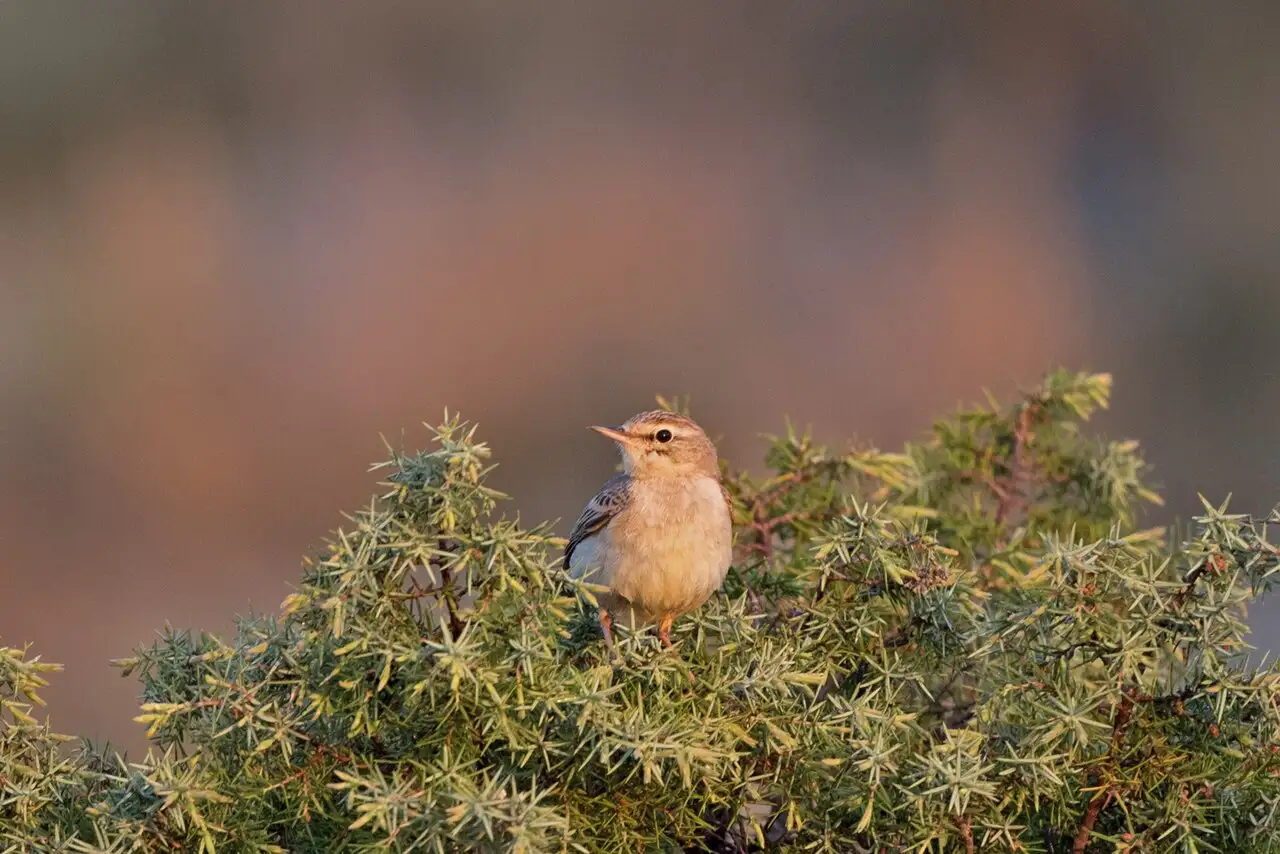
Sandy-toned Tawny Pipit perched on a juniper, from the front, with plain, pale plumagePhoto: Pierre-Marie Epiney, CC BY-SA 2.0Photo 4 of 5
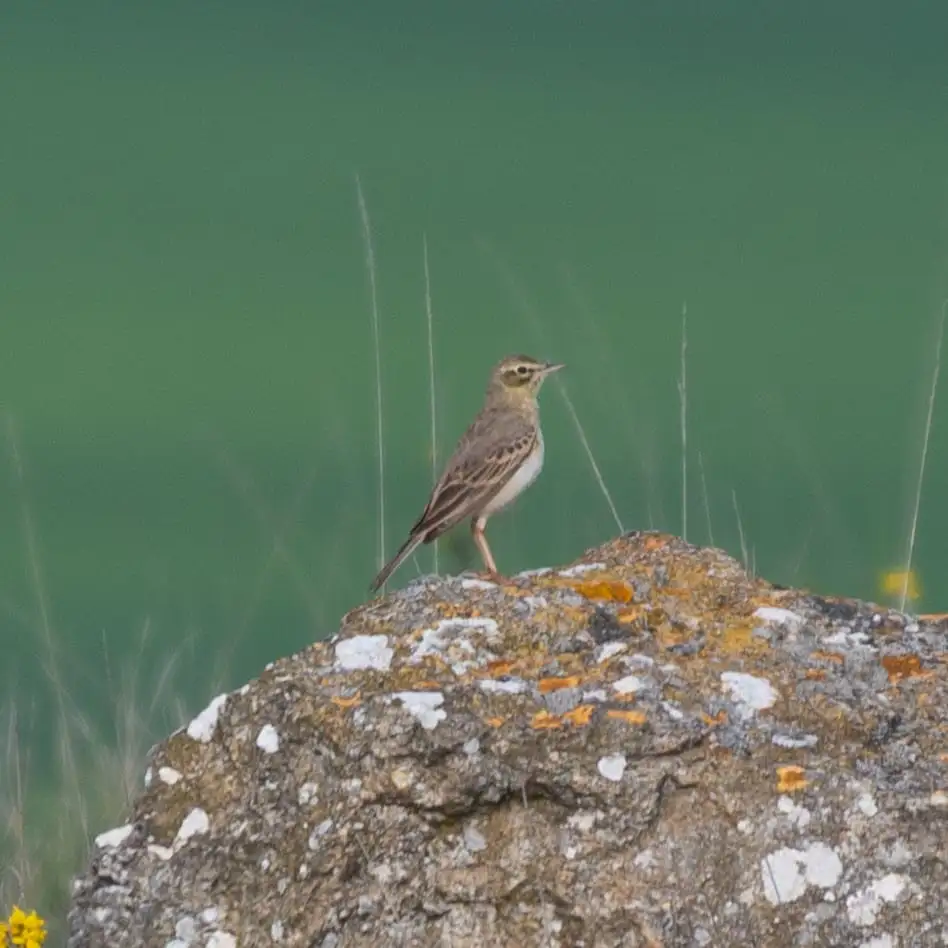
Tawny Pipit upright on a lichen-covered rock, with blurred green background (Castilla y León)Photo: euqirneto, CC BY 4.0Photo 5 of 5
1 / 5
Identification of the Tawny Pipit
The Tawny Pipit is characterised by its large size, its wagtail look and its pale, plain colouring. It shows a sandy grey back, faintly streaked, and cream underparts with no streaks. It has rounded wings, a long tail with white outer feathers, a bill orange below and dark above and thin, yellowish-orange legs. On the head it shows several contrasting lines: pale eyebrow, dark eye-stripe, white moustache with a black lower edge and white throat. It is unique among our pipits for its pale sandy tones and the absence of streaks on the breast. Both sexes are alike. Young birds recall other pipits more through their streaked, scaly back and, above all, their heavily streaked breast, although the face pattern is similar to the adults’ and very useful for identification.
Adult
Sandy grey back, faintly streaked; cream underparts, with no streaks.
Pale eyebrow, dark eye-stripe, white moustache with black edge.
Young bird
Streaked, scaly back and heavily streaked breast.
Face pattern similar to the adult’s.
Habitat and distribution of the Tawny Pipit
As a breeder it occupies central and southern Europe, the African Maghreb and a strip that extends to central Asia. In winter it is found in a band north of the equator, between Senegal and India. Three subspecies are recognised, and the only one seen in Spain is «campestris».
It is the only exception among pipits, since the Iberian steppes have no nesting pipits except this one: a species common on the continental steppes and moors of the north and east of the Peninsula, but almost absent in the south-west quadrant1. It breeds on the northern Meseta and in the Ebro valley, as well as in mountains of the east of the peninsula, Cádiz and the Balearics. It is absent or scarce on the Cantabrian coast, the Pyrenees and much of Galicia and the south-west of the peninsula, with large areas of Extremadura, although there is not enough information in many squares of the southern half. On migration it can be seen across the whole Peninsula, the Balearics and the Canaries, and in the latter archipelago it even seems to winter in low numbers.
In the breeding season it occupies areas of open vegetation and dry environments, preferring savin and juniper woods. It reaches its highest density on moors with grassland and is common in low, sparse scrub; it also nests in crops, vineyards, mountain scrub, wasteland and other open wooded areas, between sea level and the 2,700 metres of Sierra Nevada.
It is a summer visitor, with a wintering area in the African Sahel and very inconspicuous passages: it arrives from March, peaking in April and ending in May, and the autumn passage runs from late July to mid-October, peaking in September. The passages mainly involve Spanish birds, because of the small size of the other populations in western Europe.
Areas where it is regularly recorded since 2010Squares of about 25 km where it is recorded regularly (occasional passage records are left out). Data from GBIF.org (15,159 records, retrieved October 2026); outline from Natural Earth.
Etymology of the Tawny Pipit
In other languages it is called «trobat» in Catalan, «pica campestre» in Galician, «landa-txirta» in Basque and «tawny pipit» in English1. According to Jobling, «campestris» means «of fields or plains»; we have not found a source explaining the origin of its Spanish name, so we do not venture one.
Population of the Tawny Pipit
In the 2021 European Red List of Birds, the European breeding population is estimated at between 2,240,000 and 4,050,000 mature individuals, with an unknown trend. The Spanish breeding population, the largest in Europe, is put at 777,557 individuals, and the results of the SACRE programme between 1998 and 2018 show a stable trend nationally, with a moderate decline in the southern Mediterranean region.
It is not a threatened species, but, although no specific problems are known, it is exposed to the general threats that cause habitat loss: changes in land use, abandonment of the countryside and mountain livestock farming, reforestation of farmland and agricultural intensification1.
Nest of the Tawny Pipit
It is the female who builds, with dry grass and on the ground, a large cup-shaped nest, which she usually shelters beside a stone or a bush.
Courtship and breeding of the Tawny Pipit
The breeding period runs from May to August. It possibly makes two clutches, one in May–June and another in June–July. It is a monogamous and territorial bird. The female lays between three and five eggs, a very marked white with dark spots, which she incubates for about 13 days. The chicks leave the nest after two weeks of being fed by both sexes, although they are still tended for several more weeks. This is a national calendar that does not prove breeding at each locality.
Diet of the Tawny Pipit
Its diet is basically made up of insects, above all beetles, grasshoppers and crickets, but it also eats seeds and small vertebrates, such as reptiles. It feeds on the ground by pecking and chasing, and dismembers larger prey.
Curious facts about the Tawny Pipit
The Spanish breeding population is the largest in Europe1. This pipit is the only Iberian pipit that breeds on the steppes1. Its longevity record at EURING, 7 years and 11 months, comes from a bird identified in the field in the Czech Republic.
The Tawny Pipit in Cabañeros
The habitat pages of this website do not mention it, but it does appear in the bird list of the «Visitor guide to Cabañeros National Park» (OAPN, page 105). That list vouches for its presence in the Park, not for breeding there. GBIF.org records 9 observations of the Tawny Pipit in Cabañeros and its surroundings. It is almost absent in the south-west quadrant of the Peninsula and notes that there is not enough information in many squares of the southern half1. Only one of those observations falls within the Park boundary (according to OpenStreetMap); the rest are from the surroundings.
Where to see the Tawny Pipit in Cabañeros
In Cabañeros and its surroundings, in spring, summer and on passage, in open, dry areas with low, sparse scrub.
When
It arrives from March, peaking in April, and leaves from late July to mid-October.
What time
By day, on the ground, alone, walking more than flying.
Where
On moors with grassland, low, sparse scrub, savin woods, juniper woods, wasteland and crops.
What to look for
Look for the absence of streaks on the breast and the white outer tail feathers; listen for the «chir-li» repeated in flight or from a perch.



 Same family
 Same family
 Same family
 Same family
 Same order
 Same order
 Same order
 Same order






