Very gregarious: it breeds in colonies of nests stuck to buildings, with clusters of solitary nests and very dense aggregations of nests
Lifespan
Record of 11 years and 3 months in the wild (a bird ringed in Italy and recaptured by the ringer)
Conservation status
LC
NT
VU
EN
CR
EW
EX
Global (IUCN)
Least Concern
Spain
Least Concern (LC) in the Red Book of the Birds of Spain; on the List of Wild Species under Special Protection, but not in the Spanish Catalogue of Threatened Species
When to see it
Summer visitor
Months of the year when it is present
J
F
M
A
M
J
J
A
S
O
N
D
In Iberia
no
yes
yes
yes
yes
yes
yes
yes
yes
yes
no
no
Breeding season
no
no
no
yes
yes
yes
yes
yes
yes
yes
no
no
Song or voice of the Western House Martin
It is a very vocal bird and often gives calls like «chirrrp» or «siiip», sweeter than the Sand Martin’s. The song is a monotonous sequence of chained warbles of soft timbre.
SongWestern House Martin
0:00 / 0:25
10 kHz5
The sonogram draws the sound: time runs from left to right, and the higher a trace sits, the higher the note.Recording by AviCanto, YouTube (Vídeo de YouTube, con atribución).
Flight of the Western House Martin
It is usually seen in flight and in groups. Its flight is fast and agile, though less so than the Barn Swallow’s, and often takes place higher than the latter’s. It perches frequently, sometimes on the ground.
Flight typeFast and agile, higher than the Barn Swallow
It breeds in colonies of mud nests stuck to buildings, bridges and dams; sometimes it still uses rock faces. It usually sleeps in the nest.
Fast, agile flight, though less so than the Barn Swallow's, and often higher up than it; its acrobatic chases, in a group, are at a height between the swallow and the swifts.
It normally does not hunt more than 2 kilometres from the nest. It perches often, sometimes on the ground.
Photo gallery of the Western House Martin
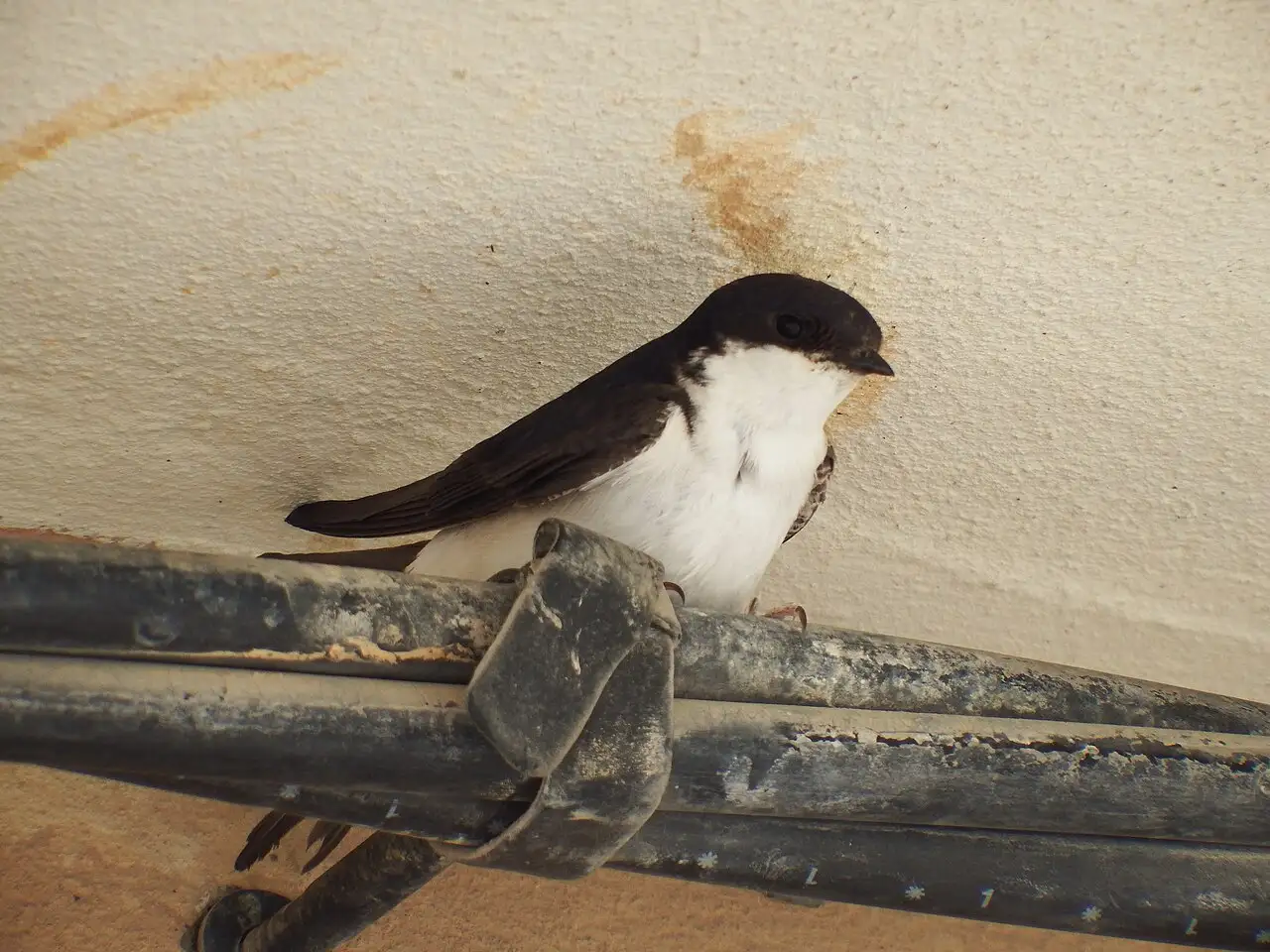
Western House Martin perched in profile under a beam, with blue-black back, white belly and legs covered in white featheringPhoto: 19Tarrestnom65, CC BY-SA 4.0Photo 1 of 4
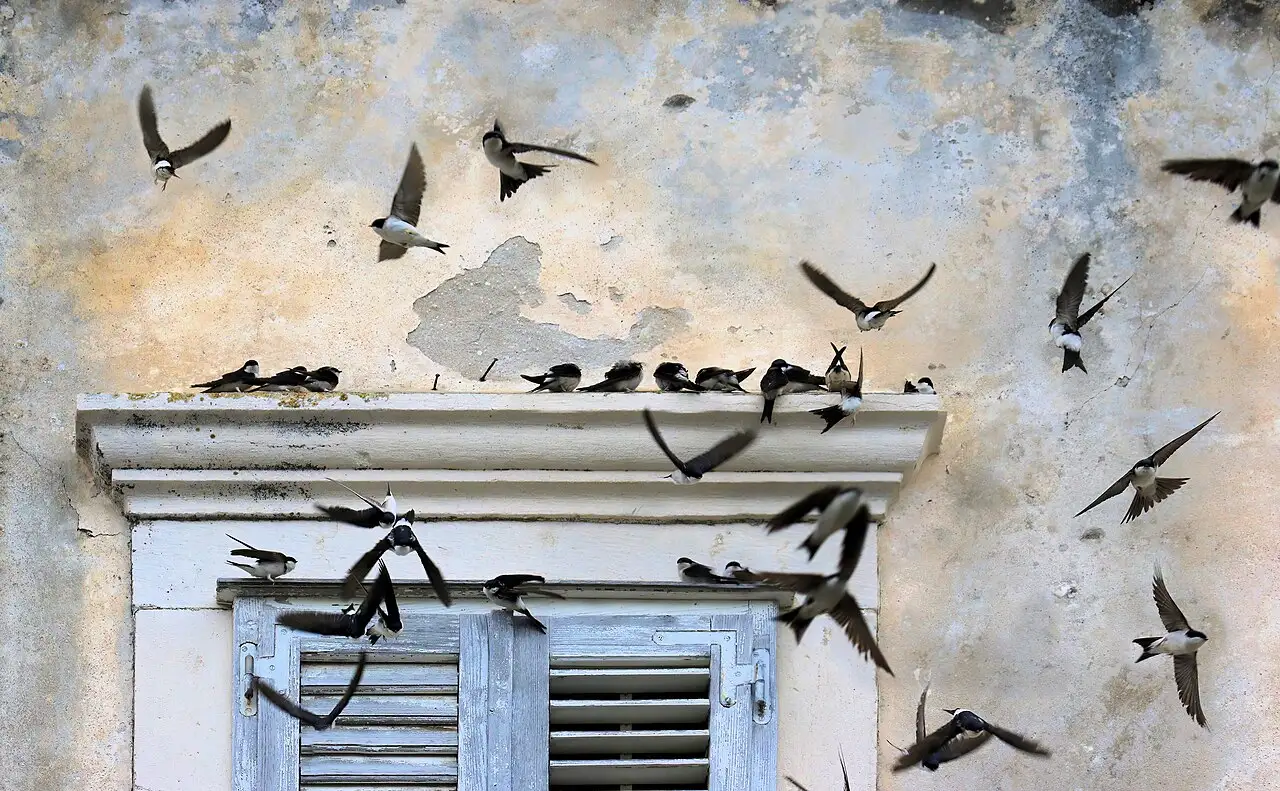
Flock of Western House Martins in flight and perched on the cornice and shutters of a buildingPhoto: Paul Harrison, CC BY-SA 4.0Photo 2 of 4
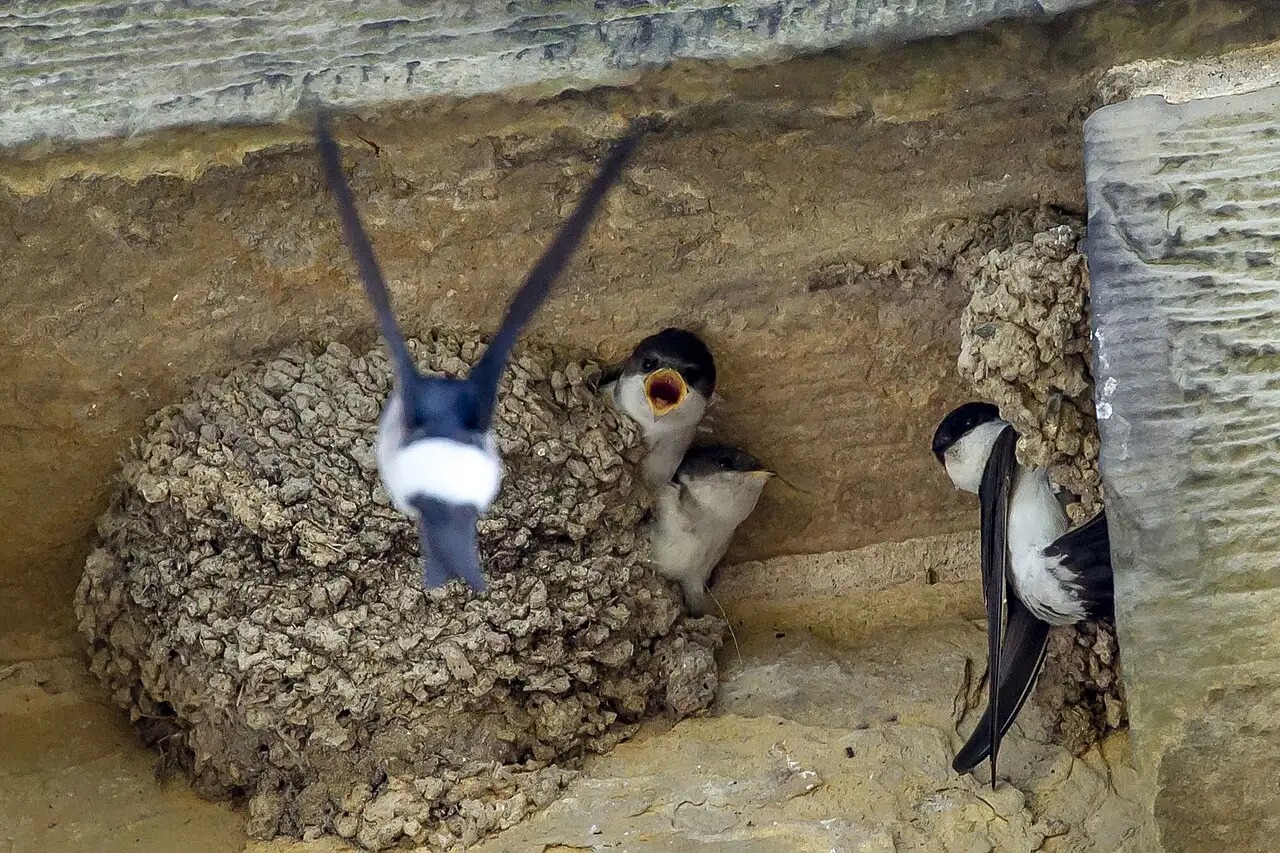
Western House Martin arriving in flight at a mud nest under an eave, with chicks peering out with open billsPhoto: Michael Palmer, CC BY-SA 4.0Photo 3 of 4
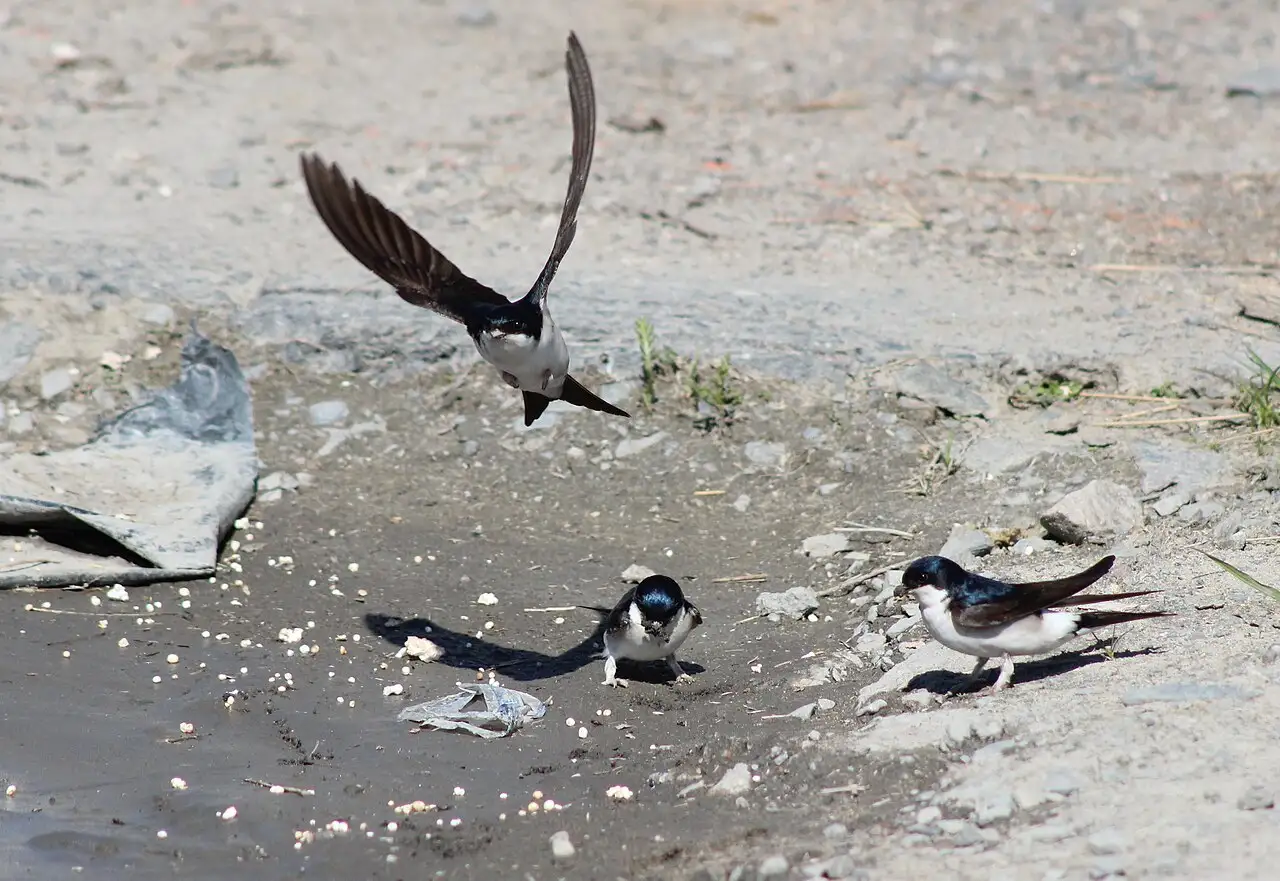
Western House Martins on muddy ground, one of them taking offPhoto: Estormiz, CC0Photo 4 of 4
1 / 4
Identification of the Western House Martin
The House Martin is a small, compact-looking swallow, glossy blue-black above and white below, with sharp boundaries between colours. It has long, pointed wings and a short, forked black tail. The bill is short, flat and black, the mouth very wide, and the legs short and covered in fine white feathers. Its white rump stands out, the only pale area on the upperparts. Both sexes are alike.
Young birds are less contrasting, browner, especially below, with diffuse boundaries between the black and white parts, and with white tips on the tertials.
Adult
Glossy blue-black above and white below.
White rump and short forked tail.
Legs covered in fine white feathers.
Young bird
Browner, especially below, with diffuse boundaries between black and white parts.
White tips on the tertials.
Habitat and distribution of the Western House Martin
As a breeding species it occupies almost the whole Palaearctic, from the Atlantic to the Pacific, except the great deserts, the polar zones and part of the Far East. It winters mainly in sub-Saharan Africa. There are several subspecies, and in Spain the smallest one, «meridionale», occurs.
In the breeding season it occupies the whole Peninsula, the Balearics, Ceuta and Melilla; in the Canaries it is only recorded on passage. It is more frequent in winter than was estimated until recently: its presence has been confirmed, in very small numbers, in the valleys of the Tagus, Guadiana and Guadalquivir rivers, in Extremadura and Andalusia.
Its specialisation in the aerial environment makes it very independent of habitat, except for placing the nest: it occupies all the habitats of the Palaearctic, from desert to tundra and from sea level to high mountain. Although undemanding, in Spain it is more numerous in warm areas and in urban environments of low and middle altitude. It breeds up to 2,000 metres, in villages, dams, bridges and cities, even the biggest, with most colonies on houses; in some places it still breeds in its original habitat, crags. It usually sleeps in the nest, sometimes communally, and can spend the night in flight.
It is a mostly summer-visiting species. In winter Spanish birds move to the Gulf of Guinea, in West Africa, and return slowly, with a lag of up to three months between north and south: in Andalusia and Extremadura they can be seen as early as January, with mass arrival from February; in the centre and east of the Peninsula they usually arrive a month later, and on the northern Meseta and the Cantabrian coast they do not become common until April. Older birds return earlier. They leave the breeding colonies from July to October. The migration passages, largely of non-Iberian birds, are very prolonged at the Strait: they go up between February and May and down between July and November, with peak influx in April and October.
Areas where it is regularly recorded since 2010Squares of about 25 km where it is recorded regularly (occasional passage records are left out). Data from GBIF.org (458,274 records, retrieved October 2026); outline from Natural Earth.
Etymology of the Western House Martin
According to Wikipedia, «Delichon» is an anagram of the ancient Greek «chelīdōn» («swallow») and «urbicum» means «of the city» in Latin; until 2004 it was spelled «urbica», and was corrected because of a misunderstanding of Latin grammar. Both the scientific and the English name, «house martin», allude to its use of human buildings. In other languages it is called «oreneta cuablanca» in Catalan, «andoriña do cu branco» in Galician, «enara ipurzuria» in Basque and «common house martin» in English1.
Population of the Western House Martin
In the 2021 European Red List of Birds the European breeding population is estimated at between 23,000,000 and 48,100,000 mature individuals, with a stable trend. The Spanish population is put at 2,880,000 birds, one of the largest contingents in Europe. The results of the SACRE programme between 1998 and 2018 show a moderately positive trend, in contrast with the decline detected for Europe as a whole.
It suffers no important threats. Possible problems include the indiscriminate use of pesticides, the deliberate removal of nests on the pretext that they dirty buildings, urban air pollution, the difficulty of nesting in cities because of new building techniques and the scarcity of places to find mud for the nest.
Nest of the Western House Martin
The nest, built by both sexes in about 10 days, is a closed hemisphere of mud balls, stuck to a ceiling or wall with a small entrance at the top edge. Nests are repaired and reused for years. It breeds in colonies divided into clusters made up both of solitary nests and of very dense aggregations of nests stuck together; it is not unusual for them to exceed a hundred nests, with quite a few cases of over a thousand, for example on bridges and large buildings.
Courtship and breeding of the Western House Martin
The breeding period varies by locality: it starts in Andalusia and Extremadura in April and May, and in the north runs on to September and October. It normally lays twice, sometimes three times. Although it is monogamous, paternity outside the pair is frequent: a third of broods and 15–20 % of chicks. It has strong fidelity to the breeding site, though not so much to the mate, which usually changes each year, even each brood. Clutch size decreases over time: in Badajoz the average is five eggs in the first, four in the second and three in the third. The eggs are white. Both parents incubate them for about 15 days and frequently feed the chicks until they fly at 25–30 days.
Diet of the Western House Martin
Its diet is made up almost exclusively of small flying insects. Although they vary by place and date, the most commonly eaten prey are dipterans (flies and mosquitoes) and aphids. It catches them in acrobatic pursuit flights, in a group, at a height between that exploited by the Barn Swallow (low zone) and that of the swifts (high zone). It normally does not hunt more than 2 kilometres from the nest.
Curious facts about the Western House Martin
Although it is originally a cliff-dweller, it has long been associated with human constructions and now lives very successfully even in big cities1. In recent years a minimal wintering has come to light in south-west Spain. A lifespan of at least 14 years is cited1; according to EURING, the ringed bird that lived longest, in Italy, reached 11 years and 3 months, and AnAge gives 15 years.
The Western House Martin in Cabañeros
The habitat pages of this website do not mention it, but in the park it has a colony that does not go unnoticed: the wall of the Torre de Abraham dam. What for us is a concrete wall, for them is an apartment block, with closed mud nests stuck to every ledge. GBIF.org records 179 observations of the Western House Martin in Cabañeros and its surroundings.
In May 2026 the park and SEO/BirdLife Ciudad Real counted its nests, dividing the wall into 11 sectors. According to occupancy models, about 29 % of the complete nests, some 133, were active. Life in the colony has its awkward neighbours: sparrows take over their nests, and when a jay appears hundreds of adults come out at once to defend it. The park newsletter of July–August 2026 tells the story (all the newsletters) (in Spanish).
Where to see the Western House Martin in Cabañeros
In Cabañeros and its surroundings, from February to October. The easiest place is the wall of the Torre de Abraham dam, where the colony is.
When
From February to October: it arrives between January and April, depending on the area, and leaves the colonies from July to October.
What time
In good light, in the air, at a height between the swallow and the swifts.
Where
In villages, dams and bridges, under eaves and cornices, and on crags.
What to look for
Look for the white rump, the short forked tail and the stuck-together mud nests.



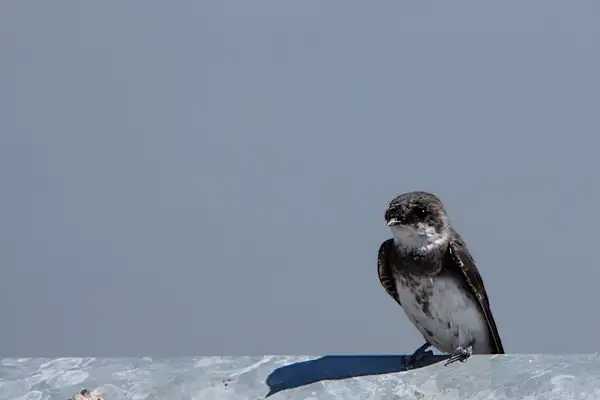
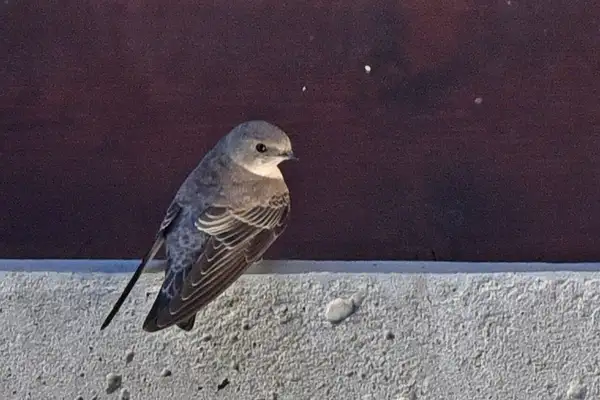
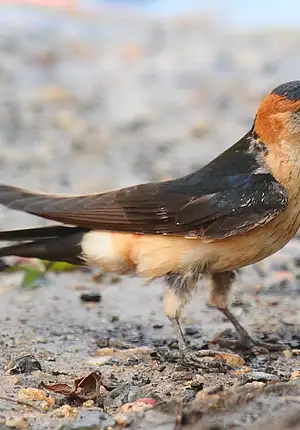 Same family
 Same family
 Same family
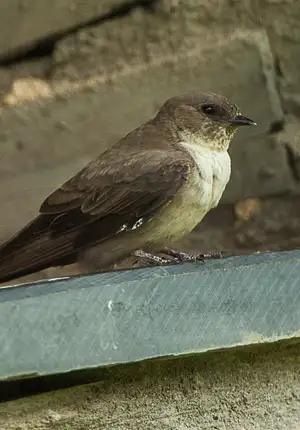 Same family
 Same order
 Same order
 Same order
 Same order





