Wingspan compared with a person with arms outstretched.
Length
34–37 cm
Wingspan
1–1.1 m
Weight
240–348 g
Social life
Basically colonial: it sometimes forms large groupings of hundreds of pairs
Lifespan
Record of 36 years and 9 months according to EURING (a bird ringed in Great Britain and caught by a raptor); AnAge gives up to 32.9 years
Conservation status
LC
NT
VU
EN
CR
EW
EX
Global (IUCN)
Least Concern
Spain
Least Concern (LC) as a winter or passage visitor in the Red Book of the Birds of Spain; not on the List of Wild Species under Special Protection nor in the Spanish Catalogue of Threatened Species
When to see it
Winter visitor
Months of the year when it is present
J
F
M
A
M
J
J
A
S
O
N
D
In Iberia
yes
yes
yes
yes
yes
yes
yes
yes
yes
yes
yes
yes
Song or voice of the Black-headed Gull
It has a very varied range of voices, from melodious calls, «kraa», to strident alarm cries, «kek». The calls in winter are higher and clearer, different from those it makes in the breeding season.
CallBlack-headed Gull
0:00 / 0:17
10 kHz5
The sonogram draws the sound: time runs from left to right, and the higher a trace sits, the higher the note.Recording by Marie-Lan Taÿ Pamart, xeno-canto XC511438 (París, Francia) (CC BY-SA 4.0).
Flight of the Black-headed Gull
Rather small in size, it is a gull that inland is often seen in groups following the plough or perched on the banks of urban rivers.
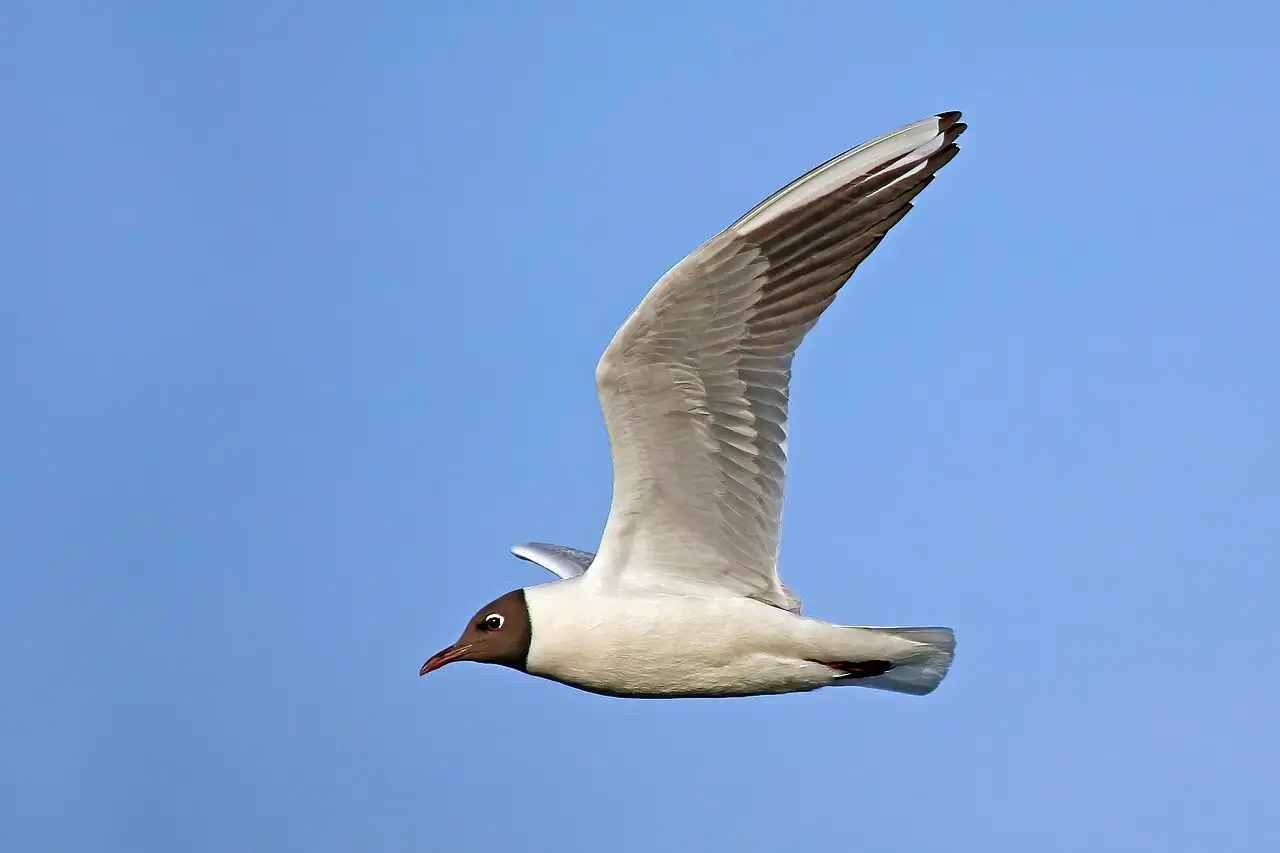
Flight typeDirect and light, in groups that follow the plough
It always breeds near wetlands and, outside the breeding season, moves around fishing ports, rubbish tips, rice fields, salt pans and inland farmland.
Inland it is common to see it in groups following the plough, hunting what the earth turns up.
Its success has to do with its ability to feed on almost any organic remains: insects, annelids, small crustaceans and little fish, as well as scraps and, in winter, remains from landfills.
Photo gallery of the Black-headed Gull
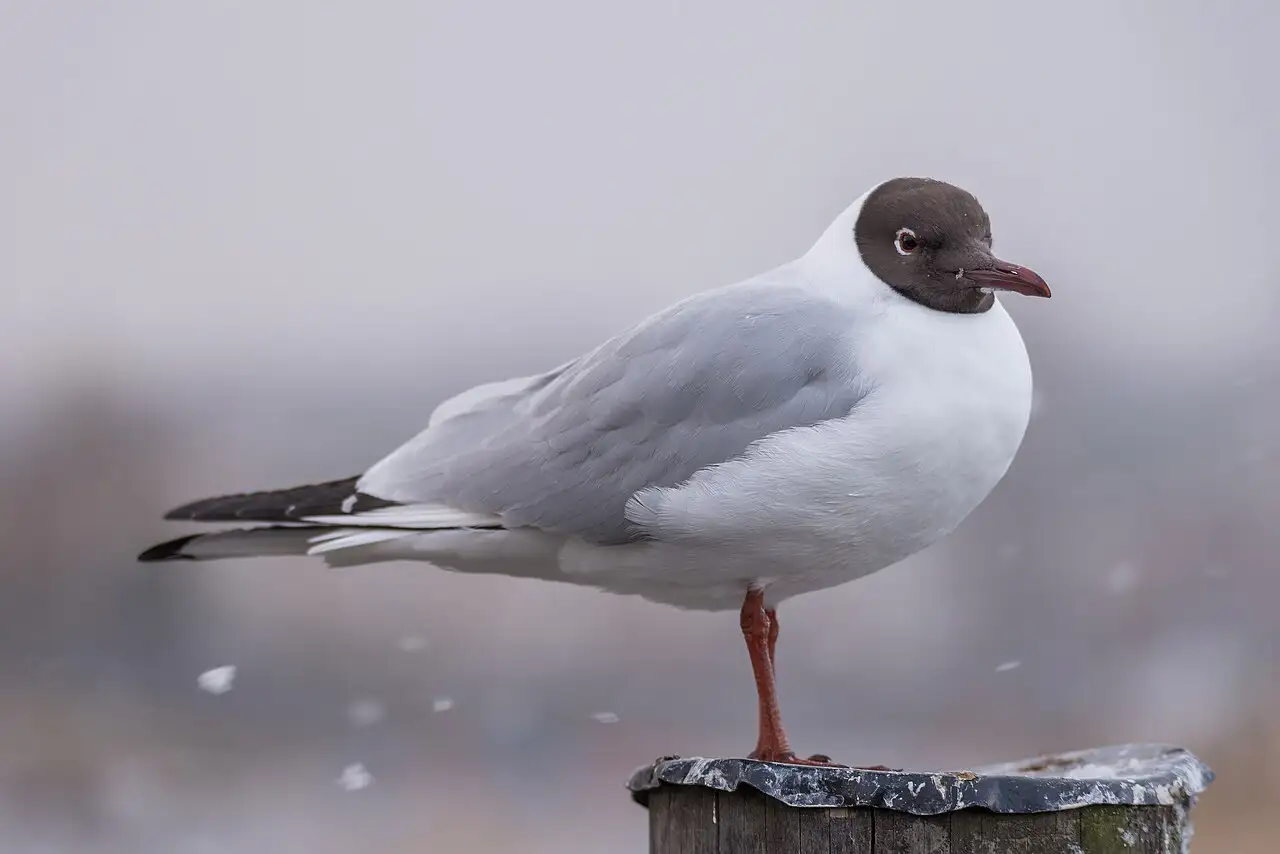
Adult Black-headed Gull perched on a pole, in profile, with the chocolate-brown hood, light grey back and red bill and legsPhoto: Arild Vågen, CC BY-SA 4.0Photo 1 of 4
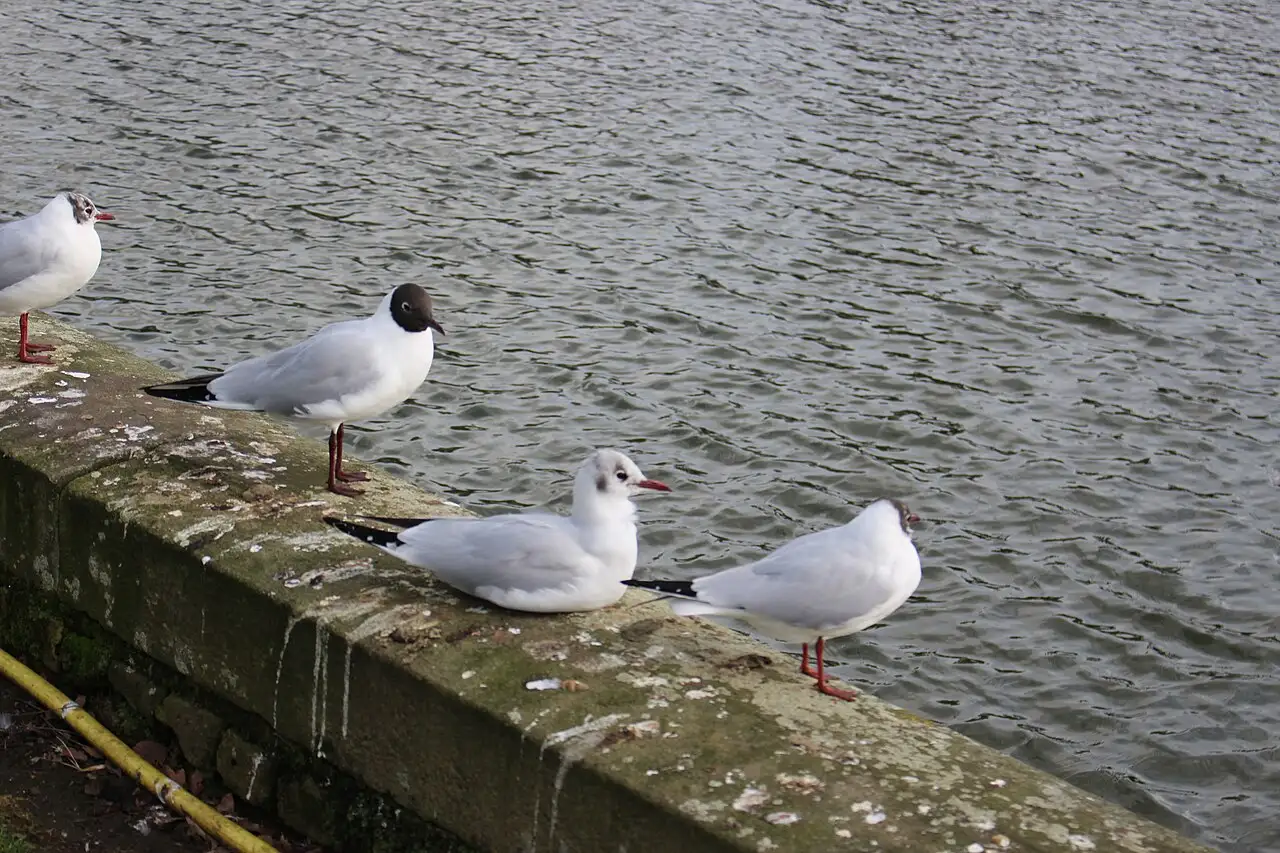
Black-headed Gulls on a wall beside the water, one with the dark hood and others with white head and an ear patchPhoto: Emőke Dénes, CC BY-SA 4.0Photo 2 of 4
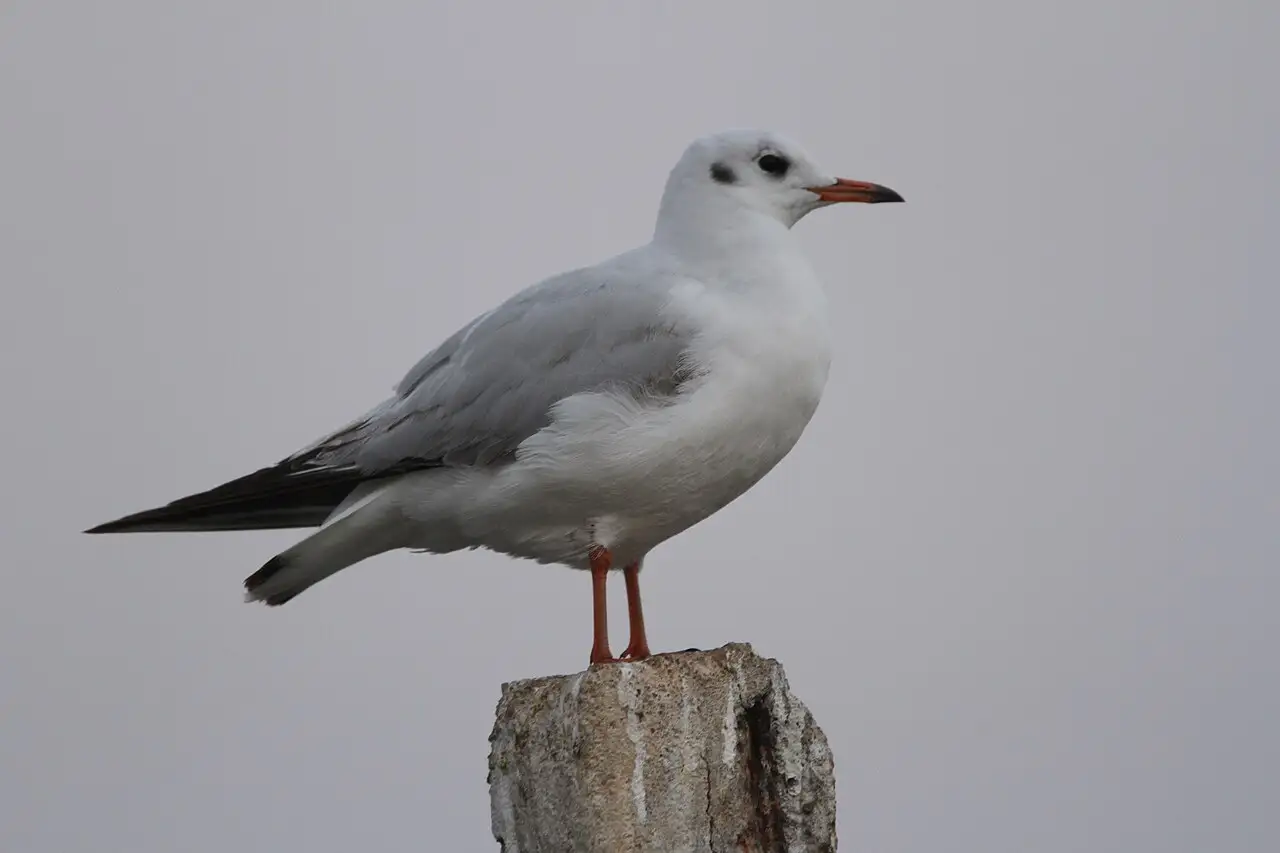
Black-headed Gull in winter plumage perched on a pole, with white head with a patch on the ear area and red bill with dark tipPhoto: Davidvraju, CC BY-SA 4.0Photo 3 of 4
Black-headed Gull in flight, with wings spread against the blue sky, the dark hood and the black wingtipsPhoto: Charles J. Sharp, CC BY-SA 3.0Photo 4 of 4
1 / 4
Identification of the Black-headed Gull
The Black-headed Gull is a rather small gull, with a characteristic chocolate-brown hood, present only in breeding plumage. Males and females, identical in appearance, show only small differences in body measurements, since males are larger. The plumage varies with age and after successive moults the definitive one is reached in the second year of life. The bill is an intense, blackish red.
Adult in breeding plumage
Upperparts light grey and underparts pure white.
Chocolate-coloured head, with a broken white eye-ring that stands out vividly.
Adult outside the breeding season
It loses the dark hood feathers, which are reduced to a small patch on the ear area.
Young bird
Mostly greyish brown on the back and without the dark hood.
The head does not become completely white: it has an ear patch and the crown spotted with brown.
Habitat and distribution of the Black-headed Gull
As a breeder it occupies practically the whole Palearctic, although it is much more abundant in the countries of central Europe and somewhat less frequent in those of the south, such as Spain or Italy, where it is a recent colonist. It is a monotypic species.
In Spain it is not abundant as a breeder, but it breeds regularly in the wetlands of the Mediterranean coasts, in lagoons of La Mancha, in the Ebro valley and, exceptionally, in other inland wetlands and at suitable sites on the Atlantic or Cantabrian coasts. The most numerous colony is that of the Ebro delta, followed by those of La Mancha, Andalusia and the Levante. It is absent as a breeder from the Canaries, Ceuta and Melilla, although it is present in winter.
During winter the Peninsula holds numerous birds arrived from their breeding colonies in Europe. It is then quite widespread and very common on coasts, beaches, fishing ports, rivers or reservoirs, often associated with landfills, where it looks for food in large groups. It always nests near wetlands, of fresh or brackish water, often in estuaries, deltas, marshes, lagoons, lakes, low-flow rivers and even in human-managed areas, such as gravel pits and reservoirs. To look for food it frequents varied environments, from fishing ports to rubbish tips, as well as inland farmland, rice fields or salt pans.
Over wide regions of its range it is clearly migratory: it moves south of its breeding areas to spend the winter on the Iberian Peninsula, in Turkey or North Africa. There are data on birds ringed in Europe and recovered on the other side of the Atlantic, in Barbados, Mexico and Canada.
Areas where it is regularly recorded since 2010Squares of about 25 km where it is recorded regularly (occasional passage records are left out). Data from GBIF.org (420,208 records, retrieved October 2026); outline from Natural Earth.
Etymology of the Black-headed Gull
According to Wikipedia, «Chroicocephalus» comes from ancient Greek «khroizo» («to colour») and «kephalé» («head»), and the epithet «ridibundus» is Latin for «laughing». It is also known as «gaviota reidora»; in other languages it is «gavina riallera» in Catalan, «gaivota chorona» in Galician, «antxeta mokogorria» in Basque and «black-headed gull» in English1.
Population of the Black-headed Gull
In the 2021 European Red List of Birds the European breeding population is estimated at between 2,810,000 and 4,120,000 mature individuals, with a decreasing trend. In Spain the last census, from 2007, counted a minimum of 9,148 breeding pairs; since then no coordinated official censuses of breeding gulls have been made and there are only partial regional estimates. Its numbers have risen since its breeding was first recorded in Spain in 1960, although in recent years it seems to have stabilised. It has no major threats on a global scale; in Spain population variations are probably related to the droughts that affect the level of the wetlands where it nests, and a change in urban waste management could reduce the food from landfills and affect this and other opportunistic birds.
Nest of the Black-headed Gull
It builds the nest directly on the ground, often in the shelter of vegetation, although at other times in areas without it. It is a structure of plant matter brought by both sexes, although it is the male who chooses the site and starts building; it measures some 25–30 centimetres in height, 40–50 in diameter and 5 in depth.
Courtship and breeding of the Black-headed Gull
It is a basically colonial species, which sometimes forms large groupings with hundreds of pairs. On those shallow platforms the females lay two or three eggs, of variable colour, from matt green to grey or even ochre, quite heavily marked, which both sexes incubate in equal proportion for 23 or 24 days. The chicks hatch covered in abundant, cryptic down, leave the nest after a few days to wander the surroundings and reach full development at 35 days of life.
Diet of the Black-headed Gull
Its diet is based mainly on food of animal origin: insects, annelids, small crustaceans and little fish, as well as assorted scraps that float on the water or are stranded on the shores; it also usually takes a certain proportion of food of plant origin. In winter it also visits landfills, where it takes advantage of the large quantity of food scraps.
Curious facts about the Black-headed Gull
Its success has to do with its ability to feed on almost any organic remains1. For inland dwellers seeing a group of gulls following the plough or perched on the banks of urban rivers has ceased to be a surprise1. EURING lists a bird ringed in Great Britain that lived 36 years and 9 months.
The Black-headed Gull in Cabañeros
The habitat pages of this website do not mention it. GBIF.org records 68 observations of the Black-headed Gull in Cabañeros and its surroundings.
Where to see the Black-headed Gull in Cabañeros
In Cabañeros and its surroundings, mostly in winter, beside rivers, reservoirs and ploughed fields.
When
All year round, although it is more abundant in winter, when birds arrive from the European colonies.
What time
In good light; in winter, in large groups.
Where
On rivers, reservoirs and inland farmland, where it follows the plough; also at landfills, rice fields and salt pans.
What to look for
Look for the chocolate hood (in the breeding season) or the ear patch (the rest of the year), and the blackish-red bill.



 Same family
 Same family
 Same family
 Same family
 Same order
 Same order
 Same order
 Same order






