Wingspan compared with a person with arms outstretched.
Length
37–42 cm
Wingspan
63–74 cm
Weight
240–360 g
Social life
Very noisy in the breeding season; both sexes incubate and rear the chicks
Lifespan
EURING lists a bird ringed in the Netherlands that lived 29 years and 9 months and was found dead, and another of 29 years and 2 months that was shot; AnAge gives 23.6 years in the wild
Conservation status
LC
NT
VU
EN
CR
EW
EX
Global (IUCN)
Near Threatened
Spain
Critically Endangered (CR) as a breeder and Vulnerable (VU) as a winter visitor and migrant in the 2021 Red Book of the Birds of Spain; on the List of Wild Species under Special Protection, but not in the Spanish Catalogue of Threatened Species
When to see it
Winter visitor
Months of the year when it is present
J
F
M
A
M
J
J
A
S
O
N
D
In Iberia
yes
yes
yes
yes
no
no
yes
yes
yes
yes
yes
yes
Song or voice of the Black-tailed Godwit
In flight it gives a rapid, nasal «vi-vi-ve», as well as some calls reminiscent of the Northern Lapwing’s1. In the breeding season it is quite noisy1. The recording (call) is by Albert Noorlander and was made at Montfoort, Montfoort, Utrecht (xeno-canto XC637137, quality A). It lasts 9 seconds and is a trimmed section of the original, without repeating or lengthening, from which we have removed the bass below 200 Hz, reduced the background noise and adjusted the volume; neither pitch nor speed has been changed. It is from the Netherlands, not Spain.
In flight it shows the black tail with a white base and mostly black wings, with a broad white transverse band. Practically the whole population wintering in Africa stops over in Doñana on its return to the breeding areas.
Flight typeMigratory; practically the whole population that winters in Africa stops over in Doñana on its return to the breeding areas
In flight it shows the black tail with a white base and the mostly black wings, with a broad white cross band.
When it flies it gives a quick, nasal «vi-vi-ve», as well as some calls that recall the Northern Lapwing's.
To look for food it sinks its bill continually into the silt of shores and islets, leaving characteristic marks.
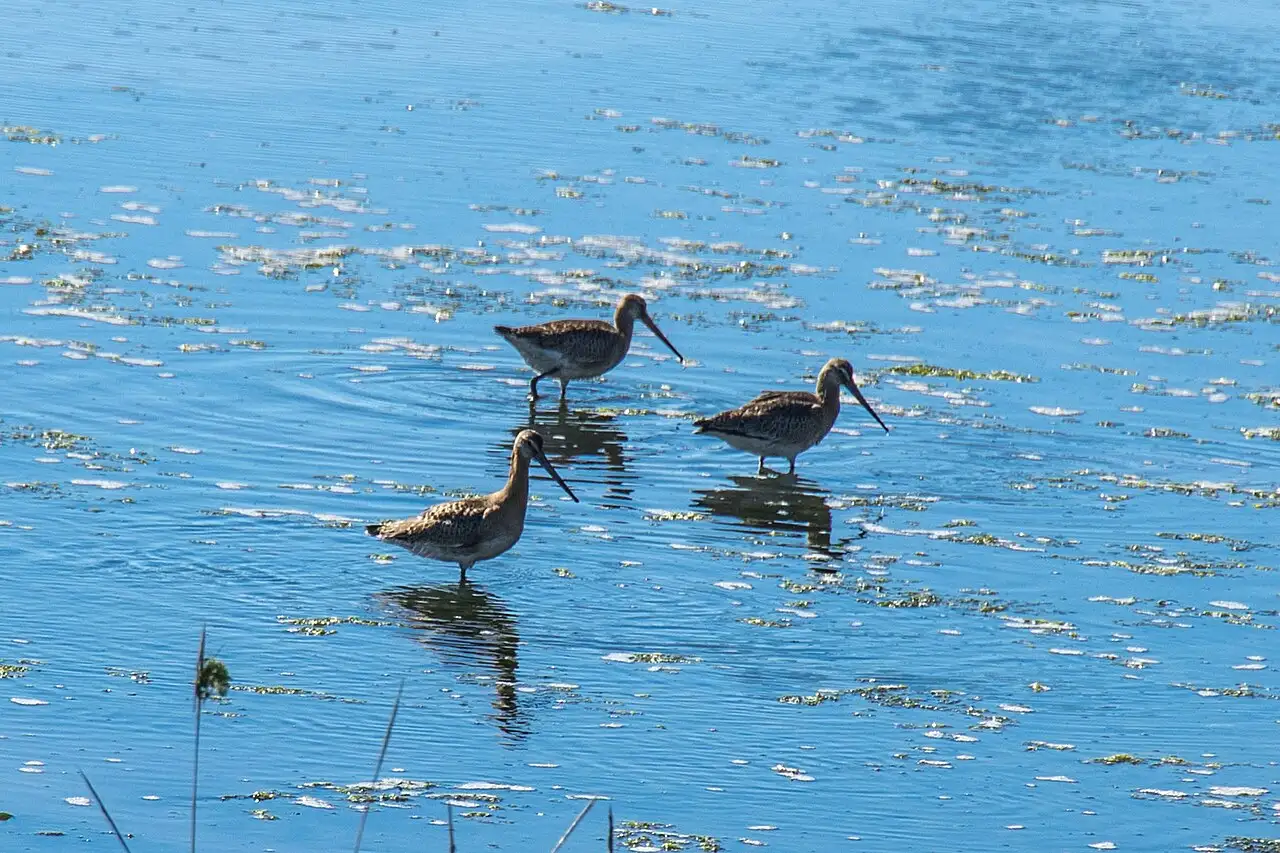
Three Black-tailed Godwits wading in shallow water against a blue background, with long straight bills and greyish-brown plumagePhoto: Alexkom000, CC BY 4.0Photo 2 of 4
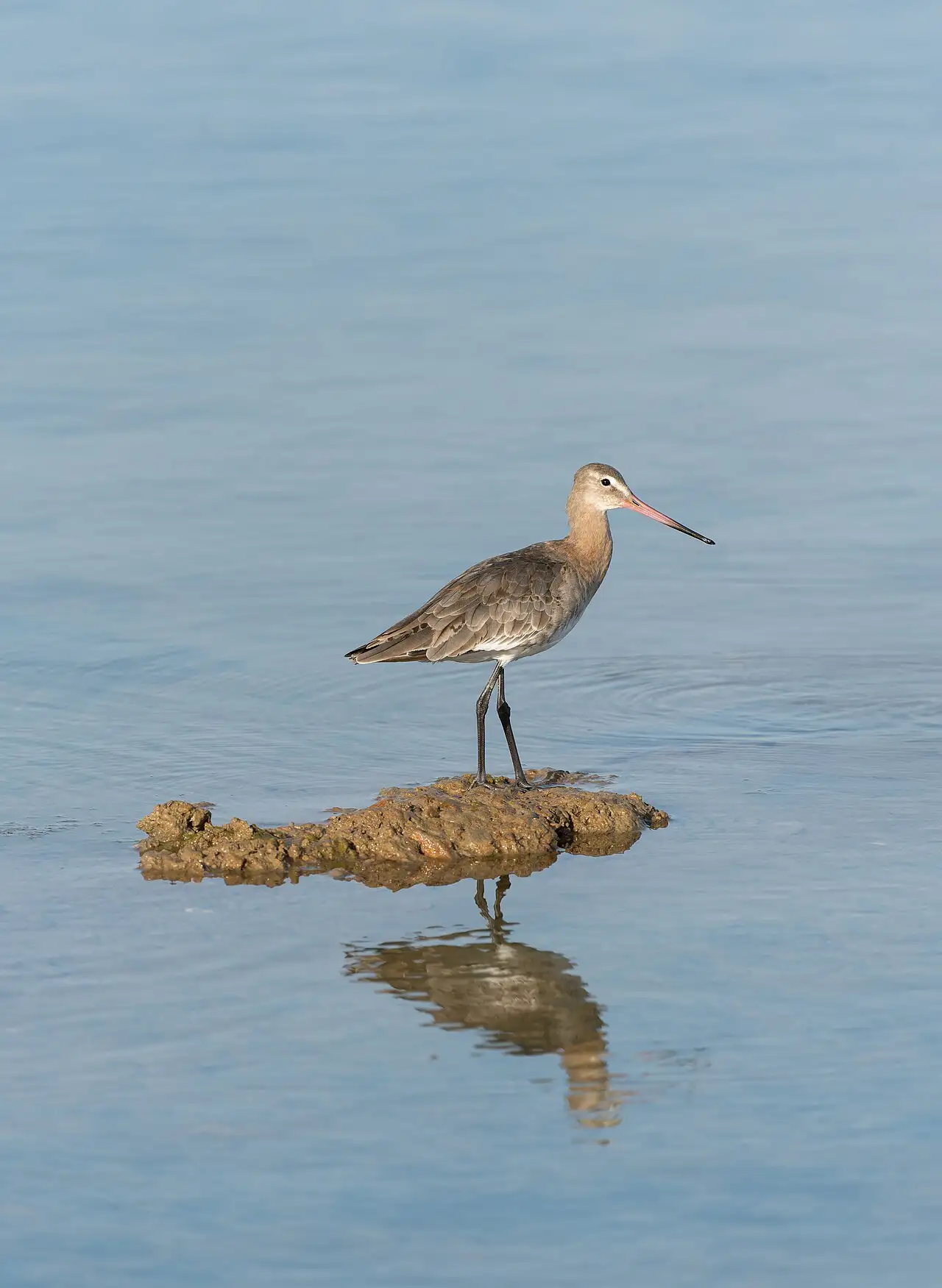
Black-tailed Godwit perched on a heap of mud in the middle of the water, with long black legs and a long straight billPhoto: Jules Verne Times Two, CC BY-SA 4.0Photo 3 of 4
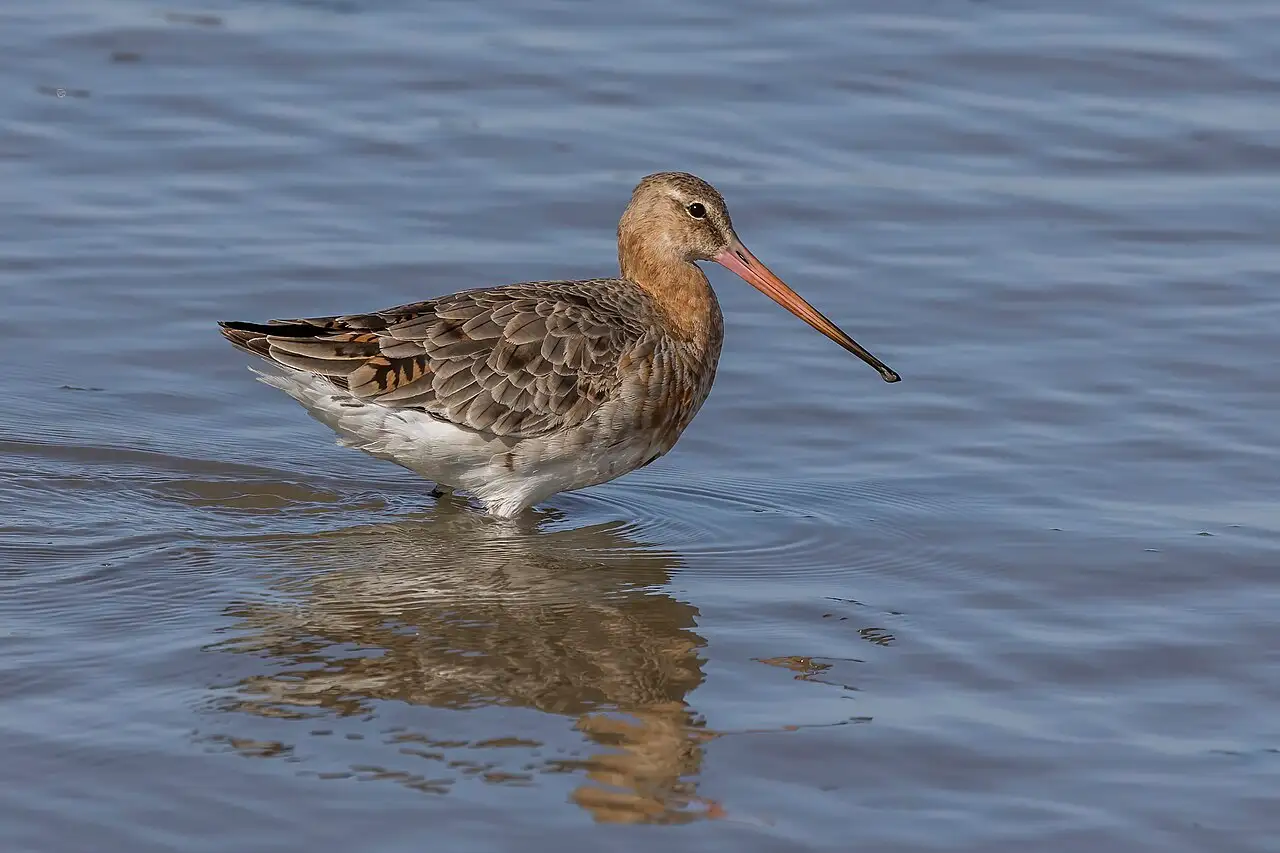
Male Black-tailed Godwit in breeding plumage in shallow water, with orange-chestnut head, neck and breast and a long pink-and-black billPhoto: Charles J. Sharp, CC BY-SA 4.0Photo 4 of 4
1 / 4
Identification of the Black-tailed Godwit
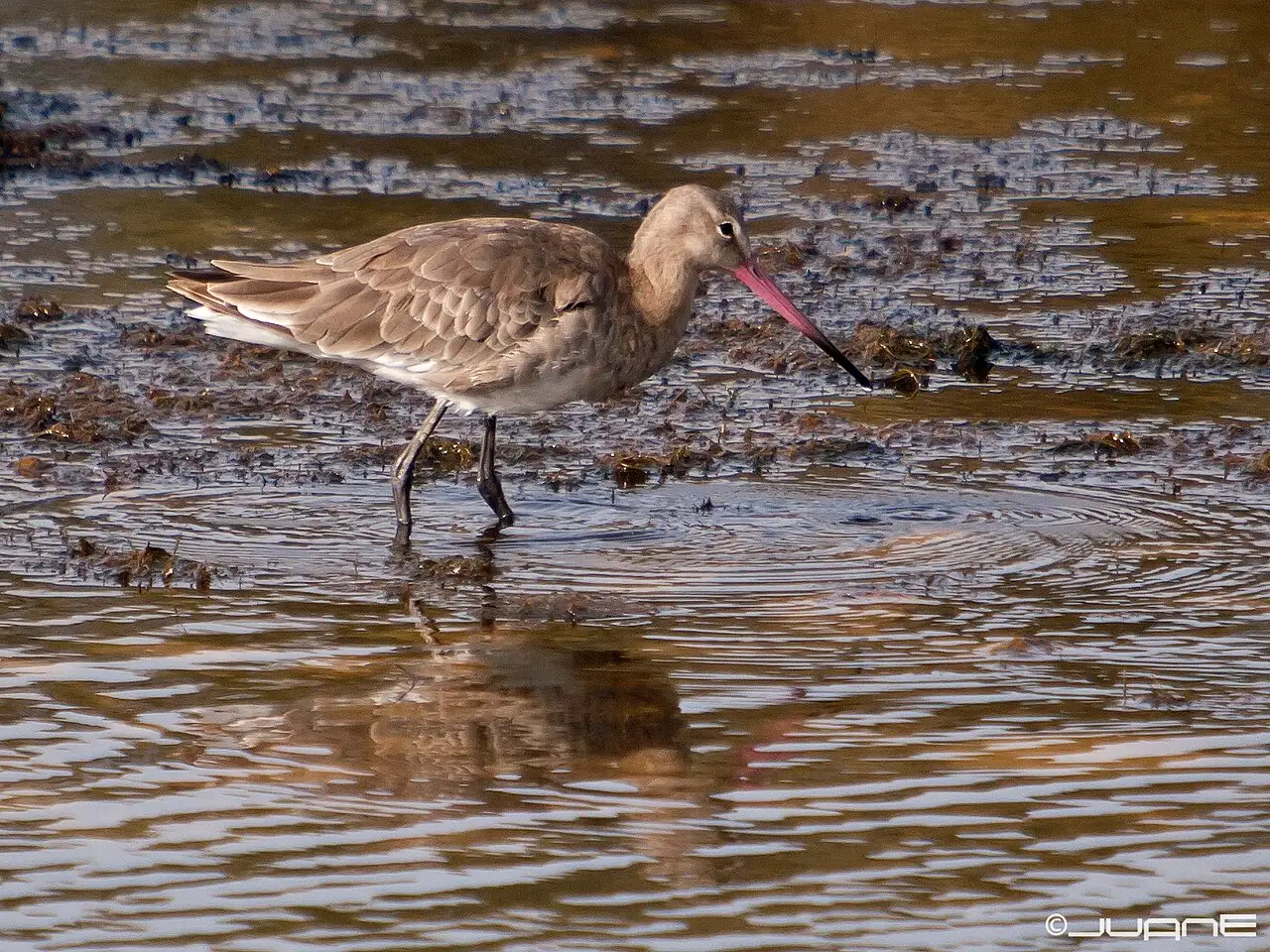
The Black-tailed Godwit is a fairly large wader, characterised by a very long, straight bill (longer in the female), orange at the base and black at the tip. The black legs are also considerably long, which, together with its elongated neck, gives it a fairly slender look. The male in breeding plumage has an orange-chestnut head, neck and breast, whitish belly and barred flanks, while the feathers of the back are black and chestnut and form an intricate pattern. During the breeding period, the female wears a plumage similar to the male’s, but of a less intense chestnut tone and with a whiter belly. Outside the breeding season, adults are fairly uniform grey, with a white belly and dorsal feathers edged with buff. The young bird has the crown, neck and breast tinged orange-grey, and its dorsal feathers have dark tones with cream edges, giving it a scaly look. In flight it shows the black tail with a white base, and the wings look mostly black, with a broad white transverse band.
Breeding male and female
Male: orange-chestnut head, neck and breast, whitish belly and barred flanks; black and chestnut back.
Female: similar plumage, of a less intense chestnut tone and with a whiter belly.
Non-breeding and young bird
Adults outside the breeding season: grey, with a white belly and dorsal feathers edged with buff.
Young bird: crown, neck and breast orange-grey, with a scaly look on the back.
Habitat and distribution of the Black-tailed Godwit
As a breeder it is distributed across suitable places in northern, central and eastern Europe, as well as northern Asia. Wintering takes place in areas south of the breeding regions and in sub-Saharan Africa. Three subspecies are recognised.
In Spain it is essentially a winter visitor, abundant in the Bay of Cádiz, the Ebro delta and the Guadalquivir marshes; on the Atlantic side Galicia and the Cantabrian marshes of Santoña stand out1. It concentrates mainly in rice fields and coastal salt pans, and on migration passage often appears in large numbers on the upper Guadiana plains (Cáceres and Badajoz). On the Peninsula birds of the subspecies «limosa» winter above all, from central Europe and Russia, and some of «islandica», from Iceland, Scotland and northern Norway. It has sporadically bred or tried to breed at sites in Castilla-La Mancha, Castilla y León, Galicia, Catalonia, Andalusia and Extremadura, but today its breeding is very sporadic and in most cases unconfirmed: the Villafáfila lagoons have been the only area used in the last two decades.
It nests in damp meadows with low vegetation (about 10 centimetres) and shallow sheets of water (10–20 centimetres deep), as well as on wetland edges and flood-prone areas. During migration passage and winter it uses more habitats: marshes, inland wetlands, rice fields, salt pans and estuaries.
It appears in Spain mainly during the winter and the migration passages, between July and April; during the summer some isolated birds that do not return to their breeding areas stay on the Peninsula. Practically the whole population wintering in Africa stops over in Doñana on its return to the breeding areas.
Areas where it is regularly recorded since 2010Squares of about 25 km where it is recorded regularly (occasional passage records are left out). Data from GBIF.org (88,708 records, retrieved October 2026); outline from Natural Earth.
Etymology of the Black-tailed Godwit
In other languages it is called «tètol cuanegre» in Catalan, «fuselo de rabo negro» in Galician, «kuliska buztanbeltza» in Basque and «black-tailed godwit» in English1. We have not found a source explaining the origin of the name «aguja colinegra» or of the scientific name, so we do not venture one.
Population of the Black-tailed Godwit
The 2021 European Red List of Birds estimates the European breeding population at between 272,000 and 334,000 mature individuals, assessed as stable. In Spain there are two populations, a continental one («limosa») and a transoceanic one («islandica»)1. The great majority of the birds in Spanish wetlands are of the continental one, which breeds mainly in the Netherlands, Germany, Belgium, Denmark, France and the United Kingdom, where a notable decline has been documented1.
According to the Third Atlas of Breeding Birds in Spain, breeders are almost token, between 0 and 1 pair, and between the last two SEO censuses (1998–2002 and 2014–2018) a 75 % decline was observed in both the population and the area occupied. The last nesting records were from 2017 at the Villafáfila Lagoons Nature Reserve (Zamora). The wintering population ranges between about 35,000 and 40,000 individuals, and in recent years a decline has been noted in the Bay of Cádiz, the Ebro delta and the Canaries, and at some inland sites, such as the Tablas de Daimiel.
The main threats are habitat loss and degradation: the drainage of wetlands and rice fields and agricultural intensification, the conversion of salt pans into marine farms, and the conversion of intertidal areas into artificial beaches or shellfish farms. They are very sensitive to human disturbance; hunting disrupts breeding and climate change affects wetlands and, with rising sea levels, optimal habitats.
Nest of the Black-tailed Godwit
The nest, little more than a slight hollow, is normally set in sparse grassland and is lightly covered with some plant material.
Courtship and breeding of the Black-tailed Godwit
The breeding period begins in mid-April. The clutch consists of three or four eggs, rarely five, olive green to dark brown, speckled and slightly glossy. Both sexes incubate, which lasts 22–24 days, and rear the chicks, which develop in about 25–35 days. Breeding in Spain is very localised: no breeding calendar for Cabañeros can be deduced from it.
Diet of the Black-tailed Godwit
Its diet is based on varied invertebrates and even some plant material. To search for food it keeps sinking its bill into the silt of shores and islets, leaving characteristic marks. The chicks usually feed on various invertebrates, both aquatic and terrestrial.
Curious facts about the Black-tailed Godwit
It is one of the most easily identified waders, apart from a possible confusion with the Bar-tailed Godwit1. The longevity given by EURING, 29 years and 9 months in a bird found dead in the Netherlands, clearly exceeds the 23.6 years of AnAge.
The Black-tailed Godwit in Cabañeros
The habitat pages of this website do not mention it, and we have not found any other published source on it in the Park; nor does it appear in the bird list of the «Visitor guide to Cabañeros National Park» (OAPN). GBIF.org records 3 observations of the Black-tailed Godwit in Cabañeros and its surroundings. The upper Guadiana plains are mentioned on migration passage, the rice fields and salt pans as places of concentration and the Tablas de Daimiel, among the inland sites where wintering has declined1. Only one of those observations falls within the Park boundary (according to OpenStreetMap); the rest are from the surroundings.
Where to see the Black-tailed Godwit in Cabañeros
In Cabañeros and its surroundings, occasionally in winter and on migration passages, at ponds, reservoirs and waterlogged areas.
When
In Spain from July to April, above all in winter and on migration passages; some isolated birds stay in summer.
What time
By day, sinking its bill into the silt of shores and islets.
Where
In marshes, salt marshes, rice fields, inland wetlands and estuaries.
What to look for
Look for the very long orange-and-black bill and the white wing band in flight; listen for its nasal «vi-vi-ve».
Videos of the Black-tailed Godwit
Similar species
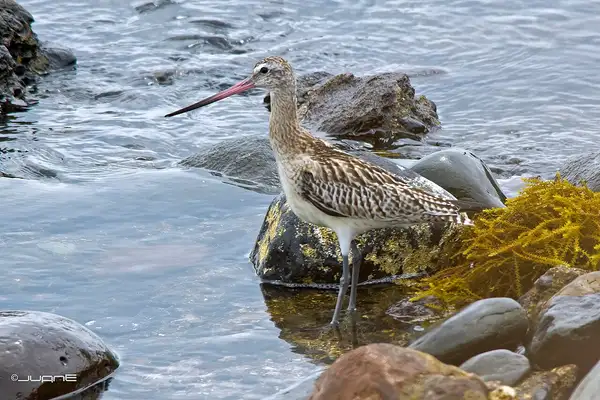
Bar-tailed Godwit
Limosa lapponica
How to tell them apart
It is similar in song and physical appearance1: it is the possible confusion with the Black-tailed Godwit.
Photo: Juan Emilio from Las Palmas de Gran Canaria, Spain, CC BY-SA 2.0




 Same family
 Same family
 Same family
 Same family
 Same order
 Same order
 Same order
 Same order






