Record of 20.8 years in the wild according to AnAge; EURING lists a bird ringed in Great Britain that lived 21 years and 11 months
Conservation status
LC
NT
VU
EN
CR
EW
EX
Global (IUCN)
Least Concern
Spain
Least Concern (LC) as a winter visitor and migrant in the Red Book of the Birds of Spain, and Not Evaluated (NE) as a breeder; on the List of Wild Species under Special Protection, but not in the Spanish Catalogue of Threatened Species
When to see it
Winter visitor
Months of the year when it is present
J
F
M
A
M
J
J
A
S
O
N
D
In Iberia
yes
yes
yes
yes
yes
no
no
yes
yes
yes
yes
yes
Song or voice of the Common Ringed Plover
The flight call is a fluty «piiip», and in a flock it gives a two-syllable «pu-ip», with the first note lower1. The recording (call) is by Mats Rellmar and was made on the Longyearbyen river, in Svalbard (Norway) (xeno-canto XC1173212, quality A). It lasts 9 seconds and is a trimmed section of a 9.6 s clip, without repeating or lengthening, from which we have removed the bass below 300 Hz, reduced the background noise and adjusted the volume; neither pitch nor speed has been changed. It is from Norway, not Spain.
It appears in winter on the coast and, in smaller numbers, in inland areas. Its pre-breeding passage is from April to May and the post-breeding one from August to October; journeys are usually made along the coast, although birds have also been seen at suitable inland sites.
Flight typeShort run along the shore, with a fluty call in flight
It spots its prey by sight and, after a short run, catches it with its bill.
The call in flight is a fluty «piiip».
When in flocks, it gives a two-syllable «pu-ip», with the first note lower.
Photo gallery of the Common Ringed Plover
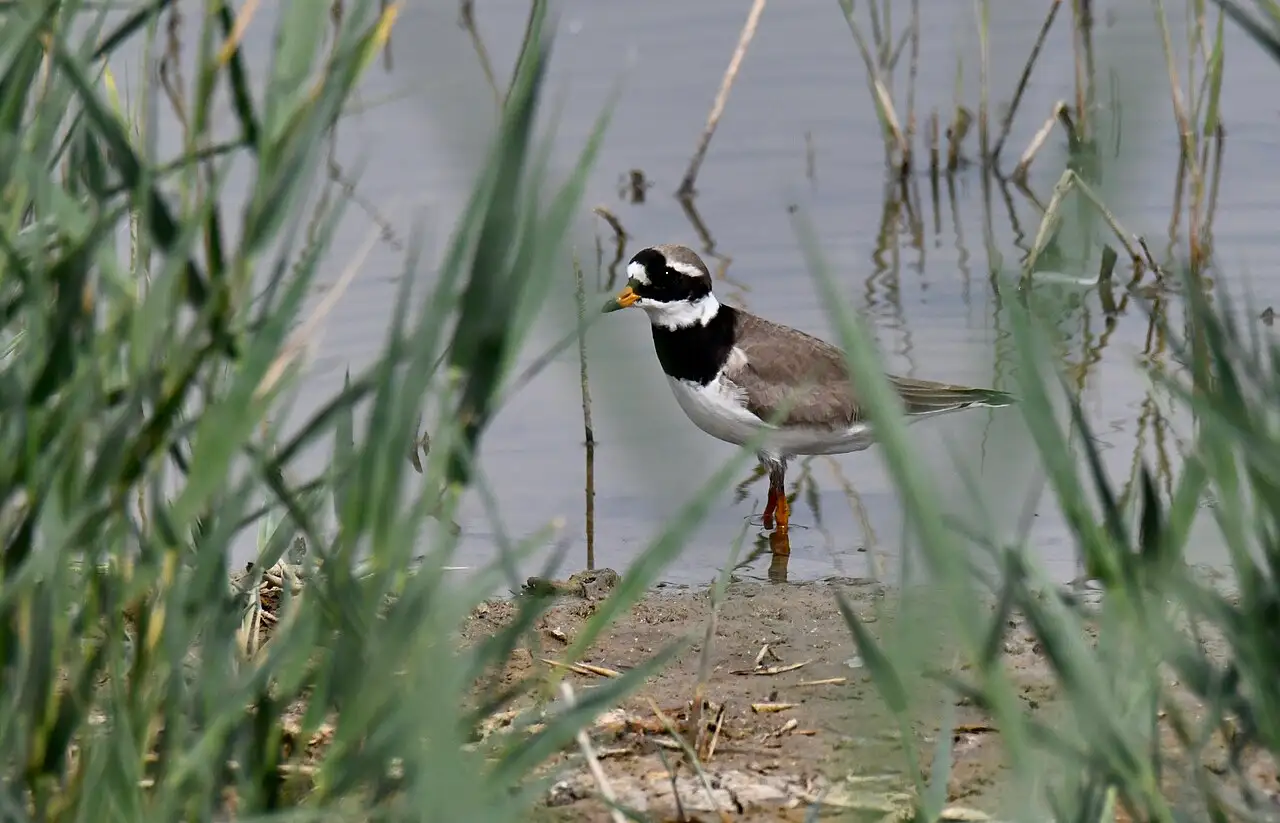
Common Ringed Plover in breeding plumage beside the water among rushes, with complete black collar, white eyebrow and bill with an orange basePhoto: Luiz Lapa from Oeiras, Portugal, CC BY 2.0Photo 1 of 5
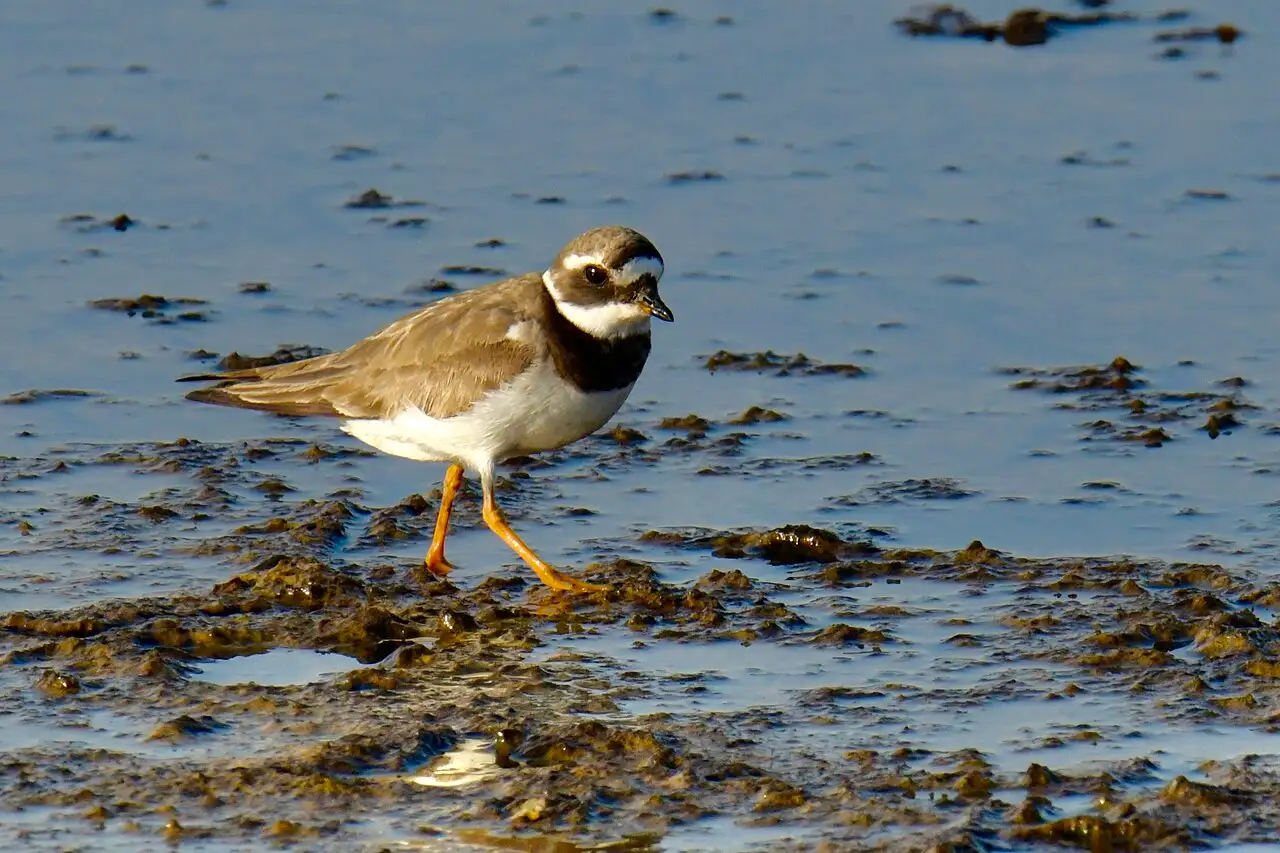
Common Ringed Plover walking along a muddy shore, with black collar and orange bill with dark tip (Toledo)Photo: David Pascual-Hernández, CC BY-NC 4.0Photo 5 of 5
1 / 5
Identification of the Common Ringed Plover
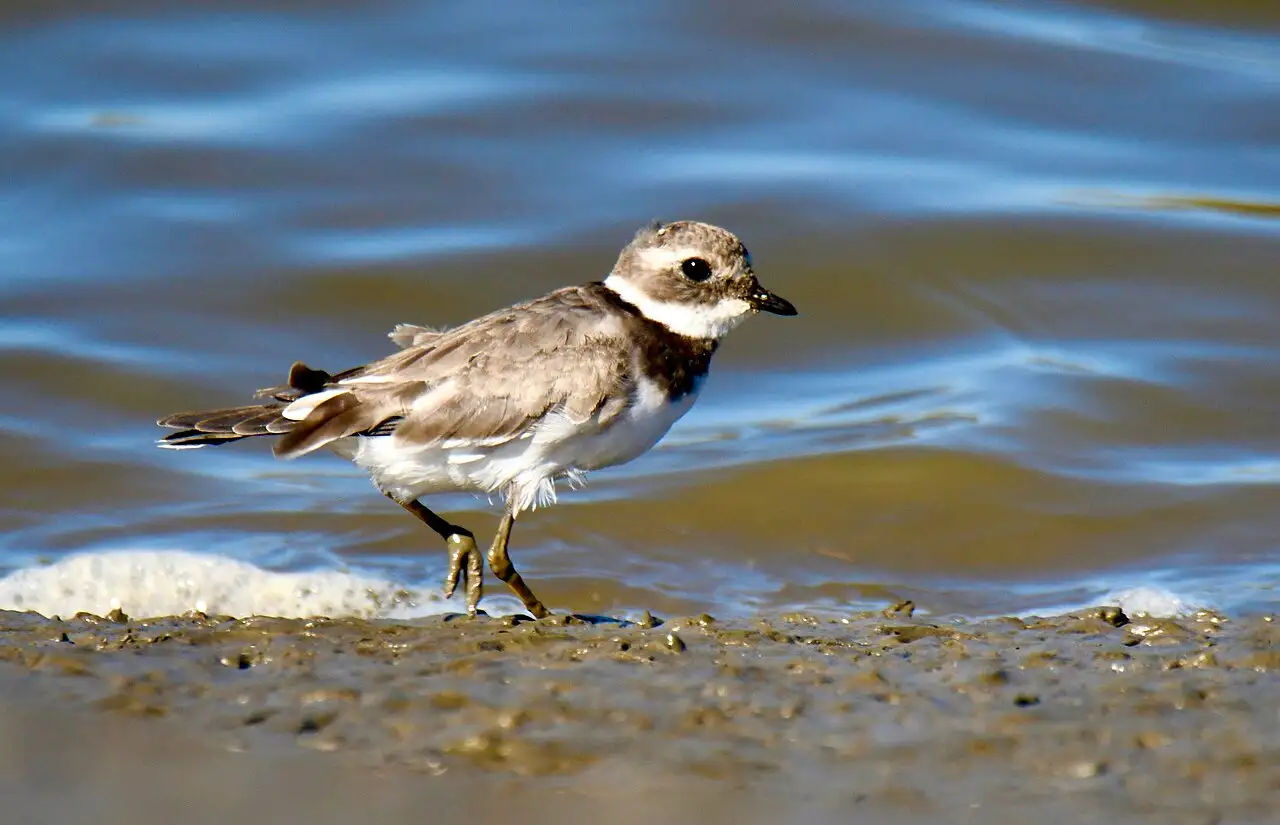
This small wader, though of sturdy look, is characterised by a bulky head topped with a fairly short bill. The adult male in breeding plumage wears a black collar and characteristic head patterns: a marked white eyebrow and a black line that starts at the crown and runs across the face to the bill, framing the white forehead. The bill has an orange base and black tip, and the legs are also orange. The female’s breeding dress is very similar to the male’s, though with the black duller. In non-breeding adults the forehead joins the eyebrow, the black areas are less intense and the orange of the bill is barely noticeable. Young birds resemble non-breeders, but with the back feathers edged with black and buff.
Male in breeding plumage
Black collar, white eyebrow and black line framing the white forehead.
Orange bill with black tip and orange legs.
Non-breeding adult and young bird
Forehead joined to the eyebrow and less intense black; the orange of the bill is barely noticeable.
Young bird: back feathers edged with black and buff.
Habitat and distribution of the Common Ringed Plover
It is distributed as a breeder across high latitudes of the northern hemisphere, from North America to Siberia. In Europe it breeds in the British Isles, northern France, Iceland, Scandinavia and the Baltic regions. Several subspecies have been described, and «hiaticula» is the one of the areas washed by the Atlantic, both in North America and in Europe.
Of the three plover species habitual in the territory, it is the only one that does not breed in Spain1. In winter it can be considered a relatively common bird on the Atlantic coasts and somewhat less usual on the Mediterranean coast; the main concentrations are in the Guadalquivir marshes and the wetlands of the Bay of Cádiz. In smaller numbers, it is also found in inland areas, as well as in the Balearics and the Canaries.
In the breeding season it prefers coastal areas, estuaries, rivers, lakes, sandbars or meadows in tundra areas. In winter and during migration it tends to concentrate on broad sandy areas and pebble beaches that offer resting places above the high-tide line.
It is a migratory species that arrives in winter in Spain from Atlantic Europe and Greenland. The pre-breeding passage takes place between April and May and the post-breeding one between August and October, on both Atlantic and Mediterranean coasts.
Areas where it is regularly recorded since 2010Squares of about 25 km where it is recorded regularly (occasional passage records are left out). Data from GBIF.org (158,387 records, retrieved October 2026); outline from Natural Earth.
Etymology of the Common Ringed Plover
In other languages it is called «corriol anellat gros» in Catalan, «píllara real» in Galician, «txirritxo handia» in Basque and «common ringed plover» in English1. According to Jobling, «hiaticula» combines the Latin «hiatus», «cleft», and the element «-cola», «dweller»; it is the scientific etymology, not an explanation of the Spanish name, whose origin we have not found and do not venture.
Population of the Common Ringed Plover
In the 2021 European Red List of Birds, the European breeding population is estimated at between 261,000 and 399,000 mature individuals, with an increasing trend. In winter it is estimated that about 10,000 individuals settle in the south-western regions of the continent, of which up to 86 % are in Andalusia, in the south-Atlantic region.
The main threats are illegal hunting, industrial and urban pollution and the destruction of habitat, both breeding and wintering, through the dredging of salt pans, the removal of islets to set up marine farms and the building of housing developments1.
Nest of the Common Ringed Plover
It does not breed in Spain. The nest is on the ground, normally in the open although sometimes hidden among vegetation, and consists of a hollow in the sand of about 8 to 12 centimetres, barely delimited with some materials1.
Courtship and breeding of the Common Ringed Plover
Although in Spain it only spends the winter, its cycle in the breeding areas is as follows: it lasts about 50 days, of which about 25 are incubation and the rest chick development, the chicks being very precocial, since they can move and feed themselves soon after hatching1. Breeding usually starts in mid-April and ends in September. Clutches are of three or four eggs, of very variable colouring and profusely spotted, which both sexes incubate.
Diet of the Common Ringed Plover
In the breeding areas it feeds on small terrestrial and coastal invertebrates; outside them, it usually includes polychaete worms, crustaceans and molluscs in its diet. It locates prey by sight and, after a short run, catches it with its bill.
Curious facts about the Common Ringed Plover
It is the only one of the three habitual plover species that does not breed in Spain1. Its longevity record on the EURING list, 21 years and 11 months for a bird identified by its marks in the field in Great Britain, is somewhat greater than AnAge’s 20.8 years.
The Common Ringed Plover in Cabañeros
The habitat pages of this website do not mention it, and we have not found any other published source on it in the Park; nor does it appear in the bird list of the «Visitor guide to Cabañeros National Park» (OAPN). GBIF.org records 10 observations of the Common Ringed Plover in Cabañeros and its surroundings. In winter it is also found, in smaller numbers, in inland areas1. None of those observations falls within the Park boundary (according to OpenStreetMap): all are from the surroundings.
Where to see the Common Ringed Plover in Cabañeros
In Cabañeros and its surroundings, on passage and in winter, beside shores and ponds with mud.
When
Present in Spain from August to May: passages from August to October and from April to May, with wintering in between.
What time
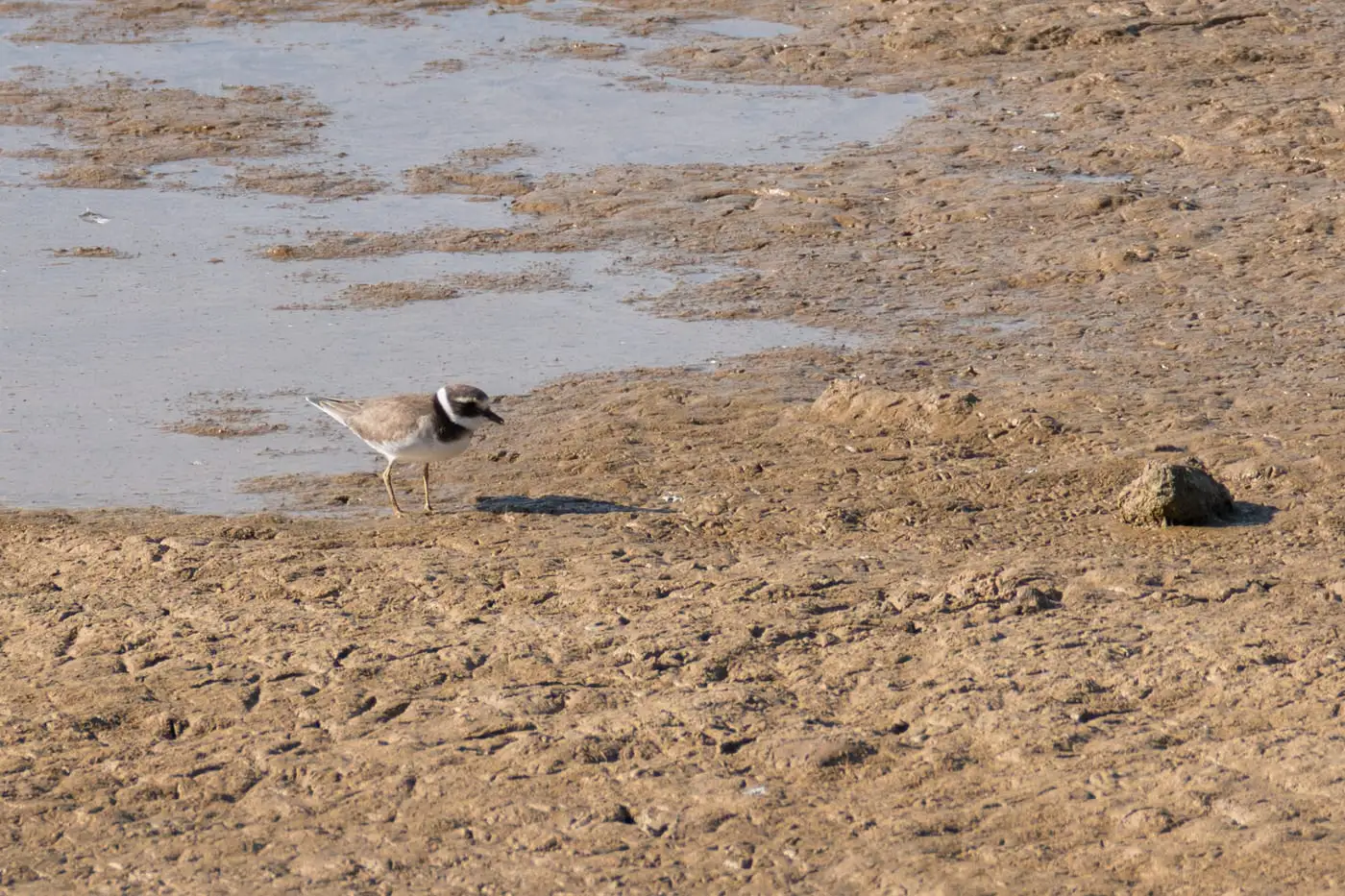
By day, on the shore, walking in short steps over mud or sand.
Where
On sandy beaches, estuaries, marshes and, in smaller numbers, in inland areas.
What to look for
Look for the complete black collar and the orange of the bill and legs; listen for the fluty «piiip» in flight.






 Same family
 Same family
 Same family
 Same order
 Same order
 Same order
 Same order
 Same order






