Some birds, above all second-year ones, stay in Spain over the summer
Lifespan
Record of 18.6 years in the wild according to AnAge; EURING lists a bird ringed in Great Britain that lived 18 years and 7 months
Conservation status
LC
NT
VU
EN
CR
EW
EX
Global (IUCN)
Least Concern
Spain
Least Concern (LC) as a winter visitor and migrant in the Red Book of the Birds of Spain; on the List of Wild Species under Special Protection, but not in the Spanish Catalogue of Threatened Species
When to see it
Winter visitor
Months of the year when it is present
J
F
M
A
M
J
J
A
S
O
N
D
In Iberia
yes
yes
yes
yes
yes
no
no
no
yes
yes
yes
yes
Song or voice of the Sanderling
In flight it gives a characteristic «tuic-tuic»1. The recording (nocturnal flight call) is by Ricardo Hevia and was made at Ortegal (near Cariño), A Coruña, Galicia (xeno-canto XC937830, quality A). It lasts 9 seconds and is a trimmed section of the original, without repeating or lengthening, from which we have removed the bass below 300 Hz, reduced the background noise and adjusted the volume; neither pitch nor speed has been changed.
In flight it shows visible pale lengthwise bands on both wings and the pale rump, cut vertically by a black band. It is a winter visitor on the Peninsula, the Balearics and the Canaries, with a marked migration passage, above all between September and October and between April and May.
Flight typeSwift run after the waves; in flight, pale bands on the wings
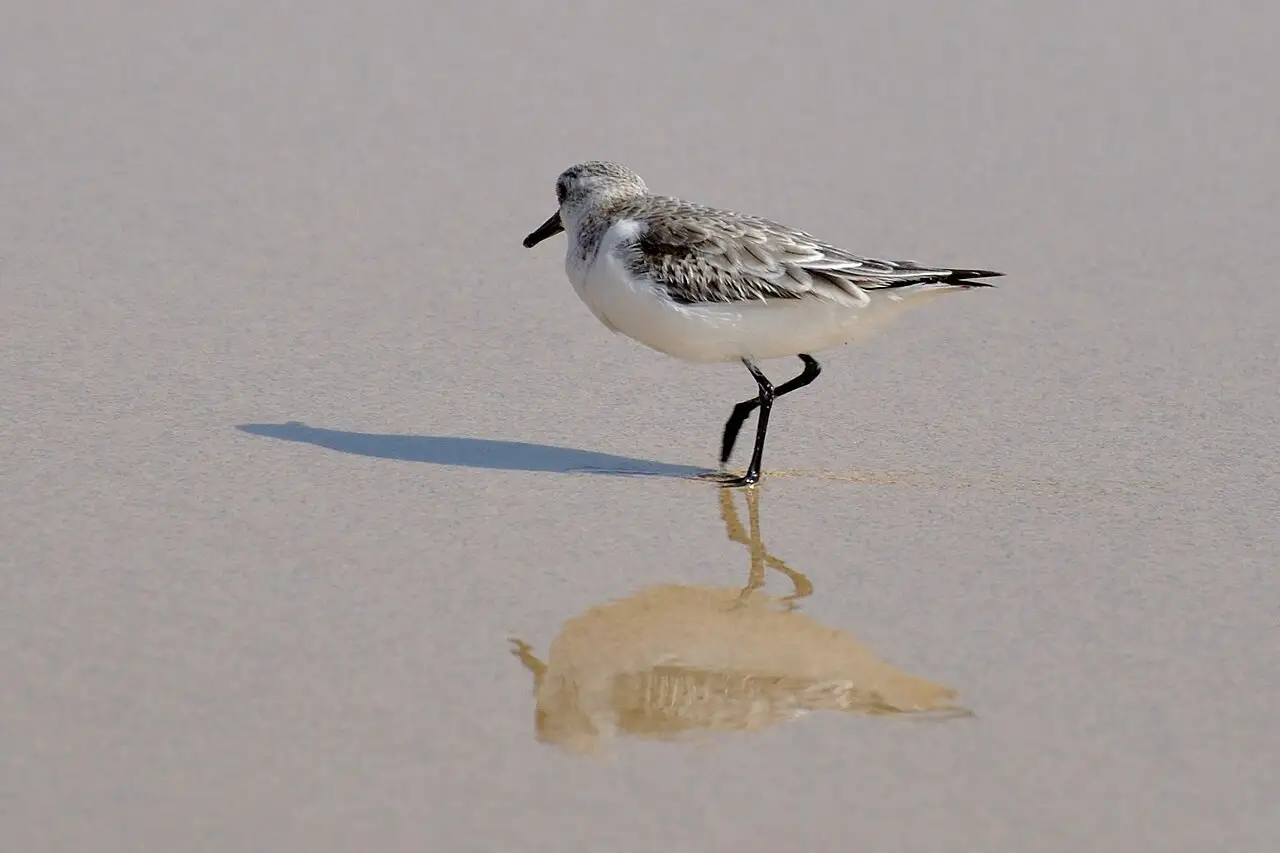
It is usually seen racing along beaches at speed, chasing the small prey that the surf carries in.
In flight it shows visible pale lengthwise bands on both wings and the pale rump, cut vertically by a black band.
In flight it gives a characteristic «tuic-tuic».
Photo gallery of the Sanderling
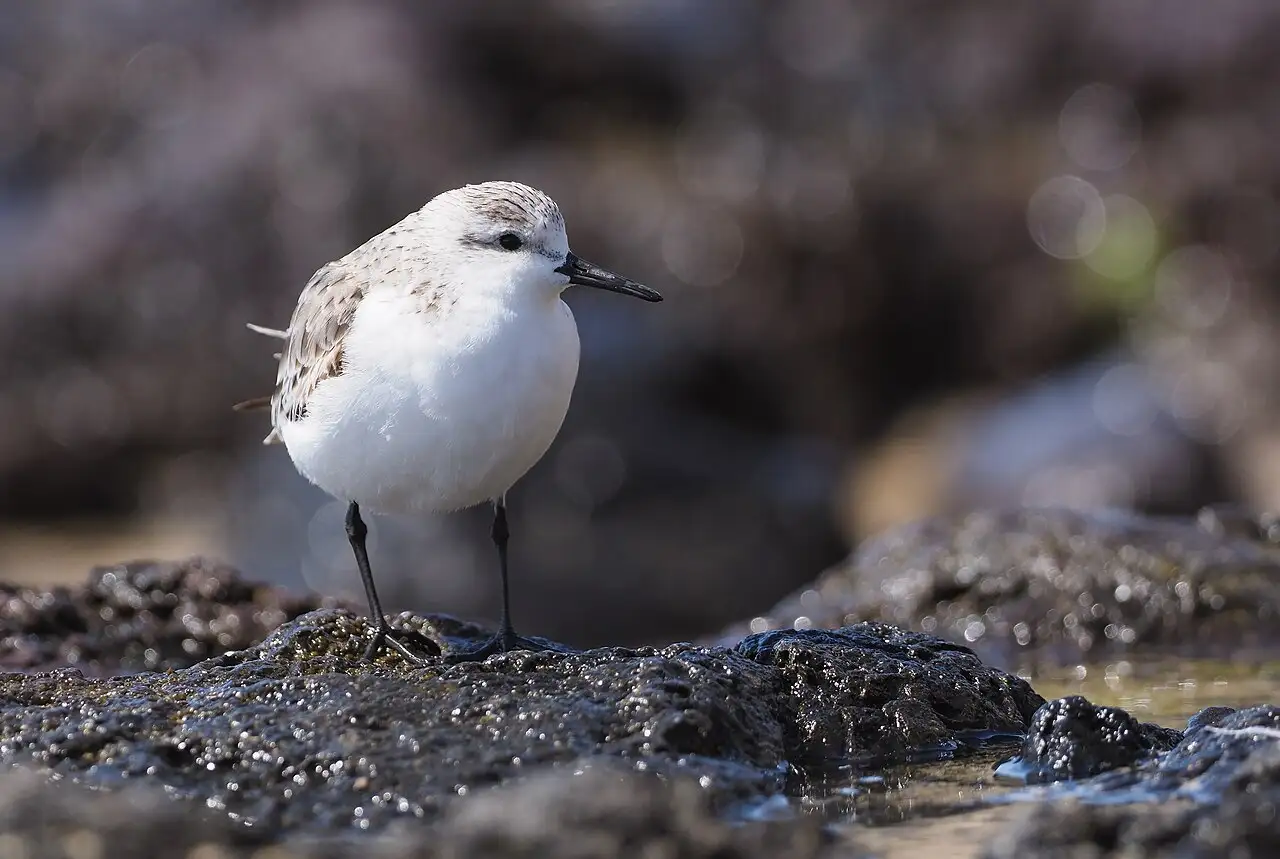
Sanderling with very pale white-and-grey plumage, in profile on some dark rocks on the shore, with black bill and legsPhoto: Frank Vassen from Brussels, Belgium, CC BY 2.0Photo 1 of 4
Sanderling running over wet sand, with its reflection, in pale grey and white plumage and black legsPhoto: Hansueli Krapf, CC BY-SA 3.0Photo 3 of 4
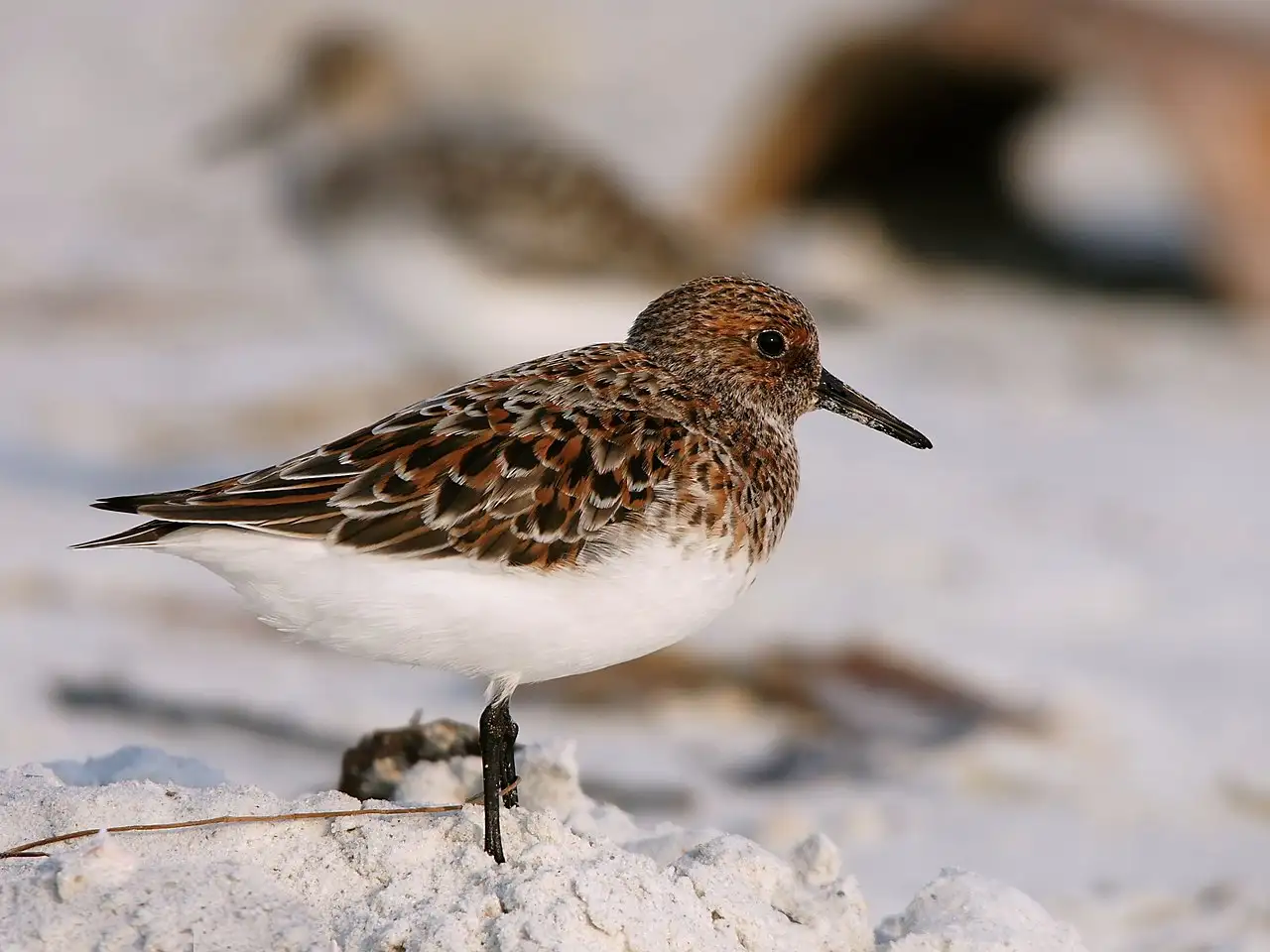
Sanderling in breeding plumage on the sand, with chestnut head and breast mottled with black and white bellyPhoto: Hans Hillewaert, CC BY-SA 4.0Photo 4 of 4
1 / 4
Identification of the Sanderling
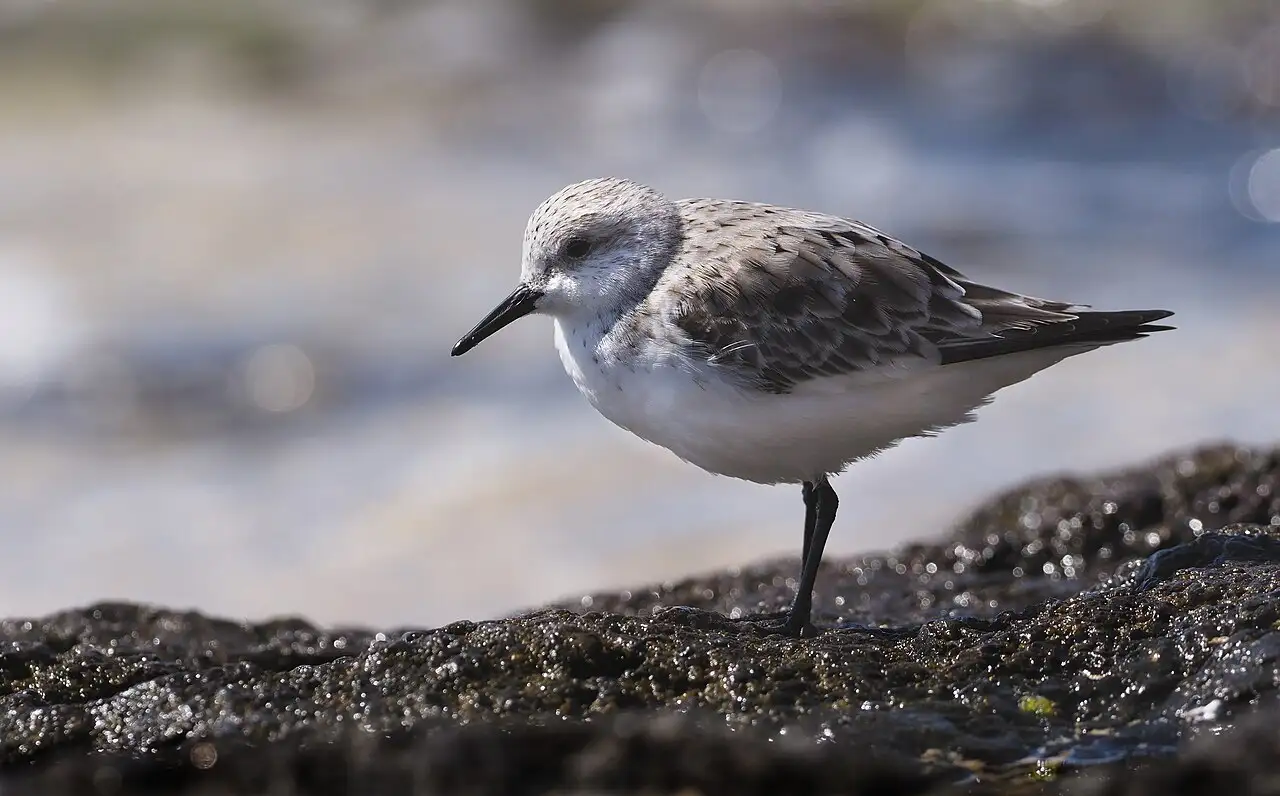
The Sanderling is a good-sized wader of fairly pale plumage, usually seen racing along beaches at speed, chasing the small prey that the surf carries in. The adult in breeding plumage shows a dark orange tinge, due to the chestnut colour of the head, neck and breast, with fine dark streaks; the upperpart feathers are black with orange notches and white margins, and the tertials show lengthwise orange bands on a black background, but the belly is white. The non-breeding adult is, by contrast, very pale grey, with white edges to the upperpart feathers and a dark carpal patch. The young bird is somewhat darker, with yellowish sides to the neck and black upperpart feathers with whitish notches; it differs from adults by its greater contrast, with dark crown, cream sides of the neck and chequered back. In flight it shows visible pale lengthwise bands on both wings and the pale rump, cut vertically by a black band.
Breeding adult
Head, neck and breast chestnut with dark streaks; upperparts black with orange notches.
White belly.
Non-breeding and young bird
Non-breeder: very pale grey, with white feather edges and a dark carpal patch.
Young bird: more contrasting, with dark crown, cream neck and chequered back.
Habitat and distribution of the Sanderling
It breeds around the Arctic, on the northern coasts of America, Greenland and northern Asia. It is one of the birds that make the longest journeys on the planet: it winters in southern South America, South Africa and tropical Africa, and even in Australia and New Zealand; there are also winter visitors in Europe and in the Mediterranean basin.
In Spain the population is located in winter mainly on the Andalusian Atlantic coastal areas, and is scarcer on the Cantabrian coast, Galicia, the Mediterranean coast and the Canaries1. On migration passage, Mediterranean sites such as the Ebro delta, the coasts of both archipelagos and inland wetlands of the peninsula are added to the wintering areas.
In the breeding season it settles in high latitudes of very cold climates, where land covered in turf, lichens and moss abounds. Outside it, it occupies mainly beaches and, marginally, salt pans, lagoons and similar environments near the coast, as well as inland waters.
It is a winter visitor on the Peninsula, the Balearics and the Canaries, with a marked migration passage, between September and October and between April and May, and scarce summering birds: some birds, above all second-year ones, stay in Spain over the summer.
Areas where it is regularly recorded since 2010Squares of about 25 km where it is recorded regularly (occasional passage records are left out). Data from GBIF.org (97,121 records, retrieved October 2026); outline from Natural Earth.
Etymology of the Sanderling
According to Wikipedia, its English name, «sanderling», derives from the Old English «sand-yrðling», «sand ploughman». In other languages it is called «territ de tres dits» in Catalan, «pilro tridáctilo» in Galician, «txirri zuria» in Basque and «sanderling» in English1. We have not found a source explaining the origin of its Spanish or scientific name, so we do not venture one.
Population of the Sanderling
In the 2021 European Red List of Birds, the European breeding population is estimated at between 50,200 and 66,800 mature individuals, with a stable trend. In Spain about 4,700 birds winter, although since it is present on many beaches that are not surveyed in the winter waterbird census, the real number could be much higher.
The most important threat is considered to be human disturbance, both during breeding and in resting areas along the passages and wintering1. It is also negatively affected by illegal hunting and pollution, which reduces food availability, and is very sensitive to the destruction and transformation of passage and wintering habitat.
Nest of the Sanderling
In the breeding areas, the nest is on slightly raised, open ground, often on bare rock, and is a small hollow lined with leaves, although the birds probably do not bring them.
Courtship and breeding of the Sanderling
In the breeding areas, the clutch consists of three or four olive or bluish eggs, with brown spots and even black streaks irregularly distributed. Incubation lasts 24–27 days and the chicks develop in about 17 days. The laying dates given by the source consulted do not agree with each other, so we do not repeat them1.
Diet of the Sanderling
It feeds, above all, on small invertebrates. In the breeding season it catches many insects, mainly adults and larvae of flies, and also beetles, butterflies or spiders; it also eats crustaceans and, in lean times, can make use of plant matter.
Curious facts about the Sanderling
It is a very pale-coloured wader which, during the short days of winter, moves swiftly following the ebb and flow of the waves on the beaches of the Atlantic coast1. It is one of the birds with the greatest movements on the planet, since it winters from Europe to southern South America, South Africa and Australia.
The Sanderling in Cabañeros
The habitat pages of this website do not mention it, and we have not found any other published source on it in the Park; nor does it appear in the bird list of the «Visitor guide to Cabañeros National Park» (OAPN). GBIF.org records 6 observations of the Sanderling in Cabañeros and its surroundings. Inland wetlands of the peninsula are cited among the passage sites1. None of those observations falls within the Park boundary (according to OpenStreetMap): all are from the surroundings.
Where to see the Sanderling in Cabañeros
In Cabañeros and its surroundings, only on passage and occasionally, on the shores of ponds and reservoirs.
When
In Spain from September to May, with passages from September to October and from April to May.
What time
By day, running along the edge of beaches and ponds, following the ebb and flow of the water.
Where
On sandy beaches and, marginally, salt pans, lagoons and inland waters.
What to look for
Look for the very pale plumage and the light bands on the wings in flight; listen for the «tuic-tuic».



 Same family
 Same family
 Same family
 Same family
 Same order
 Same order
 Same order
 Same order






