Wingspan compared with a person with arms outstretched.
Length
33–43 cm
Wingspan
0.85–1.03 m
Weight
223.8 g
Social life
Very noisy in the colonies, which are usually very dense and may be single-species or mixed; it migrates in small groups
Lifespan
Record of 16 years in the wild according to AnAge; EURING lists a bird ringed in Spain that lived 18 years and 1 month and was shot
Conservation status
LC
NT
VU
EN
CR
EW
EX
Global (IUCN)
Least Concern
Spain
Data Deficient (DD) in the 2021 Red Book of the Birds of Spain; on the List of Wild Species under Special Protection, but not in the National Catalogue of Threatened Species
When to see it
Summer visitor
Months of the year when it is present
J
F
M
A
M
J
J
A
S
O
N
D
In Iberia
no
no
yes
yes
yes
yes
yes
yes
yes
yes
no
no
Breeding season
no
no
no
yes
yes
yes
yes
no
no
no
no
no
Song or voice of the Gull-billed Tern
It is very noisy in the colonies. In flight its usual call is a deep, nasal, resonant «guruick», and as an alarm it gives a quick «güic-güic-güic»1. The recording (flight call) is by Esperanza Poveda and was made in the Aljarafe (near Choza de Huerta Tejada), Seville, Andalusia (xeno-canto XC1075632, quality A). It lasts 9 seconds and is a trimmed section of the original, without repeating or lengthening, from which we have removed the bass below 300 Hz, reduced the background noise and adjusted the volume; neither pitch nor speed has been changed.
In flight it is elegant and on a more direct track than other terns, with shallow, slow, regular wingbeats. It does not plunge-dive or dive: it hunts insects on the wing or swoops to catch prey on the water surface or vegetation.
Flight typeElegant and on a straight track, with shallow, slow, regular wingbeats
In flight it is elegant and on a more direct track than other terns, with shallow, slow, regular wingbeats.
It does not plunge-dive or dive: it hunts insects on the wing or swoops to catch prey on the water surface or vegetation.
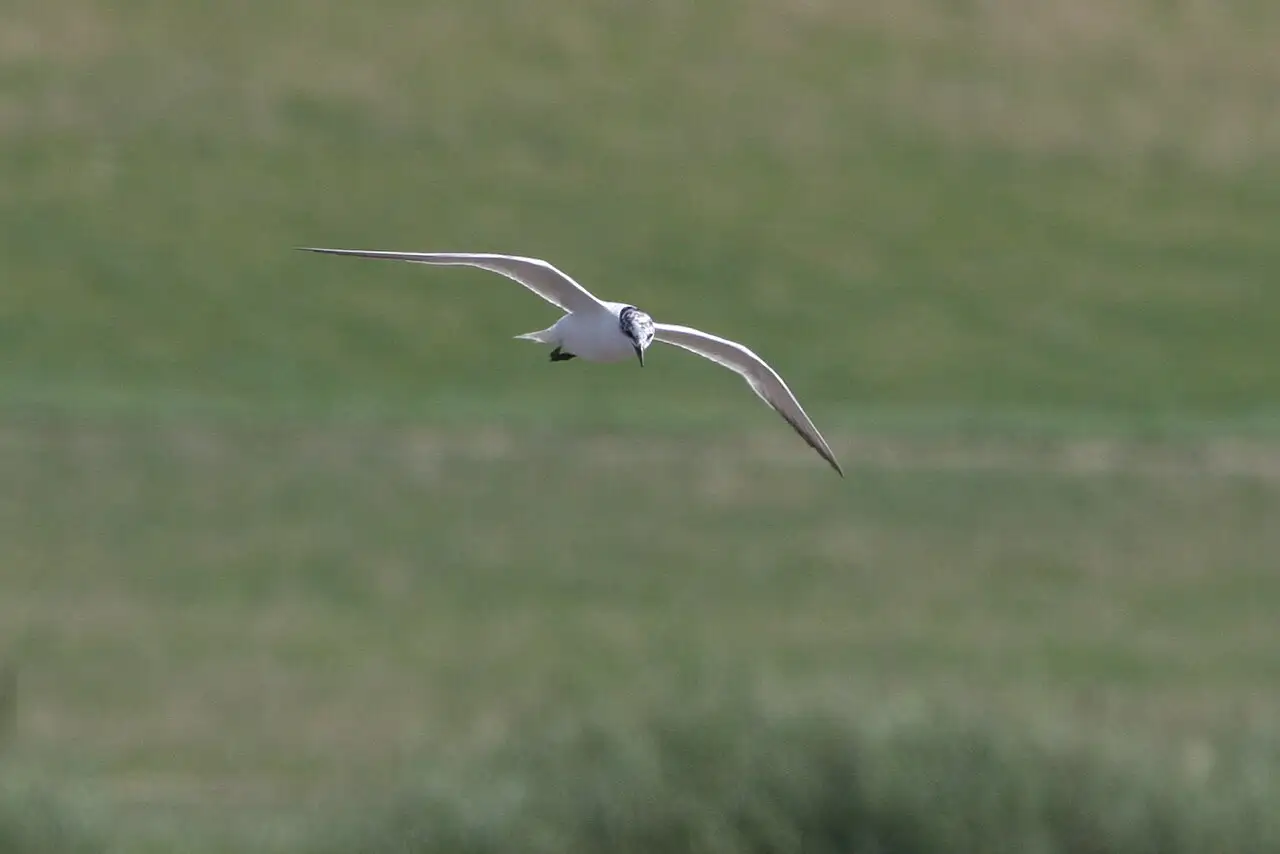
The wings are long and broader at the base, more rounded and less angled than those of other terns.
Photo gallery of the Gull-billed Tern
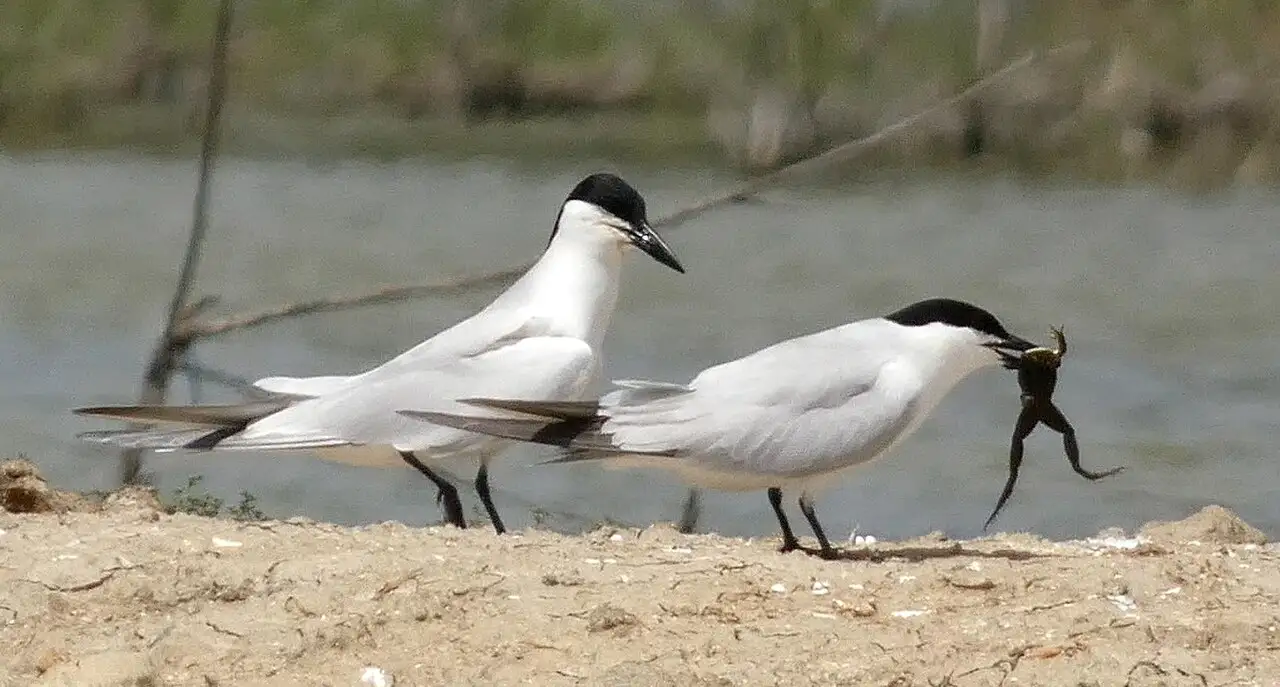
Two Gull-billed Terns perched on the sand beside the water, with black cap and thick bill; one has a frog in its billPhoto: Dominique Armange, CC BY-SA 4.0Photo 1 of 5
Gull-billed Tern in flight with wings wide open over a meadow, with pale plumage and black capPhoto: christoph_moning, CC BY 4.0Photo 2 of 5
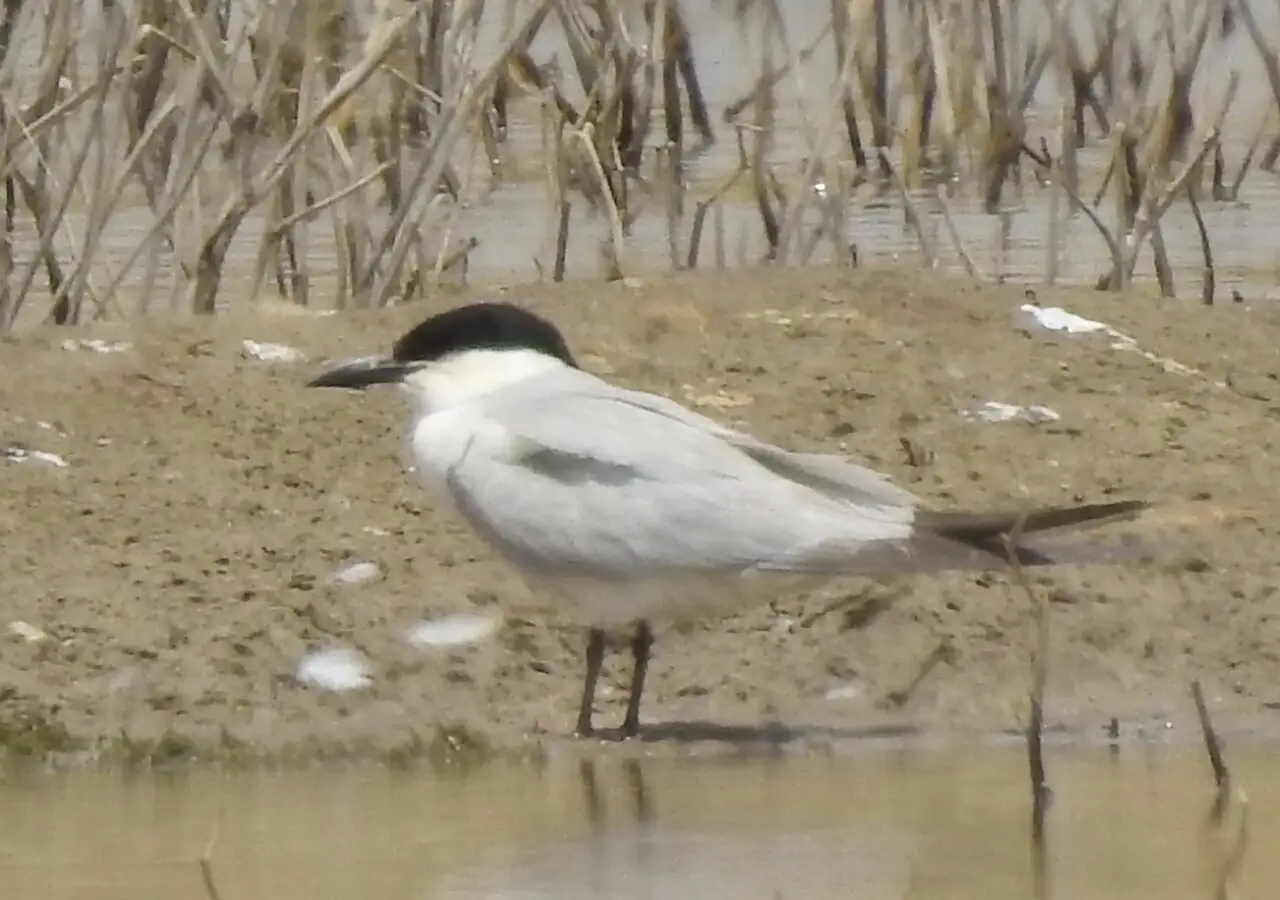
Gull-billed Tern perched on the sand of a shore, in profile, with black cap, short, thick bill and light grey backPhoto: aissadjamelfilali, CC BY-SA 4.0Photo 3 of 5
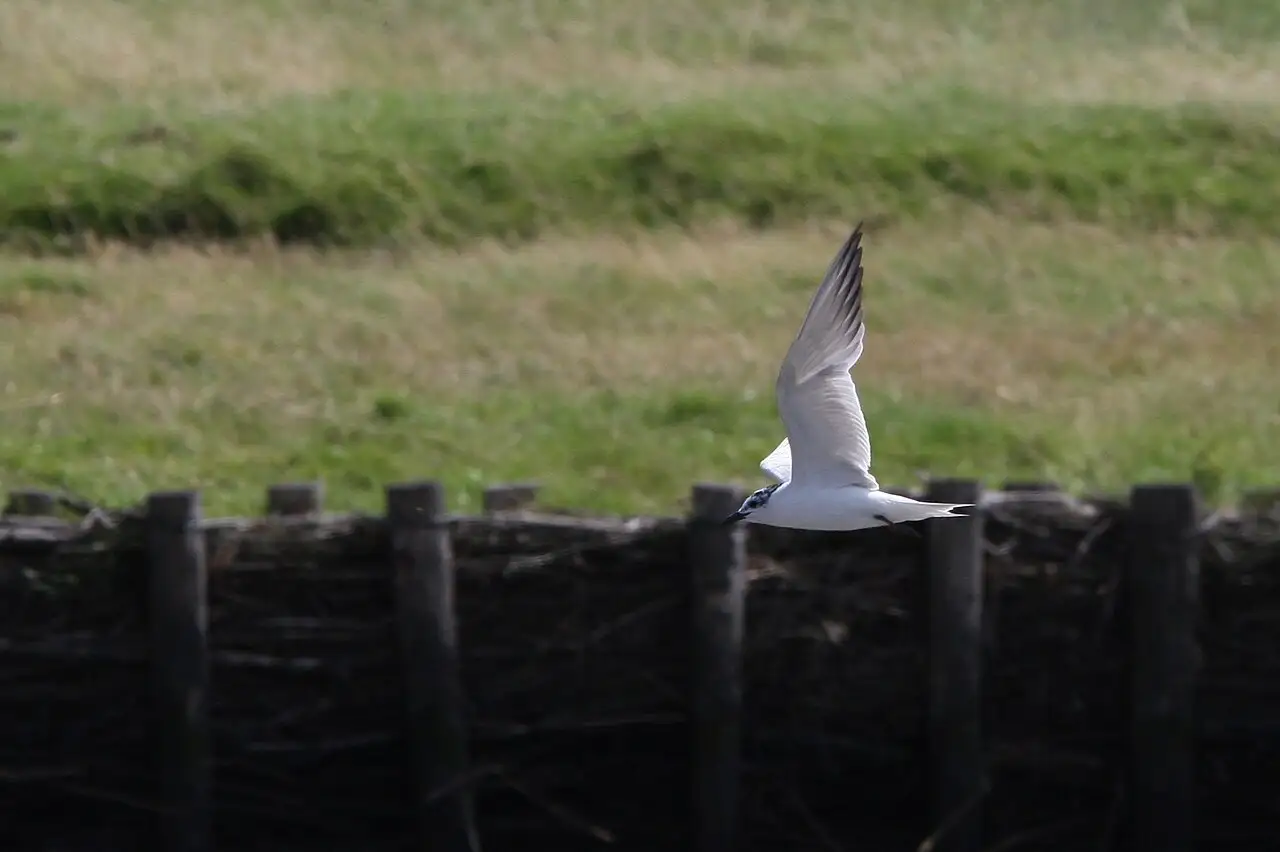
Gull-billed Tern in flight with one wing raised high against a dark fence, with white body and black capPhoto: christoph_moning, CC BY 4.0Photo 4 of 5
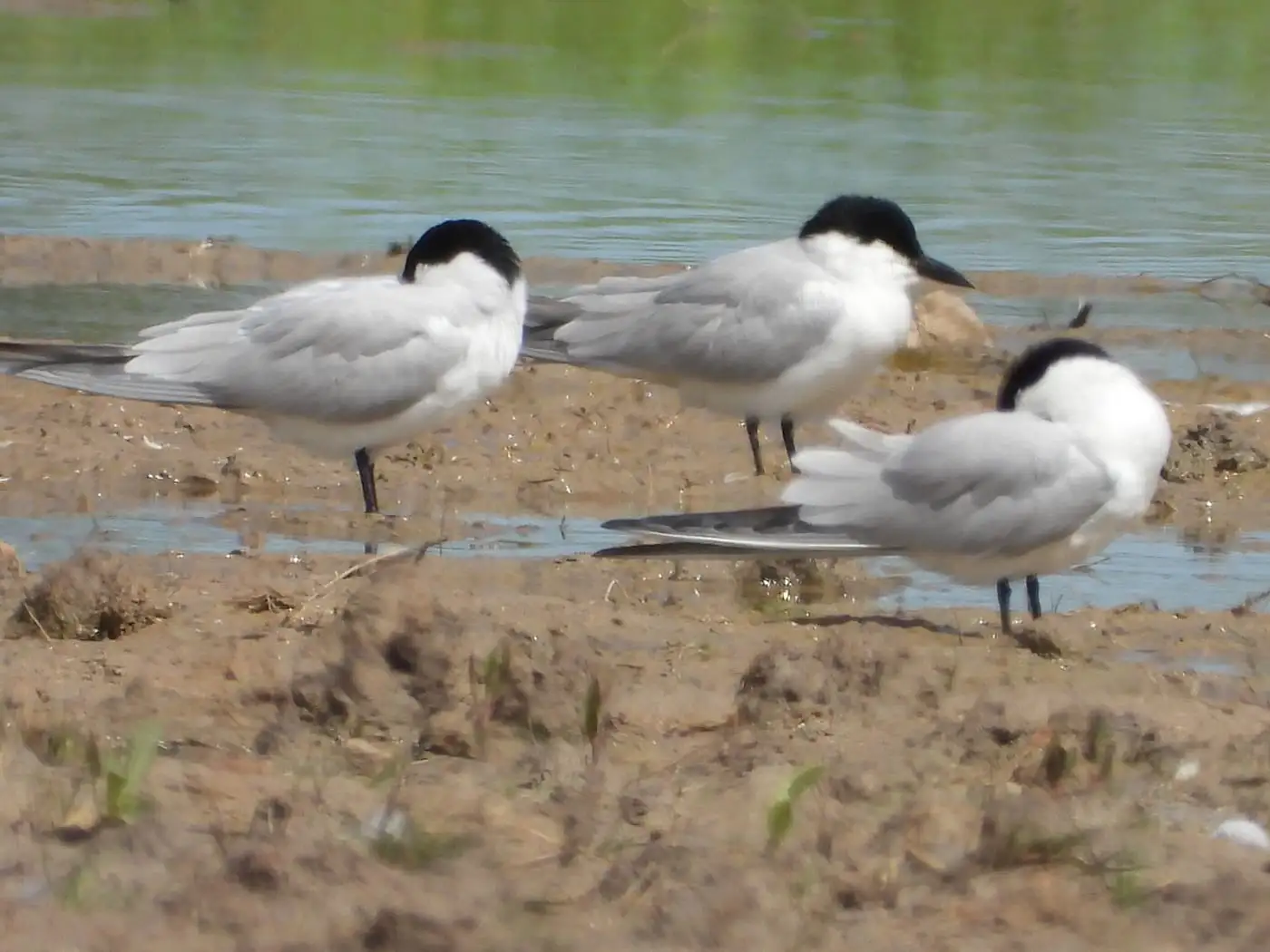
Three black-capped Gull-billed Terns perched on the mud of a shore (Andalusia)Photo: Gitte L, CC BY-NC 4.0Photo 5 of 5
1 / 5
Identification of the Gull-billed Tern
The Gull-billed Tern, of medium to large size and pale overall appearance, at first sight is very similar to the Sandwich Tern, from which it is told by having a short bill (as long as half the head), thick and completely black. The wings are long and broader at the base, as well as more rounded and less angled. The short, slightly forked tail is light grey, like the rump. When perched it shows, at all ages, a very rounded head, with the short bill and fairly long legs. In flight it is elegant and on a more direct track than other terns. Its presence inland, where the Sandwich Tern is never seen, also distinguishes it from the latter. It is the only one of its family that has a short, robust bill, like a gull’s.
Adult
In the breeding season, glossy black cap, crestless, which extends quite far over the nape towards the back.
In winter, the cap is reduced to a small dark mask behind the eye that does not continue over the nape.
Young bird
Paler look, with a buff tone on head, back and wings, with hardly any distinctive markings.
Habitat and distribution of the Gull-billed Tern
It breeds in Central and South America, Australia, south-west Asia, the Middle East, Africa and Eurasia. Although it is practically cosmopolitan, its distribution is very localised. Six subspecies have been described, indistinguishable in the field. In Europe its colonies extend to Turkey and the Caspian Sea, almost always below 50 degrees north latitude, and these populations winter in the sub-Saharan area.
In Spain it breeds in numerous wetlands of the Peninsula, although it is restricted to the southern half and areas of the Mediterranean basin1. The traditional breeding areas are above all in the Guadiana basin and the Guadalquivir marshes and, less abundantly, in the Tagus basin and the Ebro delta, as well as in Extremaduran reservoirs and La Mancha lagoons. Some colonies are on brackish waters, such as the Fuente de Piedra lagoon, Gallocanta and the Santa Pola salt pans. The subspecies «nilotica» is the one that occupies Spanish territory.
It nests mainly on sandy flats, islets in lagoons and reservoirs, brackish marshes, saline lagoons, muddy areas with sparse vegetation and river deltas, always on natural or artificial islands and, occasionally, on their shores. To feed it occupies a wide range of habitats, drier than those of other terns, although it is usually seen on fresh water and marshes; outside the breeding season it also appears on steppe lagoons, wasteland near water and even sea coasts, but with more tendency towards inland waters.
It is typically migratory and a summer visitor: it arrives in early April and leaves in August, once breeding is over. The populations of northern Europe cross the Peninsula towards their winter quarters on the western coasts of Africa and the Niger river region, so it is seen on pre-breeding passage from March and on post-breeding passage until September and even October, in small groups and generally inland. There are occasional records of winter visitors.
Areas where it is regularly recorded since 2010Squares of about 25 km where it is recorded regularly (occasional passage records are left out). Data from GBIF.org (38,075 records, retrieved October 2026); outline from Natural Earth.
Etymology of the Gull-billed Tern
In other languages it is called «curroc comú» in Catalan, «carrán de bico curto» in Galician, «txenada mokobeltza» in Basque and «gull-billed tern» in English1. We have not found a source explaining the origin of the Spanish name «pagaza piconegra» or the scientific one, so we do not venture one.
Population of the Gull-billed Tern
The 2021 European Red List of Birds estimates between 26,700 and 37,400 mature individuals, with a stable trend, and a recent positive trend in the northern Mediterranean and the Black Sea, which reflects the partial recovery of the European population after decades of decline. Spain holds up to 50 % of Europe’s birds, with a steady increasing trend since 1970 in both number and breeding range1. The III Atlas of Breeding Birds in Spain (2014–2018) calculates some 5,000 pairs, spread across five cores: Andalusia, Extremadura, the Valencian Community, Catalonia and Castilla-La Mancha; there are other populations in Castilla y León, Murcia and Aragon1.
The evolution of the population is not clear, because of the poor coverage and standardisation of the censuses and the marked spatial and population fluctuations that characterise the species. The positive changes in its population size and area of occupation have lowered its threat level, and it is considered advisable to design a national census programme, identify its breeding localities and gather longer time series1.
Nest of the Gull-billed Tern
It breeds in usually very dense colonies, single-species or mixed; in the latter it nests alongside other gulls and terns (Little Tern and Black-headed and Slender-billed Gulls) or waders (Black-winged Stilt, Pied Avocet and Collared Pratincole). To settle it prefers islands with a plant cover of under 20 %.
Courtship and breeding of the Gull-billed Tern
The earliest colonies begin to breed in late April, although replacement clutches may run on until June or July. The average clutch is two eggs, incubated by both parents, although it varies from one year to the next and in some years clutches of three predominate. The incubation period is 22 or 23 days; the chicks are fed by both parents, leave the nest at three or four days of life to seek shelter in nearby vegetation and take 28–35 days to fly. Breeding success varies greatly between colonies, from under 20 % of pairs successful to over 80 %.
Diet of the Gull-billed Tern
It is an opportunistic bird, much more insect-eating than other terns: its basic food is beetles (Coleoptera) and grasshoppers (Orthoptera). It also eats dragonflies, moths, worms, spiders and earthworms, and takes advantage of local abundances of crustaceans, fish, amphibians, reptiles, small mammals and even chicks of other birds. It feeds mainly in cultivated areas, intensive or extensive, in natural grasslands and on flooded land.
Curious facts about the Gull-billed Tern
Its habits are more those of a steppe bird than of a tern1. The longevity EURING gives, 18 years and 1 month in a bird shot in Spain, is somewhat more than AnAge’s 16 years; oiseaux.net cites a maximum of 20 years.
The Gull-billed Tern in Cabañeros
The habitat pages of this website do not mention it, and we have not found any other published source on it in the Park; nor does it appear in the bird list of the «Visitor guide to Cabañeros National Park» (OAPN). GBIF.org records 3 observations of the Gull-billed Tern in Cabañeros and its surroundings. The Tagus basin, Extremaduran reservoirs and La Mancha lagoons are cited among its breeding areas1. None of those observations falls within the Park boundary (according to OpenStreetMap): all are from the surroundings.
Where to see the Gull-billed Tern in Cabañeros
In Cabañeros and its surroundings, occasionally, between March and October, over ponds, reservoirs and crops.
When
In Spain from March to October; it arrives in early April and leaves in August, with passage until September or October.
What time
By day, hunting insects on the wing over crops, grasslands and flooded land.
Where
On islets and shores of lagoons and reservoirs, brackish marshes and deltas, and inland, unlike the Sandwich Tern.
What to look for
Look for the short, thick, black bill, and listen for its deep, nasal «guruick».
Videos of the Gull-billed Tern
Similar species
Sandwich Tern
Thalasseus sandvicensis
How to tell them apart
It is similar in physical appearance1: the Gull-billed Tern has the short, thick, completely black bill, and inland it is not confused with it, because the Sandwich Tern is never seen there.
Photo: Juan Emilio from Las Palmas de Gran Canaria, Spain, CC BY-SA 2.0




 Same family
 Same family
 Same family
 Same family
 Same order
 Same order
 Same season in the park
 Same order






