Wingspan compared with a person with arms outstretched.
Length
23–28 cm
Wingspan
57–65 cm
Weight
72.5 g
Social life
Gregarious; forms not very compact colonies, and often gathers in large flocks to feed
Lifespan
Record of 21 years in the wild according to AnAge; EURING lists a bird found dead in Denmark at 21 years
Conservation status
LC
NT
VU
EN
CR
EW
EX
Global (IUCN)
Least Concern
Spain
Critically Endangered (CR) in the 2021 Red Book of the Birds of Spain and Endangered (EN) in the National Catalogue of Threatened Species
When to see it
Passage migrant
Months of the year when it is present
J
F
M
A
M
J
J
A
S
O
N
D
In Iberia
no
no
yes
yes
yes
yes
yes
yes
yes
yes
no
no
Breeding season
no
no
no
no
yes
yes
no
no
no
no
no
no
Song or voice of the Black Tern
In flight it gives an abrupt «kshlet», similar to the Little Tern’s, and some brief, nasal «klit» and «kliia»; as an alarm it uses a powerful «ki-ki-ki» or a harsh «kaieh»1. The recording (flight call of a group feeding over a wetland) is by Simon Gillings and was made at Bygholm, in northern Denmark (xeno-canto XC1137695, quality A). It lasts 9 seconds and is a trimmed section of a 21 s clip, without repeating or lengthening, from which we have removed the bass below 300 Hz, reduced the background noise and adjusted the volume; neither pitch nor speed has been changed. It is from Denmark, not Spain.
It is told apart from the sea terns by its more leisurely flight with more side-to-side swaying1. It is a migratory species: in Spain the autumn migration runs from late June to October, with the highest densities in August and early September, and the return to the breeding areas from March until the first half of May.
Flight typeLeisurely, with side-to-side swaying, without plunge-diving
It differs from terns mainly by its more unhurried flight with more lateral rocking, its shorter, broader wings and its short, barely forked tail.
It catches its prey directly in the air or on the water surface, but without plunging in, and unlike terns it rarely hovers.
It usually gathers in large flocks to feed, and in flight gives an abrupt «kshlet» and short, nasal «klit» and «kliia».
Photo gallery of the Black Tern
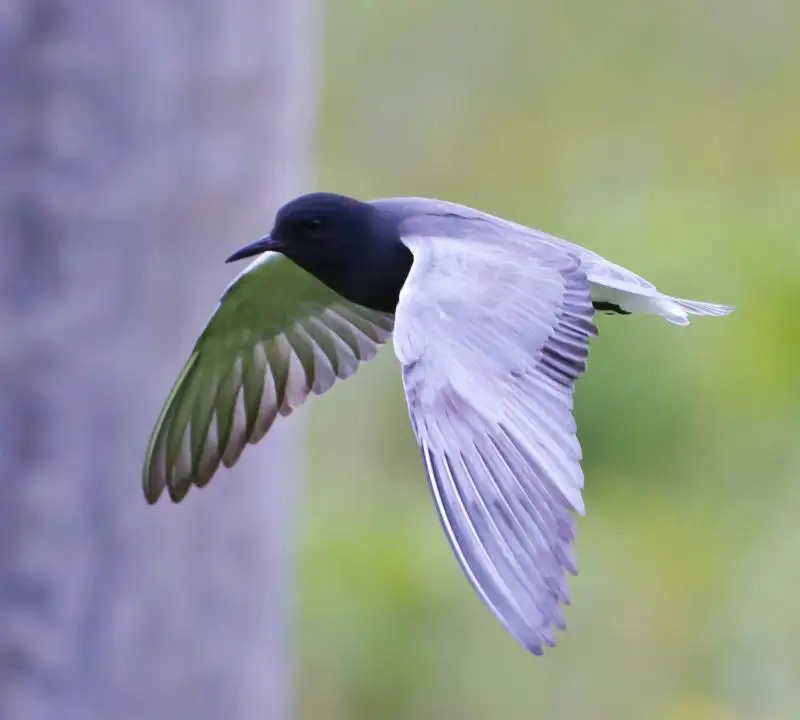
Black Tern in flight seen from the front, with black head and breast, grey wings open and dark bill, on a blurred green backgroundPhoto: Ómar Runólfsson, CC BY 2.0Photo 1 of 5
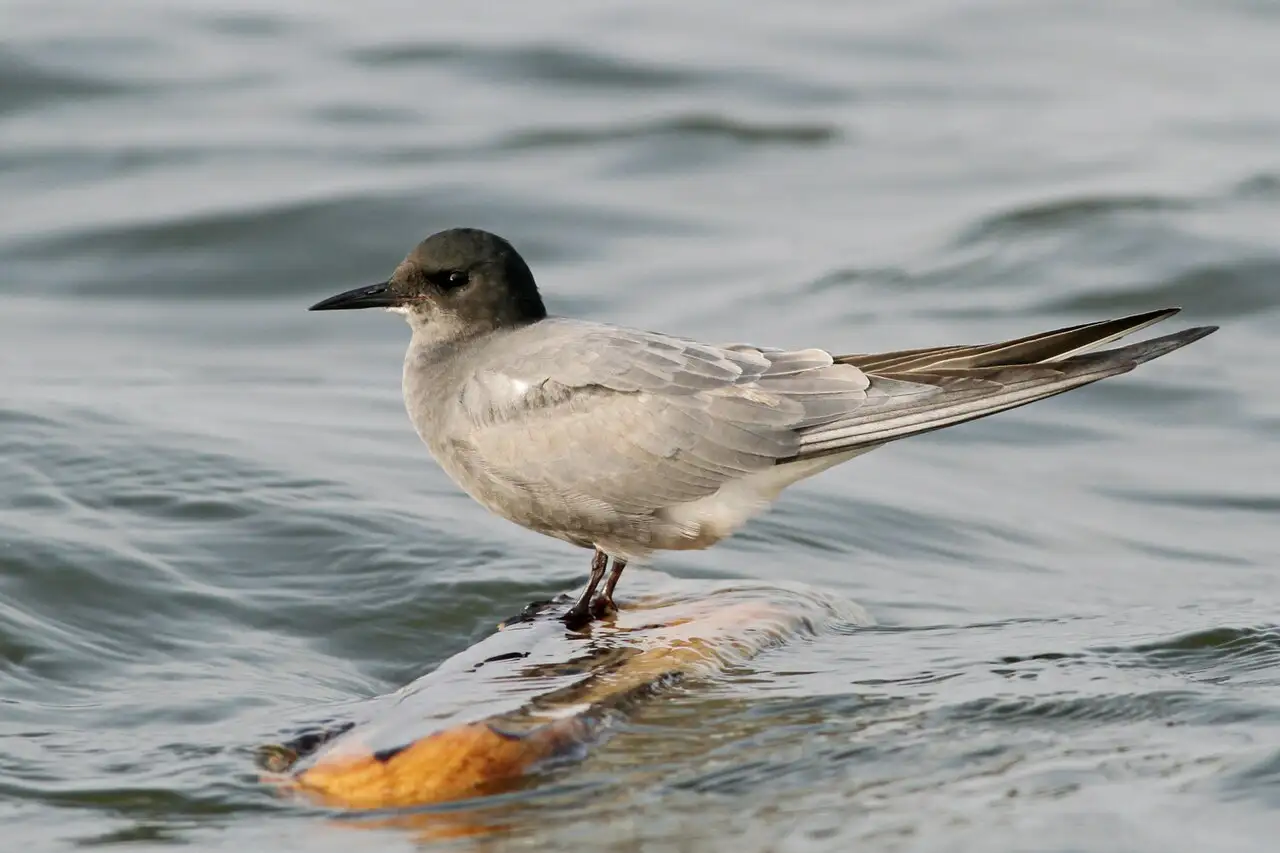
Black Tern perched in profile on a log floating in the water, with dark head, grey body and long tailPhoto: Andrej Chudý from Slovakia, CC BY-SA 2.0Photo 2 of 5
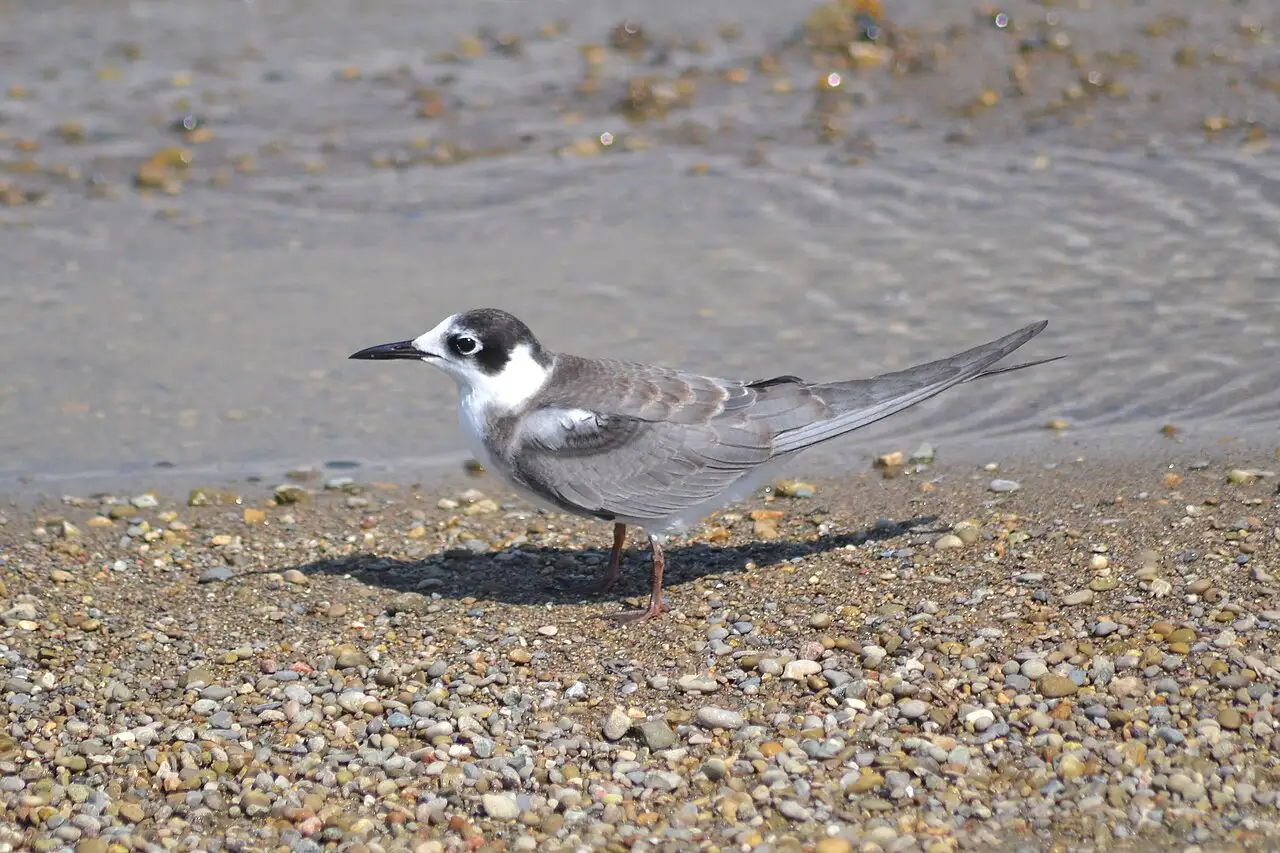
Black Tern in winter plumage on the gravel of a shore, with white forehead and face and a dark patch on the breastPhoto: Andrew C, CC BY 2.0Photo 3 of 5
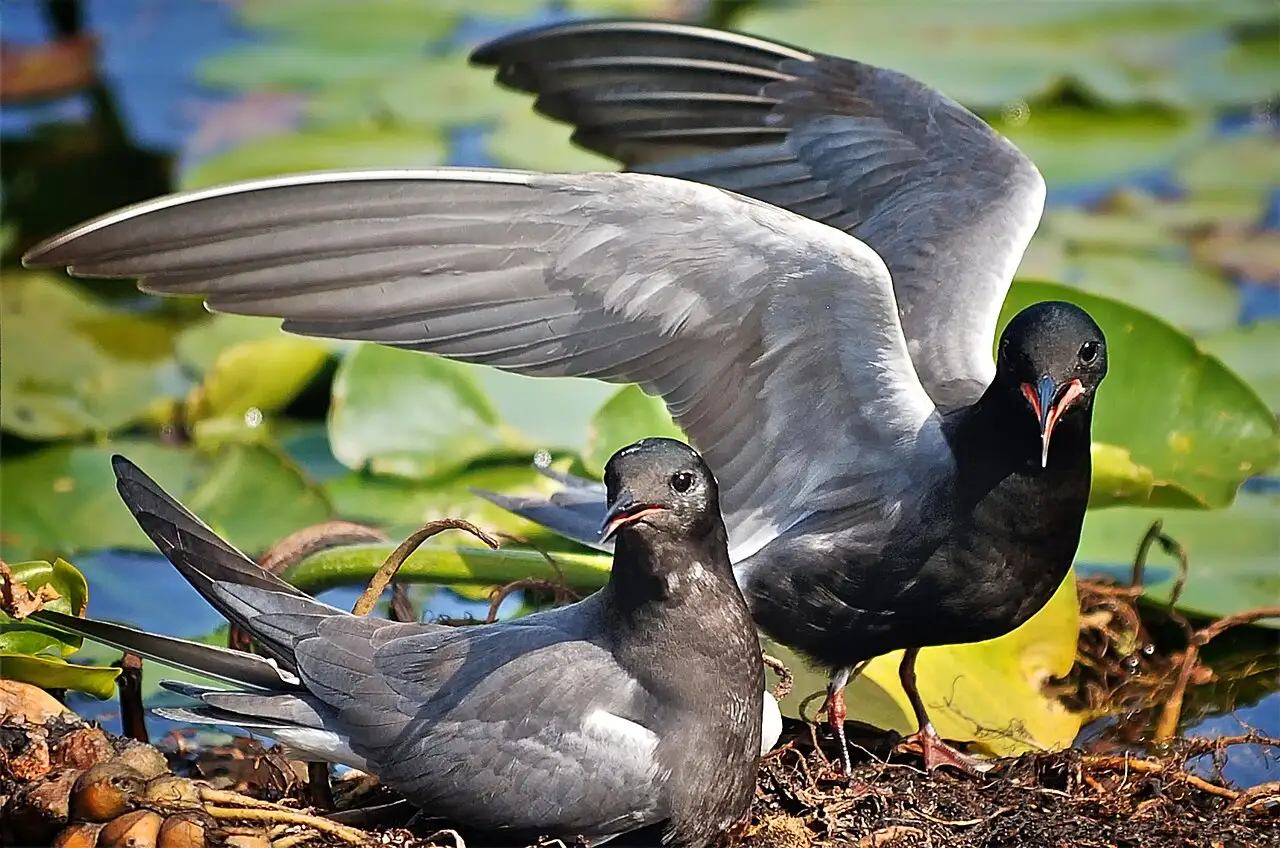
Grey-plumaged Black Tern with wings open on a stump in the water (Catalonia)Photo: Lluís Amat, CC BY-NC 4.0Photo 5 of 5
1 / 5
Identification of the Black Tern
The Black Tern, like other marsh terns, differs from the sea terns mainly by its more leisurely flight with more side-to-side swaying, shorter, broader wings and a short, barely forked tail. The adult in summer plumage has the head and body black, except the undertail coverts and the end of the belly, in grey tones; the upperparts, including the rump and tail, are a uniform dark grey, and the bill and legs are equally dark. In winter, the underparts, neck, face and forehead are white, and the black of the head is reduced to the cap, which extends to the nape and behind the eye forming a characteristic pattern; the upperparts are then pale grey, with a dark patch on the breast like a half-closed collar and paler legs. During the moult it shows many variations, but generally has the head and underparts mottled or spotted with white. The young bird is similar to the adult in winter plumage, but with the back and wing coverts scaled with dark.
Summer plumage
Head and body black, with grey undertail coverts and end of the belly.
Uniform dark grey upperparts, dark bill and legs.
Winter and young bird
Winter: underparts, neck, face and forehead white; black cap; dark patch on the breast.
Young bird: like the winter adult, with back and coverts scaled with dark.
Habitat and distribution of the Black Tern
It breeds in boreal and temperate latitudes of Europe, Asia and North America. In Eurasia it extends from the Iberian Peninsula to central Asia, in an area reaching Poland, the Baltic countries and Russia in the north, and Turkey, the Caspian Sea and Siberia in the south; it is absent from much of western Europe and southern Russia. European and Asian populations winter on the Atlantic coasts of central and southern Africa. Two subspecies are recognised, and on the Peninsula the subspecies «niger» occurs.
As a breeder it is found on the Peninsula only in the Guadalquivir marshes, but that observations at numerous points of the territory show its migratory nature, above all as a bird of passage1. Its late migratory phenology and the fact that some non-breeding birds stay on the Peninsula all summer make it hard to verify breeding.
It breeds in mid-latitude regions, from sea level to 2,000 metres, on coasts and inland, above all in permanent or temporary wetlands of fresh or slightly brackish water, 1 to 2 metres deep and with enough vegetation on the margins: lakes, small ponds, slow watercourses, marshes, flooded meadows, rice fields and similar spaces. In Spain it is more typical of marshes and coastal wetlands. During migrations it feeds in estuaries and other coastal habitats, and is often seen associated with marine mammals and large predatory fish.
Areas where it is regularly recorded since 2010Squares of about 25 km where it is recorded regularly (occasional passage records are left out). Data from GBIF.org (17,833 records, retrieved October 2026); outline from Natural Earth.
Etymology of the Black Tern
It is also known as «fumarel común»; in other languages it is «fumarell negre» in Catalan, «gaivina negra» in Galician, «itsas enara beltza» in Basque and «black tern» in English1. We have not found a source explaining the origin of the register’s name, «charrán negro», or of the scientific name, so we do not venture one.
Population of the Black Tern
The 2021 European Red List of Birds estimates between 225,000 and 355,000 mature individuals in Europe, with an unknown trend. Although it is not a globally threatened species, in Europe it has suffered a notable decline in numbers across its whole range, with a strong decline of the breeding population in France and Italy. The Peninsula is in the marginal region of its range, so it breeds sporadically and very sparsely in wetlands with suitable habitats.
The water level of wetlands is a limiting factor, with great fluctuations in the number of pairs and breeding sites. Among the main threats are the drying out and degradation of wetlands, aggravated by climate change, pollution from plant-protection products and eutrophication, and predation and destruction of nests, with the overpopulation of Wild Boar in Doñana and livestock pressure1.
Nest of the Black Tern
It generally builds floating nests, held up by vegetation, in areas with good visibility and in shallow water.
Courtship and breeding of the Black Tern
It is gregarious and forms not very compact colonies. In Spain it can gather in mixed colonies with the much more abundant Whiskered Tern, as in the Guadalquivir marshes. The breeding period is concentrated in May and June. Clutches are of two or three eggs, which both sexes incubate for 20–23 days. The chicks are fed by both parents, leave the nest two or three days after hatching, although they stay close until the second week of life, and fly at 19–25 days. Breeding in Spain is exceptional and does not allow it to be marked as a breeder in Cabañeros, where its status as a bird of passage remains.
Diet of the Black Tern
Its diet is based mainly on aquatic insects, especially beetles, and other invertebrates, with a small percentage of small fish and tadpoles. It catches prey directly in the air or on the water surface, without plunging in, and often gathers in large flocks to feed. Unlike the sea terns, it rarely hovers.
Curious facts about the Black Tern
It is very scarce as a breeder in Spain and more abundant on migration passages, with an unmistakable breeding plumage that, at some distance, looks almost black1. Its longevity record in the wild is the same in both sources: 21 years in AnAge and 21 years in EURING.
The Black Tern in Cabañeros
The habitat pages of this website do not mention it, and we have not found any other published source on it in the Park; nor does it appear in the bird list of the «Visitor guide to Cabañeros National Park» (OAPN). GBIF.org records 6 observations of the Black Tern in Cabañeros and its surroundings. On the Peninsula it breeds only in the Guadalquivir marshes1. In the rest of the territory it is seen mainly on passage1. None of those observations falls within the Park boundary (according to OpenStreetMap): all are from the surroundings.
Where to see the Black Tern in Cabañeros
In Cabañeros and its surroundings, only on passage, over reservoirs and ponds.
When
On passage: the return runs from March to the first half of May and the autumn migration from late June to October.
What time
By day, flying over the water in flocks.
Where
Over marshes, lagoons, rice fields and reservoirs; on the coast, in estuaries.
What to look for
Look for the leisurely, swaying flight and the almost black summer plumage; listen for the abrupt «kshlet».




 Same family
 Same family
 Same family
 Same family
 Same order
 Same order
 Same order
 Same order






