Wingspan compared with a person with arms outstretched.
Length
49–57 cm
Wingspan
1.18–1.5 m
Weight
686–999 g
Social life
Fundamentally colonial; in Spain it breeds in colonies of other large gulls
Lifespan
Record of 34 years and 10 months in the wild (a bird ringed in Great Britain and Ireland, caught)
Conservation status
LC
NT
VU
EN
CR
EW
EX
Global (IUCN)
Least Concern
Spain
Least Concern (LC) as a breeder and as a winter or passage visitor in the Red Book of the Birds of Spain; not on the List of Wild Species under Special Protection nor in the Spanish Catalogue of Threatened Species
When to see it
Winter visitor
Months of the year when it is present
J
F
M
A
M
J
J
A
S
O
N
D
In Iberia
yes
yes
yes
yes
yes
yes
yes
yes
yes
yes
yes
yes
Song or voice of the Lesser Black-backed Gull
It gives a very long, noisy call, which begins with some short sounds, followed by a sequence like a guffaw: «au au kuiia kuaok kuaok».
CallLesser Black-backed Gull
0:00 / 0:30
10 kHz5
The sonogram draws the sound: time runs from left to right, and the higher a trace sits, the higher the note.Recording by Aves Córdoba, Wikimedia Commons (Vídeo de YouTube, con atribución).
Flight of the Lesser Black-backed Gull
Over a good part of its range it is migratory: in winter it moves south in search of its wintering areas. The populations of the subspecies «intermedius» and «graellsii», from north-west Europe, occupy the Atlantic coastline between France and Mauritania, all the Iberian coasts and a good number of sites in the interior of the Peninsula.
Flight typeDirect, over coasts, rivers and reservoirs
It leaves a beach, a port or a reservoir with a very long, noisy call, which begins with short sounds and goes on with a sequence like a guffaw: «au au kuiia kuaok kuaok».
In winter it is very common along the whole peninsular coast and on rivers and reservoirs of the inland south-west, often associated with landfills, where it looks for food.
It is omnivorous: it includes in its diet vertebrates, invertebrates, plants and rubbish, and often parasitises other birds or raids seabird colonies.
Photo gallery of the Lesser Black-backed Gull
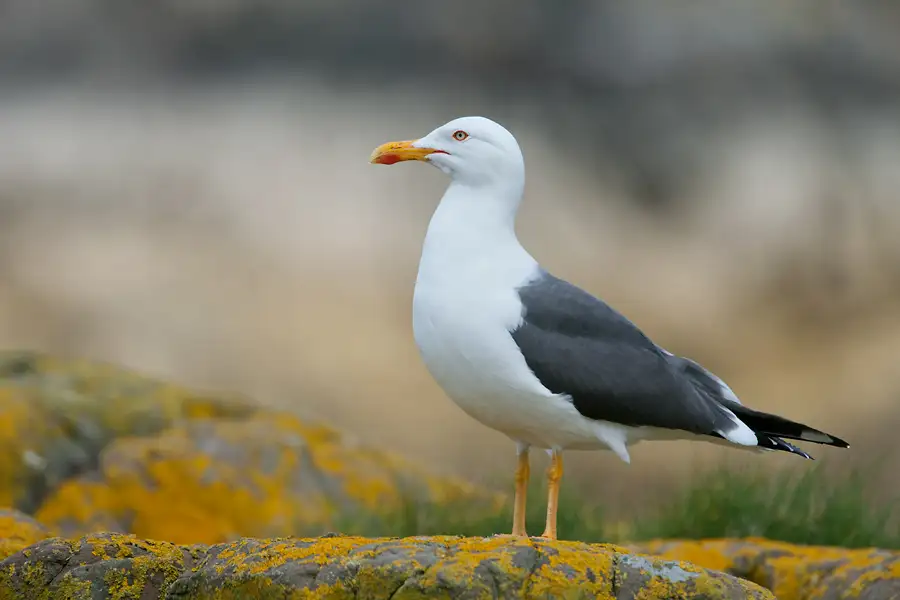
Adult Lesser Black-backed Gull perched on lichen-covered rocks, in profile, with dark grey back, yellow bill with a red spot and yellow legsPhoto: Marek Szczepanek, CC BY-SA 4.0Photo 1 of 4
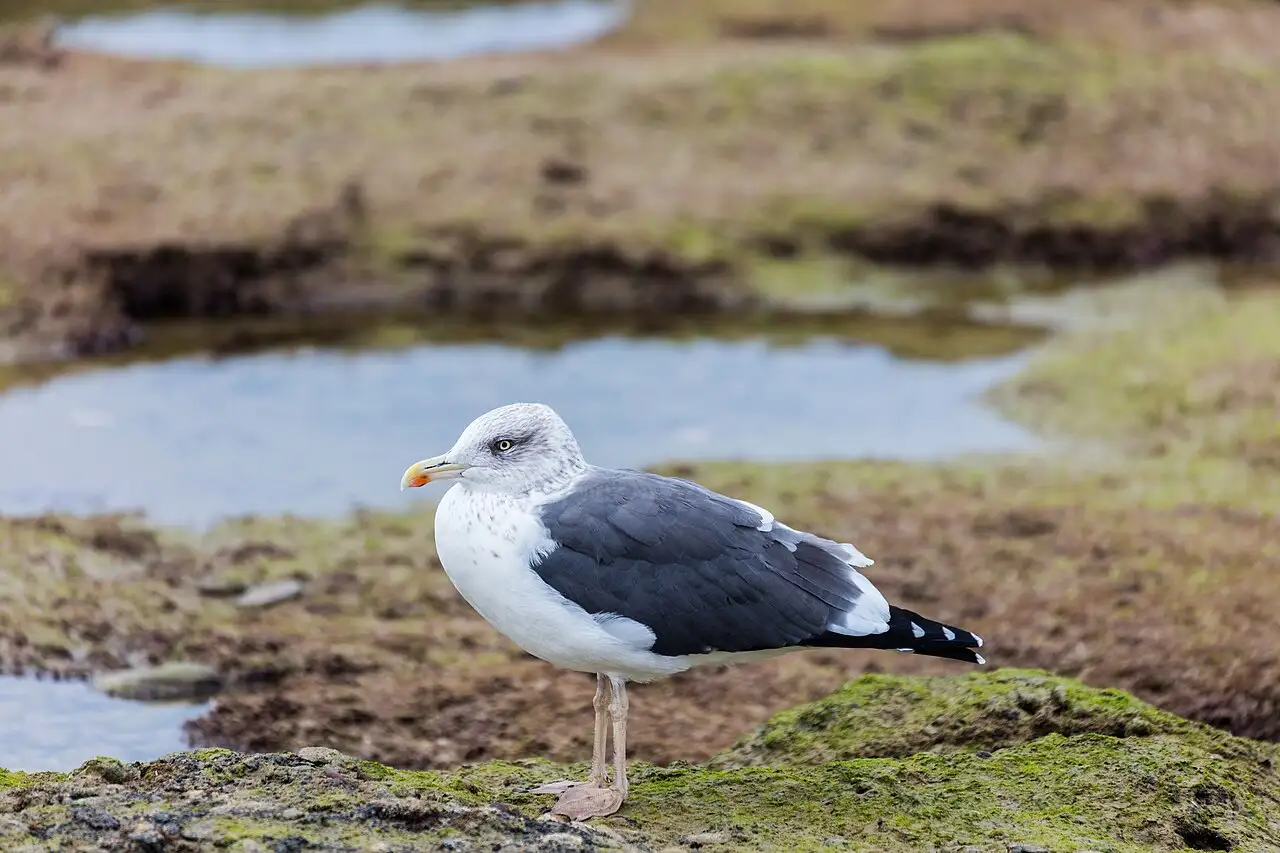
Adult Lesser Black-backed Gull in a rocky area of the Cádiz coast, with dark grey back and white streaked headPhoto: Diego Delso, CC BY-SA 4.0Photo 2 of 4
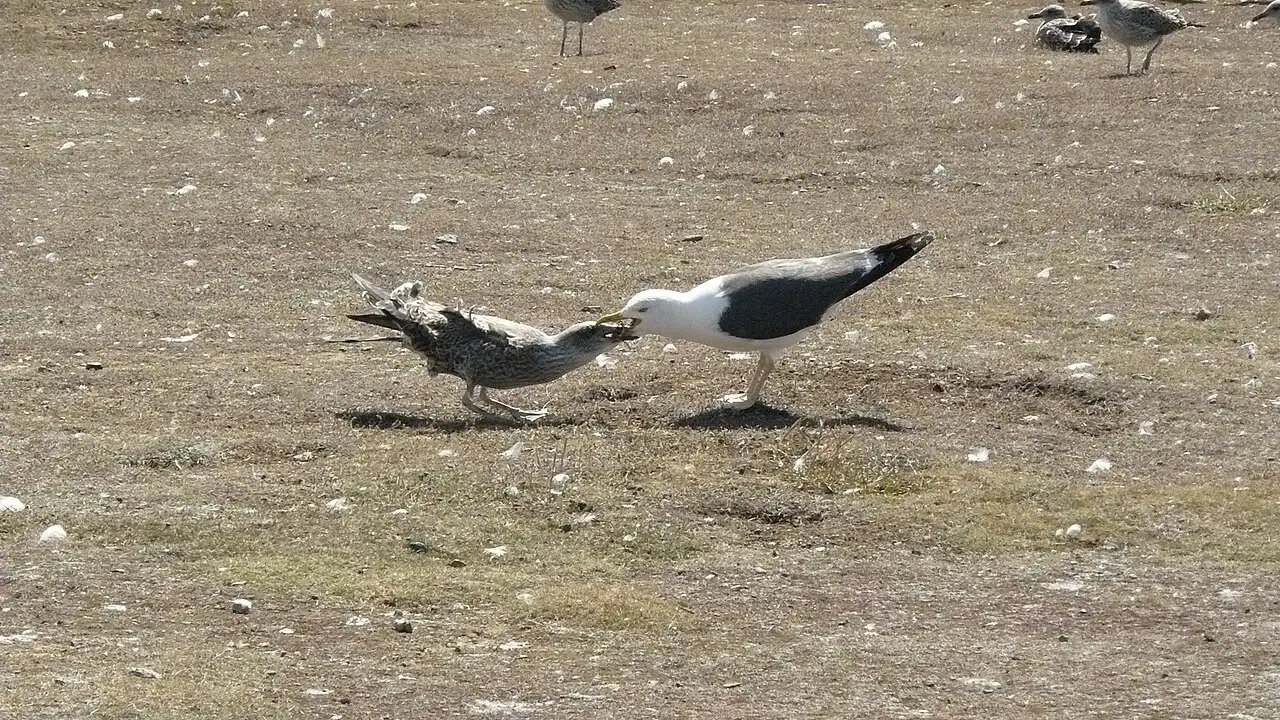
Adult Lesser Black-backed Gull facing a young bird of mottled brown plumage, in a meadowPhoto: Lyokoï, CC BY-SA 4.0Photo 3 of 4
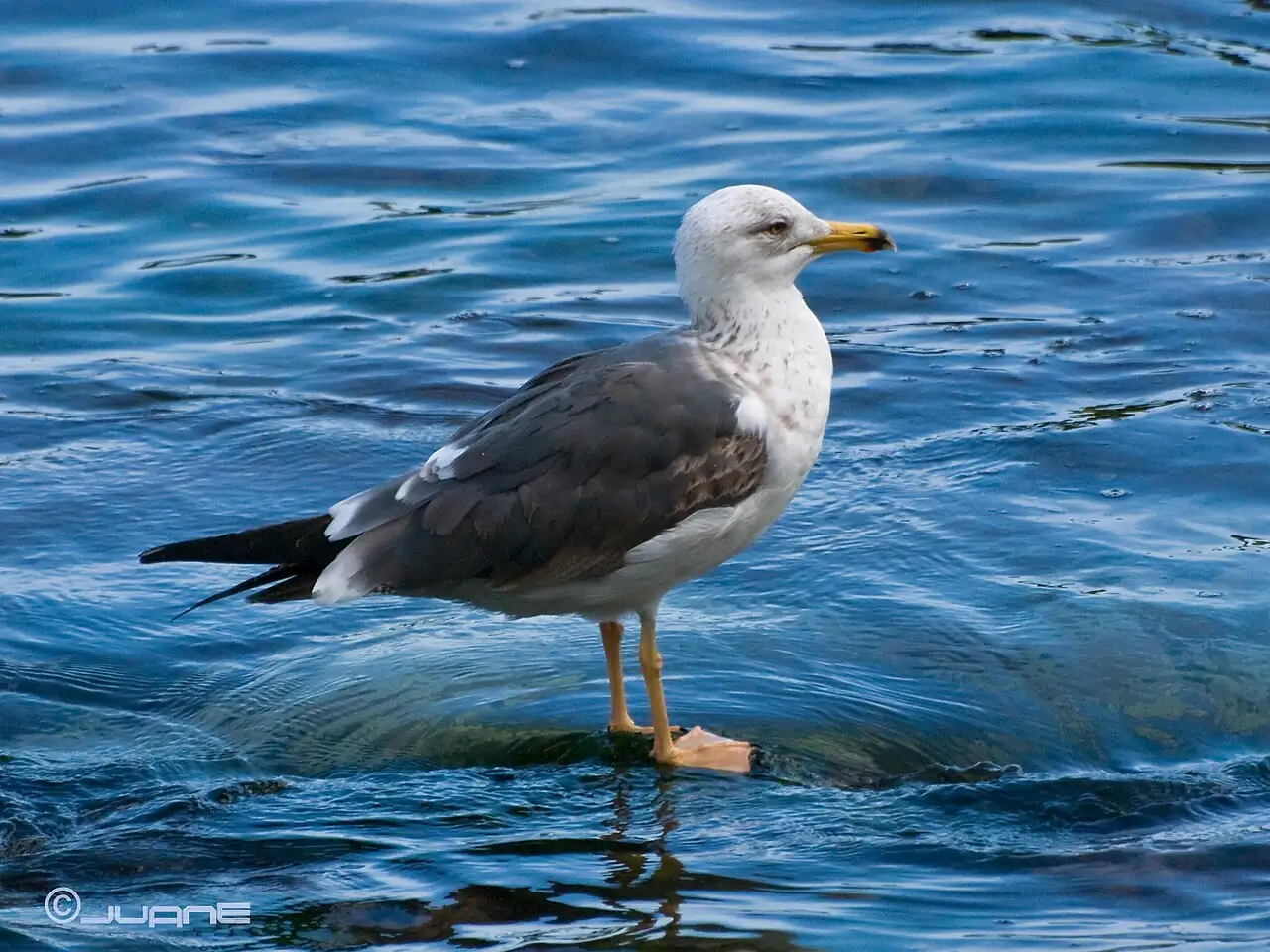
It is a large gull with a very dark back, to a greater or lesser degree depending on the subspecies. Females and males are identical in appearance, although the male is somewhat larger. The definitive plumage is completely white on the underparts and an intense grey on the upperparts, while the legs and bill are a vivid yellow, like the iris, which wears a red eye-ring.
Young birds have a dress dominated by brown tones and dirty white, with abundant spots and streaks; the bill is black and the legs pink. Immatures undergo three moults in successive summers, until they reach in their fourth year of life a plumage practically identical to the adult’s, with slight differences that disappear after the following year’s moult.
Adult
Back intense grey and underparts white.
Bill and legs yellow, iris yellow with red eye-ring.
Young bird
Brown tones and dirty white, with spots and streaks.
Black bill and pink legs.
Habitat and distribution of the Lesser Black-backed Gull
As a breeder it occupies coastal localities of the western and north-western Palearctic, where there are three subspecies: «fuscus», which nests in the Baltic, Norway and Russia; «intermedius», distributed across southern Scandinavia and Denmark; and «graellsii», found in Iceland, the Netherlands, Belgium, Great Britain, the Atlantic seaboard of France and the Iberian Peninsula.
In Spain it has recently colonised the territory as a breeder, and usually settles scattered or in small cores within gatherings of Yellow-legged Gulls, at different sites on the Cantabrian and Atlantic coasts and in the Ebro delta. During winter it is very common, both along the whole peninsular coast and on rivers and reservoirs of the inland south-west (wetlands of Madrid, La Mancha, Extremadura and the Guadalquivir vega), often associated with the presence of landfills, where it looks for food. Wintering birds belong both to the subspecies «intermedius» and to «graellsii»; those of «fuscus» are much rarer.
It nests in middle and high latitudes of the oceanic strip of the western Palearctic, generally on flat ground or on the less rugged part of banks and cliffs, as well as on beaches and moors near the coast; sometimes it builds its nests on the roofs of buildings. When looking for food it regularly searches beaches, ports, coastal waters, river mouths, landfills and wetlands.
Birds of the subspecies «fuscus» move towards the Black and Caspian seas, Turkey, the Persian Gulf, Arabia and parts of eastern and southern Africa. There is an exceptional recovery of a bird ringed in northern Finland, which was found on an island north of Australia, 10,000 kilometres from its ringing site.
Areas where it is regularly recorded since 2010Squares of about 25 km where it is recorded regularly (occasional passage records are left out). Data from GBIF.org (1,304,648 records, retrieved October 2026); outline from Natural Earth.
Etymology of the Lesser Black-backed Gull
In other languages it is called «gavià fosc» in Catalan, «gaivota escura» in Galician, «kaio iluna» in Basque and «lesser black-backed gull» in English1. Three subspecies are found on the Peninsula: «fuscus», «intermedius» and «graellsii».
Population of the Lesser Black-backed Gull
In the 2021 European Red List of Birds, the European breeding population is estimated at between 738,000 and 828,000 mature individuals, with an increasing trend. The Spanish breeding population has been put at some 195–210 pairs, some of them mixed with Yellow-legged Gulls. Since the species settled in Spain, in the 1970s, the population rose until the mid-1990s and, since then, the general trend has been downward: 480–500 pairs were counted in 2002 and 298 in 2006–2007.
This decline coincides with that of the Yellow-legged Gull, so both may be affected by the same circumstances: increasingly restricted access to landfills, the reduction in fishing discards, the «paralysis syndrome» (a pathology that causes high mortality in seabirds and of which thousands of cases have been detected in Spain and Portugal) and predation in colonies.
Nest of the Lesser Black-backed Gull
The nest is a mound built by both members of the pair from algae, grass and other plant materials, some 10–15 centimetres high, 25–35 centimetres in outer diameter and up to 8 centimetres deep.
Courtship and breeding of the Lesser Black-backed Gull
Like many other gulls, it is a fundamentally colonial bird; where it is not very abundant, as in Spain, it breeds in colonies of other large gulls. The females lay between one and four eggs, normally three, of olive-chestnut or pale greenish colour with brown markings, which both sexes incubate equally for 24–27 days. The chicks wander the surroundings of the nest soon after hatching and complete their development when about 40 days old.
Diet of the Lesser Black-backed Gull
It is an omnivorous species, which includes in its diet a great variety of vertebrates, invertebrates, plants and rubbish. It often parasitises other birds and raids the colonies of different seabirds, where it steals eggs and chicks; it also quite regularly eats all kinds of carrion, although its relatively reserved nature makes it less inclined to mix with human activities.
Curious facts about the Lesser Black-backed Gull
It has made versatility and adaptability its argument for overcoming the drawbacks of a world much modified by people. A bird ringed in northern Finland was found on an island north of Australia, 10,000 kilometres from its ringing site. The longest-lived ringed bird, caught in Great Britain and Ireland, reached 34 years and 10 months.
The Lesser Black-backed Gull in Cabañeros
The habitat pages of this website do not mention it. GBIF.org records 497 observations of the Lesser Black-backed Gull in Cabañeros and its surroundings; in winter it is very common on rivers and reservoirs of the inland south-west, with La Mancha and Extremadura among them1.
Where to see the Lesser Black-backed Gull in Cabañeros
On the reservoirs and bodies of water around Cabañeros, in winter.
When
From autumn to spring: it is a winter visitor, although there are records of presence in every month.
What time
In good light, beside the water and at landfills.
Where
On rivers, reservoirs, wetlands and landfills inland, as well as on the coast.
What to look for
Look for the gull with a very dark back, with yellow bill and legs and red eye-ring.



 Same family
 Same family
 Same family
 Same family
 Same order
 Same order
 Same order
 Same order






