Wingspan compared with a person with arms outstretched.
Length
23–29 cm
Wingspan
64–70 cm
Weight
80–95 g
Social life
It forms colonies that can hold hundreds of pairs, and often shares the site with other species, such as the Black-necked Grebe
Lifespan
Record of 17 years and 10 months in the wild according to EURING (a bird ringed in Hungary); AnAge gives 16 years
Conservation status
LC
NT
VU
EN
CR
EW
EX
Global (IUCN)
Least Concern
Spain
Data Deficient (DD) in the 2021 Red Book of the Birds of Spain; on the List of Wild Species under Special Protection, but not in the Spanish Catalogue of Threatened Species
When to see it
Summer visitor
Months of the year when it is present
J
F
M
A
M
J
J
A
S
O
N
D
In Iberia
no
no
yes
yes
yes
yes
yes
yes
yes
yes
no
no
Breeding season
no
no
no
no
yes
yes
yes
yes
no
no
no
no
Song or voice of the Whiskered Tern
In flight it calls with a dry, harsh «cherk». The recording, of barely twelve seconds, is from India, and is the only freely licensed one we have found; we have filtered and normalised it.
Its silhouette is that of the genus, but its bill is more robust and its flight less agile than that of other marsh terns. It hunts low, with short glides and hovers.
Flight typeLow over the water, with short glides and hovers
It is seen on natural lagoons, marshes and shallow wetlands of clean, fresh or brackish water; in favourable years, hundreds feed over the water.
It catches its prey mainly at the water surface, flying low with short glides and hovers, and often catches insects on the wing, over crops, grasslands and bodies of water.
In flight it calls with a dry, harsh «cherk»; its flight is less agile and its bill more robust than those of other marsh terns.
Photo gallery of the Whiskered Tern
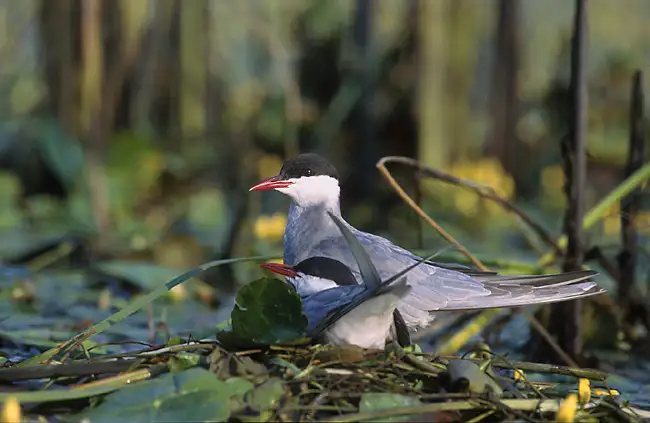
Pair of Whiskered Terns in breeding plumage on a floating nest of aquatic vegetation, with black cap, white cheeks and red billPhoto: Marek Szczepanek, CC BY-SA 3.0Photo 1 of 4
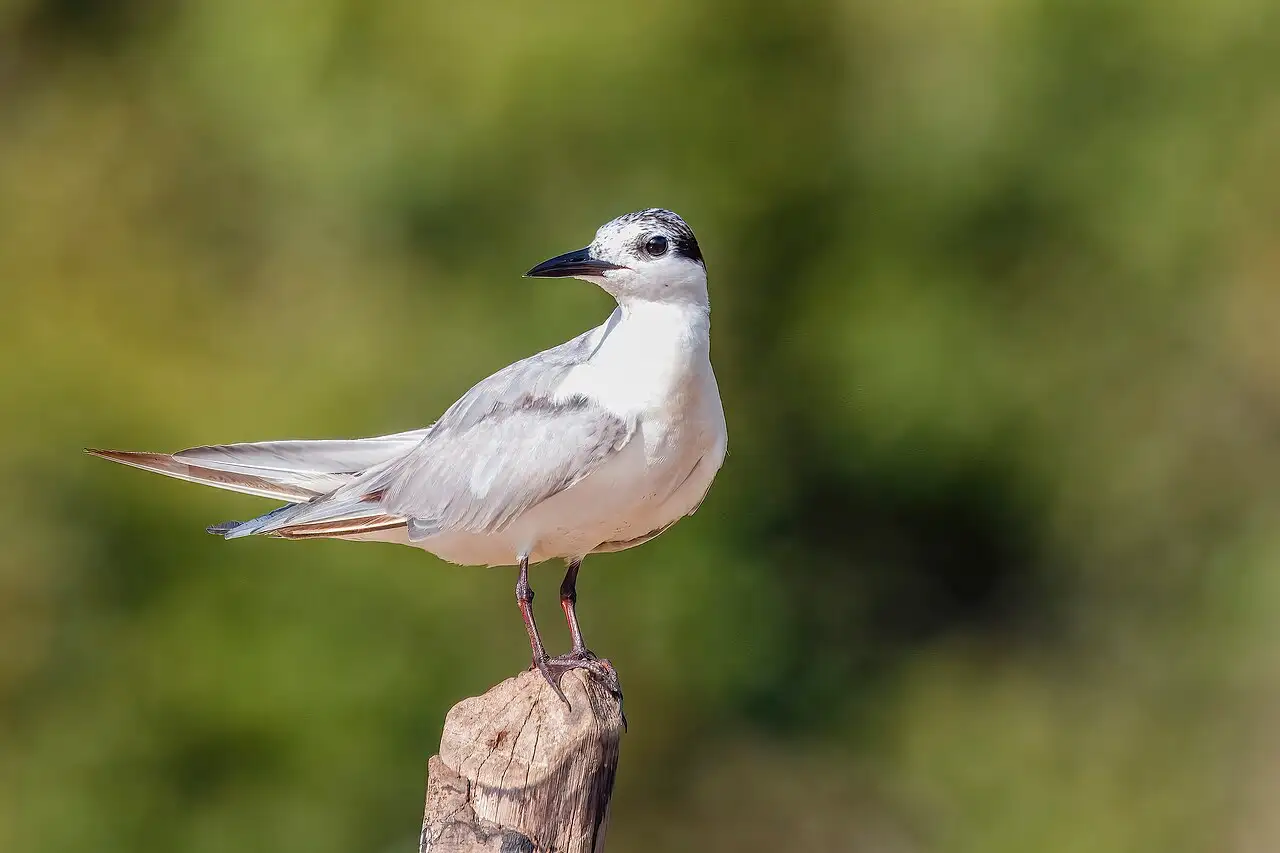
Whiskered Tern in winter plumage perched on a wooden post, pale grey in appearance, with white forehead and black billPhoto: Charles J. Sharp, CC BY-SA 4.0Photo 2 of 4
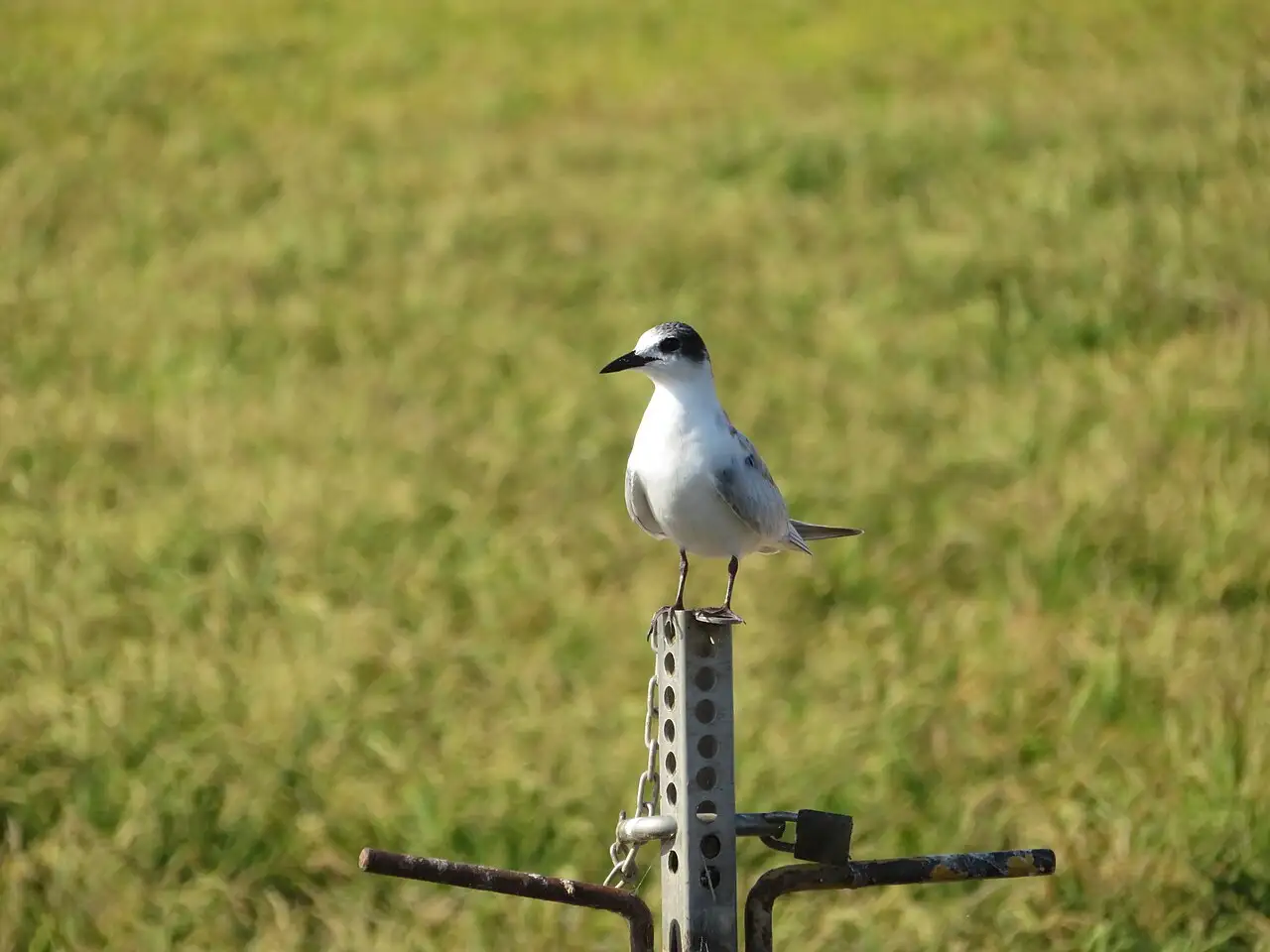
Whiskered Tern perched on top of a metal post in the Ebro delta, with white underparts and dark capPhoto: Juan Emilio Prades Bel, CC BY 4.0Photo 3 of 4
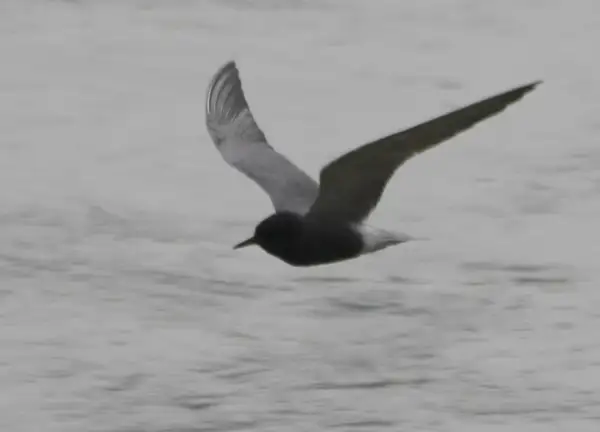
Whiskered Tern in flight over the edge of a wetland, with its wings openPhoto: Ivan Medenica, CC BY-SA 4.0Photo 4 of 4
1 / 4
Identification of the Whiskered Tern
The Whiskered Tern, slightly larger than the Black and White-winged Terns, has the silhouette and characteristics of this genus, although its bill is more robust and its flight less agile. The adult in summer plumage has the body, except the undertail coverts, and the upperparts, including the rump and tail, in an ash-grey tone. The bill and legs are dark red, and the black cap extends to the back; the white face is very conspicuous. In winter it shows a pale grey overall look, with white underparts and forehead and the rest of the cap streaked with white. The plumages during moult are not as striking as in the other marsh terns.
Adult in summer plumage
Body and upperparts ash grey.
Black cap and very conspicuous white face.
Dark red bill and legs.
Adult in winter
Pale grey overall look, with white underparts and forehead.
Rest of the cap streaked with white.
Juvenile
Like the Black Tern’s, but with white rump, pale wings and a back scaled with dark and a cinnamon tinge.
Like the White-winged Tern’s, it lacks the dark patch on both sides of the breast.
Habitat and distribution of the Whiskered Tern
It is widely distributed, but in a fragmentary way, across the whole of Europe (Spain and occasionally Portugal, western France, north-east Italy, Poland, the Balkans, Ukraine, southern Russia and Kazakhstan), eastern and southern Africa, southern Asia and Australia. Six subspecies are recognised, and in Spain «hybrida» appears.
In Spain it extends across the favourable wetlands of the southern half and the Mediterranean coast, where its main breeding sites are: the Guadalquivir marshes, the wetlands of Alicante, the Albufera of Valencia and the Ebro delta. There are also breeding records at numerous new localities in Cádiz, Córdoba, Málaga, Granada, Albacete, Ciudad Real and Valencia. It does not breed in the Balearics or the Canaries. On spring passage it can be seen in practically any part of Spain, even, exceptionally, in the Canaries.
It breeds on inland lakes with good vegetation cover on the shores, as well as on marshes and rivers, normally in lowlands. In Spain it frequents natural lagoons, sometimes artificial ones, marshes and shallow wetlands of clean, fresh or brackish water, and in every case needs low emergent vegetation on which to support the nest.
It is typically migratory. Most of the western European population winters in western tropical Africa, and the eastern European one reaches Iran, Pakistan and eastern Africa. In Spain it passes mainly through the interior, where it is only detected in wetlands, and is hardly seen on the coasts. Its abundance varies greatly each year. The spring passage, much more noticeable, takes place between March and May, and the autumn one from late July to late October.
Areas where it is regularly recorded since 2010Squares of about 25 km where it is recorded regularly (occasional passage records are left out). Data from GBIF.org (43,202 records, retrieved October 2026); outline from Natural Earth.
Etymology of the Whiskered Tern
According to Wikipedia, the genus «Chlidonias» comes from ancient Greek «khelidónios», «swallow-like», from «khelidón», «swallow». The epithet «hybridus» is Latin and means «hybrid»: Peter Simon Pallas thought it might be a hybrid of the White-winged Tern and the Common Tern, and wrote it that way. In other languages it is called «fumarell carablanc» in Catalan, «gaivina de cara branca» in Galician, «itsas enara musuzuria» in Basque and «whiskered tern» in English1.
Population of the Whiskered Tern
According to the 2021 European Red List of Birds, the European population is estimated at between 117,000 and 294,000 mature individuals, with an increasing trend. In Spain the last two censuses, from 1998–2002 and 2014–2018, gathered in the III Atlas of Breeding Birds in Spain, show a 51 % increase in range. The current size of the breeding population and its evolution are not known exactly; according to the last census, from 2007, it was estimated at between 6,406 and 6,426 pairs.
It is very sensitive to variations in water level and to the loss or alteration of its habitats, and its populations can vary greatly depending on the resources or habitats available for nesting. One of the main threats is the conversion of wetlands into crops, and predation is another danger, above all when the water level drops.
Nest of the Whiskered Tern
The nest, made of plant remains, is built on a floating platform of aquatic vegetation anchored to the bottom. Both members of the pair contribute to building it.
Courtship and breeding of the Whiskered Tern
The breeding period in Europe runs from May to August. The clutch is three to five eggs, which both members of the pair incubate for 18–20 days. The chicks are precocious: they leave the nest from the fourth day after hatching and fly at 21–23 days of age.
Diet of the Whiskered Tern
Its diet is very varied: from insects and aquatic and terrestrial invertebrates and their larvae to tadpoles, crabs and small fish. It generally hunts over bodies of water, although it can also do so on dry ground, and catches prey mainly at the water surface, flying low with short glides and hovers. It often catches insects on the wing, both over crops and grasslands and over bodies of water.
Curious facts about the Whiskered Tern
Its appearance is very much conditioned by the water level of the wetlands: as it builds floating nests, it needs an acceptable water depth, and in favourable years it is a spectacle to see hundreds of marsh terns feeding over the water1. In winter plumage or during moult it can go unnoticed among other marsh terns and terns.
The Whiskered Tern in Cabañeros
The habitat pages of this website do not mention it, but Ciudad Real is among the provinces with recent breeding records at new localities1. We have not found any other published source on it in the Park. GBIF.org records 16 observations of the Whiskered Tern in Cabañeros and its surroundings.
Where to see the Whiskered Tern in Cabañeros
In Cabañeros and its surroundings, from March to October, in lagoons and shallow wetlands with emergent vegetation.
When
From March to October: it is a summer visitor, with a very noticeable spring passage between March and May, and breeds from May to August.
What time
By day, hunting over the water surface.
Where
In natural lagoons, marshes and shallow wetlands of clean water, with emergent vegetation for the nest.
What to look for
Look for the white cheeks of the breeding plumage and listen for its harsh «cherk»; in winter it is much more discreet.
It is similar in voice and physical appearance1. The Whiskered Tern is slightly larger, and its juvenile resembles the Black Tern’s but with a white rump1.
Photo: sébastien bertru, CC BY-SA 2.0
White-winged Tern
Chlidonias leucopterus
How to tell them apart
It is similar in voice and physical appearance1. The Whiskered Tern is slightly larger1.
Photo: Frank Vassen, CC BY 2.0
Other birds
Birds related to the Whiskered Tern or sharing its habitats in Cabañeros.




 Same family
 Same family
 Same family
 Same family
 Same order
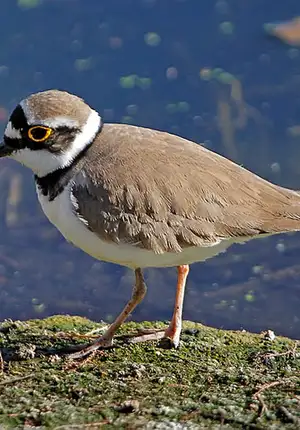 Same order
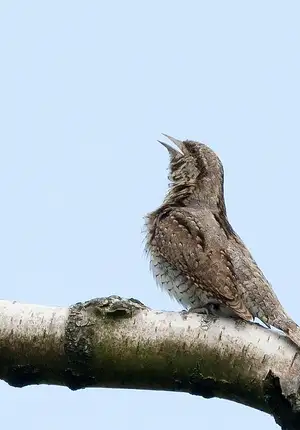 Same season in the park
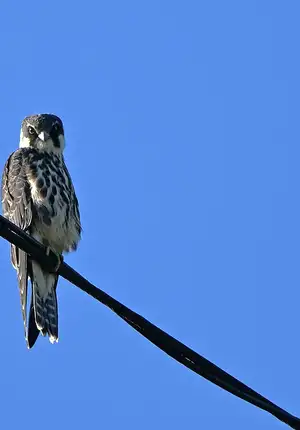 Same season in the park






