Non-native. It is native to Australia and Tasmania. Those seen in Europe, also in Spain, come from releases or escapes from bird collections, and in our country it has only bred occasionally. This page deals with the species, which is seen in the area, and does not present it as a native wild bird.
Order
Anseriformes
Family
Anatidae
Species
Cygnus atratus
Wingspan compared with a person with arms outstretched.
Length
110–140 cm
Wingspan
1.6–2 m
Weight
3.7–9 kg
Social life
It forms colonies with nests very close together; it forms pairs that, according to Wikipedia, usually last a lifetime
Lifespan
Record of 24.7 years in the wild according to AnAge; EURING does not list the species
Conservation status
LC
NT
VU
EN
CR
EW
EX
Global (IUCN)
Least Concern
Spain
Not in the Red Book of the Birds of Spain or the List of Wild Species under Special Protection
When to see it
Resident
Months of the year when it is present
J
F
M
A
M
J
J
A
S
O
N
D
In Iberia
yes
yes
yes
yes
yes
yes
yes
yes
yes
yes
yes
yes
Song or voice of the Black Swan
It gives soft, musical, high vocalisations, both in flight and on the water, and loud whistling sounds and shrieks in defence of the nest, the chicks or in an alarm1. The recording (call and song) is by Stanislas Wroza and was made in Doñana, in Seville (xeno-canto XC417673, quality A). It lasts 9 seconds and is a trimmed section of a 15 s clip, without repeating or lengthening, from which we have removed the bass below 200 Hz, reduced the background noise and adjusted the volume; neither pitch nor speed has been changed.
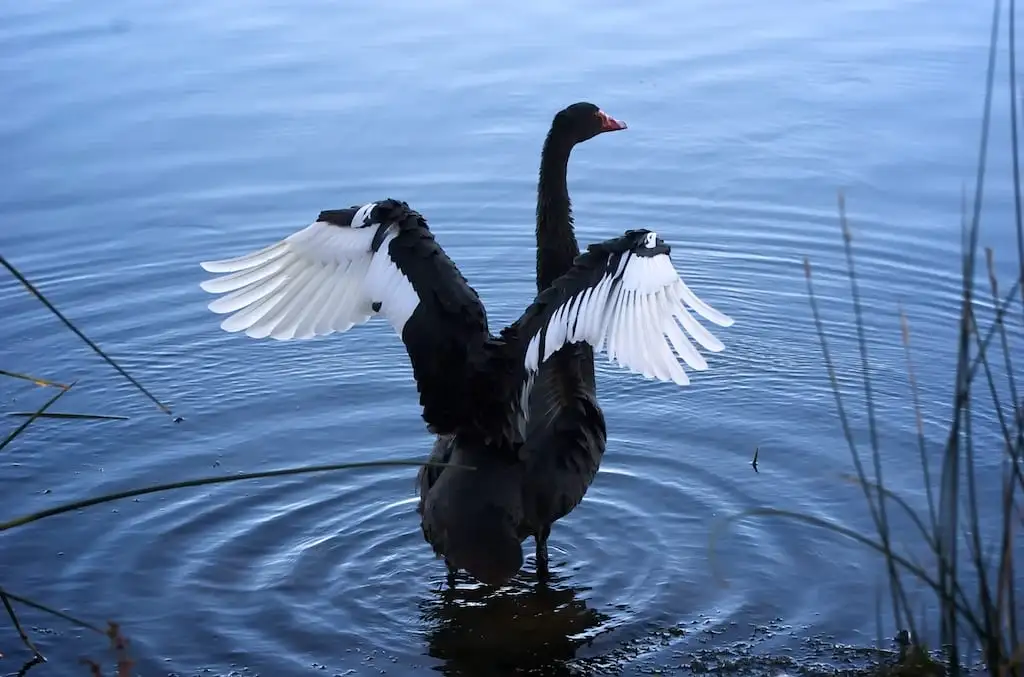
In flight the alulae, the outer primaries and the secondaries, white, can be seen, which are barely visible when perched. According to Wikipedia, in flight it forms wedges or lines, with the long neck stretched out. In Australia it is essentially resident, with short movements in search of suitable habitats1. The tiny resident population in Spain increases between November and March, which suggests that many birds come from the feral populations of northern countries1.
Flight typeIn wedge or line flocks, with the long neck stretched out and the flight feathers white
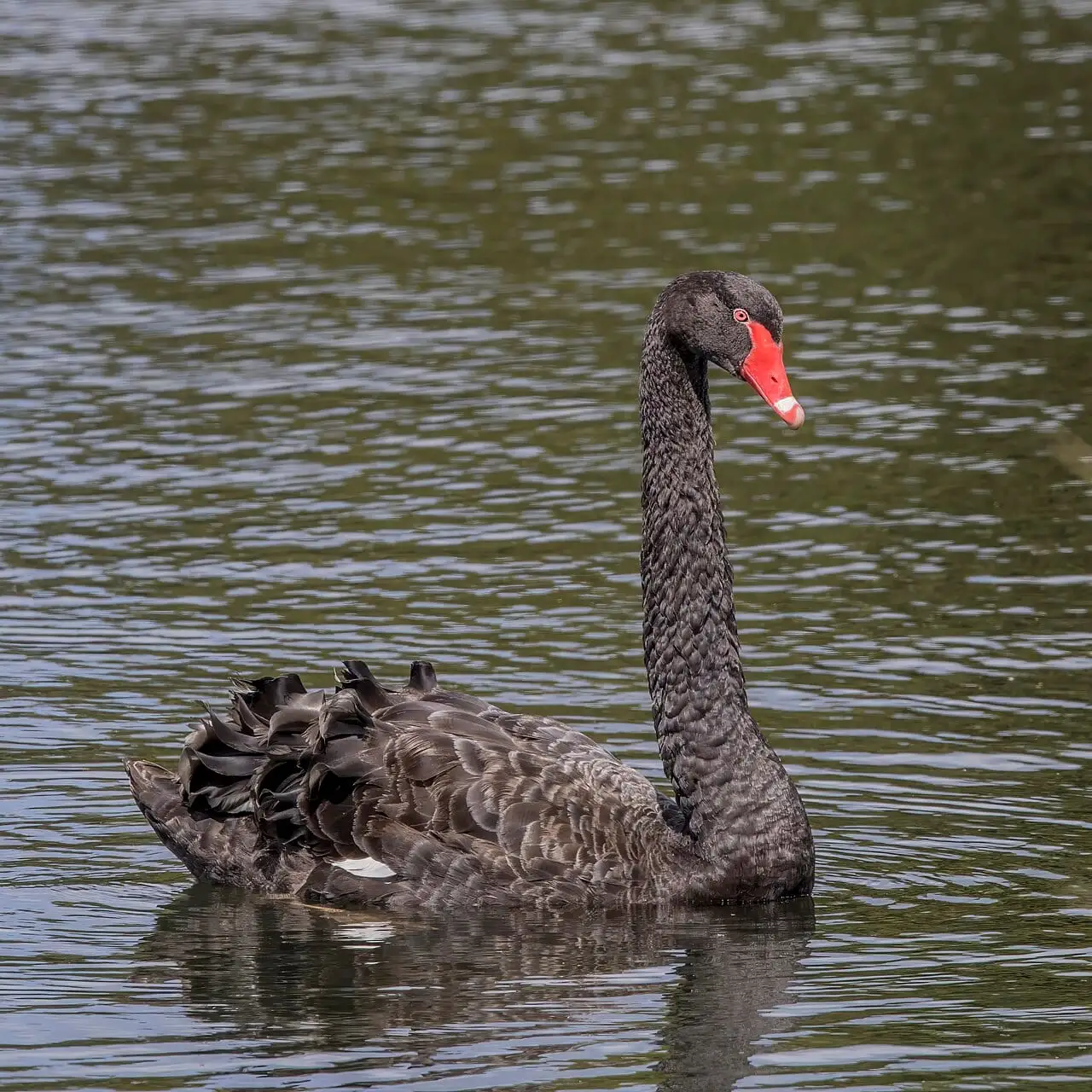
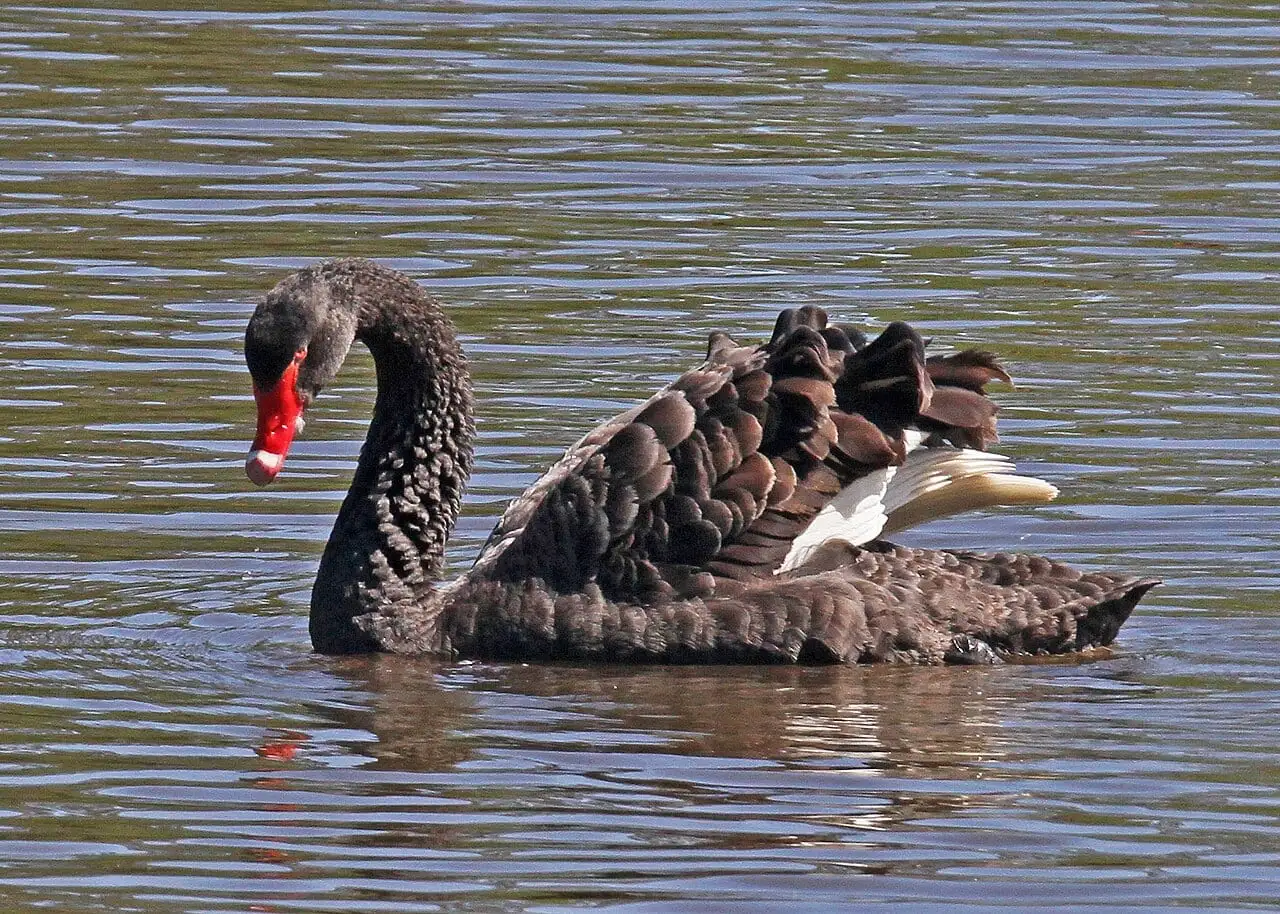
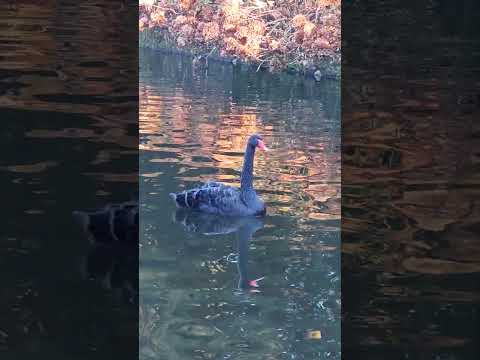
It is told from other swans by its black plumage and red bill, with a white band at the tip.
The alulae, the outer primaries and the secondaries are white, but are generally only seen in flight.
It gives soft, musical, high calls, both in flight and on the water.
Photo gallery of the Black Swan
Black Swan swimming with arched neck, curly black plumage on the wings and red bill with a white tipPhoto: Charles J. Sharp, CC BY-SA 4.0Photo 1 of 4
Black Swan with wings open on the water, showing the white flight feathers under the black plumagePhoto: Helenabella, CC BY-SA 3.0Photo 2 of 4
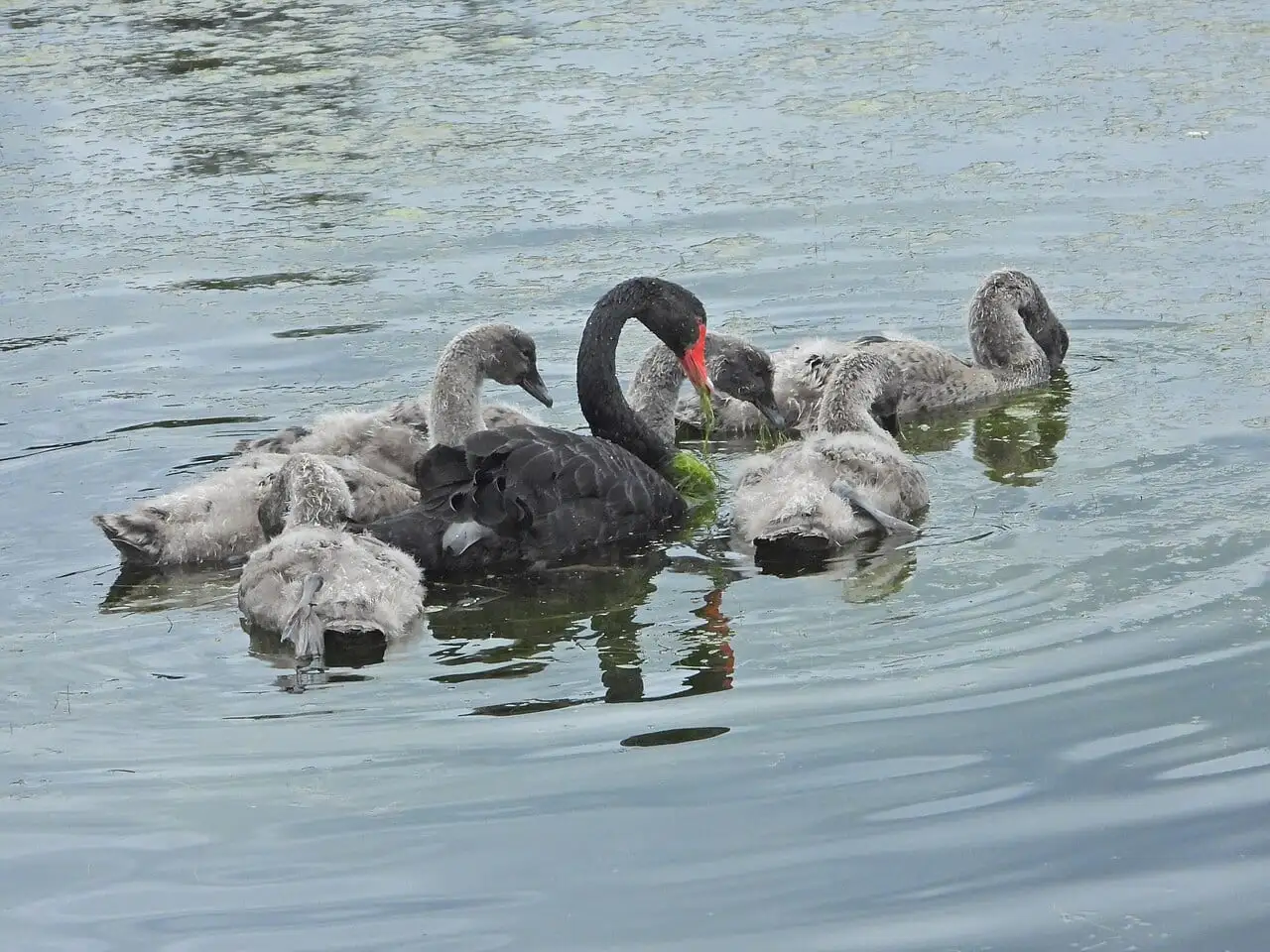
Adult Black Swan swimming with five grey-plumaged chicksPhoto: Gloria Sarker, CC BY-SA 4.0Photo 3 of 4
Black Swan in profile with dark plumage and red bill, swimming in greenish waterPhoto: Joseph C Boone, CC BY-SA 4.0Photo 4 of 4
1 / 4
Identification of the Black Swan
The Black Swan is an easily identifiable species compared with other swans thanks to the black colour of its plumage and the red of its bill. The alulae, outer primaries and secondaries are white, although this is generally seen only in flight. At the tip of the bill it has a white band, hard to see at a distance, and the iris is reddish or pinkish. Females are on average smaller than males and have both bill and iris in less striking tones. Young birds are generally brownish grey, and the bill is paler than in adults.
Habitat and distribution of the Black Swan
It is native to Australia and Tasmania, and has formed small, slowly increasing populations from birds released or escaped from collections. In Europe it is concentrated mainly in the Netherlands, but also in the United Kingdom, France, Belgium and Germany. In its natural range it prefers large freshwater lakes and saline lagoons with relatively calm water, with tall vegetation that lets it build its nest.
In Spain the number of observations is still scarce, although they already occur every year, with an increase from 19 records in 1986–1999 to 32 in 2000–2010 and 59 in 2011–20181. It appears mainly in the north and east of the Peninsula, and birds have also been recorded on Mallorca, Tenerife and Gran Canaria. It has bred only occasionally: certainly at Deba (Gipuzkoa) and probably in Madrid and A Coruña.
Areas where it is regularly recorded since 2010Squares of about 25 km where it is recorded regularly (occasional passage records are left out). Data from GBIF.org (2,882 records, retrieved October 2026); outline from Natural Earth.
Etymology of the Black Swan
According to Wikipedia, the English naturalist John Latham described it in 1790 under the name «Anas atrata». In other languages it is called «cigne negre» in Catalan, «cisne negro» in Galician, «beltxarga beltza» in Basque and «black swan» in English1. We have not found a source explaining the origin of the Spanish or scientific name, so we do not venture one.
Population of the Black Swan
The 2021 European Red List of Birds does not give population data for the species in Europe. The Third Atlas of Breeding Birds in Spain gives an estimate of 200–260 pairs in 2015–2018 for the whole of Europe. There are no estimates of numbers in Spain, although the records suggest that the figure is rather small and quite fluctuating.
No threats to the species are seen, but, given its foreign origin, its development and how it might affect native species must be monitored, although at present the number of birds is small1.
Nest of the Black Swan
It forms colonies, with the nests, which can reach a metre across, very close together. The platform is built on the ground or on aquatic vegetation.
Courtship and breeding of the Black Swan
It has no defined breeding season: it breeds when environmental conditions are favourable, and usually makes the period coincide with the highest water levels. The clutch, generally of 5 or 6 eggs (less often up to 14), is incubated by both parents for 35–48 days, and the chicks fly after about 5–6 months. All this holds for the species in its native range1.
Diet of the Black Swan
It feeds mainly on algae, leaves and shoots submerged up to a metre deep.
Curious facts about the Black Swan
According to Wikipedia, like other swans it is largely monogamous and forms pairs for life, with a divorce rate of 6 %. It was very popular in waterfowl collections around the world from its discovery, in the 17th century1. From there come the escapes and releases that have formed small feral populations1. AnAge gives 24.7 years of longevity in the wild and 5,650 g adult weight; Wikipedia, 3.7 to 9 kg.
The Black Swan in Cabañeros
The habitat pages of this website do not mention it, and we have not found any other published source on it in the Park; nor does it appear in the bird list of the «Visitor guide to Cabañeros National Park» (OAPN). GBIF.org records 3 observations of the Black Swan in Cabañeros and its surroundings, which fits a bird that appears occasionally through escapes. None of those observations falls within the Park boundary (according to OpenStreetMap): all are from the surroundings.
Where to see the Black Swan in Cabañeros
In Cabañeros and its surroundings, only occasionally, on reservoirs and lagoons.
When
It appears all year in Spain, with more birds between November and March.
What time
By day, swimming and feeding in calm water.
Where
On lakes, lagoons and reservoirs of calm water with tall vegetation.
What to look for
Look for the black plumage and red bill; the white flight feathers are only seen when it opens its wings.
Videos of the Black Swan
Similar species
Mute Swan
Cygnus olor
How to tell them apart
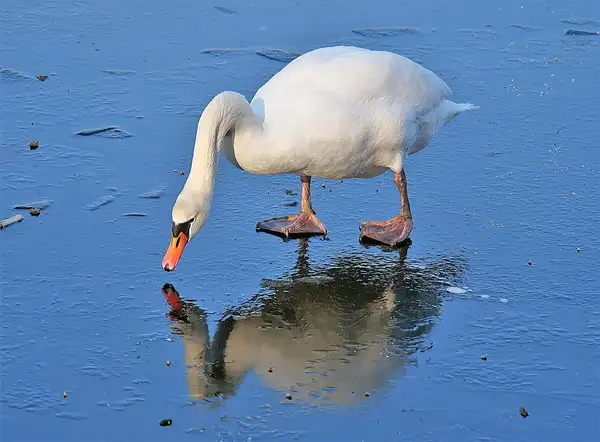
It is another swan, with white plumage. The Black Swan is easily identified compared with the other swans by the black colour of its plumage and the red of its bill1.
Photo: Rolf Dietrich Brecher from Germany, CC BY-SA 2.0
Other birds
Birds related to the Black Swan or sharing its habitats in Cabañeros.



 Same family
 Same family
 Same family
 Same family
 Same season in the park
 Same season in the park
 Same season in the park
 Same season in the park






