It is the only resident species among the shrikes in Spain; in some areas male and female stay together in the breeding territory
Lifespan
About 7 and a half years maximum age in the wild (oiseaux.net)
Conservation status
LC
NT
VU
EN
CR
EW
EX
Global (IUCN)
Least Concern
Spain
Endangered (EN) in the 2021 Red Book of the Birds of Spain; included in the List of Wild Species under Special Protection, but not in the Spanish Catalogue of Threatened Species
When to see it
Resident
Months of the year when it is present
J
F
M
A
M
J
J
A
S
O
N
D
In Iberia
yes
yes
yes
yes
yes
yes
yes
yes
yes
yes
yes
yes
Song or voice of the Iberian Grey Shrike
It gives very varied notes, metallic, ringing and quite powerful. It also reproduces trills and warbles of finches and larks, and can imitate the song of other small birds to attract and hunt them. The recording (song) is by Gonzalo Peña Sánchez and was made at Arrocampo (hide 1), Extremadura (xeno-canto XC975928, quality A). It lasts 9 seconds and is a trimmed section of the original, without repeating or lengthening, from which we have removed the bass below 300 Hz, reduced the background noise and adjusted the volume; neither pitch nor speed has been changed.
It is usually seen perched on wires, posts or the tops of bushes, scanning for prey. It is resident and frequent in open environments across the whole of Mediterranean Spain.
Flight typeLow, from a dominant perch to the prey
It hunts by ambush, scanning from a commanding perch: a pole, a wire beside a road or the high branch of a shrub. From there it launches itself at insects, mice, voles, small birds or reptiles.
It flies low, with the long tail behind; the white patch on the black wings and the whitish edges of the tail can be seen.
It often makes larders, impaling its prey on the sharp branches of hawthorns and blackthorns or on barbed-wire fences, where it also tears them apart.
Photo gallery of the Iberian Grey Shrike
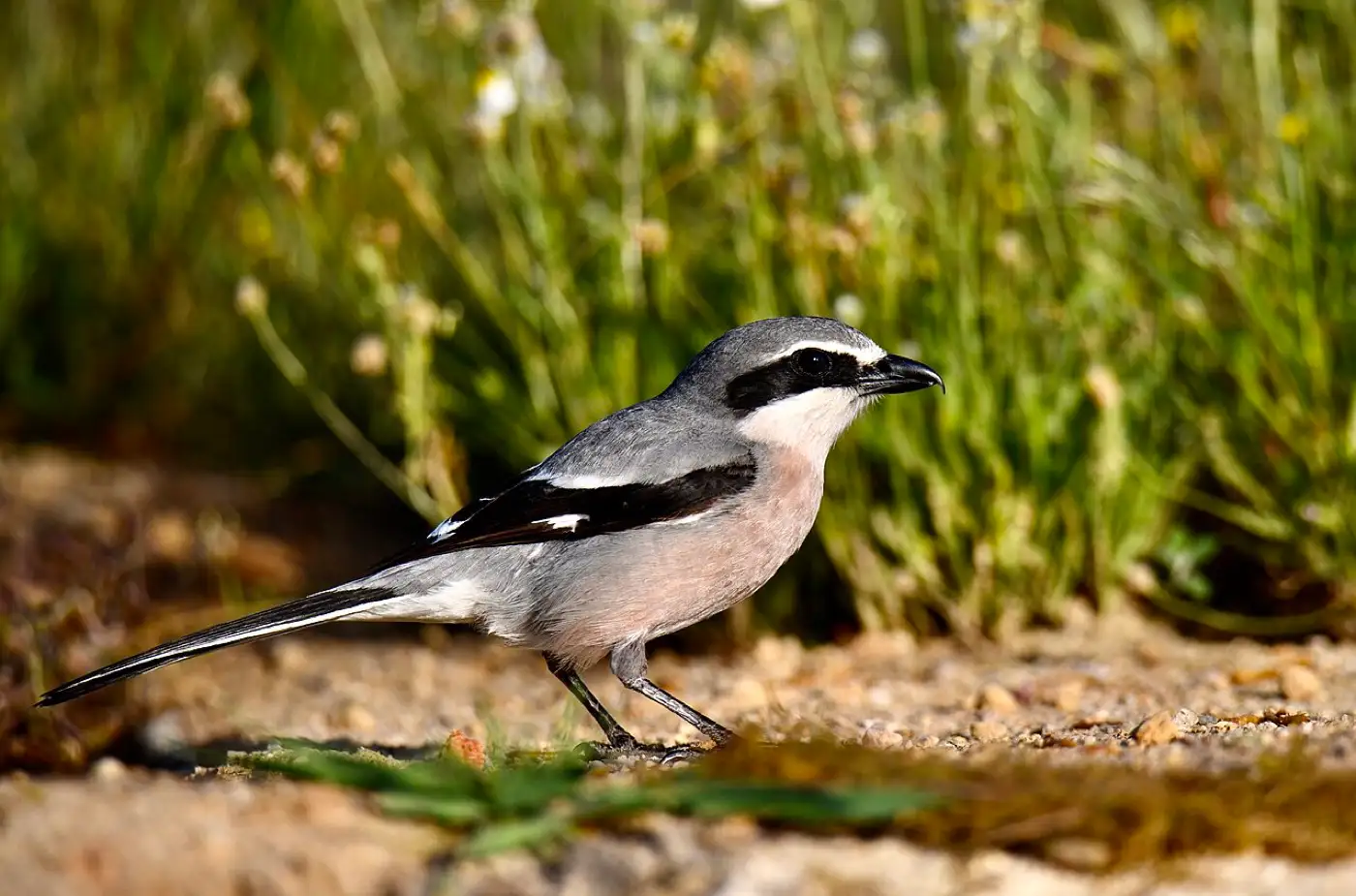
Iberian Grey Shrike on the ground among grasses, with black eye-mask, grey back, black wings with the white patch and long tailPhoto: Luiz Lapa from Oeiras, Portugal, CC BY 2.0Photo 1 of 4
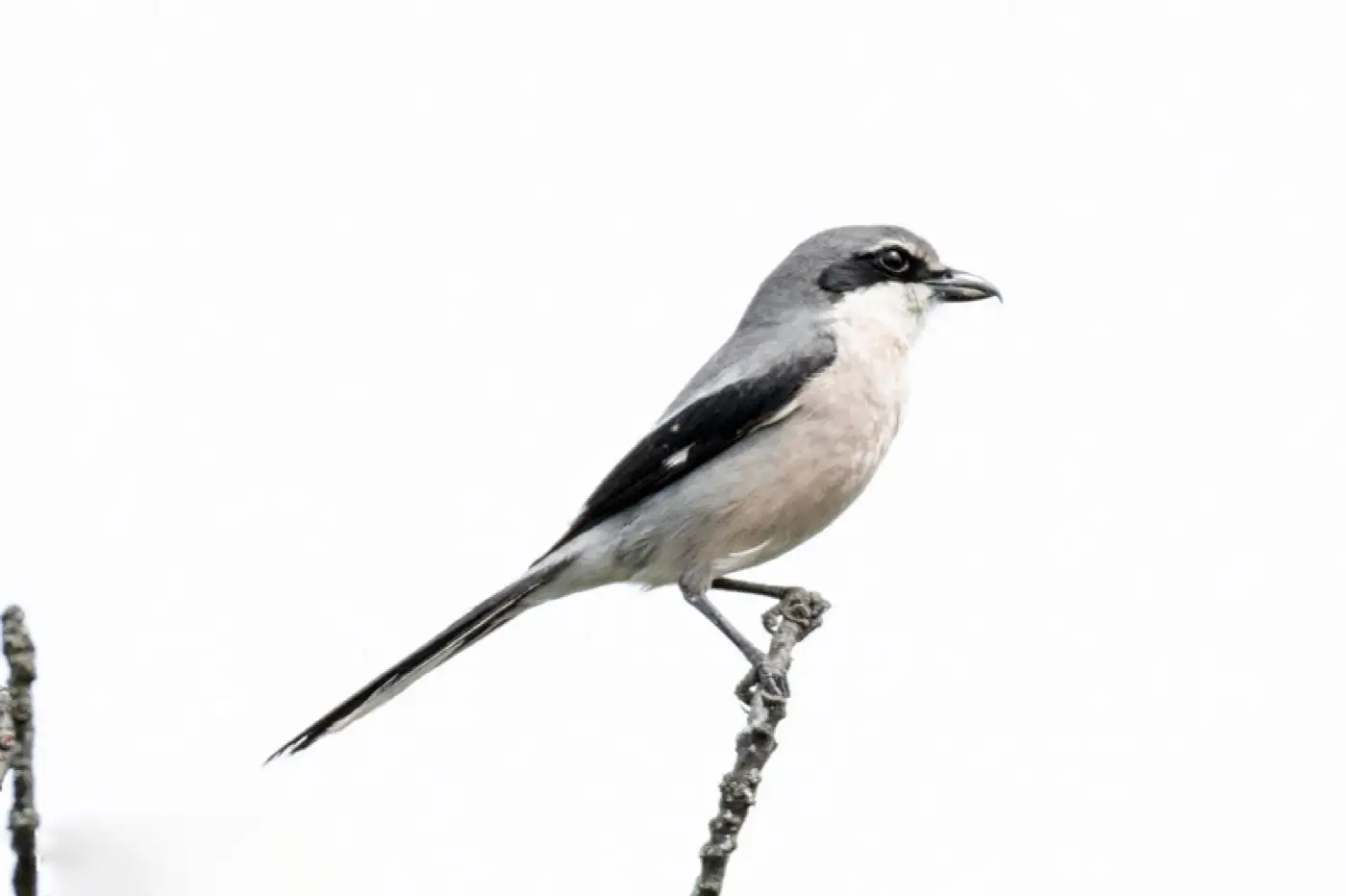
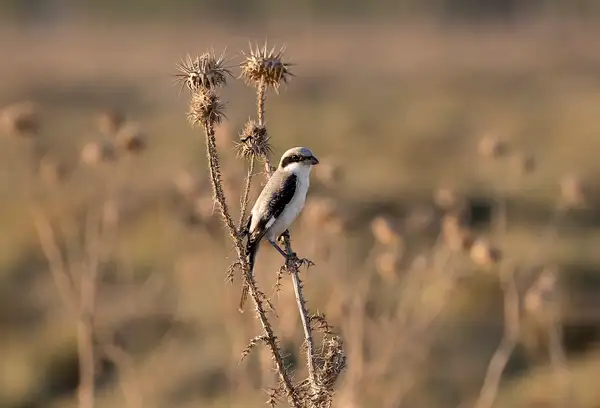
Iberian Grey Shrike perched at the top of a dry branch, with black eye-mask, pinkish-white breast and long tailPhoto: yves hoebeke, CC BY-SA 2.0Photo 3 of 4
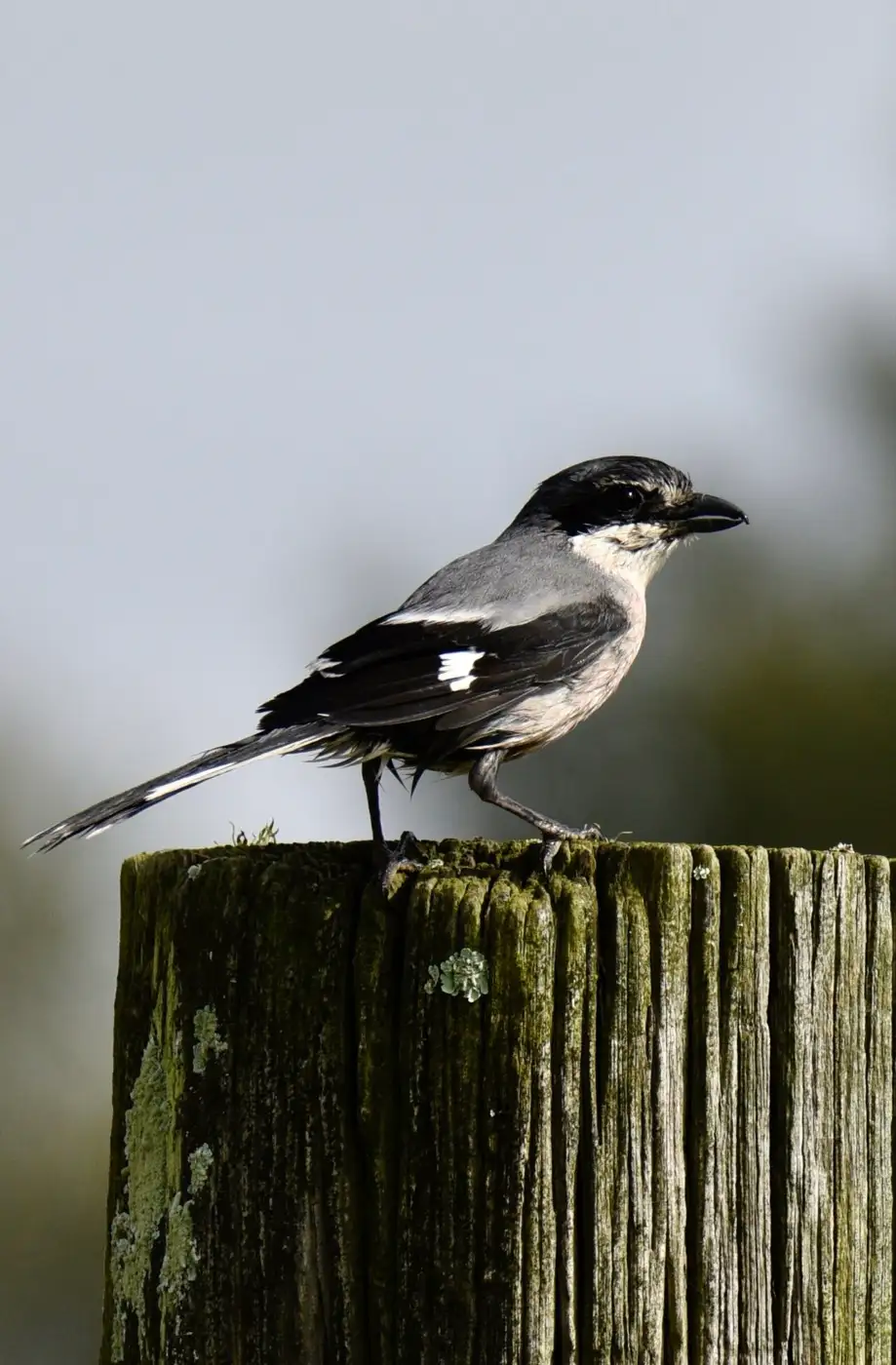
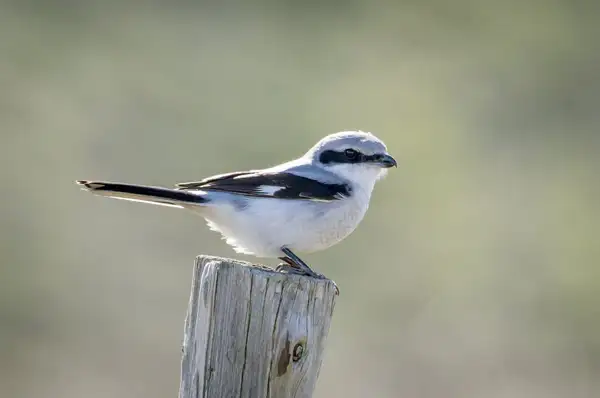
Iberian Grey Shrike perched on a wooden post, in profile, with black eye-mask and the white patches of the wingsPhoto: Luiz Lapa from Oeiras, Portugal, CC BY 2.0Photo 4 of 4
1 / 4
Identification of the Iberian Grey Shrike
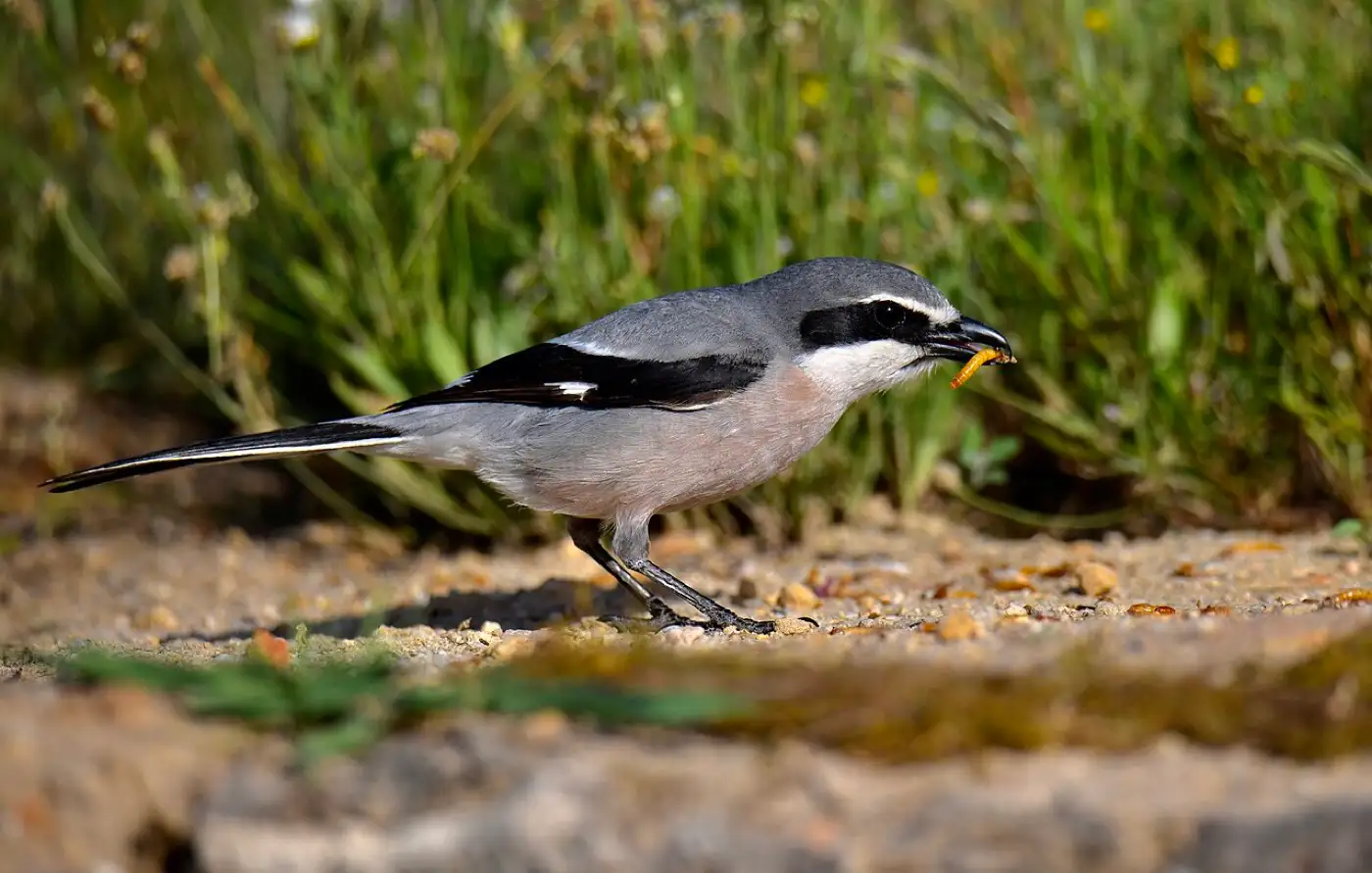
The Iberian Grey Shrike is very easy to recognise. At first glance its stockiness and long tail stand out, with a robust bill with a hooked tip and a very bulky head, on which a broad black eye-mask draws the eye. The back and head are leaden grey. The wings are black, with a distinctive white patch; the tail, also black, has whitish outer edges; and the breast and belly are pinkish white.
It is very similar to the Lesser Grey and Great Grey Shrikes. Adult Iberian Grey Shrikes are larger than the Lesser Grey and lack the broad black band that covers the forehead of the latter; young birds have a barred breast, which sets them apart from juvenile Lesser Grey Shrikes. The pink breast distinguishes it from the Great Grey Shrike, with entirely white breast and belly, paler grey mantle and two white patches on the wings.
Adult
Back and head leaden grey, with a broad black eye-mask; robust, hooked bill.
Black wings and tail, with a white wing patch and whitish outer tail edges; pinkish-white breast and belly.
Young bird
Barred breast.
Habitat and distribution of the Iberian Grey Shrike
It is very scarce in Europe and restricted to southern France, Portugal and Spain. Different subspecies are recognised, spread across three continents: Europe, Africa and Asia.
In Spain it colonises the whole Peninsula, except the northern slope of the Cantabrian range, Galicia and the Pyrenees. As a breeding species it thins out in the Iberian System and in some Mediterranean areas (Cádiz, the Guadalquivir plains). In the Canaries, the subspecies «koenigi» settles in coastal areas dominated by cardón and tabaiba spurges or in retama thickets and abandoned farmland.
It occupies open areas, with scattered trees and bushes, almost always below 1,500 metres. It is seen in dehesas, open patches of scrub (kermes oaks, junipers, grazed savin woods), farmland, almond groves, olive groves and, in general, in farming landscapes with crops, dryland or irrigated.
It is the only resident species of the shrike family in Spain, although some birds cross the Strait of Gibraltar in August and September; in the Balearics they are only detected in the winter months.
Areas where it is regularly recorded since 2010Squares of about 25 km where it is recorded regularly (occasional passage records are left out). Data from GBIF.org (73,188 records, retrieved October 2026); outline from Natural Earth.
Etymology of the Iberian Grey Shrike
«Lanius» is Latin for «butcher»: shrikes are also called «butcher birds» because of how they feed. «Meridionalis» is Latin for «of the south». The Iberian Grey Shrike, «Lanius meridionalis», is now distinguished from the Great Grey Shrike, «Lanius excubitor»1; this website’s habitat pages still cite it as «Iberian Grey Shrike (Lanius excubitor)».
Population of the Iberian Grey Shrike
Between 720,000 and 1.2 million individuals are estimated in south-western Europe, with a decreasing trend (European Red List of Birds 2021). A large part of that contingent would be in Spain, where about 280,000 birds would live. According to the SACRE programme, between 1998 and 2018 the species suffered a 70 % fall, the sharpest decline of all passerines, and that is why the 2021 Red Book considers it Endangered. The main reason seems to be the indiscriminate use of pesticides in the farming industry; agricultural and forestry measures, such as minimising the use of plant-protection products in sensitive areas or banning mass reforestation, are thought to be beneficial.
Nest of the Iberian Grey Shrike
It sets it in small trees or in dense, usually thorny, bushes. To build it, it uses twigs, dry grasses and moss.
Courtship and breeding of the Iberian Grey Shrike
In semi-arid, warm territories in Africa it starts breeding in January, but in Spain it usually begins in March or April. It can raise up to three broods, although in general it has one clutch, especially in cold continental or mid-mountain territories. The clutch consists of five to seven eggs, greenish white or ochre, with dark spots (brown, reddish, grey or purple) that concentrate at the broader end. The chicks hatch after 15–19 days of incubation, both parents feed them and they leave the nest in under three weeks.
Diet of the Iberian Grey Shrike
It feeds on large insects (beetles, grasshoppers, crickets), mice, voles, small birds and reptiles. It often makes larders by impaling its prey on the sharp branches of hawthorns, blackthorns and other thorny bushes; to tear up the larger ones it leans on those bushes and on thorny fences. It hunts by ambush, scanning from a dominant perch, such as telephone or electricity poles, wires running alongside roads and tracks or high branches of bushes.
Curious facts about the Iberian Grey Shrike
It is the biggest shrike on the Peninsula. It could be said to have a bill more fitting for a raptor, but it has the feet of a passerine. Its population has fallen by 70 % since 1998, the sharpest decline among passerines.
The Iberian Grey Shrike in Cabañeros
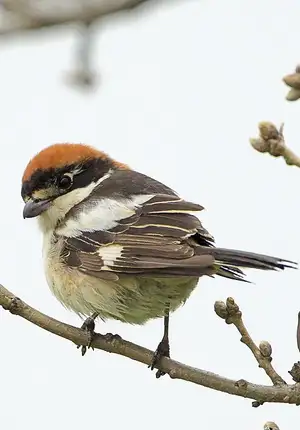
This website’s page on dehesas lists it, as Iberian Grey Shrike, among the species of the breeding birdlife of the dehesas of Cabañeros, and calls it an «abundant species», alongside the Woodchat Shrike.
Where to see the Iberian Grey Shrike in Cabañeros
In the dehesas of Cabañeros, on posts, wires and bushes.
When
All year: it is resident.
What time
Throughout the day, scanning from a high perch.
Where
In open areas with scattered trees and bushes: dehesas, farmland, olive groves and crops.
What to look for
A stocky grey bird with a black eye-mask and long tail, on a post or wire.
Videos of the Iberian Grey Shrike
Similar species
Great Grey Shrike
Lanius excubitor
How to tell them apart
It looks very like the Iberian Grey, but its breast and belly are entirely white, the mantle is a paler grey and it has two white patches on the wings.
Photo: Smudge 9000 from North Kent Coast, England, CC BY-SA 2.0
Lesser Grey Shrike
Lanius minor
How to tell them apart
In colouring it looks like a replica of the Iberian Grey, although smaller, and is told apart by the broad black band that covers its forehead.
Photo: Zeynel Cebeci, CC BY-SA 4.0
Other birds
Birds related to the Iberian Grey Shrike or sharing its habitats in Cabañeros.



 Same family
 Also in dehesas (wood pasture)
 Also in dehesas (wood pasture)
 Also in dehesas (wood pasture)
 Also in dehesas (wood pasture)
 Also in dehesas (wood pasture)
 Also in dehesas (wood pasture)
 Also in dehesas (wood pasture)






