Uncertain origin. The origin of the birds on the Peninsula is doubtful: only the Canary population is taken as certainly wild, and its presence in many localities is probably due to birds escaped from captivity or released. This page deals with the species and does not present it as a wild bird of Cabañeros.
Order
Anseriformes
Family
Anatidae
Species
Tadorna ferruginea
Wingspan compared with a person with arms outstretched.
Length
58–70 cm
Wingspan
1.1–1.35 m
Weight
1.2 kg
Social life
It feeds in flocks or family groups; both parents tend the chicks and defend them from predators
Lifespan
EURING lists a bird identified by field marks, in the Netherlands, that lived 6 years and 5 months; AnAge does not have the species
Conservation status
LC
NT
VU
EN
CR
EW
EX
Global (IUCN)
Least Concern
Spain
Vulnerable (VU) in the 2021 Red Book of the Birds of Spain, because of the small wild population in the Canaries; it is on the List of Wild Species under Special Protection, but not in the National Catalogue of Threatened Species
When to see it
Resident
Months of the year when it is present
J
F
M
A
M
J
J
A
S
O
N
D
In Iberia
yes
yes
yes
yes
yes
yes
yes
yes
yes
yes
yes
yes
Breeding season
no
no
no
yes
yes
yes
yes
yes
no
no
no
no
Song or voice of the Ruddy Shelduck
It is rather noisy1. In flight it gives an «ang» like a trumpet blast and a two-syllable «ah-ung», as well as a hollow «ahrrr». The recording (call) is by Marcin Sołowiej and was made at the Los Molinos reservoir, in Fuerteventura, where the Canary population lives, the only wild and regular one in Spain (xeno-canto XC857194, quality A). It lasts 9 seconds and is a trimmed stretch of a 17.5 s clip, without repeating or lengthening it, from which we have removed the bass below 300 Hz, reduced the background noise and adjusted the volume; neither pitch nor speed has been changed.
It has a rather long neck and legs, and long, narrow wings. In flight, the forewing, white above and below, contrasts with the rump and tail, an iridescent black. It is migratory in part of its range1. Small groups of wild birds probably reach the Peninsula and the Canaries from Morocco after breeding1.
Flight typeDirect, with long, narrow wings and the white forewing
It is a medium-sized, goose-like duck, with a rather long neck and legs and long, narrow wings.
The forewing is white above and below, and contrasts with the rump and tail, black and iridescent.
It is usually quite noisy: in flight it gives an «ang» like a trumpet blast and a two-syllable «ah-ung».
Photo gallery of the Ruddy Shelduck
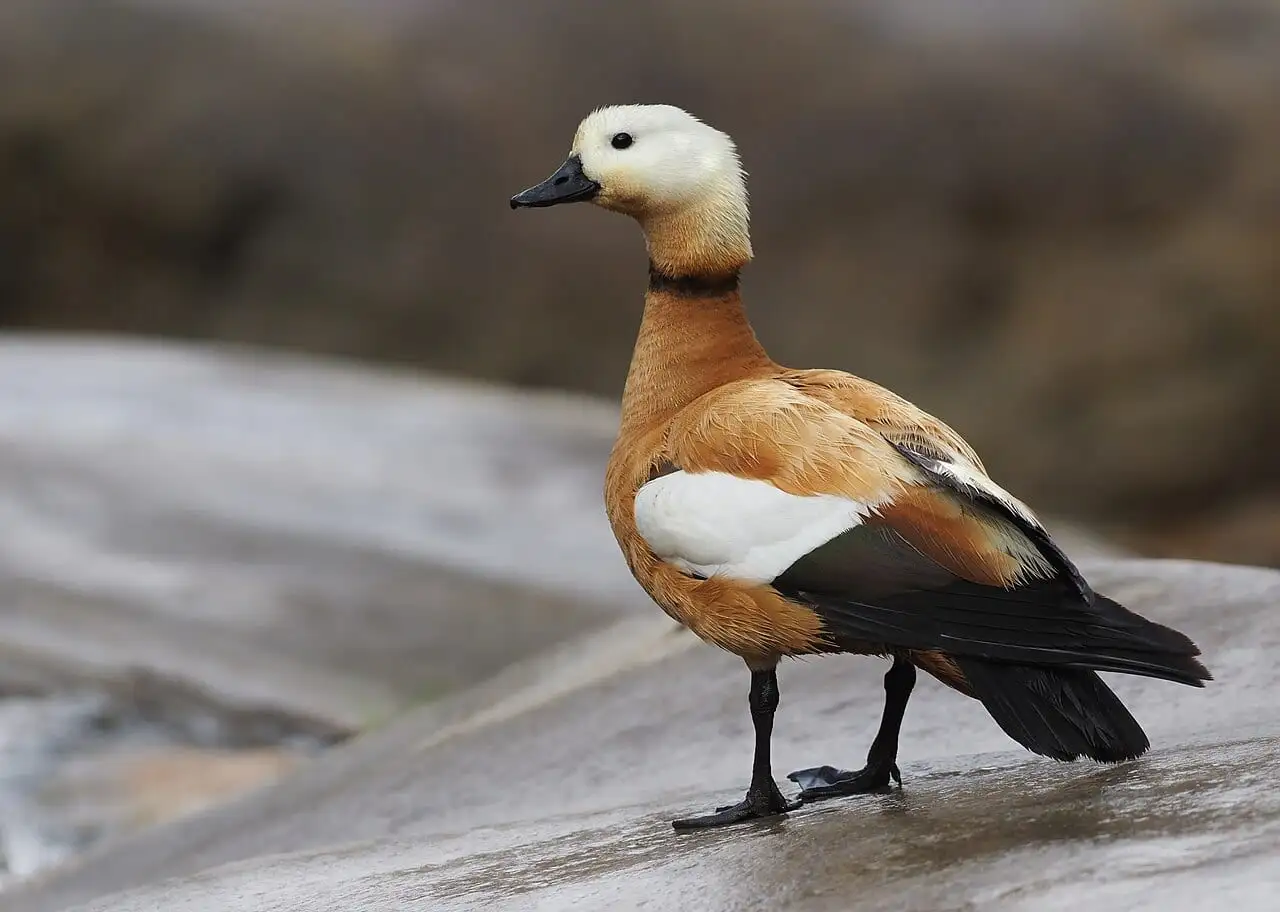
Ruddy Shelduck in profile on a rock, with cream head, narrow black collar, orange body, white wing coverts and black tailPhoto: Frank Vassen, CC BY 2.0Photo 1 of 4
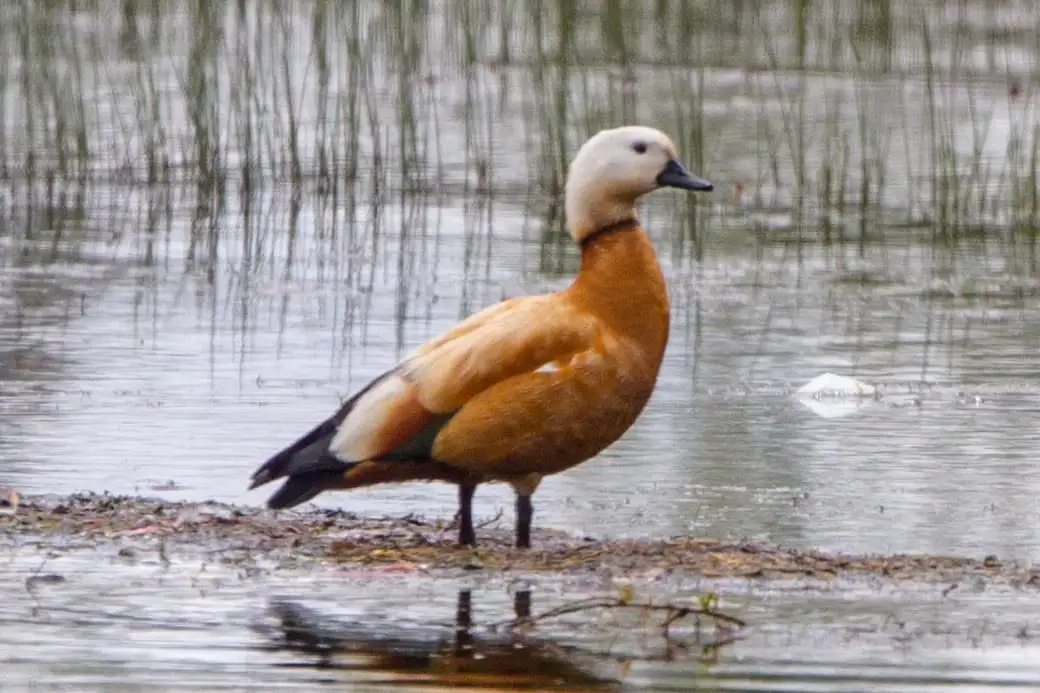
Ruddy Shelduck in shallow water beside a rush bed, with cream head, orange body and black tailPhoto: Ron Knight, CC BY 2.0Photo 2 of 4
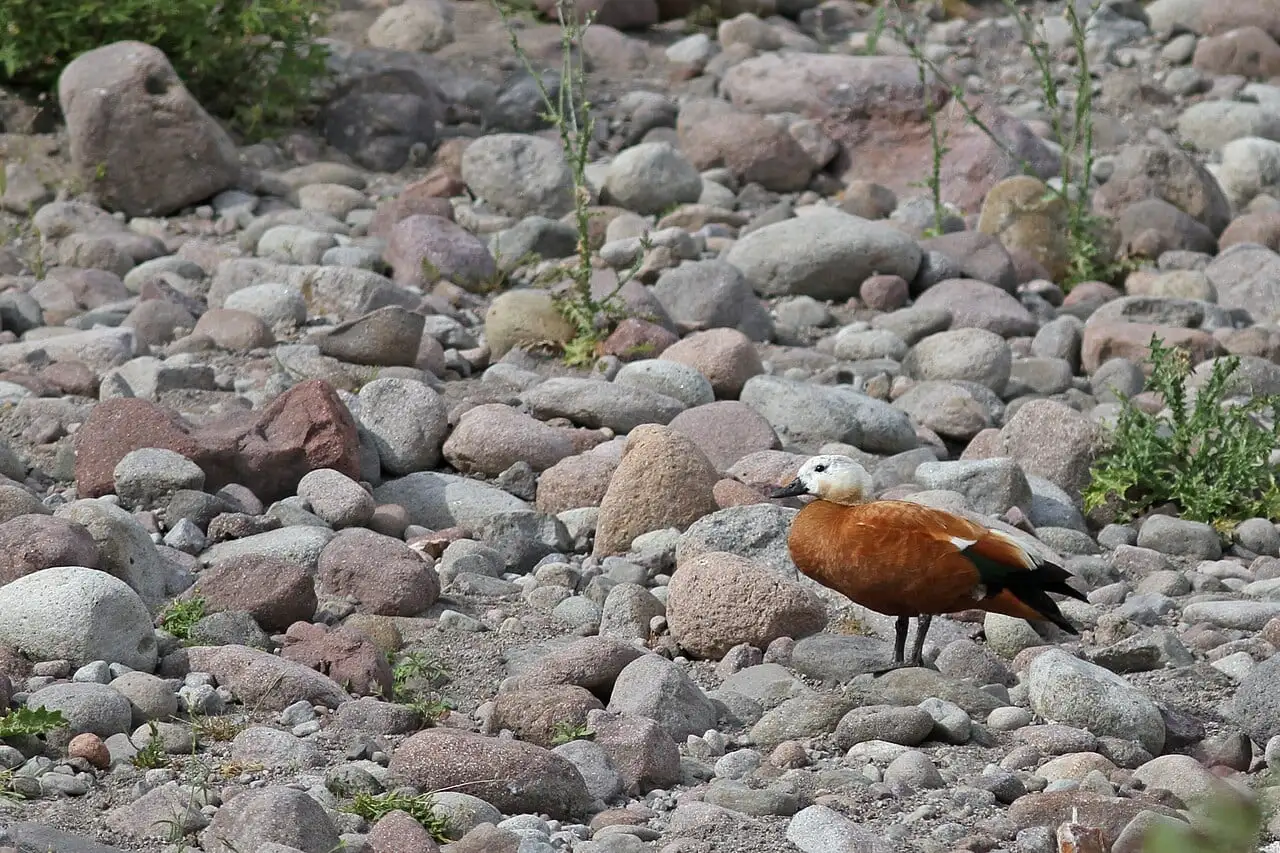
Ruddy Shelduck perched on the stones of a bank, with orange body and paler headPhoto: Bouke ten Cate, CC BY 4.0Photo 3 of 4
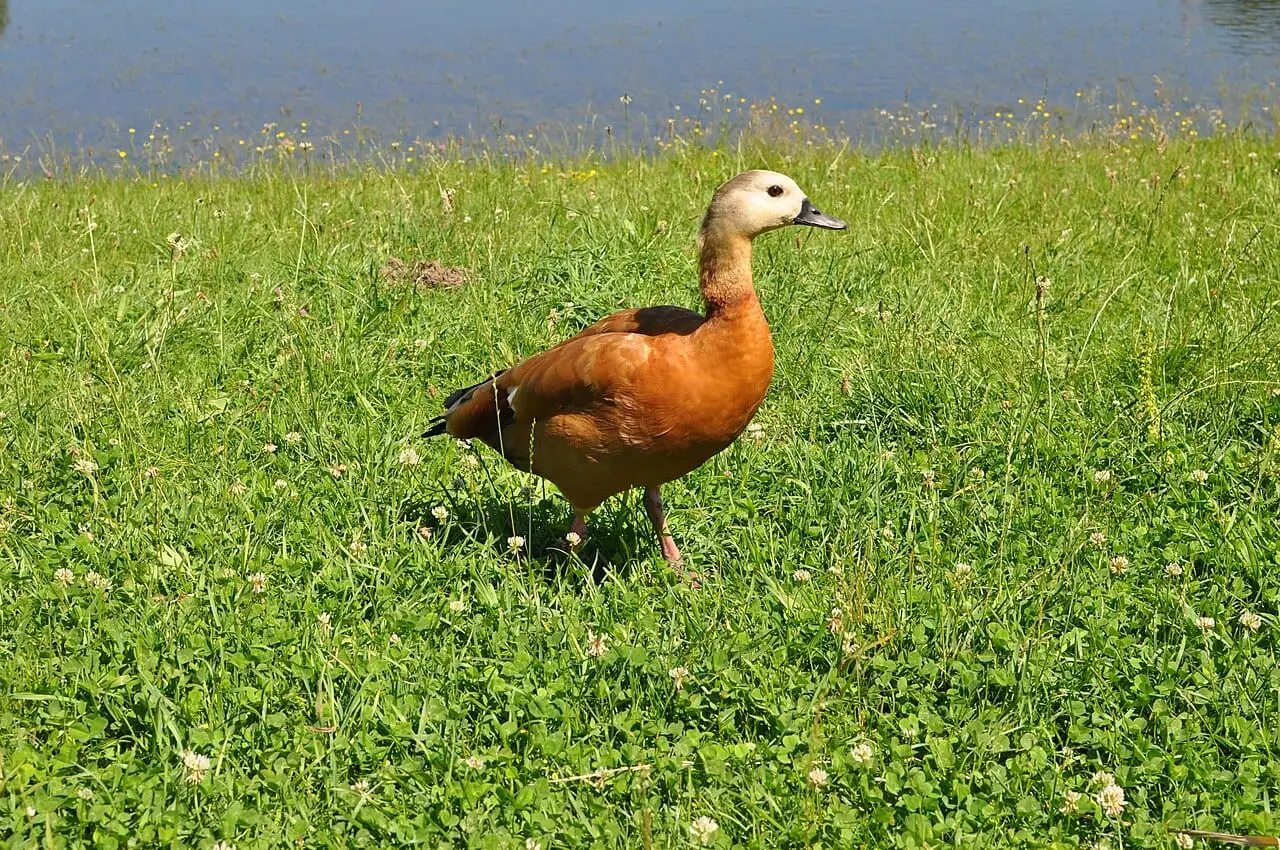
Ruddy Shelduck walking on the grass, with orange-brown body, cream head and black tailPhoto: Nicu Farcaș, CC BY-SA 4.0Photo 4 of 4
1 / 4
Identification of the Ruddy Shelduck
The Ruddy Shelduck is a medium-sized, goose-like duck, with a rather long neck and legs and long, narrow wings. The sexes are alike and have an orange-brown body, with a paler, cream head, above all on the forehead and around the eye. The rump and tail are iridescent black, the forewing is white above and below, and the bill is black. The adult male wears a narrow black collar and a plainer back than the adult female, who instead shows a more prominent facial mask. The juvenile resembles the female, but with a greyer back.
Habitat and distribution of the Ruddy Shelduck
It is a species of southern Palearctic distribution, occupying several areas in west-central Asia, south-eastern Europe, north-west Africa and also the Ethiopian highlands.
In Spain it is restricted to localised sites in Andalusia, Valencia, Aragón, Navarre, the Basque Country, Cantabria and Asturias1. It is more noticeable and widespread in the Canaries, Madrid, southern Castilla y León and northern Extremadura and Castilla-La Mancha1. It frequents several types of wetland, above all those that let it graze on the edges. Inland it also rests on dry plains and feeds on alfalfa crops, cereal fields and the ground of livestock farms.
On the Peninsula and in the Balearics, the Ruddy Shelduck was a winter visitor that became rare during the 20th century, and in the recent past it was relatively common in the Guadalquivir marshes, where even occasional breeding was known1.
Areas where it is regularly recorded since 2010Squares of about 25 km where it is recorded regularly (occasional passage records are left out). Data from GBIF.org (12,825 records, retrieved October 2026); outline from Natural Earth.
Etymology of the Ruddy Shelduck
According to Wikipedia, Pallas described it in 1764 under the name «Anas ferruginea», and it was later moved to the genus «Tadorna», whose name comes from the French «tadorne», which is the name of the Common Shelduck. In other languages it is called «ànec canyella» in Catalan, «tadorna ferruxenta» in Galician, «paita gorrizta» in Basque and «ruddy shelduck» in English1. We have found no source explaining the origin of the Spanish name or of the epithet, so we do not venture a guess.
Population of the Ruddy Shelduck
The 2021 European Red List of Birds estimates some 35,500–64,100 Ruddy Shelducks in Europe, with an unknown trend. The last national census in Spain was that of 2009 and gave some 3,100 birds, although it is judged that not all of that population is breeding. In the Canaries the trend is positive: between 1994 and 2000 there were 3 to 6 pairs in Fuerteventura; between 2007 and 2014 there were counts of 80 to 375 birds, with 30–54 breeding pairs, and in 2020 the maximum was recorded, 729 birds.
On the Peninsula there are records of large flocks: 41 birds in September 2018 at La Puebla de Alfindén (Zaragoza), 287 between September and November 2017 on wetlands in Madrid and about 100 in December 2019 at the Rosarito reservoir (Ávila–Toledo). A small breeding population probably exists in Spain, fed in part by birds escaped from private collections1.
The greatest threat is the destruction of habitat and the abstraction of water for irrigation from the ponds of Fuerteventura. There are also poaching and persecution, plundering of nests (the chicks are caught by islanders or taken by feral cats and gulls), deaths from collisions with power lines, outbreaks of disease in Fuerteventura and hybridisation with birds escaped from private collections.
Nest of the Ruddy Shelduck
The nest is a hole in sandy or clayey ground, natural or dug by another animal, sometimes with a little grass. It may also nest in the open, in places far from water, such as abandoned buildings or farm sheds, in hollow trees (sometimes at considerable height above the ground) or in cracks in rocks and cliffs.
Courtship and breeding of the Ruddy Shelduck
The breeding cycle lasts about 85 days, of which 28 or 29 are incubation and about 55 chick development, with the chicks feeding themselves soon after breaking the shell; even so both parents tend them and defend them from predators. Most pairs breed between April and August. The clutch is eight or nine whitish eggs, sometimes up to 12. This is the calendar given for the species, not proof that it breeds in Cabañeros1.
Diet of the Ruddy Shelduck
It is omnivorous, although plant matter predominates in its diet, in proportions that vary with place and season. It feeds in alfalfa fields, where besides stems and shoots it eats seeds and insects, and looks for worms in damp soil. It also feeds in shallow water. It is gregarious when feeding, so it forms flocks or family groups.
Curious facts about the Ruddy Shelduck
The Vulnerable (VU) category of the Ruddy Shelduck in Spain is due to the Canary population, the only wild and regular one, which remains small despite its increase1. EURING lists a bird identified by field marks in the Netherlands at 6 years and 5 months, and oiseaux.net gives 1.2 kg as adult weight; AnAge does not have the species.
The Ruddy Shelduck in Cabañeros
The habitat pages of this website do not mention it, and we have found no other published source about it in the Park; nor is it in the bird list of the «Visitor’s Guide to Cabañeros National Park» (OAPN). GBIF.org records 3 observations of the Ruddy Shelduck in Cabañeros and its surroundings. None of those observations falls within the Park boundary (according to OpenStreetMap): all are from the surroundings. It is more widespread in northern Extremadura and Castilla-La Mancha; given the doubtful origin of the peninsular birds, those records do not prove a wild population1.
Where to see the Ruddy Shelduck in Cabañeros
In Cabañeros and its surroundings, occasionally, on wetlands and reservoirs.
When
Present all year in Spain; the only wild and regular population is that of the Canaries.
What time
By day, in flocks or family groups feeding on crops and banks.
Where
On wetlands, reservoirs and alfalfa and cereal crops near water.
What to look for
Look for the orange body, the cream head and the white forewing; listen for the «ang» in flight.



 Same family
 Same family
 Same family
 Same family
 Same season in the park
 Same season in the park
 Same season in the park
 Same season in the park






