Wingspan compared with a person with arms outstretched.
Length
46–56 cm
Wingspan
78–90 cm
Weight
650–980 g
Social life
Its habits are not very gregarious: small groups associate with other ducks, above all Mallards, and with coots to feed
Lifespan
Record of 19 years and 6 months according to EURING (a bird ringed in Great Britain and Ireland and found dead from a virus)
Conservation status
LC
NT
VU
EN
CR
EW
EX
Global (IUCN)
Least Concern
Spain
Least Concern (LC) as a winter visitor or migrant in the Red Book of the Birds of Spain; not on the List of Wild Species under Special Protection or in the Spanish Catalogue of Threatened Species
When to see it
Resident
Months of the year when it is present
J
F
M
A
M
J
J
A
S
O
N
D
In Iberia
yes
yes
yes
yes
yes
yes
yes
yes
yes
yes
yes
yes
Song or voice of the Gadwall
The male gives a hoarse, deep croak, like a «merc», and the female a dry «a aac a aac», similar to the female Mallard’s.
Flight callGadwall
0:00 / 0:15
10 kHz5
The sonogram draws the sound: time runs from left to right, and the higher a trace sits, the higher the note.Recording by Joost van Bruggen, xeno-canto XC436359 (Países Bajos) (CC BY-SA 4.0).
Flight of the Gadwall
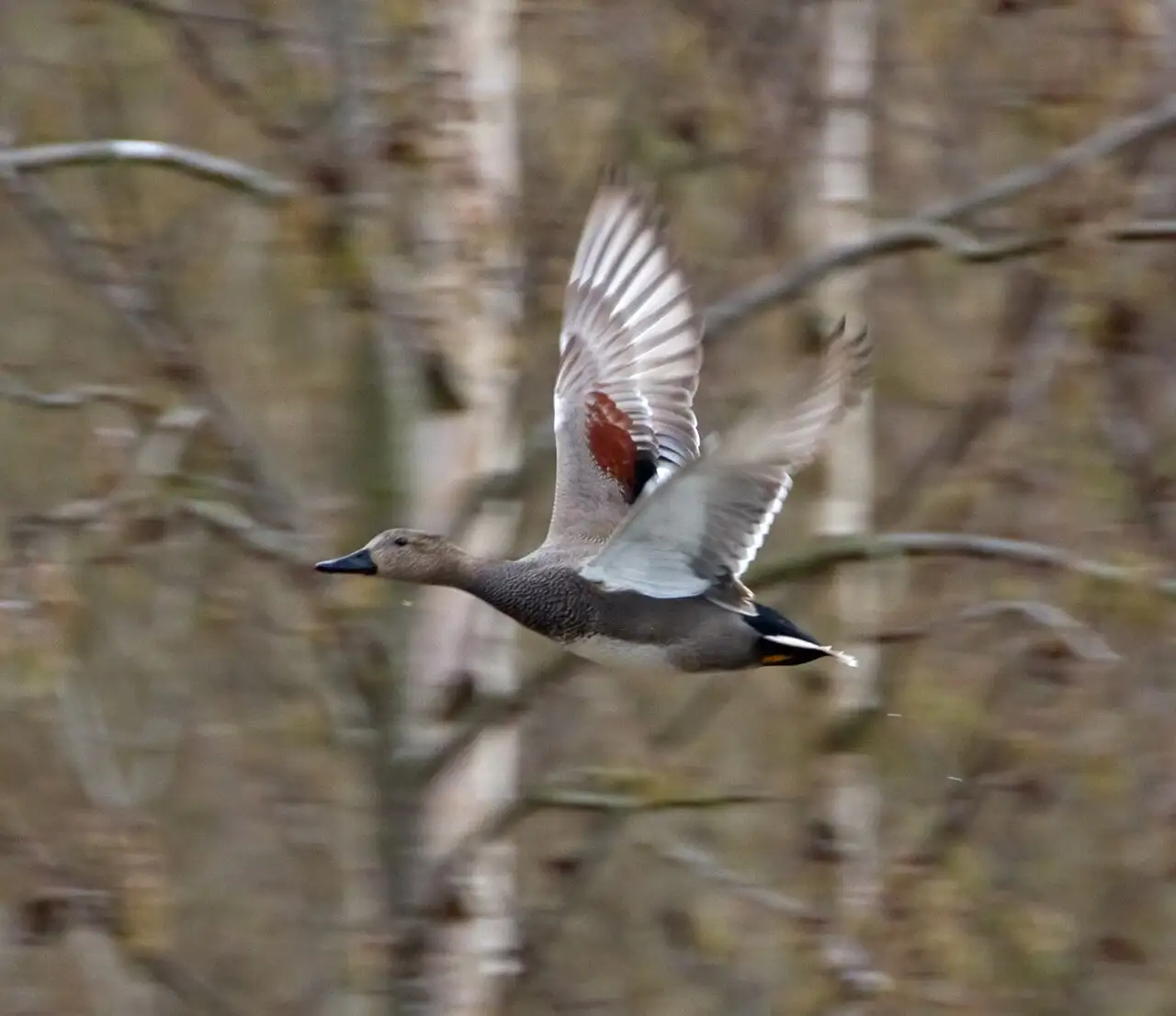
In flight the white speculum and some chestnut patches on the upper side of the wings stand out.
Flight typeDirect, with the white speculum clearly visible
It settles in shallow wetlands, preferably freshwater, with emergent vegetation and islets; in winter it also frequents lagoons, reservoirs, marshes and estuaries.
The white speculum and some chestnut patches on the upper wing stand out.
It feeds by tipping up on the water, until half its body is submerged, on leaves, stems and roots of aquatic plants, and often associates with other ducks and coots.
Photo gallery of the Gadwall
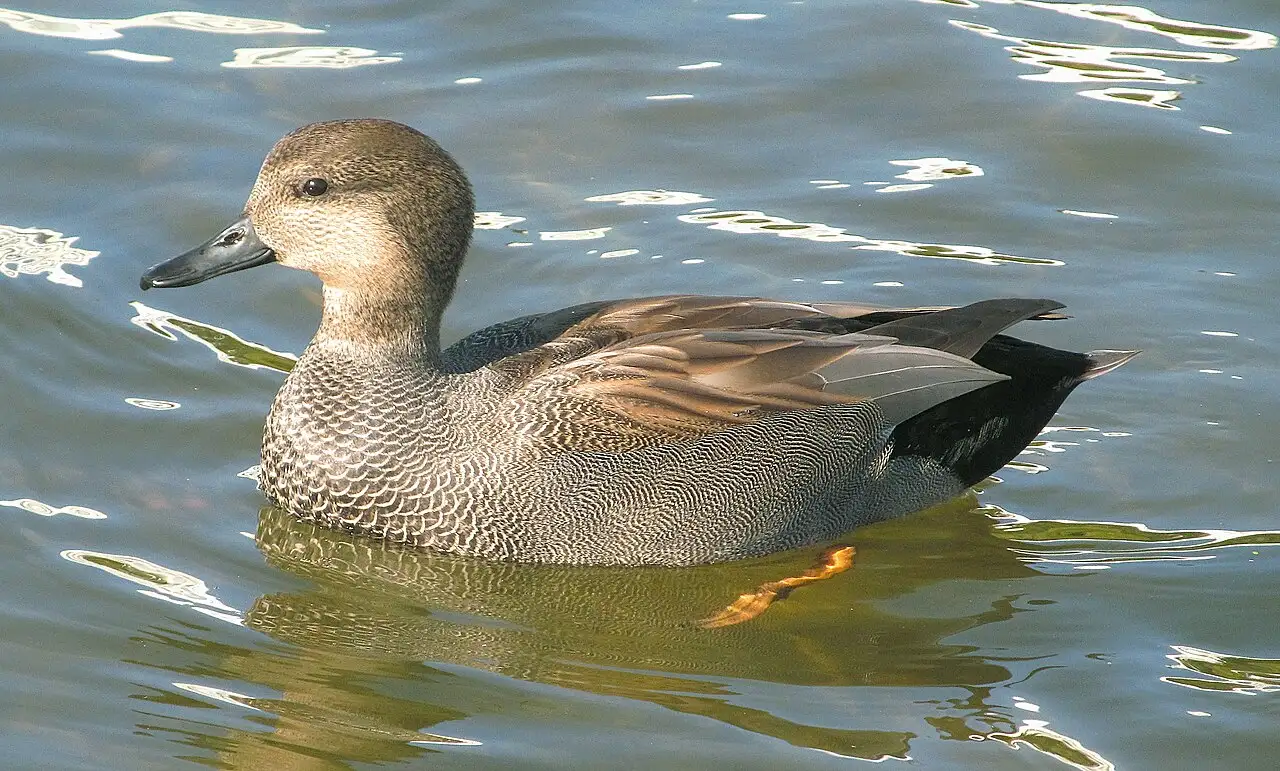
Male Gadwall swimming, in profile, with brown head, finely vermiculated grey body and black rumpPhoto: Tsyganov Sergey, CC0Photo 1 of 4
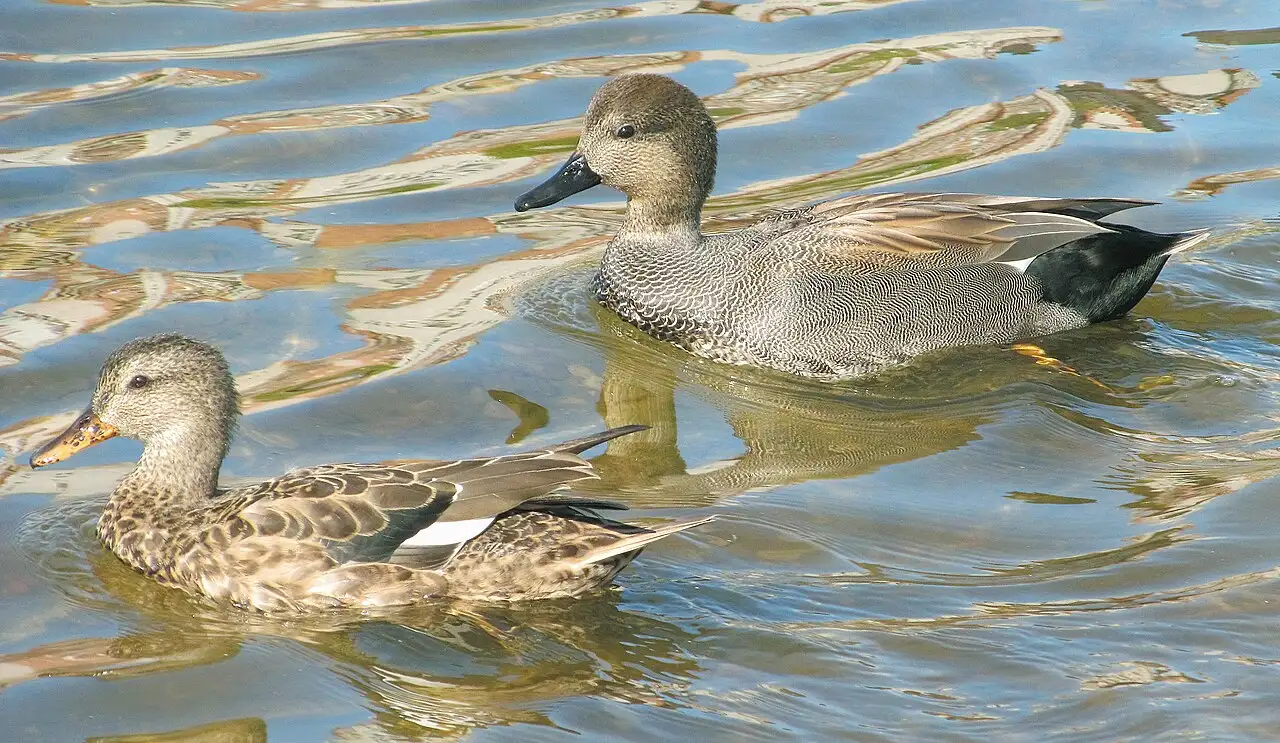
Pair of Gadwalls on the water: the grey male, with black rump, and the brownish female, with the white speculumPhoto: Tsyganov Sergey, CC0Photo 2 of 4
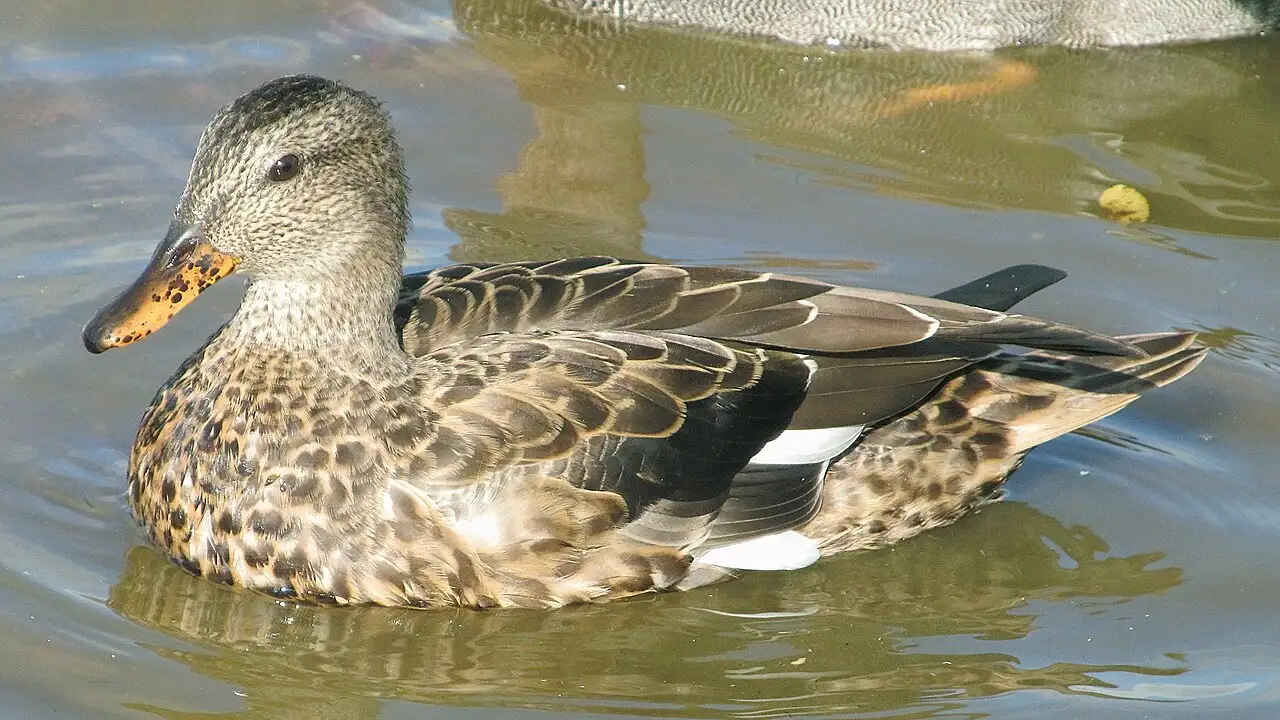
Female Gadwall swimming, with mottled brown plumage, orange bill and the white speculum visiblePhoto: Tsyganov Sergey, CC0Photo 3 of 4
Male Gadwall in flight, wings open, the white speculum and the chestnut patches on the upper side of the wingPhoto: Tony Hisgett from Birmingham, UK, CC BY 2.0Photo 4 of 4
1 / 4
Identification of the Gadwall
Somewhat smaller than the Mallard, the Gadwall is a slender bird, with fairly dull, uniform plumage. The white speculum, very visible both in flight and when perched or swimming, is the most distinctive feature of the species in both sexes. In flight some chestnut patches on the upper side of the wings also stand out.
Male
In the breeding period, finely vermiculated grey tones.
Black rump and white speculum.
Female and young bird
The female is brownish.
Young birds look like the female, but with more reddish tints.
Habitat and distribution of the Gadwall
It is a species with a wide worldwide distribution, with several geographical races. In the Palaearctic the subspecies «strepera» spreads across Great Britain, southern Scandinavia, much of central and southern Europe (including Spain), Turkey, Russia and central Asia.
The Peninsula holds the main breeding cores in the Guadalquivir marshes, the Ebro delta and La Mancha, although it also breeds more sparsely at various sites in Aragón, Extremadura, Toledo, Madrid, Castilla y León, Álava, Galicia, Asturias, Cantabria and the Levante. It also breeds in the Balearics, is rare and irregular in the Canaries and is absent from Ceuta and Melilla.
Relatively demanding about habitat, in the breeding season it usually settles in shallow wetlands, preferably freshwater, with emergent vegetation and islets. In winter it frequents lagoons, reservoirs, marshes and estuaries, and prefers above all small ponds and farm pools, followed by large reservoirs and river courses.
It is a partly migratory species, with resident populations in the southernmost localities of its range, such as the Peninsula, where breeders make only occasional dispersive movements, tied to weather conditions and to fluctuations in wetland water levels. The resident population grows in winter with a notable contingent of birds from central and northern Europe, which stay between October and March.
Areas where it is regularly recorded since 2010Squares of about 25 km where it is recorded regularly (occasional passage records are left out). Data from GBIF.org (175,957 records, retrieved October 2026); outline from Natural Earth.
Etymology of the Gadwall
According to Wikipedia, the epithet «strepera» comes from late Latin and means «noisy». In other languages it is called «ànec griset» in Catalan, «pato cincento» in Galician, «ipar-ahatea» in Basque and «gadwall» in English1.
Population of the Gadwall
In the 2021 European Red List of Birds the European breeding population is estimated at between 164,000 and 262,000 mature individuals, with an increasing trend. In Spain there are not enough data on the number of birds, because of the spatial irregularity of its presence and the high variability of its abundance; the year-to-year trend varies so much over recent decades that it prevents a trend from being set, so the «Data Deficient» category should be considered1. The main threats are habitat loss or alteration, because the shallow wetlands it uses most are sensitive to pollution and eutrophication, and human disturbance.
Nest of the Gadwall
Once the pair has formed, the female builds the nest, which is usually near the water, well hidden among emergent vegetation or sheltered by some scrub, and consists of a small hollow covered in twigs and leaves and lined with plenty of down.
Courtship and breeding of the Gadwall
As in other duck species, it is the female who chooses her mate through stereotyped postures, to which the male responds; both end with a joint gesture of dipping their bills in the water at the same time. The clutch consists of 6 to 15 pale pink eggs, which the female incubates for 24–26 days, after which they hatch simultaneously. A few hours after hatching, the chicks leave the nest to accompany their mother, with whom they stay about 50 days, the time needed to fly. As in almost all ducks, the male watches the nest at the start of incubation and soon leaves for the usual moulting places, the «mancada».
Diet of the Gadwall
Its diet is essentially vegetarian and based on leaves, stems and roots of aquatic plants, which it gets by tipping up on the water until half its body is submerged, the usual method of dabbling ducks, the group it belongs to. To a lesser extent it takes in animal matter, above all aquatic insects, and cereal grains.
Curious facts about the Gadwall
As well as breeding in various regions of Spain, it hosts in winter an important contingent of birds from central and northern Europe1. According to Wikipedia, DNA studies place it as the sister species of the Falcated Duck (Mareca falcata), and both are related to the three species of wigeon. EURING lists a ringed bird from Great Britain that lived 19 years and 6 months.
The Gadwall in Cabañeros
The habitat pages of this website do not mention it. GBIF.org records 59 observations of the Gadwall in Cabañeros and its surroundings.
Where to see the Gadwall in Cabañeros
In Cabañeros and its surroundings, all year, in ponds, lagoons and reservoirs.
When
All year; between October and March winter visitors arrive from central and northern Europe.
What time
In good light.
Where
In shallow wetlands with emergent vegetation and islets; in winter, in small ponds and farm pools, lagoons and reservoirs.
What to look for
Look for the white speculum, the male's black rump and, in flight, the chestnut patches on the wing.



 Same family
 Same family
 Same family
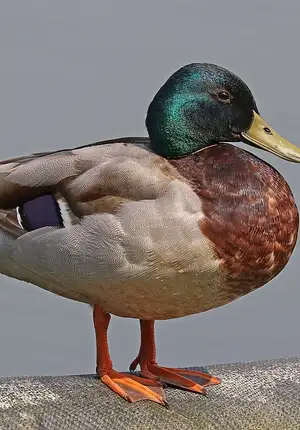 Same family
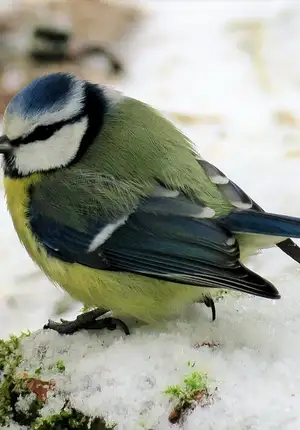 Same season in the park
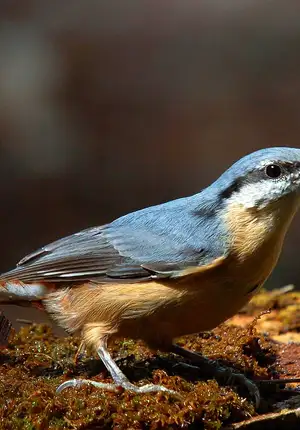 Same season in the park
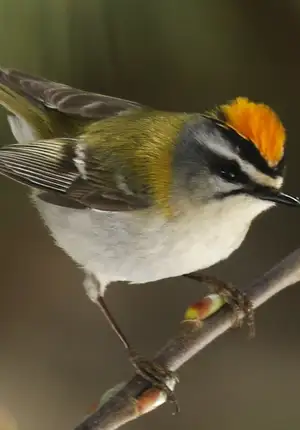 Same season in the park
 Same season in the park






