Wingspan compared with a person with arms outstretched.
Length
42–49 cm
Wingspan
67–75 cm
Weight
0.5–1.2 kg
Social life
The female builds the nest, incubates alone and cares for the chicks until they develop
Lifespan
Record of 22 years and 4 months in the wild according to EURING (a bird ringed in Great Britain and Ireland); AnAge gives 23.2 years
Conservation status
LC
NT
VU
EN
CR
EW
EX
Global (IUCN)
Vulnerable
Spain
Near Threatened (NT) as a breeder and Endangered (EN) as a winter visitor in the 2021 Red Book of the Birds of Spain; on neither the List of Wild Species under Special Protection nor the Spanish Catalogue of Threatened Species
When to see it
Resident
Months of the year when it is present
J
F
M
A
M
J
J
A
S
O
N
D
In Iberia
yes
yes
yes
yes
yes
yes
yes
yes
yes
yes
yes
yes
Breeding season
no
no
no
yes
no
no
no
no
no
no
no
no
Song or voice of the Common Pochard
It is usually fairly silent. During the courtship display the male gives a «u-i-ouu», and the female a hoarse «prarr prarr prarr», which is what is heard in this recording.
CallCommon Pochard
0:00 / 0:10
10 kHz5
The sonogram draws the sound: time runs from left to right, and the higher a trace sits, the higher the note.Recording by Noé Ferrari, Wikimedia Commons (CC BY 4.0).
Flight of the Common Pochard
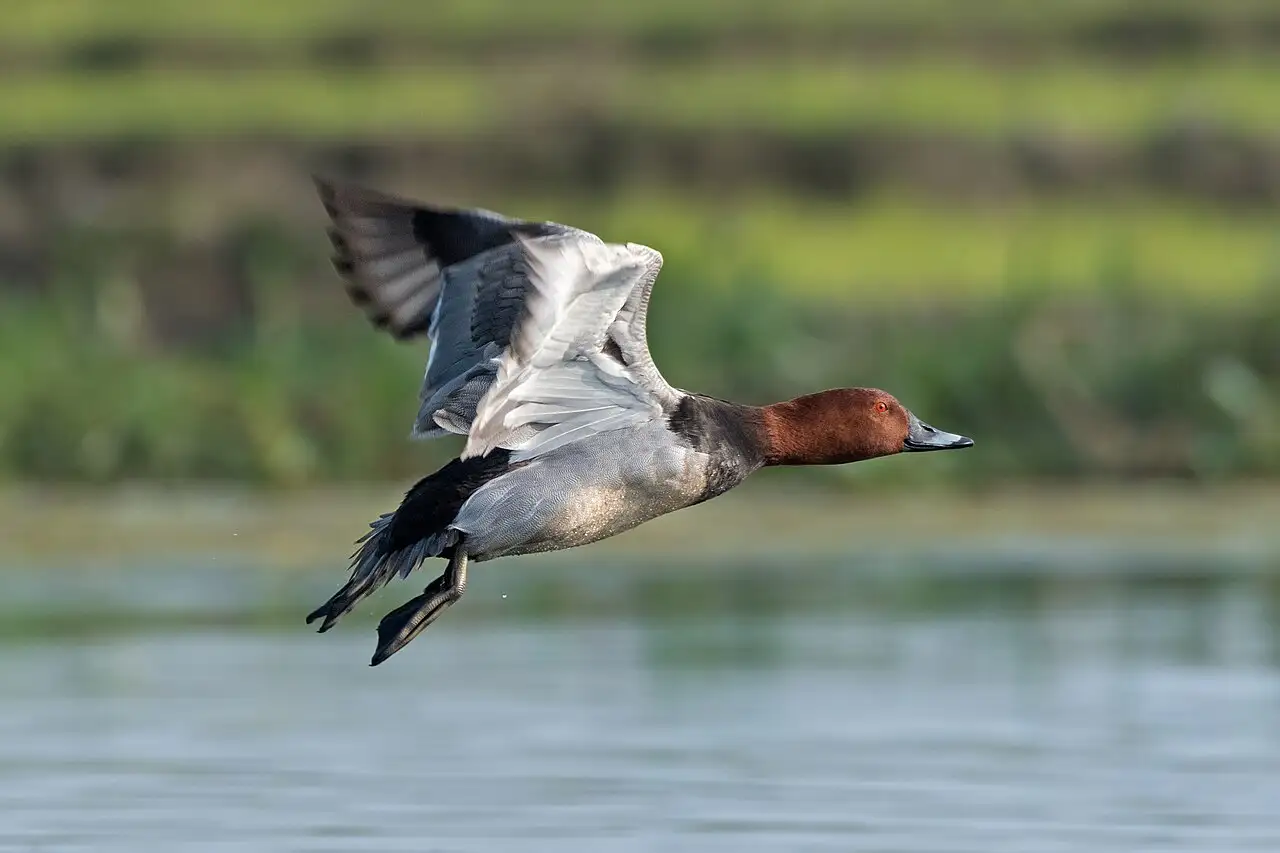
It has a vibrant flight. In the air the male looks quite grey, with the breast and upper back dark and the head reddish.
Flight typeVibrant, with compact body and short tail
A typical diving duck, it swims with the body well submerged and the tail low; it breeds in ponds, marshes and slow rivers, and winters on lakes, reservoirs and gravel pits.
In flight the male looks quite grey, with the breast and upper back dark and the head reddish.
It is omnivorous: it eats insects, crustaceans and small fish, and also submerged vegetation and seeds.
Male Common Pochard in low flight over the water, with grey wings open, black breast and reddish headPhoto: soumikbiswas, CC BY-SA 4.0Photo 3 of 4
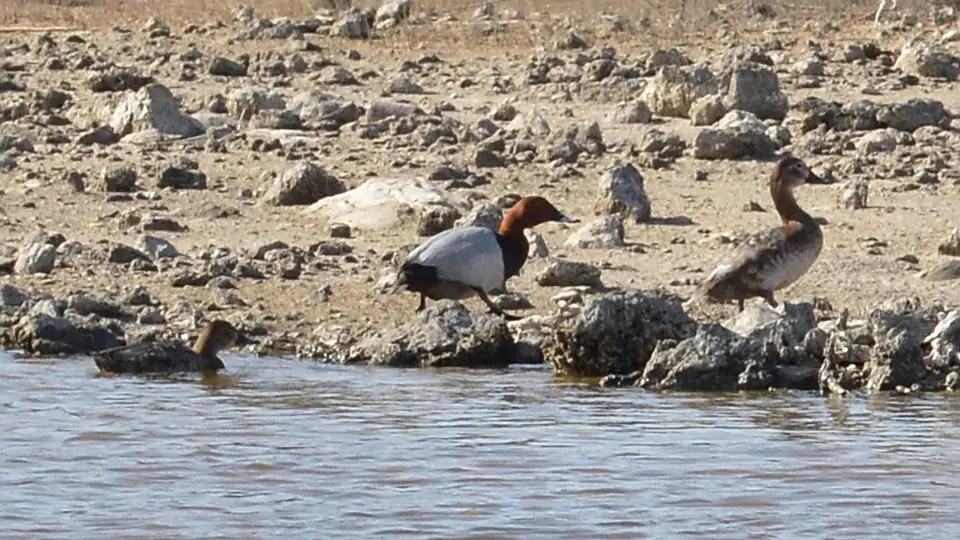
Common Pochards on the stony shore of a wetland at the Albufera de MallorcaPhoto: Ryan Hodnett, CC BY-SA 4.0Photo 4 of 4
1 / 4
Identification of the Common Pochard
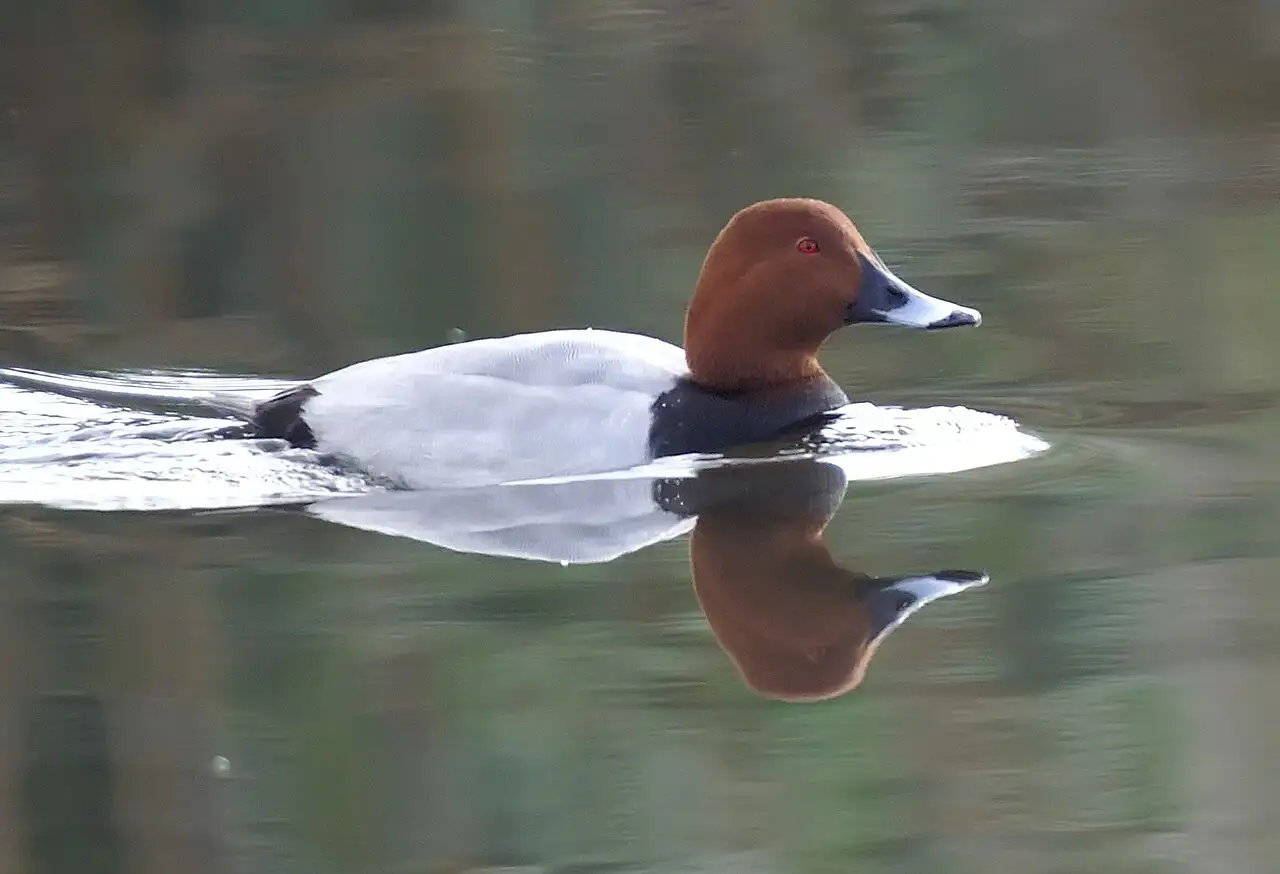
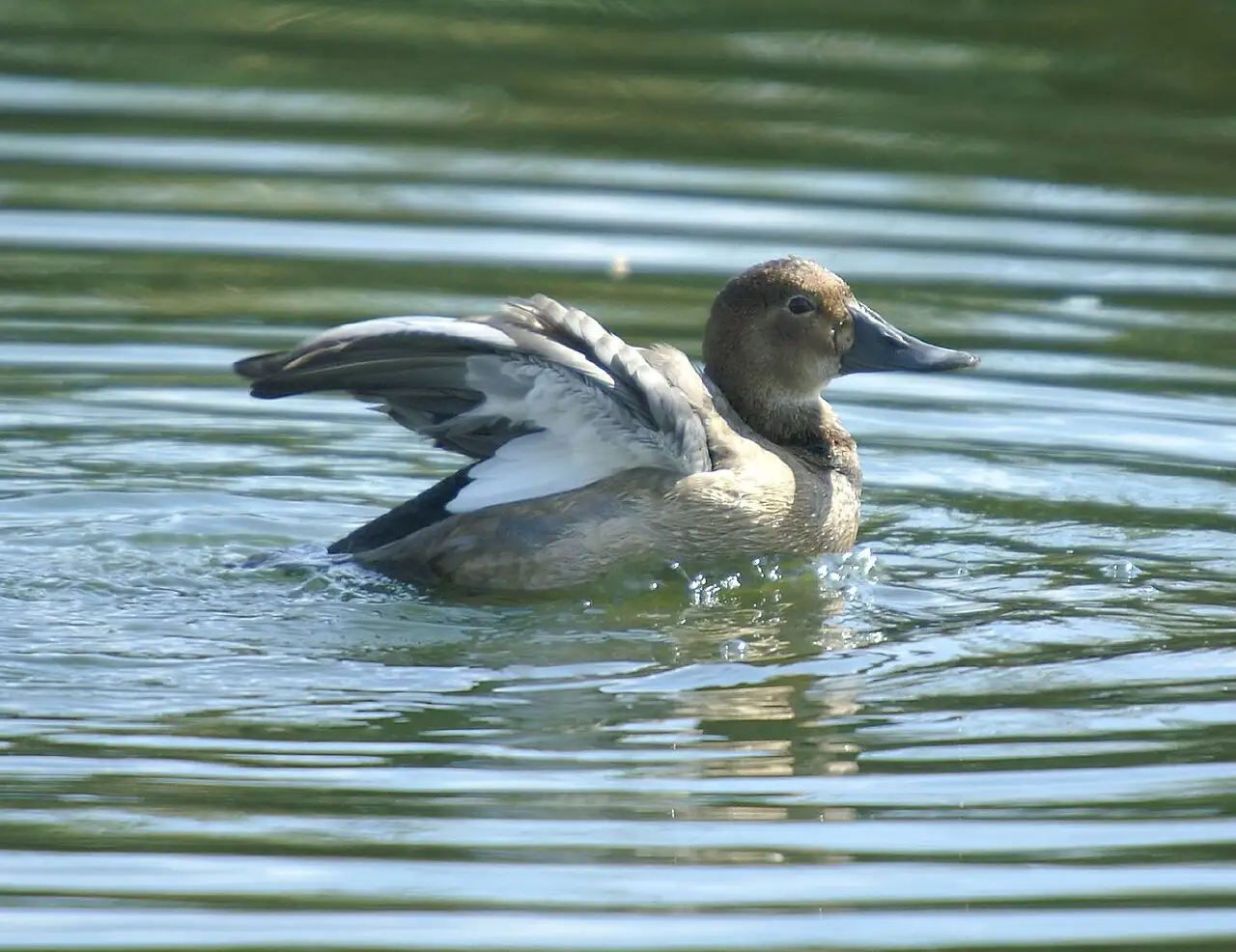
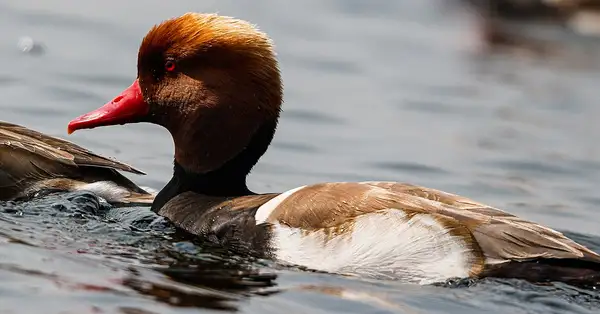
It is a typical diving duck, of compact appearance, short tail and strong legs, which swims with the body well submerged and the tail low. The adult male in breeding plumage has the rear and breast black, the back, flanks and belly greyish and the head reddish brown; the bill is dark, crossed by a grey band, and the eye red. The female is much more uniform, with the rear and breast reddish, the back, flanks and belly greyish and the head dirty cream; she has a dark eye and blackish bill, with a narrow pale band.
Adult
Male: reddish-brown head, red eye, black breast and rear, grey body.
Female: dirty-cream head, reddish breast and rear, greyish body, dark eye.
Young bird
Very like the female, but duller, with more brown and less grey.
Habitat and distribution of the Common Pochard
It breeds widely in Europe, except the far north, and in a wide strip of central and western Asia. Its migratory populations spend the winter in southern Europe, in central and northern Africa and in southern and eastern Asia. No subspecies are recognised.
It is the most frequent and widespread diving duck in Spain. It breeds in many wetlands: the Guadalquivir marshes, the Ebro delta, the lagoons of Jaén, Córdoba and Seville, Villafáfila, Gallocanta, Pitillas, the wetlands of Cádiz, sites in Extremadura and La Mancha, the rivers of Madrid, lagoons of Albacete, the Levante and south-eastern wetlands and the Balearics. In winter it disperses across countless localities of the Peninsula, above all in the south-western quadrant.
It is undemanding: it breeds in ponds, marshes and slow rivers with open water and abundant marsh vegetation, and winters on large lakes and lagoons, reservoirs, flooded gravel pits and brackish coastal waters.
It is resident on the Peninsula, but every year we receive important contingents from central and northern Europe, which arrive from September and stay until May, with peaks from December to February. Iberian birds, for their part, disperse in all directions, even beyond our borders.
Areas where it is regularly recorded since 2010Squares of about 25 km where it is recorded regularly (occasional passage records are left out). Data from GBIF.org (120,820 records, retrieved October 2026); outline from Natural Earth.
Etymology of the Common Pochard
According to Wikipedia, «Aythya» comes from ancient Greek «aithuia», an unidentified seabird mentioned by Aristotle and Hesychius, and «ferina» is a Latin word meaning «game» or «game meat», derived from «ferus», «wild». In other languages it is called «morell caproig» in Catalan, «pato chupón europeo» in Galician, «murgilari arrunta» in Basque and «common pochard» in English1.
Population of the Common Pochard
The 2021 European Red List of Birds estimates that some 373,000–679,000 Common Pochards live in Europe, with a decreasing trend, and the IUCN considers it Vulnerable worldwide. In Spain some 16,600 are calculated in the breeding season (III Atlas of Breeding Birds) and an average of some 26,000 visit us each winter (2021 Red Book of the Birds of Spain), although the wintering population has fallen by 57 % since 1991.
Its threats are the loss and degradation of wetlands, through overexploitation of water and pollution from agricultural nutrients and poorly treated waters, and hunting: in the Valencian Community alone at least 6,318 were shot between 2012 and 2018, and in France more than 25,000 have been shot in a single season. It is also affected by competition with invasive species such as carp, lead from shot and climate change. Declaring it «Endangered» in the state catalogue is called for1.
Nest of the Common Pochard
The female builds a fairly elaborate platform on the ground, near the water, with stems, leaves and other plant materials, which she then lines with down.
Courtship and breeding of the Common Pochard
Laying usually takes place during April and consists of 6 to 11 greyish-green eggs, which the female incubates alone for 24–28 days. The chicks, very alert and independent, like those of all ducks, remain in her care until they complete their development, at 50–55 days.
Diet of the Common Pochard
It is omnivorous and its diet mixes, in proportions that change with place and time of year, animal food (insects, crustaceans and small fish) and plant food (submerged plants). In some places it eats mainly seeds and other plant matter.
Curious facts about the Common Pochard
According to the 2021 Red Book of the Birds of Spain, as a breeder it is Near Threatened, but as a winter visitor it is Endangered, through the collapse of 57 % of the pochards that winter in Spain. EURING lists a pochard ringed in Great Britain and Ireland that lived 22 years and 4 months.
The Common Pochard in Cabañeros
The habitat pages of this website do not mention it, and we have not found any other published source on it in the Park. GBIF.org records 41 observations of the Common Pochard in Cabañeros and its surroundings.
Where to see the Common Pochard in Cabañeros
In Cabañeros and its surroundings, mostly in winter, on reservoirs and ponds with open water.
When
All year, but above all from September to May, with the peak from December to February.
What time
By day, swimming or diving in open water.
Where
On reservoirs, lagoons, flooded gravel pits and ponds with marsh vegetation.
What to look for
Look for the male's reddish-brown head and black breast; and how it swims, very low with the tail down.



 Same family
 Same family
 Same family
 Same family
 Same season in the park
 Same season in the park
 Same season in the park
 Same season in the park






