Wingspan compared with a person with arms outstretched.
Length
28–37 cm
Wingspan
60–77 cm
Weight
131–345 g
Social life
It breeds in territories where young birds tend to settle very close to where they were born
Lifespan
Record of 21 years and 7 months in the wild (a bird ringed in the Netherlands and found dead after hitting a window)
Conservation status
LC
NT
VU
EN
CR
EW
EX
Global (IUCN)
Least Concern
Spain
Least Concern (LC) in the Red Book of the Birds of Spain; on the List of Wild Species under Special Protection, but not in the Spanish Catalogue of Threatened Species
When to see it
Resident
Months of the year when it is present
J
F
M
A
M
J
J
A
S
O
N
D
In Iberia
yes
yes
yes
yes
yes
yes
yes
yes
yes
yes
yes
yes
Song or voice of the Eurasian Sparrowhawk
It is very silent; occasionally it gives a «kiu-kiu-kiu-kiu».
CallEurasian Sparrowhawk
0:00 / 0:18
10 kHz5
The sonogram draws the sound: time runs from left to right, and the higher a trace sits, the higher the note.Recording by Steven Wilson, Wikimedia Commons (CC BY-SA 4.0).
Flight of the Eurasian Sparrowhawk
Seen in flight it is a fairly pale bird, in whose silhouette the long, narrow-based tail catches the eye. It is normally seen flying swiftly at low height among the trees, although it may also rise and glide for a while over the forest canopy.
Flight typeSwift and low among the trees
Very silent, it leaves a woodland branch and, occasionally, gives a «kiu-kiu-kiu-kiu».
It flies swiftly at low height among the trees; the short, rounded wings and long tail give it great manoeuvrability and acceleration.
It may also rise and glide for a while over the forest canopy. Its diet is basically bird-eating: it hunts birds of various sizes.
Photo gallery of the Eurasian Sparrowhawk
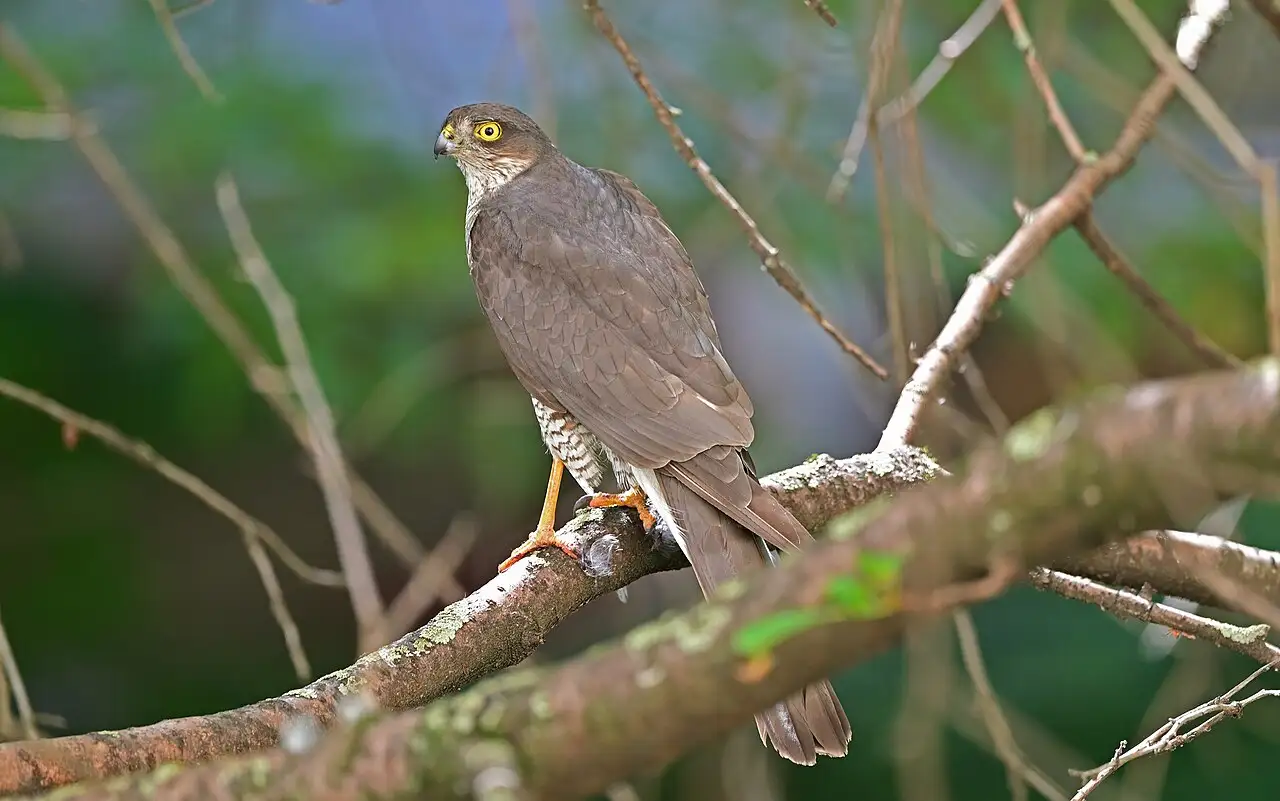
Male Eurasian Sparrowhawk perched on a branch, from the front, with greyish head, yellow eye and finely barred breastPhoto: Julia Wittmann, CC BY 4.0Photo 1 of 4
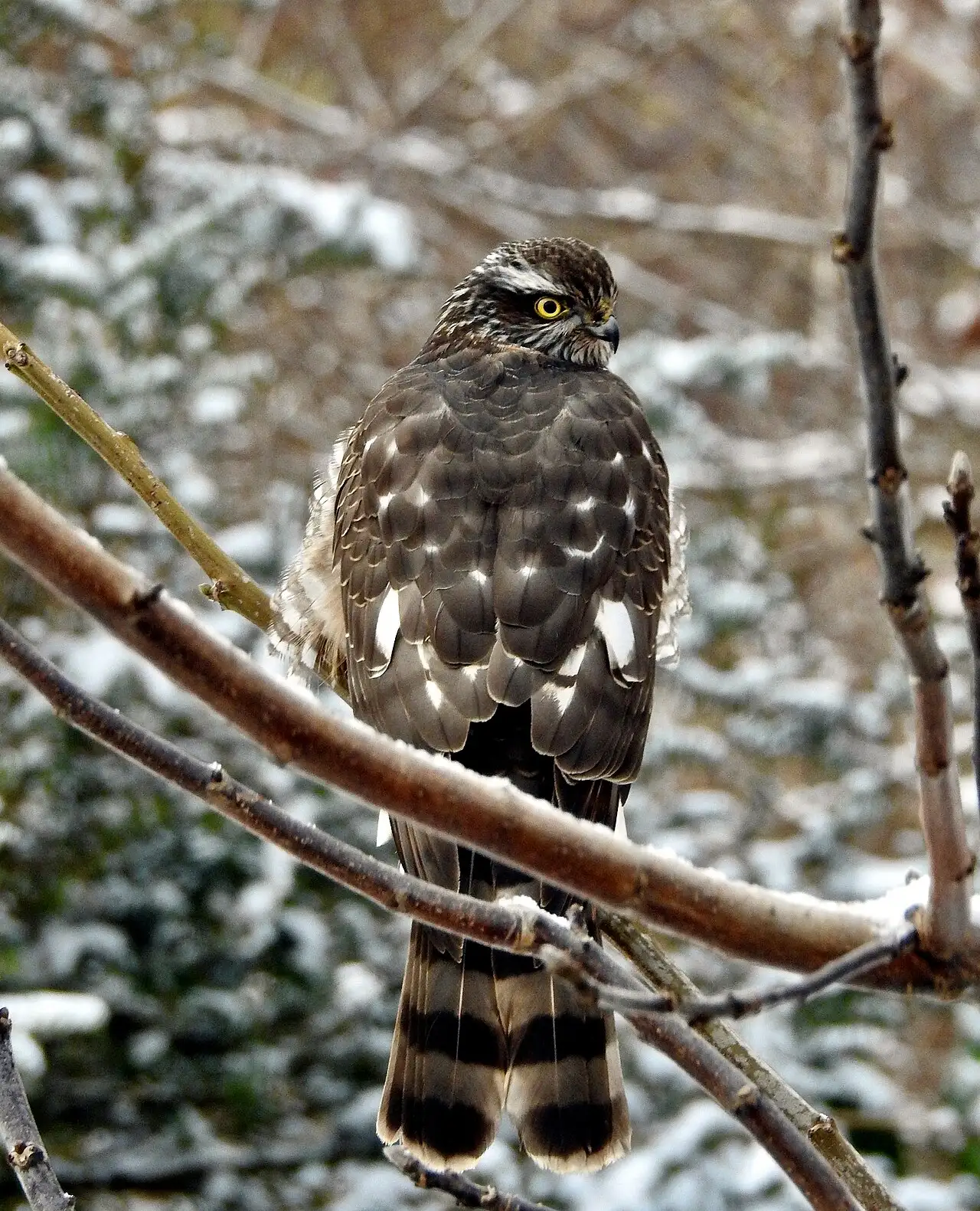
Eurasian Sparrowhawk from behind on a snowy branch, with long barred tail and pale patches on the wingsPhoto: Boschfoto, CC BY-SA 4.0Photo 2 of 4
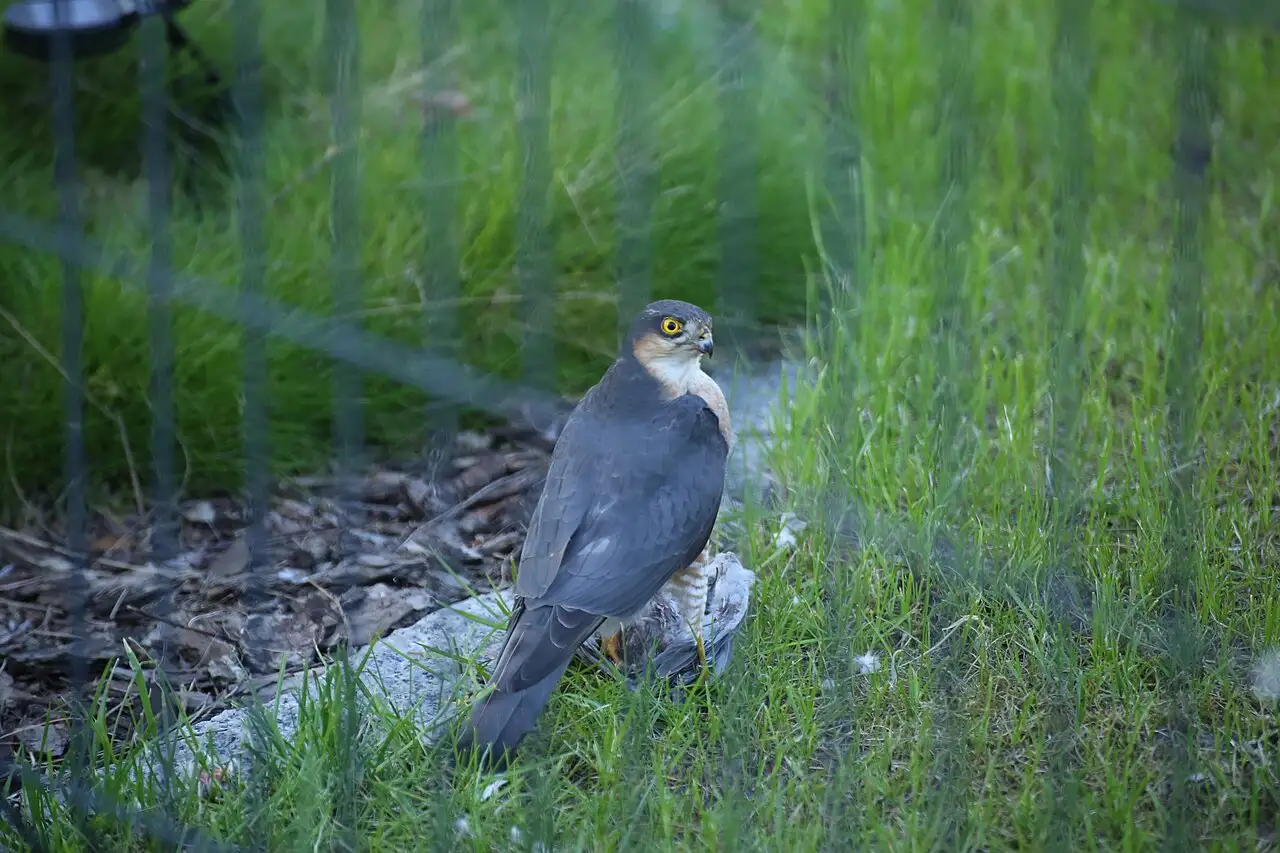
Blue-grey male Eurasian Sparrowhawk, perched in the grass behind a mesh, with a prey under its talonsPhoto: Mirus255, CC BY-SA 4.0Photo 3 of 4
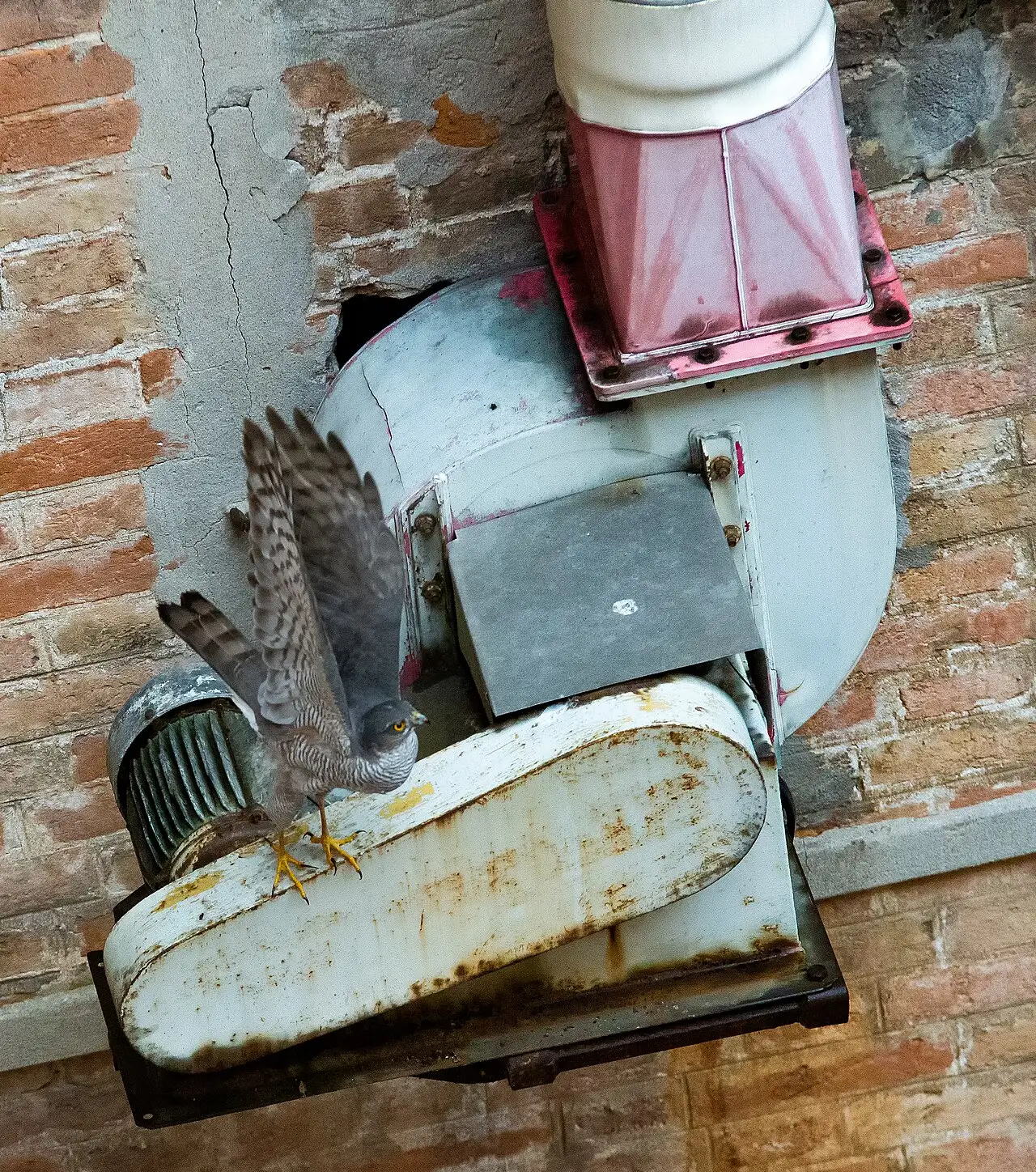
Eurasian Sparrowhawk perched on a ventilation pipe of a brick building, with wings openPhoto: Bortali, CC BY-SA 4.0Photo 4 of 4
1 / 4
Identification of the Eurasian Sparrowhawk
This small raptor of woodland habits, long tail and short, rounded wings shows marked reversed sexual dimorphism: females are markedly bulkier than males, and there are marked differences in plumage pattern between the sexes.
The adult male has the upperparts and crown a fairly intense greyish colour, while the underparts are pale, with fine cross barring and a rufous tone that can be very noticeable, above all on the cheeks and flanks. Above the eye he wears a faint white line like an eyebrow. The legs are yellow and the long tarsi have no feathers. The female, much heavier and more robust, has a colour pattern dominated by greyish-brown tones on the back and crown, with whitish underparts very finely barred with brown; the eyebrow is larger and more evident than in the male.
The plumage of young birds has brownish upperparts, with the feathers edged in buff, and whitish underparts coarsely barred with reddish brown. Above the yellow eye they show a marked eyebrow.
Adult male
Upperparts and crown a fairly intense grey.
Underparts pale, finely barred, with a rufous tone on cheeks and flanks.
Faint white eyebrow and yellow legs.
Adult female
Much heavier and more robust; back and crown greyish brown.
Underparts whitish, very finely barred with brown, and eyebrow more evident.
Young bird
Upperparts brownish with the feathers edged in buff.
Underparts whitish and coarsely barred with reddish brown; marked eyebrow.
Habitat and distribution of the Eurasian Sparrowhawk
It is widely distributed across Eurasia, as far as Siberia and Japan, and is also present in favourable areas of North Africa. It has several subspecies: on the Peninsula «nisus» is found and in the Canaries «granti», endemic to that archipelago and to Madeira, spread across all the islands with woodland.
It is well distributed across the Peninsula, although considerably more abundant in the northern half; in the rest of the territory it appears more tied to mountain areas, such as Sierra Morena, the ranges of Cádiz and Málaga or the Montes Universales. Some typically agricultural districts, such as Tierra de Campos or the Guadalquivir Vega, may also be occupied to a significant degree. Its presence is more sporadic on both plateaus, the Ebro valley and the south of Extremadura, where it can be found in forest islands and riverside groves. It does not appear in the Balearics or Melilla, though it does in Ceuta.
It is a markedly woodland raptor: it occupies wooded areas, with a preference for oak woods, montane beech woods and pine woods, although it may also breed in holm oak woods, cork oak woods or Mediterranean pine woods and in riverside groves with good cover. It is favoured by young woodland patches (15 to 40 years old) set in heterogeneous landscapes, with villages and farmland. In winter it is seen in very different habitats, from dense woods to farmland with some trees, dehesas and riverside groves, and some birds commonly enter villages and small towns or frequent parks, where they find an important supply of prey.
Although in Spain sparrowhawks are quite sedentary, at other latitudes the species is the more migratory the further north it is. For that reason the Peninsula receives between September and November an important flow of Central European and Nordic birds, mostly subadults, which follow the Mediterranean coast to cross the Strait of Gibraltar; a part stays in Spain over the winter, spread across numerous regions until the start of spring.
Areas where it is regularly recorded since 2010Squares of about 25 km where it is recorded regularly (occasional passage records are left out). Data from GBIF.org (121,437 records, retrieved October 2026); outline from Natural Earth.
Etymology of the Eurasian Sparrowhawk
According to Wikipedia, «accipiter» is «hawk» or «sparrowhawk» in Latin, and «nisus» alludes, in Greek mythology, to King Nisus of Megara, who was turned into a sparrowhawk after his daughter Scylla betrayed him to his enemy Minos. The English name, «sparrowhawk», comes from Old English «spearhafoc», a hawk that hunts sparrows. In other languages it is called «esparver comú» in Catalan, «gabián común» in Galician, «gabirai arrunta» in Basque and «Eurasian sparrowhawk» in English1.
Population of the Eurasian Sparrowhawk
In the 2021 European Red List of Birds the European breeding population is estimated at between 728,000 and 1,150,000 mature individuals, with a stable trend. In Spain there are no reliable data to establish the population: the national estimate from the 2010 census gave an average of 13,810 territories, but the lack of more recent data means it must be taken with caution. Some 6,000–10,000 pairs are calculated on the Peninsula and 150–200 in the Canaries, with the best populations in Galicia (2,000–3,000 pairs), Castilla y León (800–1,000) and Cantabria (300–400). The national trend is unknown, although it seems the population has fallen in recent decades, with some stabilisation; on Gran Canaria it has increased.
In Europe the species suffered decades ago from the massive use of organophosphate and organochlorine pesticides, which caused infertility, and recovered spectacularly after their ban; in Spain the phenomenon has never been documented, although it may have had an influence locally. Today no especially important risk factors are detected, apart from some birds shot illegally, deaths from collisions with cables or barbed wire and the occasional scarcity of prey. Episodes of competitive exclusion by the Eurasian Goshawk have been described and, since young birds tend to settle very close to the territory where they were born, local threats can affect small or isolated populations.
Nest of the Eurasian Sparrowhawk
The nest is a lightly built platform of sticks and twigs, some 60 centimetres across and 21 high, located in the fork of a tree. It is usually prepared each season by the male, often on an existing pigeon or corvid structure.
Courtship and breeding of the Eurasian Sparrowhawk
The breeding cycle is somewhat late: laying takes place around May or June in the north of the Peninsula and a month earlier in the centre and south. The clutch consists of three to seven eggs (generally four to six), pale blue or greenish speckled with reddish brown, which only the female incubates for 39–42 days. The female cares for and feeds the chicks with the prey the male brings. They develop in 24–30 days, the males before the females, and are independent 20–30 days later.
Diet of the Eurasian Sparrowhawk
Its diet is basically bird-eating and includes birds of various sizes, from a goldcrest or a leaf warbler to a pigeon, depending on local availability, although blackbirds, thrushes and sparrows serve it as food with great regularity. Females, more robust, tend to take larger species than males. Occasionally other prey have been cited, such as rodents, lizards and insects.
Curious facts about the Eurasian Sparrowhawk
It is one of the smallest raptors of our fauna and has specialised in catching small birds, some as tiny as goldcrests or tits, for which it has short, rounded wings and a particularly long tail. According to EURING, the longest-lived ringed bird, in the Netherlands, reached 21 years and 7 months; AnAge gives 20.2 years.
The Eurasian Sparrowhawk in Cabañeros
The habitat pages of this website do not mention it. GBIF.org records 109 observations of the Eurasian Sparrowhawk in Cabañeros and its surroundings.
Where to see the Eurasian Sparrowhawk in Cabañeros
In Cabañeros and its surroundings, all year.
When
All year round: in Spain it is quite sedentary, and between September and November birds arrive from Central Europe and the north.
What time
In good light, in woods, riverside groves and dehesas; in winter also in farmland with trees, villages and parks.
Where
Flying swiftly among the trees or raised above the forest canopy.
What to look for
Look for the long, narrow-based tail, the short, rounded wings and, in the male, the barring underneath with a rufous tone.



 Same family
 Same family
 Same family
 Same family
 Same order
 Same season in the park
 Same season in the park
 Same season in the park






