Solitary or in pairs; territorial, it marks its space by drumming
Lifespan
Record of almost 13 years in the wild
Conservation status
LC
NT
VU
EN
CR
EW
EX
Global (IUCN)
Least Concern
Spain
Included in the List of Wild Species under Special Protection; not in the Spanish Catalogue of Threatened Species
When to see it
Resident
Months of the year when it is present
J
F
M
A
M
J
J
A
S
O
N
D
In Iberia
yes
yes
yes
yes
yes
yes
yes
yes
yes
yes
yes
yes
Breeding season
no
no
no
no
yes
yes
yes
no
no
no
no
no
Song or voice of the Great Spotted Woodpecker
The most common is a loud, ringing «tchik» that it repeats at irregular intervals, as an attention call or when it is nervous. Sometimes it gives a more vehement call, a quick sequence, «kjettettettett», known as the «whinny». And, above all, the drumming: blows so rapid and consecutive that they make it the woodpecker that drums fastest, with which it marks its territory and attracts females.
CallGreat Spotted Woodpecker
0:00 / 0:21
10 kHz5
The sonogram draws the sound: time runs from left to right, and the higher a trace sits, the higher the note.Recording by Alexander Kürthy, Wikimedia Commons (CC BY-SA 4.0).
Flight of the Great Spotted Woodpecker
It flies in great waves: bursts of wingbeats that lift it and stretches with the wings pressed to its body in which it drops, from trunk to trunk. In the air the white shoulder patches can be seen and, when it spreads its tail, the red beneath it.
Flight typeUndulating, in great waves
It leaves the trunk with quick wingbeats. In spring, before that, it will have made it ring with its drumming.
Very undulating flight, with bursts of wingbeats that lift it and stretches with the wings pressed to its body in which it drops. The white shoulder patches can be seen.
It brakes with its wings open and clings to the bark with its feet, propped on its stiff tail, and starts to climb.
Photo gallery of the Great Spotted Woodpecker
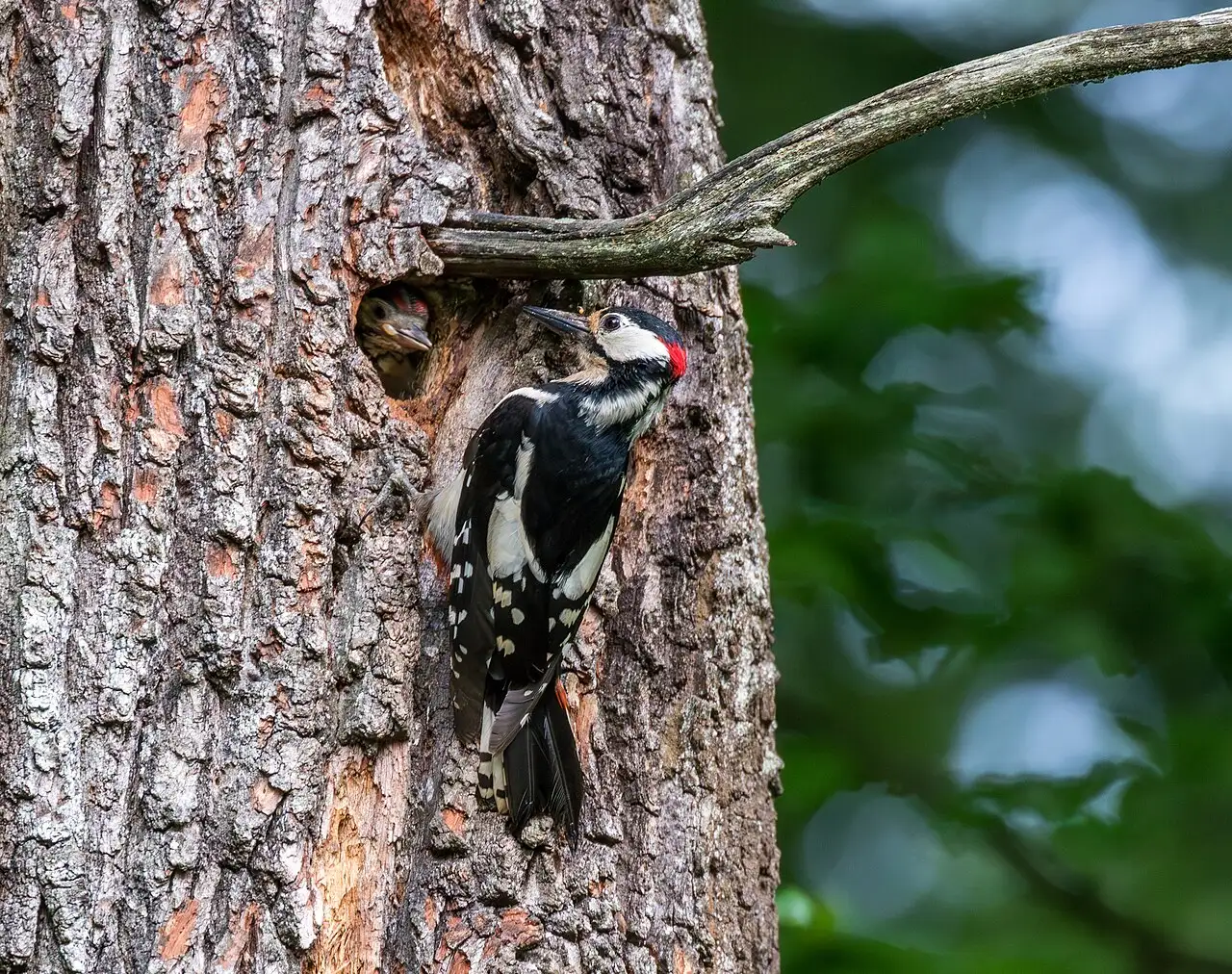
Male Great Spotted Woodpecker clinging to a trunk beside the entrance to its nest, with red napePhoto: JoachimKohler-HB, CC BY-SA 4.0Photo 1 of 4
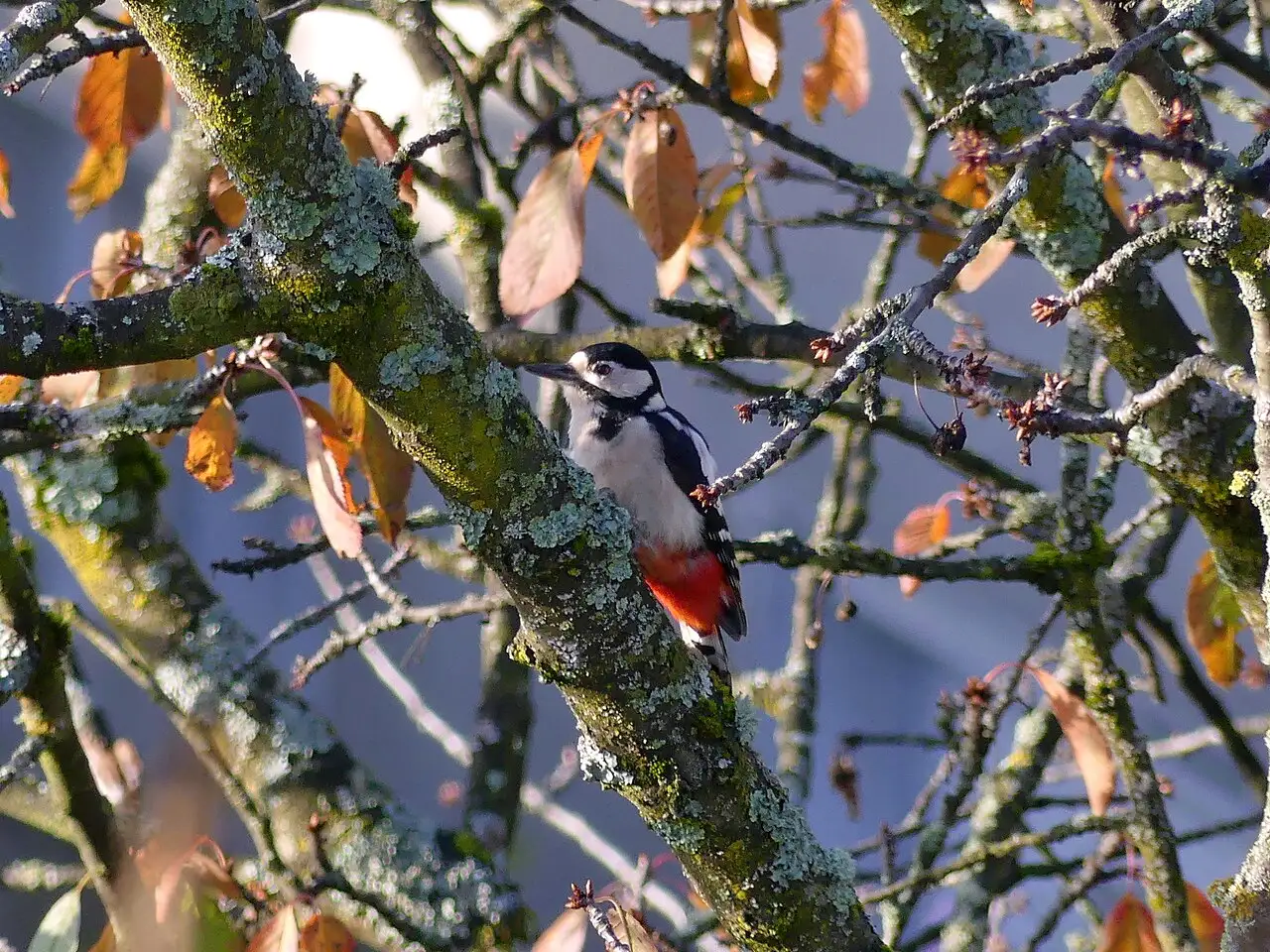
Great Spotted Woodpecker in the branches of a cherry tree in autumn, with the intense red under the tailPhoto: Florian Pépellin, CC BY-SA 4.0Photo 2 of 4
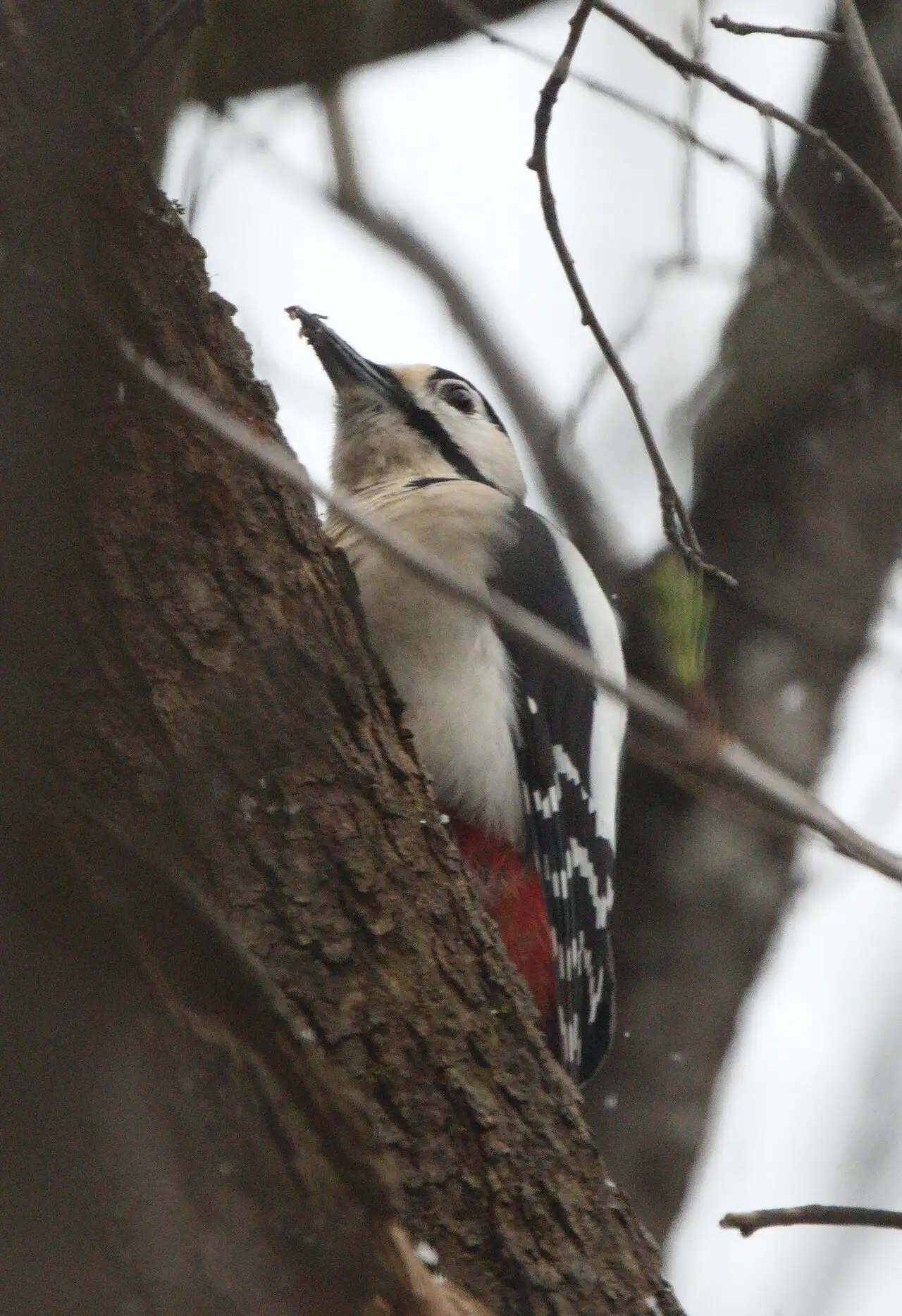
Great Spotted Woodpecker on a trunk, in profile, with pale breast, black-and-white back and the red under the tailPhoto: Tobias Schönberg, CC0Photo 3 of 4
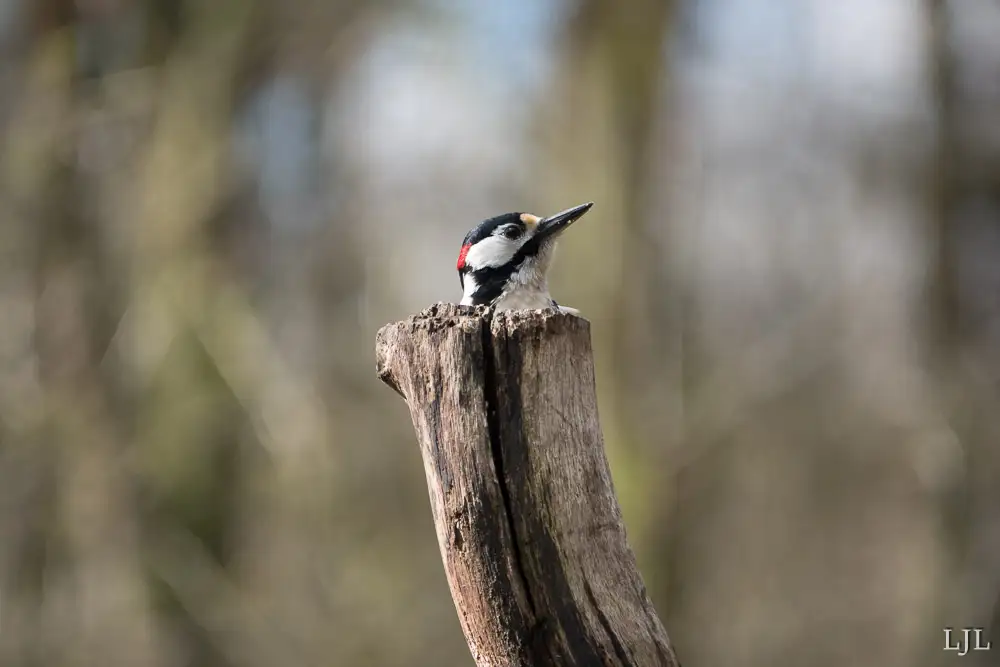
Male Great Spotted Woodpecker perched on top of a stump, with red nape and the black stripes of the facePhoto: Leo Luijten from Netherlands, CC BY 2.0Photo 4 of 4
1 / 4
Identification of the Great Spotted Woodpecker
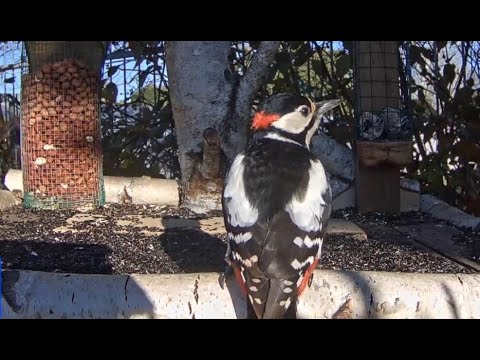
It shares the typical colouring of woodpeckers, with very intense, well-defined tones. The back is black and white and it has black stripes on both sides of the face and neck that link up with the breast, the bill, the shoulders and the nape. The underparts are white, with no streaks or spotting, and the anal area wears an extensive reddish colouring. It has four toes, two forward and two back, with which it climbs trunks, and it uses the strong tail as a lever.
Male
Red nape.
Female
Black nape.
Young bird
More diffuse plumage, with dirty-white underparts and less red under the tail.
It has a red crown.
Habitat and distribution of the Great Spotted Woodpecker
It is the most widespread woodpecker of the whole of European birdlife: it is spread across the whole Palearctic as far as the south of the Atlas, Anatolia, the Caucasus, northern Iran and Mongolia. It is absent from Ireland and some islands. Numerous subspecies are recognised; on the Peninsula «hispanus» lives.
In Spain it is found across the whole territory, but is more abundant and better distributed in the northern half, except in the arid regions of the Ebro valley. In the south it is concentrated in mountain districts, and is scarce or absent in the Levante, the Guadalquivir valley and the plains of La Mancha and Extremadura. It occupies every kind of woodland of some maturity, closed or open, from alpine pine woods above 2,000 metres in the Pyrenees to poplar groves at sea level, although it prefers dense conifer woods. That adaptability is due in part to its being able to work almost any wood, even the hardest, such as holm oak, juniper or yew. It is resident throughout its range.
Areas where it is regularly recorded since 2010Squares of about 25 km where it is recorded regularly (occasional passage records are left out). Data from GBIF.org (236,391 records, retrieved October 2026); outline from Natural Earth.
Etymology of the Great Spotted Woodpecker
«Dendrocopos» comes from Greek «dendron», «tree», and «kopos», «the one who strikes», and «major» is «the greater» in Latin. Spanish «picapinos» alludes to its pecking pines, but also holm oaks and other woods.
Population of the Great Spotted Woodpecker
In Spain there are close to 800,000 individuals, with the most important cores on the northern plateau and the Central, Iberian and Betic systems, among others. According to the SACRE programme, the population shows a moderate increase across its whole range. In Europe between 17.2 and 27.3 million mature individuals are estimated, with a decreasing trend. It is classified as Least Concern. It is affected by the felling of woods, fires, the removal of dead trees and inadequate forestry practices, which prevent good densities in some areas.
Nest of the Great Spotted Woodpecker
It is a deep tunnel that it excavates in the wood of a tree and that begins in May and takes it two or three weeks. For that the skull is made of spongy bones, full of small chambers of air that cushion the impact, and the bill is longer below so that the lower part of the head absorbs most of the blow. It does not reuse the nest each season, and starlings, tits, hoopoes, bats and squirrels make use of it afterwards.
Courtship and breeding of the Great Spotted Woodpecker
Laying is usually in June and consists of four to seven white eggs, which both parents incubate for 10 to 13 days. They feed the chicks together for 20 to 23 days with abundant invertebrates. Then the chicks leave the cavity, although they go on receiving food from their parents for a few days more.
Diet of the Great Spotted Woodpecker
It eats mainly insects, especially their larvae, which it looks for by excavating with its bill inside the wood or under the bark. In winter, when they are scarce, it takes plant matter, such as pine nuts, acorns, hazelnuts and other nuts: it wedges them in a hole in the bark and then drills the shell. It often drills grooves in pines to suck the sap. Sometimes, in the breeding season, it eats eggs and chicks of other woodland birds.
Curious facts about the Great Spotted Woodpecker
Because it does not reuse the nest, the holes it makes are made use of afterwards by starlings, tits, hoopoes, bats and squirrels, and that is why it is considered a multiplier of forest biodiversity. And its skull, of spongy bones, is a small feat of engineering against blows.
The Great Spotted Woodpecker in Cabañeros
The habitat pages of this website cite it among the birds of the mature scrub of the sclerophyllous forest and, at lower density, among those of the deciduous forest.
Where to see the Great Spotted Woodpecker in Cabañeros
In the sclerophyllous forest and the Pyrenean oak woods of Cabañeros, in old trees.
When
All year round. In late winter and spring, when it drums, it is easier.
What time
In the morning, when the drumming can be heard from afar.
Where
Pressed against the trunks and thick branches of holm oaks, cork oaks and Pyrenean oaks, pecking the bark.
What to look for
A black-and-white bird with red under the tail, which climbs the trunk in hops, and a very rapid tapping.
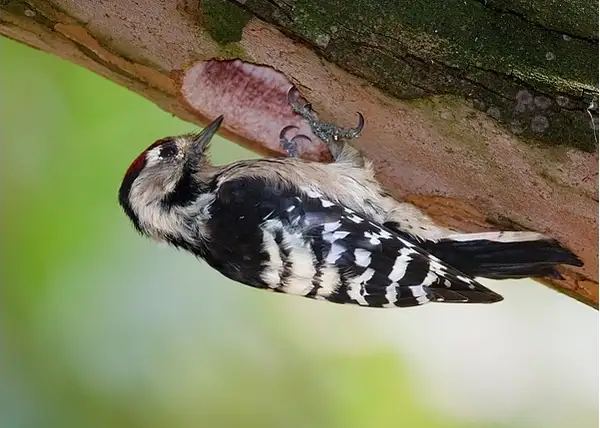
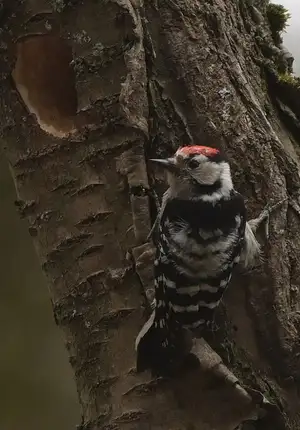
The size of a sparrow, with the back barred in white and black, without the red under the tail, and the crown red in the male. It is much scarcer.
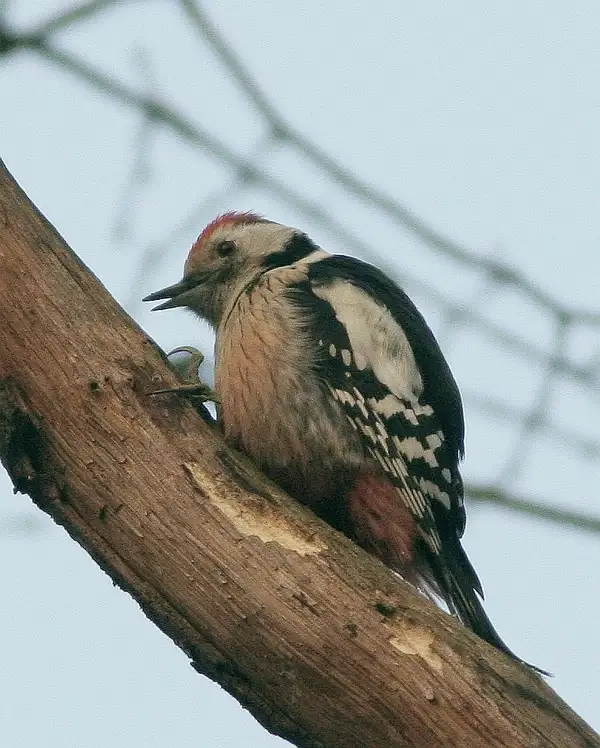
Photo: Martin Mecnarowski, CC BY-SA 3.0
Middle Spotted Woodpecker
Dendrocoptes medius
How to tell them apart
Somewhat smaller, with the crown red in both sexes, the breast streaked and without the Great Spotted Woodpecker’s complete black moustache. Tied to old oak woods.
Photo: Artur Mikołajewski, CC BY 3.0
Other birds
Birds related to the Great Spotted Woodpecker or sharing its habitats in Cabañeros.




 Same family
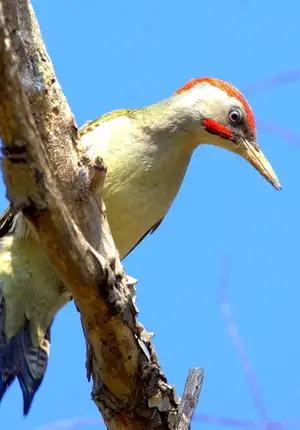 Same family
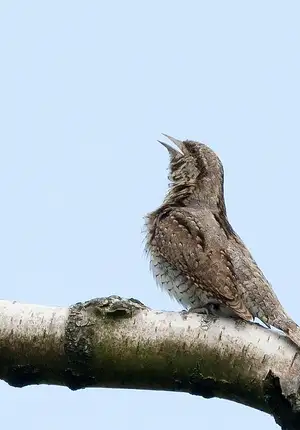 Same family
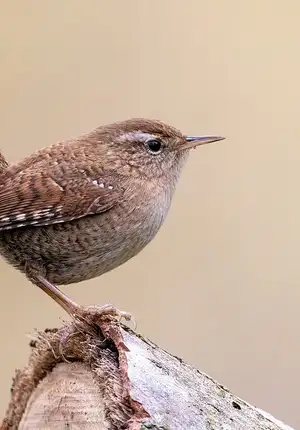 Also in sclerophyllous woodland
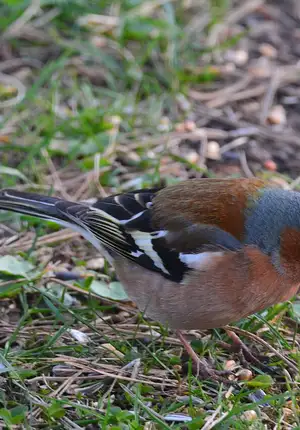 Also in sclerophyllous woodland
 Also in sclerophyllous woodland
 Also in sclerophyllous woodland
 Also in sclerophyllous woodland






