The male is polygamous: he builds the nest and attracts one or several females
Lifespan
Record of 7 years and 3 months in the wild (a bird ringed in Hungary)
Conservation status
LC
NT
VU
EN
CR
EW
EX
Global (IUCN)
Least Concern
Spain
Least Concern (LC) in the Red Book of the Birds of Spain; included in the List of Wild Species under Special Protection and not in the Spanish Catalogue of Threatened Species
When to see it
Resident
Months of the year when it is present
J
F
M
A
M
J
J
A
S
O
N
D
In Iberia
yes
yes
yes
yes
yes
yes
yes
yes
yes
yes
yes
yes
Song or voice of the Eurasian Penduline Tit
The call consists of an aspirated «tsii» or «tsiiuj», repeated several times; the song is based on a series of slow variations of the call.
CallEurasian Penduline Tit
0:00 / 0:30
10 kHz5
The sonogram draws the sound: time runs from left to right, and the higher a trace sits, the higher the note.Recording by AviCanto, Wikimedia Commons (Vídeo de YouTube, con atribución).
Flight of the Eurasian Penduline Tit
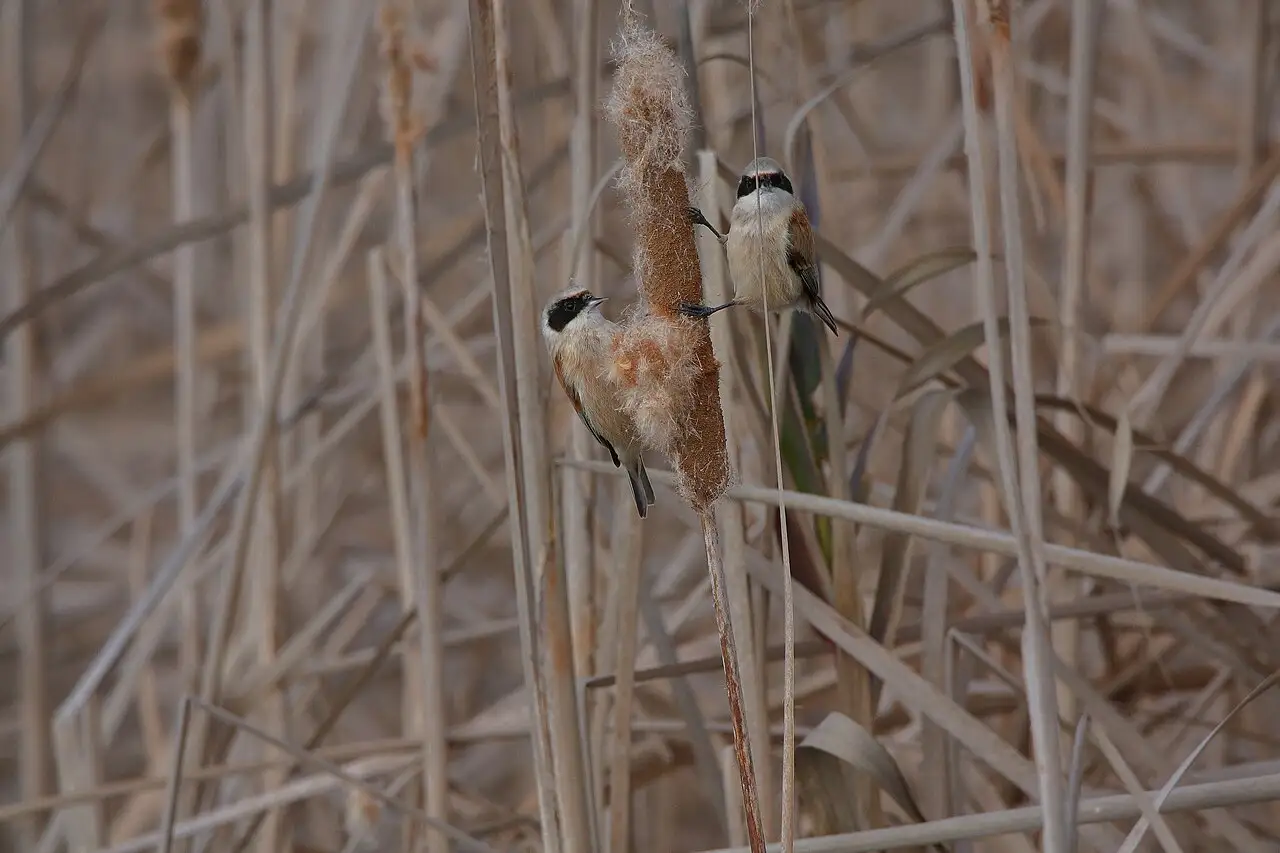
It is a tiny, discreet little bird that wanders agilely among the branches of trees and reed stems, and among the dense, thorny scrub of riverbanks.
Flight typeAgile, among the branches and reed stems
A regular inhabitant of reedbeds and riverside groves with dense, thorny scrub, it leaves a willow or poplar branch, where its aspirated, repeated «tsii» is heard.
It wanders agilely among the branches of trees or reed stems, on the banks of the middle and lower stretches of rivers.
It carefully goes over branches, stems, buds or flowers of willows, poplars and reeds in search of spiders and insects and their larvae.
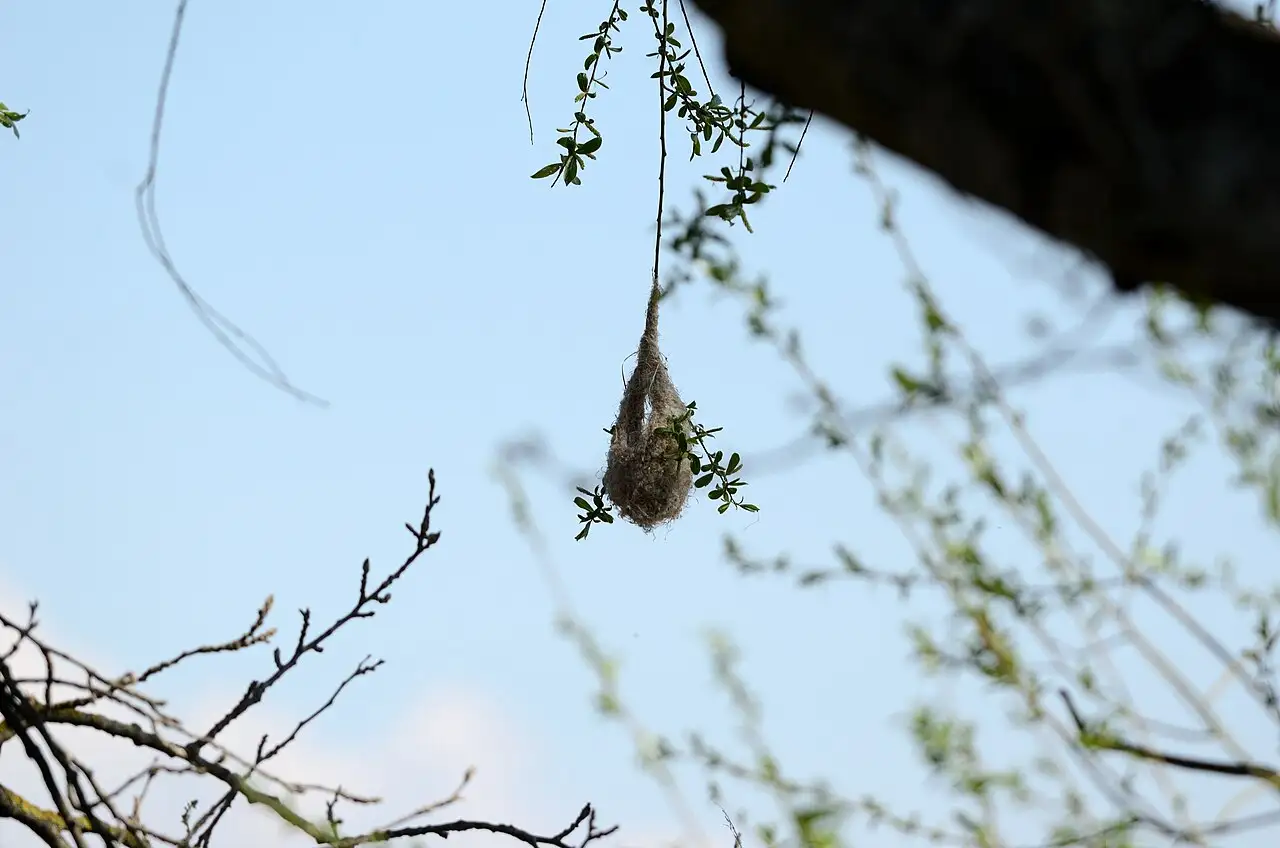
Globular nest of a Eurasian Penduline Tit hanging from the end of a thin branch against the skyPhoto: Nicolas Weghaupt, CC0Photo 3 of 4
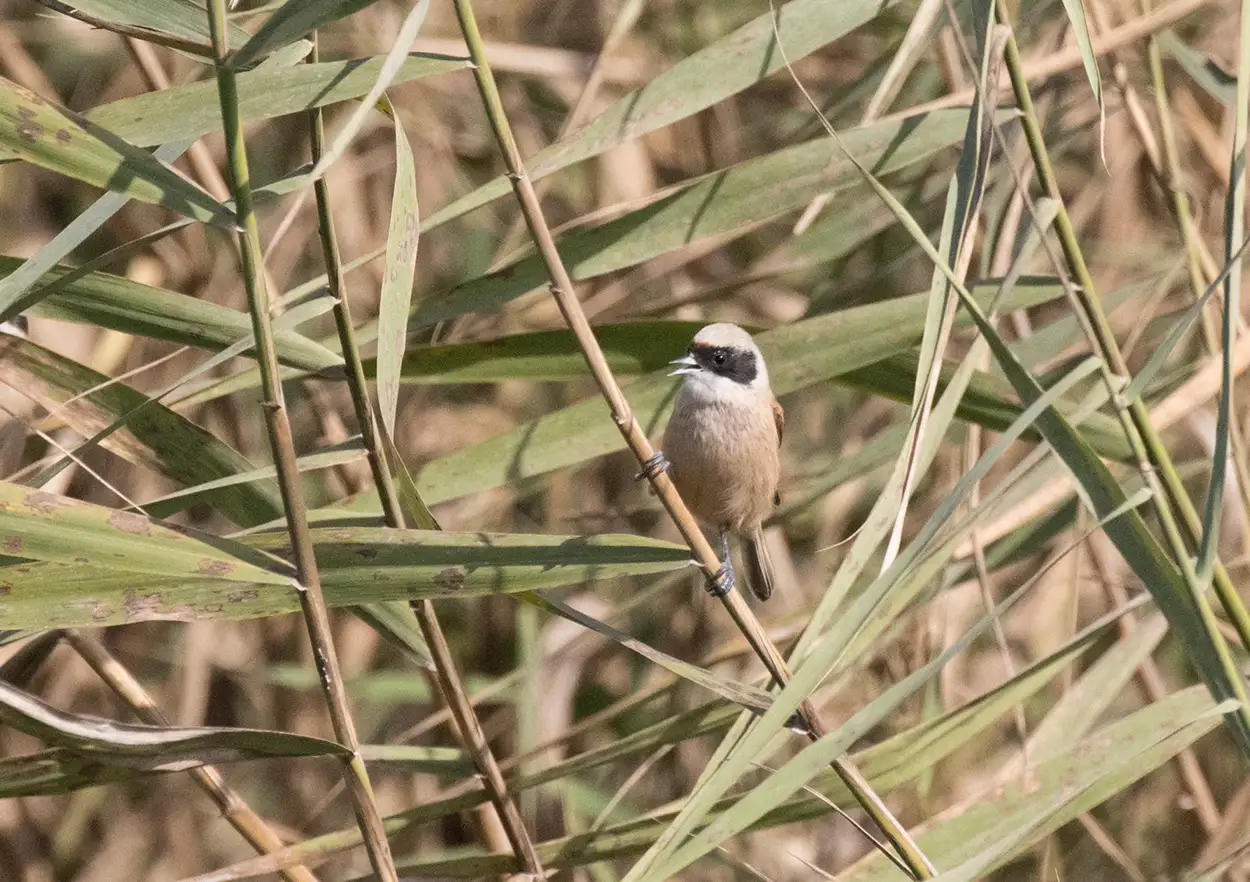
Eurasian Penduline Tit perched on a reed stem, from the front, with the black face maskPhoto: Zeynel Cebeci, CC BY-SA 4.0Photo 4 of 4
1 / 4
Identification of the Eurasian Penduline Tit
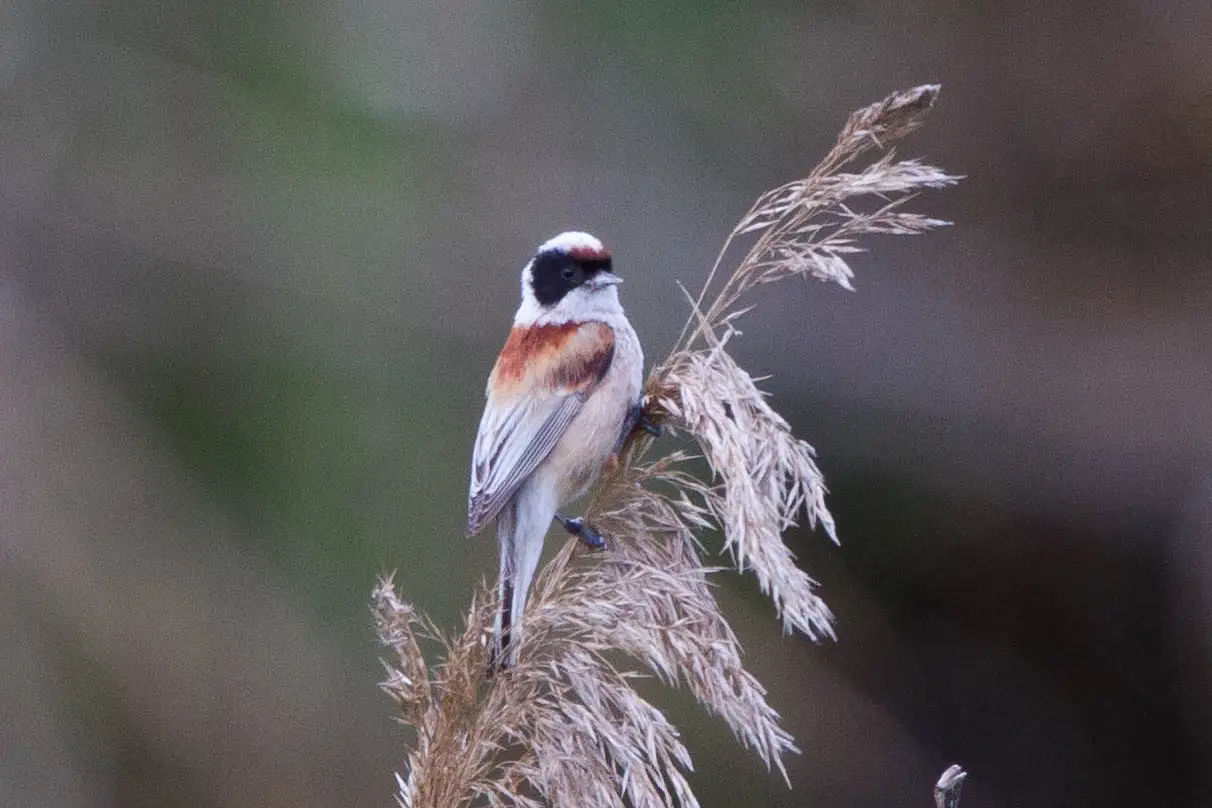
It is a tiny, discreet little bird that is easily recognised by the striking black face mask, which stands out vividly against the whitish-grey colouring of the head and extends from the lower forehead to the ear region. The mask is somewhat less evident in the female and greyish in juveniles. The upperparts wear a chestnut tone, paler in the female, with black edges. The belly is dark, with diffuse reddish-brown spots on the breast.
Male
Black face mask on the whitish-grey head.
Chestnut back with black edges.
Female
Mask somewhat less evident and back paler.
Juvenile
Greyish mask.
Habitat and distribution of the Eurasian Penduline Tit
Three subspecies are known, distributed along a temperate-climate strip of Eurasia. It is absent from some regions of northern and central Europe, although at present it is expanding towards these areas. In Spain the subspecies «pendulinus» lives.
It is concentrated along the basins of the great rivers of the Peninsula (Duero, Tagus, Guadiana, Guadalquivir and Ebro and their main tributaries) and is more abundant in the northern half of the Peninsula, in Castilla y León, Madrid, Navarre, Aragon and Catalonia. It is absent from the Cantabrian fringe, Galicia and both archipelagos, as well as Ceuta and Melilla. In recent decades a loss of territories is observed in the northern half of the Peninsula against an expansion in the southern half, above all in Extremadura, Andalusia and the province of Ciudad Real.
It is closely tied to the banks of the middle and lower stretches of rivers, as well as lakes, streams, ponds or estuaries, as long as they have abundant tree vegetation (willows, poplars and elms) mixed with reeds, cattails and dense, thorny shrubs. In these places it finds not only protection, but ideal sites to set up its nests.
In the most southerly countries of its range it is sedentary; northern birds are migratory and move south and south-west Europe in late summer. In Spain, Iberian birds concentrate in winter around the courses of the great rivers and wetlands, and also occupy a wide coastal strip of the Mediterranean seaboard that includes the Balearics.
Areas where it is regularly recorded since 2010Squares of about 25 km where it is recorded regularly (occasional passage records are left out). Data from GBIF.org (62,572 records, retrieved October 2026); outline from Natural Earth.
Etymology of the Eurasian Penduline Tit
According to Wikipedia, «Remiz» is the Polish word for this bird. In other languages it is called «teixidor» in Catalan, «paxaro-moscón europeo» in Galician, «dilindaria» in Basque and «Eurasian penduline tit» in English1.
Population of the Eurasian Penduline Tit
In the 2021 European Red List of Birds, the European breeding population is estimated at between 518,000 and 940,000 mature individuals, with an increasing trend. The size of the current breeding population in Spain is unknown. The trend shows a moderate increase in the last two decades, according to data from the SACRE common bird monitoring programme, with a particularly notable growth in the southern region, which offsets the negative trend in the northern Mediterranean region; these data seem to corroborate its expansion southwards.
The main problems come from the destruction of its nesting habitat, the burning of reedbeds and the abusive use of insecticides, to which must be added the collection of its nests. All the same, the species is expanding thanks, to a large extent, to conservation work on riverside groves and marshy areas included in protected natural areas.
Nest of the Eurasian Penduline Tit
Before pairing up, males build an extraordinarily complex nest, which they set at the end of a willow or poplar branch. The structure, of plant fibres, is globular in shape and is covered on the outside with the white down these trees produce. When the pair is formed, both finish the nest with an access tunnel to the chamber, attached to the main structure, and with the lining of the interior, for which they use soft materials, such as wool or down. The result is a sturdy structure, completely sealed off from the outside.
Courtship and breeding of the Eurasian Penduline Tit
With the work half finished, the hard-working male focuses on attracting one or several females, since he is polygamous: he gives his nuptial song perched on a nearby branch until a female shows interest in the construction and goes in. The female lays between five and eight eggs (sometimes more), plain, matt and white, which she incubates for 13 or 14 days, while the male brings food to the various families he has formed. The chicks hatch and develop in some 21–25 days.
Diet of the Eurasian Penduline Tit
Its diet is based mainly on small invertebrates (spiders, insects and their larvae), which it obtains by searching thoroughly the branches, stems, buds or flowers of willows, poplars and reeds. Throughout the winter it also eats plant matter, above all buds and seeds of willows.
Curious facts about the Eurasian Penduline Tit
Its nest is, without doubt, one of the most elaborate and complex of the whole of Spanish birdlife. The longest-lived ringed bird, checked in Hungary, reached 7 years and 3 months.
The Eurasian Penduline Tit in Cabañeros
This website’s page on the rivers of Cabañeros cites it, together with the Little Bittern, among the community of birds of the helophytic vegetation, and describes it as «scarce in the willow groves».
Where to see the Eurasian Penduline Tit in Cabañeros
In the willow groves and riverside vegetation of the rivers of Cabañeros, where it is scarce.
When
All year round: it is resident and in winter it concentrates around the great rivers and wetlands.
What time
In good light, going along the banks with binoculars.
Where
In willow groves, reedbeds and riverside groves with dense, thorny scrub.
What to look for
Look for the black mask on the pale head and the globular nests hung from the branches of willows and poplars.



 Also in rivers and riverbanks
 Also in rivers and riverbanks
 Also in rivers and riverbanks
 Also in rivers and riverbanks
 Also in rivers and riverbanks
 Same order
 Same order
 Same order






