Migrant throughout its range, with a fairly large wintering population on coastal areas
Lifespan
Record of 28.8 years in the wild according to AnAge; EURING lists a bird ringed in Norway that lived 24 years
Conservation status
LC
NT
VU
EN
CR
EW
EX
Global (IUCN)
Near Threatened
Spain
Least Concern (LC) as a winter visitor and migrant in the Red Book of the Birds of Spain; on the List of Wild Species under Special Protection, but not in the Spanish Catalogue of Threatened Species
When to see it
Winter visitor
Months of the year when it is present
J
F
M
A
M
J
J
A
S
O
N
D
In Iberia
yes
yes
yes
yes
yes
no
no
yes
yes
yes
yes
yes
Song or voice of the Dunlin
The species’ characteristic sound in flight is a dry «crit»1. The recording (call of a flock feeding on the mud at low tide) is by Jacobo Ramil Millarengo and was made in the O Bao marsh, at O Grove (Pontevedra, Galicia) (xeno-canto XC845733, quality A). It lasts 9 seconds and is a trimmed section of a 27 s clip, without repeating or lengthening, from which we have removed the bass below 300 Hz, reduced the background noise and adjusted the volume; neither pitch nor speed has been changed.
It behaves as a migrant throughout its range, although with movements of different range1. The autumn passage along the Iberian and Balearic coasts runs from August to October, and the spring one, from April to May, which is less conspicuous in the Mediterranean; both passages are hardly evident on inland waters.
Flight typeRuns over the mud and flies in flocks
In winter and on passage it stops over on intertidal flats, estuaries, coastal lagoons and even the shores of inland waters, and from there it takes flight.
The species' characteristic sound in flight is a dry «crit».
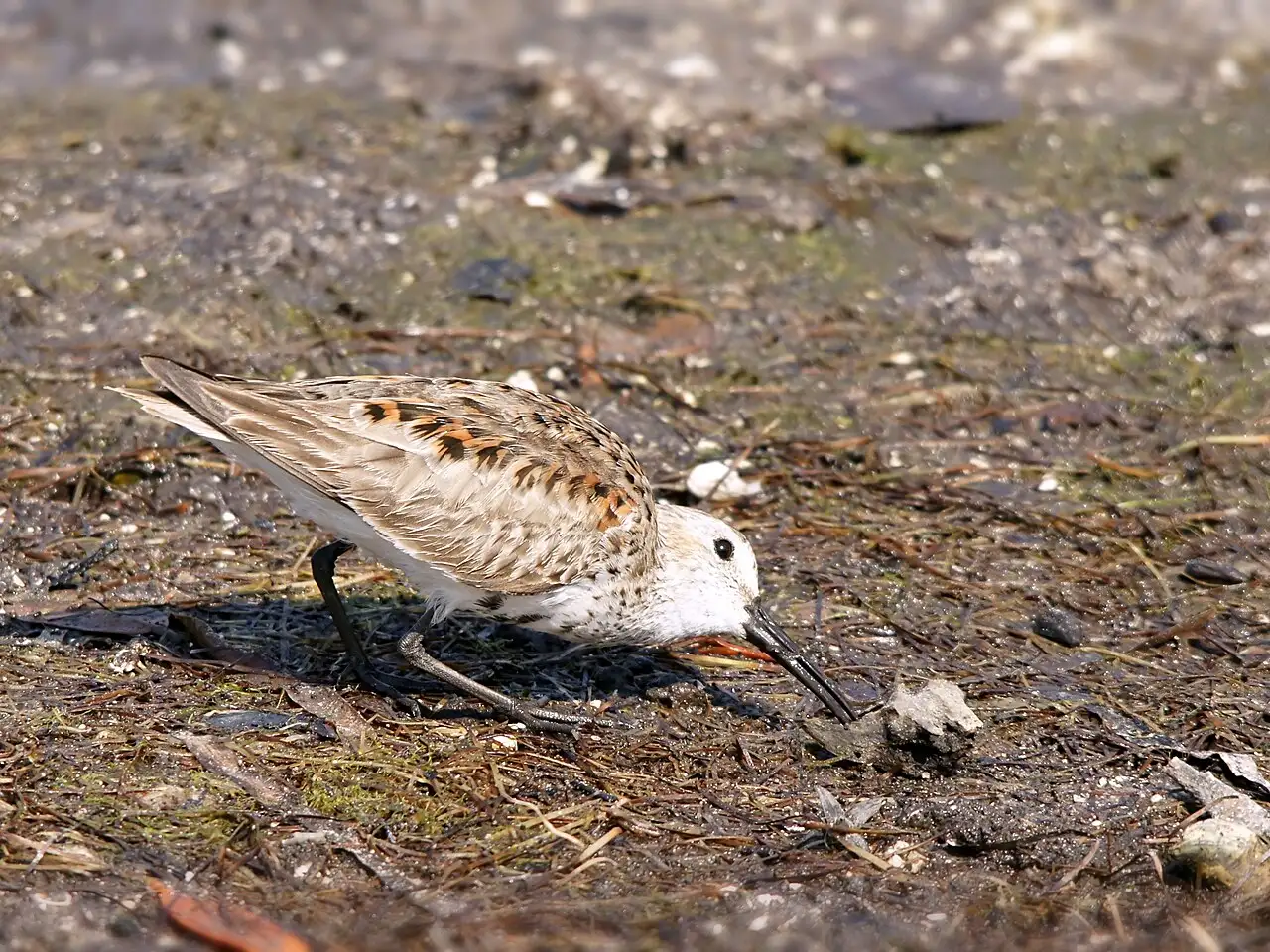
It catches at a run, on the surface or at shallow depth within the mud, invertebrates such as insects and their larvae, small crustaceans and annelids.
Photo gallery of the Dunlin
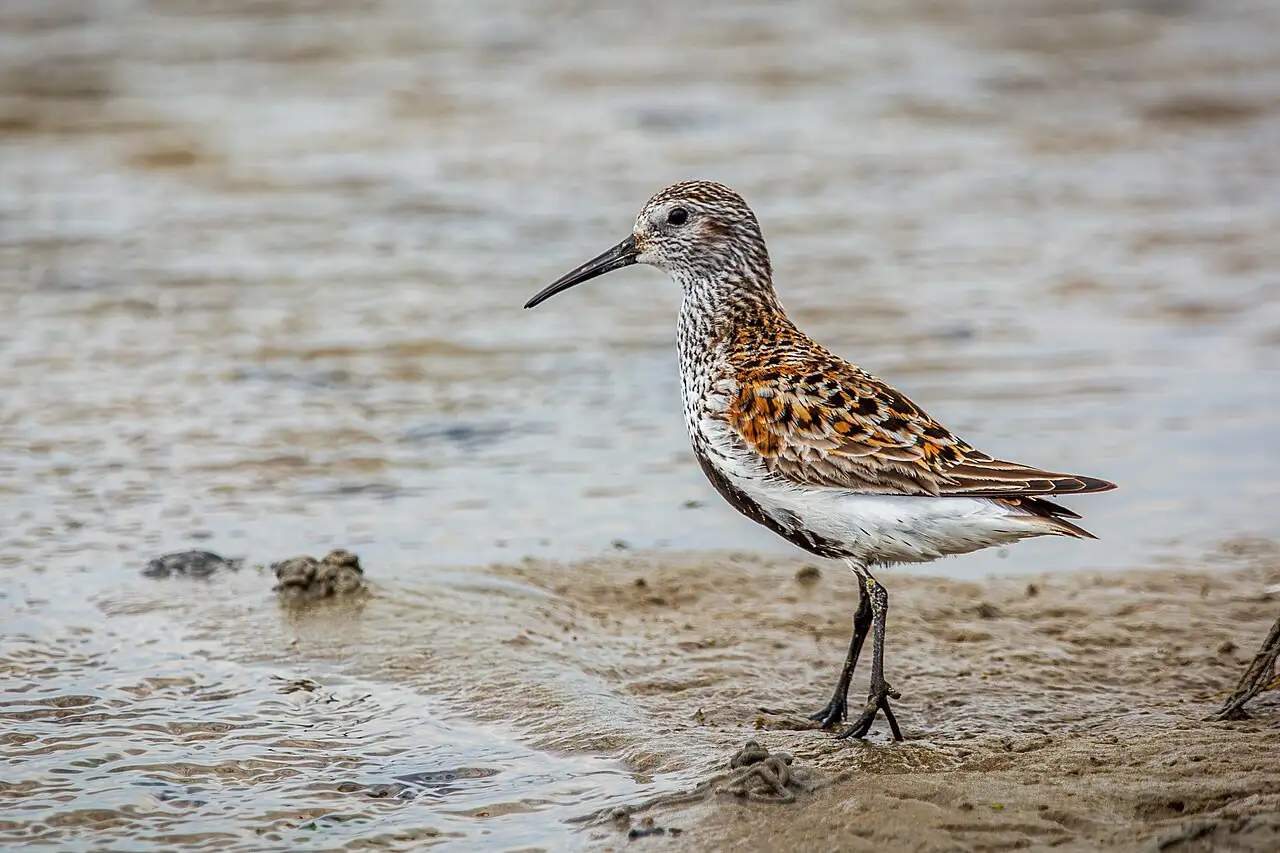
Adult Dunlin in breeding plumage, in profile on damp mud, with reddish back speckled with black, belly with the black patch and long, slightly curved billPhoto: Stephan Sprinz, CC BY-SA 4.0Photo 1 of 5
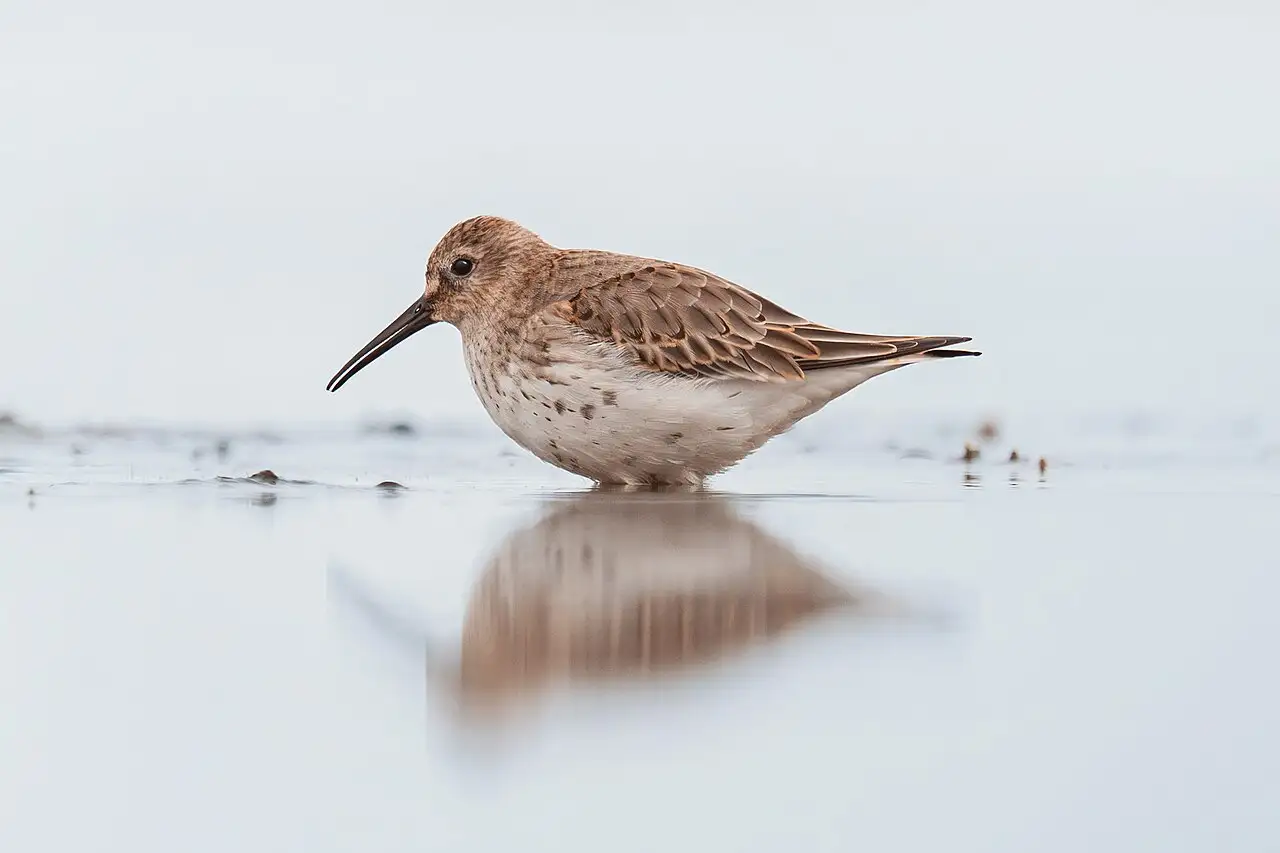
Dunlin in dull, greyish-brown plumage, in shallow water, with its reflection and the long, curved billPhoto: Aneta p, CC BY 4.0Photo 2 of 5
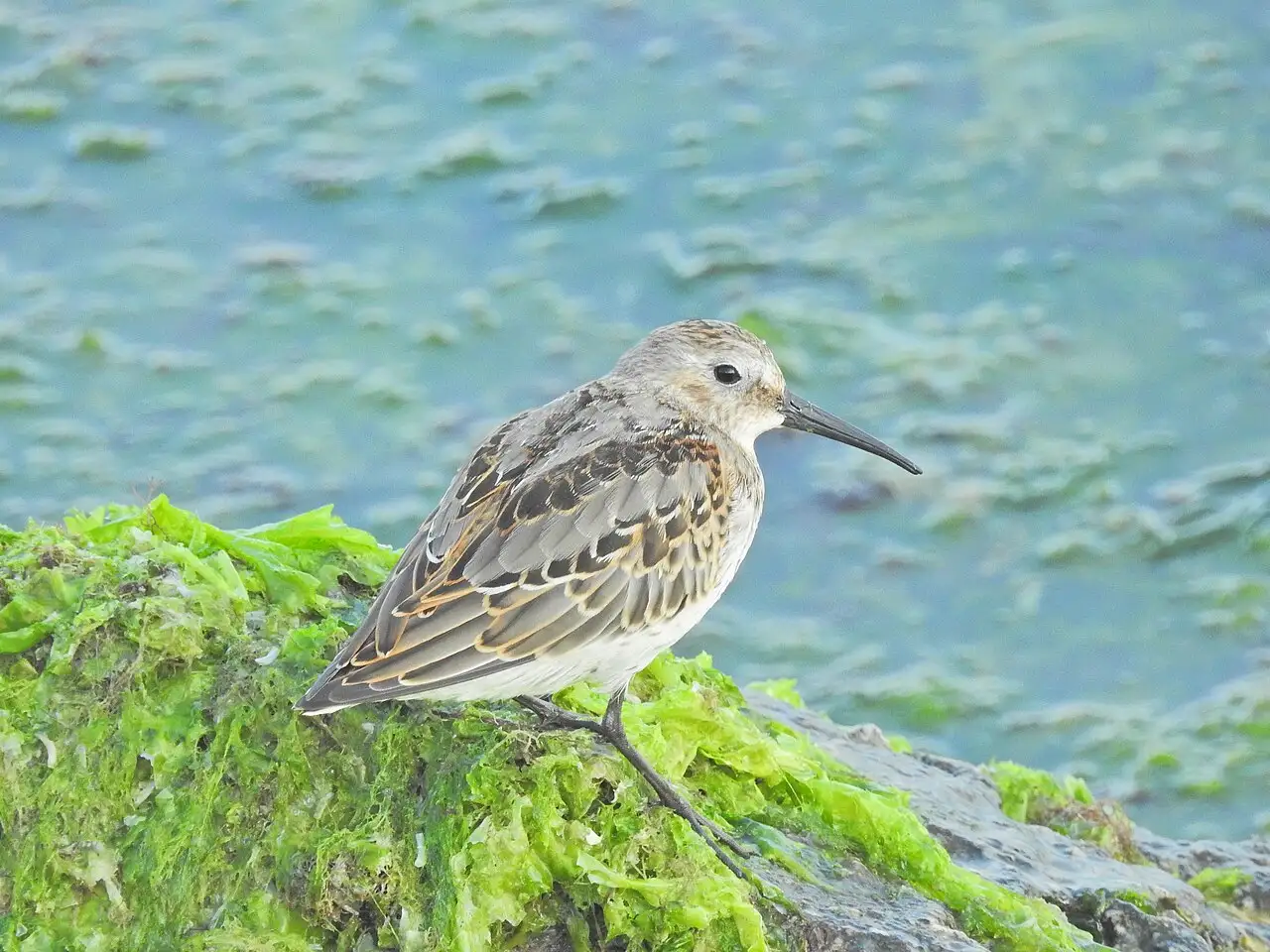
Dunlin in grey-brown plumage, perched in profile on a green alga, with the long, slightly curved billPhoto: xulescu_g, CC BY-SA 2.0Photo 3 of 5
Dunlin crouching in the mud, pecking among debris, with back speckled with reddish and white bellyPhoto: Hans Hillewaert, CC BY-SA 3.0Photo 4 of 5
Dunlin in winter plumage, walking on the mud with the long bill curved somewhat downwards (Galicia)Photo: Diego González Dopico, CC BY 4.0Photo 5 of 5
1 / 5
Identification of the Dunlin
The Dunlin, or «correlimos común», is a medium-sized bird, with dark-coloured bill and legs. The adult in breeding plumage shows a very striking black belly patch, with the boundary more or less diffuse, and the upperparts in reddish, black and brownish tones, in varying amounts depending on the subspecies. The non-breeder is a uniform grey tone, with a white belly and faint streaks on the neck and breast, while the juvenile is orange-brown, with a diffuse streaking on the breast and neck and the edges of the mantle feathers very pale.
Breeding adult
Black belly patch, very striking.
Upperparts reddish, black and brownish.
Non-breeder and juvenile
Non-breeder: uniform grey, white belly and faint streaks on the neck and breast.
Juvenile: orange-brown, with diffuse streaking and the edges of the mantle very pale.
Habitat and distribution of the Dunlin
It is widely distributed as a breeder across Alaska, Canada, Greenland, Iceland, the British Isles, some points of Central Europe, Scandinavia and Russia. In winter it moves south, to temperate and subtropical areas, without crossing the equator. There are several subspecies; in Spain up to three can be found, «alpina» (northern Europe), «schinzii» (south-east Greenland and North Atlantic islands) and «arctica» (north-east Greenland), and occasionally «sakhalina», from north-east Siberia.
In Spain the winter distribution corresponds to a large extent to the spring one: it is well spread across coastal areas and, to a lesser extent, inland waters, where it thins out during the spring passage1. It winters in good numbers in the Ebro delta, the Guadalquivir marshes, the Galician rías and the Bay of Cádiz, although it is seen in many other wetlands and coastal areas, both Atlantic and Mediterranean, and in the Canaries.
During breeding it prefers grasslands with small lagoons, boggy areas, fens and damp moors; on migration passage and in winter it stops over on intertidal flats, estuaries, coastal lagoons and even the shores of inland waters.
Areas where it is regularly recorded since 2010Squares of about 25 km where it is recorded regularly (occasional passage records are left out). Data from GBIF.org (163,083 records, retrieved October 2026); outline from Natural Earth.
Etymology of the Dunlin
According to Wikipedia, Linnaeus described it in 1758, with the locality of Lapland, under the name «Tringa alpina». It is also known as «correlimos común»; in other languages it is «territ variant» in Catalan, «pilro común» in Galician, «txirri arrunta» in Basque and «dunlin» in English1. We have not found a source explaining the origin of the register’s name, «playero dorso rojo», or the scientific one, so we do not venture one.
Population of the Dunlin
In the 2021 European Red List of Birds, the European breeding population is estimated at between 104,000 and 154,000 mature individuals, with an unknown trend; there are no population data for Spain. Among the main threats are the spread of invasive aquatic plants, such as «Spartina anglica», which prevent the development of the organisms it feeds on, and the transformation and destruction of wintering habitat through wetland drainage and uncontrolled industrial and urban development in marshes and other coastal habitats1.
Nest of the Dunlin
In the breeding areas, the nest is on the ground, hidden among vegetation or on a bush, and is a soft hollow lined with grasses and leaves.
Courtship and breeding of the Dunlin
In the breeding areas, the clutch, generally a single one, runs from late April to late May, although there may be replacement clutches until mid-June, and consists of three or four eggs of beige to bluish green, speckled with dark brown or reddish. Both sexes incubate them for 21–22 days; the chicks, which from the first moment move with ease, develop fully in some 19–21 days.
Diet of the Dunlin
It feeds mainly on invertebrates, from insects and their larvae to small crustaceans and annelids, which it catches at a run on the surface or at shallow depth within the mud.
Curious facts about the Dunlin
AnAge gives 28.8 years of longevity in the wild, somewhat more than the 24 years of EURING for a bird ringed in Norway. A large part of the migratory flow crossing the Peninsula continues beyond the Strait of Gibraltar, which it crosses between late August and early September1.
The Dunlin in Cabañeros
The habitat pages of this website do not mention it, and we have not found any other published source on it in the Park; nor does it appear in the bird list of the «Visitor guide to Cabañeros National Park» (OAPN). GBIF.org records 6 observations of the Dunlin in Cabañeros and its surroundings. On inland waters wintering and passage are hardly evident1. None of those observations falls within the Park boundary (according to OpenStreetMap): all are from the surroundings.
Where to see the Dunlin in Cabañeros
In Cabañeros and its surroundings, only on passage and occasionally, on the shores of ponds and reservoirs.
When
In Spain from August to May: passages from August to October and from April to May, with wintering in between.
What time
By day, running on the mud and pecking, often in flocks.
Where
On intertidal flats, estuaries, coastal lagoons and, less so, the shores of inland waters.
What to look for
Look for the black belly patch in summer and the uniform grey in winter; listen for the dry «crit» in flight.



 Same family
 Same family
 Same family
 Same family
 Same order
 Same order
 Same order
 Same order






