The female incubates; both sexes care for the young
Lifespan
Record of 22 years and 3 months in the wild (a bird ringed in Germany, found shot)
Conservation status
LC
NT
VU
EN
CR
EW
EX
Global (IUCN)
Least Concern
Spain
Endangered (EN) as a breeder and Least Concern (LC) as a winter visitor and migrant, in the 2021 Red Book of the Birds of Spain; not on the List of Wild Species under Special Protection or in the Spanish Catalogue of Threatened Species
When to see it
Winter visitor
Months of the year when it is present
J
F
M
A
M
J
J
A
S
O
N
D
In Iberia
yes
yes
yes
yes
yes
yes
yes
yes
yes
yes
yes
yes
Breeding season
no
no
no
no
yes
yes
yes
no
no
no
no
no
Song or voice of the Common Snipe
On taking off it gives a «catch» or «ca-atch», which it repeats as it flies. Its song is a long «chip-err», but the commonest sound in courtship is a hum, like a goat’s bleat, caused by air rubbing on the outer tail feathers of the males, spread as they make their diving flights.
Call, song and drummingCommon Snipe
0:00 / 0:38
10 kHz5
The sonogram draws the sound: time runs from left to right, and the higher a trace sits, the higher the note.Recording by AviCanto, Wikimedia Commons (Vídeo de YouTube, con atribución).
Flight of the Common Snipe
It has a fast flight, with a sudden take-off and zigzag path. In flight it looks brown overall, with the tail a reddish ochre tone.
Flight typeFast, with a sudden zigzag take-off
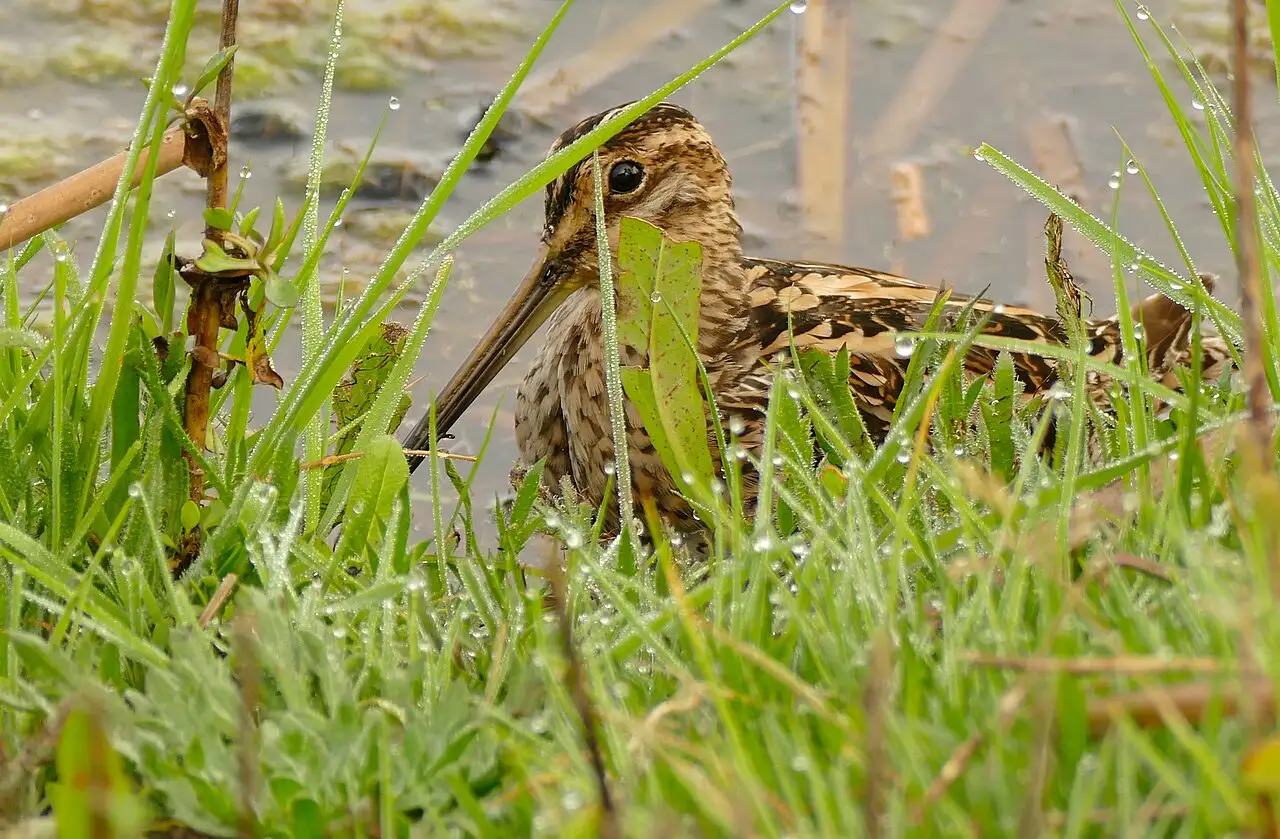
Very shy and discreet, it sinks its bill into the substrate of shallow water or waterlogged meadows; it takes off with a sudden start and gives a «catch» that it repeats as it flies.
It has a fast flight, on a zigzag path; in flight it shows a brown overall appearance, with the tail a reddish-ochre tone.
It is found in a great variety of wetlands, coastal or inland, above all on migration passage and in winter.
Photo gallery of the Common Snipe
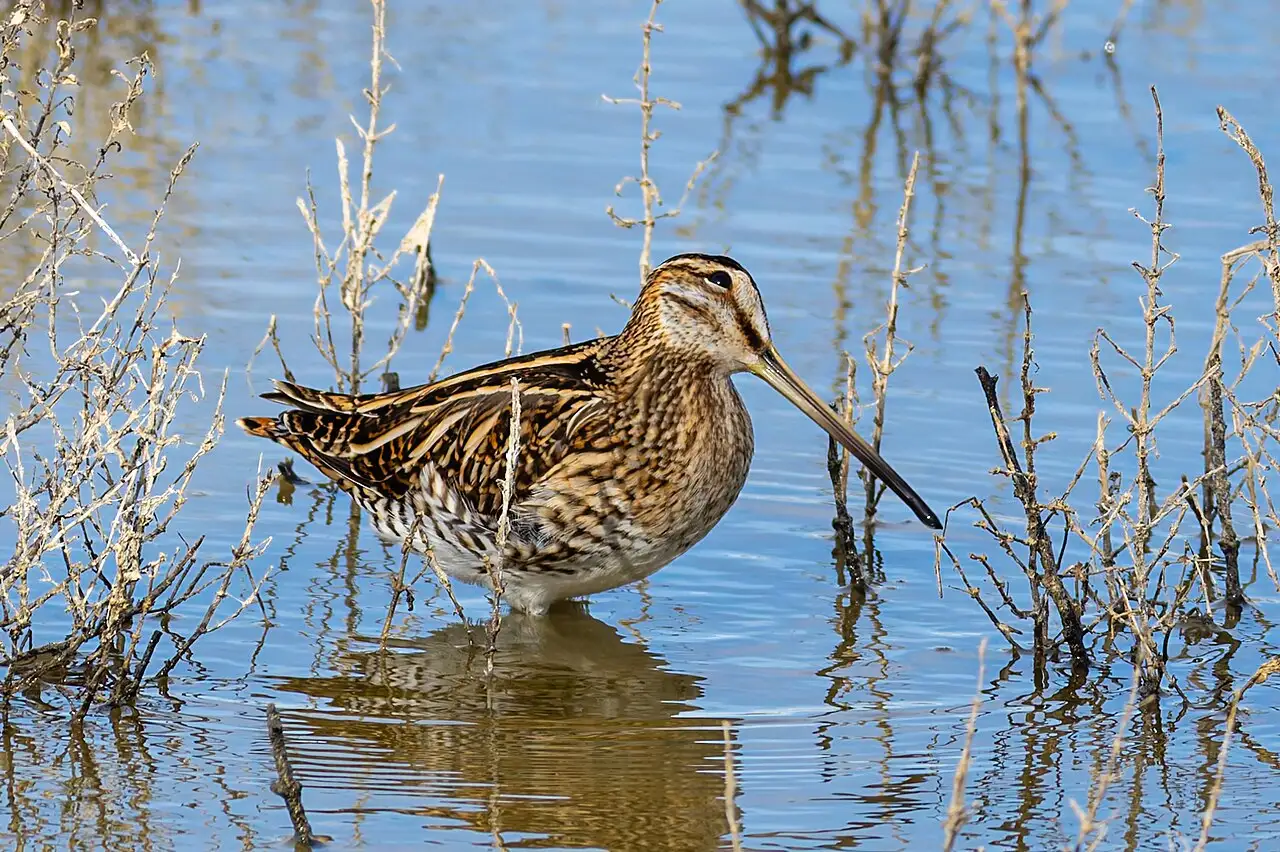
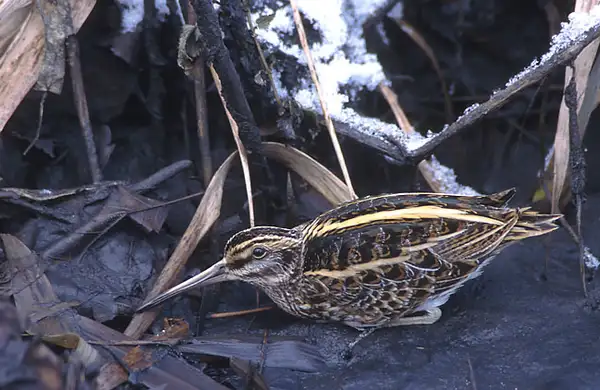
Common Snipe in profile, wading in shallow water, with a very long bill, mottled back and flanks with ochre barsPhoto: Hobbyfotowiki, CC0Photo 1 of 4
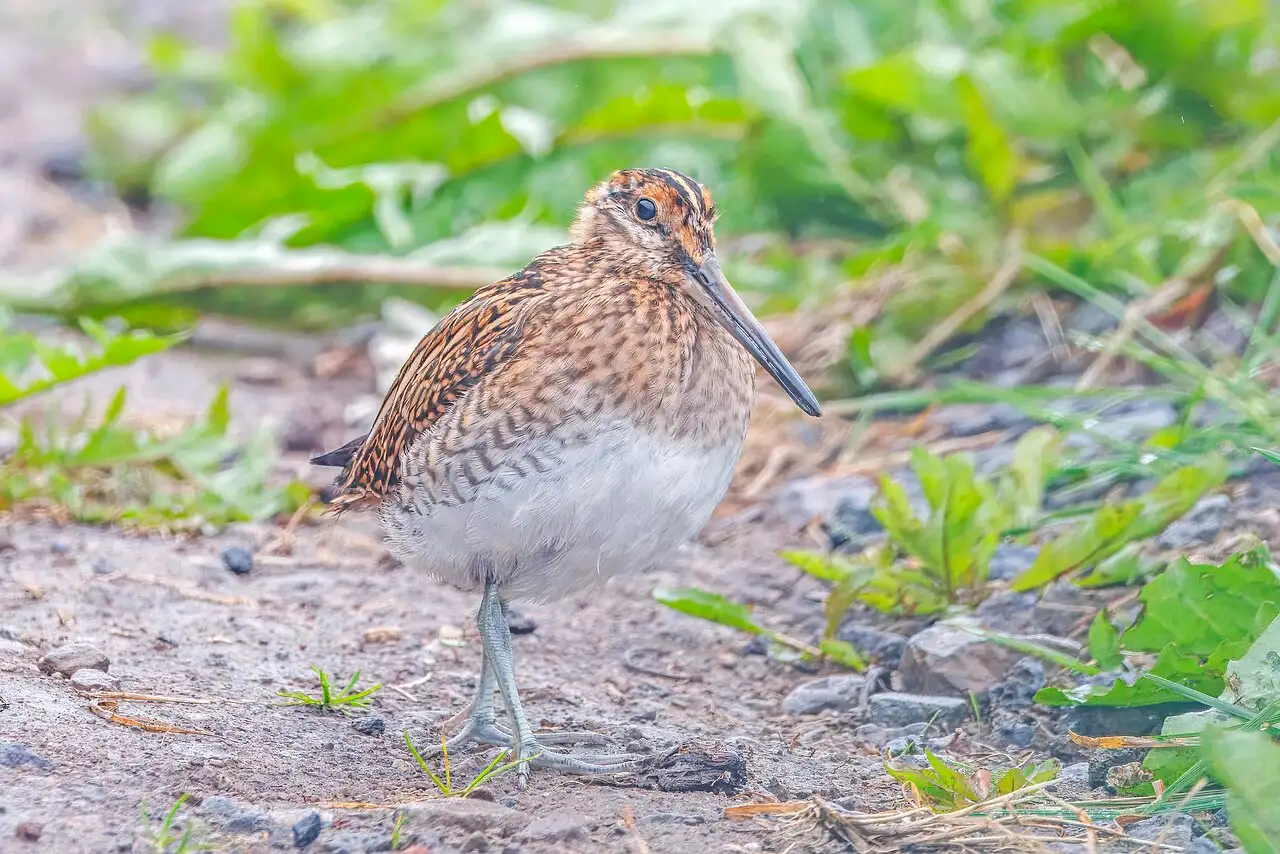
Common Snipe in profile on the mud, with plain white belly, ochre-streaked back and long billPhoto: Charles J. Sharp, CC BY-SA 4.0Photo 3 of 4
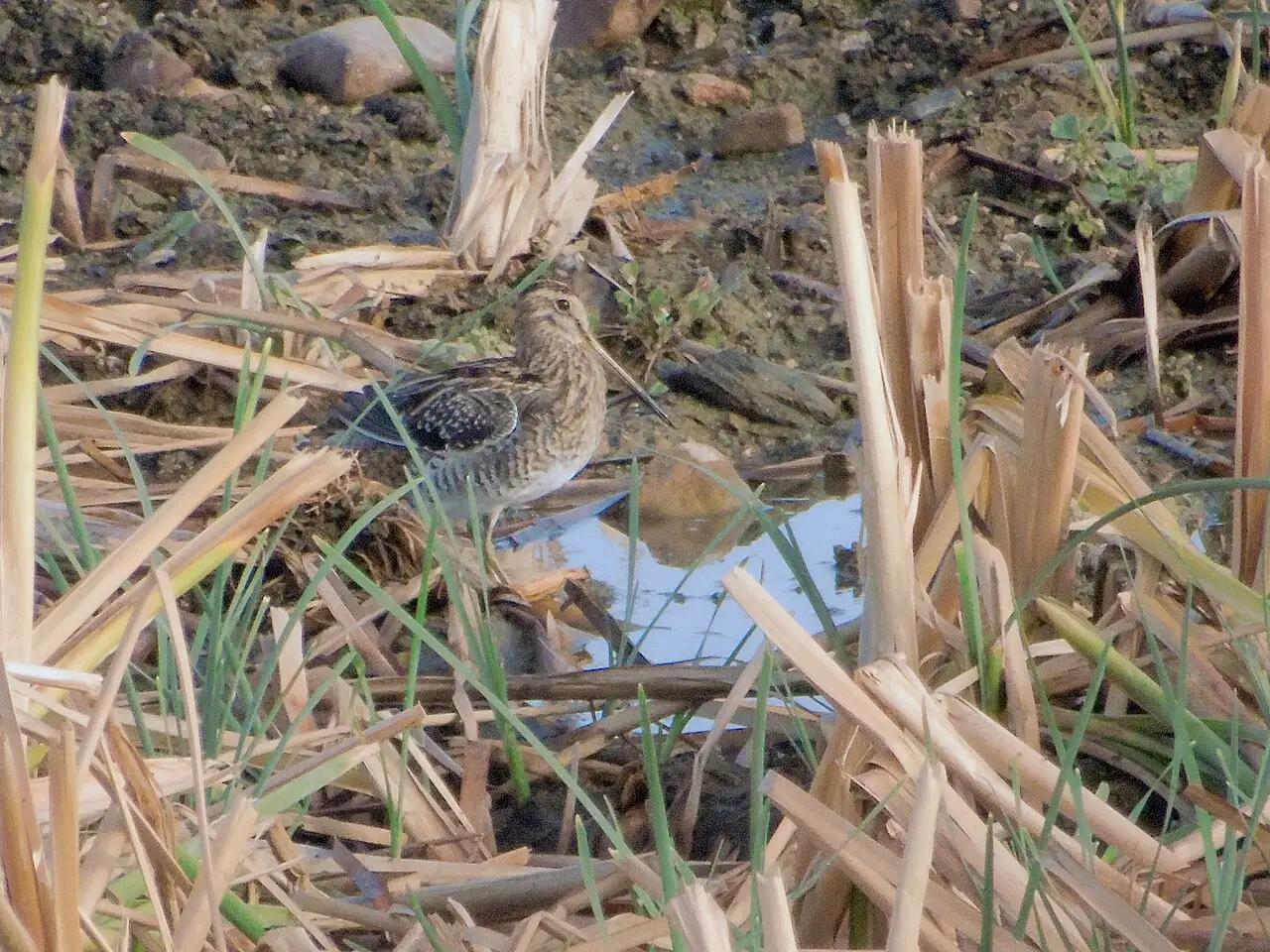
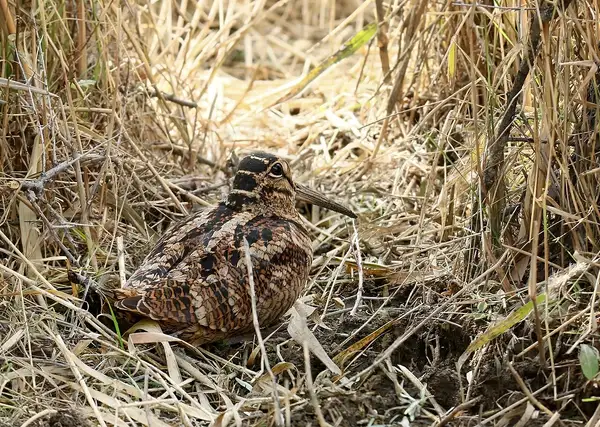
Common Snipe by the water among dry reeds at Sierra de Fuentes (Cáceres)Photo: Murisec 71, CC BY-SA 4.0Photo 4 of 4
1 / 4
Identification of the Common Snipe
It is a medium-sized wader, with a very long bill and a generally brownish colouring. It has flanks with ochre bars and a plain white belly. The delicately mottled back is streaked lengthwise with cream stripes. The head also shows several lengthwise stripes that frame the dark crown.
It has a fast flight, with a sudden take-off and zigzag path. In flight it looks brown overall, with the tail a reddish ochre tone.
Adult
Very long bill and generally brownish colouring.
Flanks with ochre bars, plain white belly and back mottled and streaked with cream.
Habitat and distribution of the Common Snipe
It is distributed across the northern hemisphere, throughout Eurasia and North America, and has several subspecies. In Spain the subspecies «gallinago» occurs, which also lives in northern and central Eurasia.
It can appear, on passage and in winter, in suitable habitats across the whole Peninsula and the Balearics and, more sparsely, the Canaries. The winter distribution spreads over the whole territory in places with suitable habitat, preferring rice fields, reservoir shores and coastal marshes, as well as irrigated crops, damp grasslands and riverside woods. There are more populations in the western half of the Peninsula, although there are also important sites on the Mediterranean coast and in the Ebro valley.
As a breeder it is scarce and localised, found in two small areas of southern Ourense and at several points in the Central System, mainly in Ávila. Sporadically it could breed in several more wetlands in the centre and north of the Peninsula, located between 850 and 1,900 m above sea level. All the known breeding sites in our country lie in mid-mountain areas, between 850 metres (Ourense) and 1,000–1,600 (Ávila).
It is a species with demanding habitat requirements and very sensitive to the water regime. The sites it chooses usually have damp soils rich in organic matter, with grassland or pastures used by livestock or mown, as well as peat bogs or rush beds. In winter it occupies both coastal and inland areas; among the latter it chooses river banks, ponds, lagoons, reservoirs and, above all, dehesas and rice fields in Extremadura.
The birds wintering in Spain are mostly of Scandinavian and central European origin. Passages take place in February–April and August–November; the migratory behaviour of the Spanish breeding population is unknown.
Areas where it is regularly recorded since 2010Squares of about 25 km where it is recorded regularly (occasional passage records are left out). Data from GBIF.org (125,970 records, retrieved October 2026); outline from Natural Earth.
Etymology of the Common Snipe
In other languages it is called «becadell comú» in Catalan, «aguaneta cabra» in Galician, «istingor arrunta» in Basque and «common snipe» in English1.
Population of the Common Snipe
According to the 2021 European Red List of Birds, the European population is estimated at between 5,270,000 and 7,260,000 individuals, with a decreasing trend. In Spain the breeding population is put at 50–75 pairs. Breeding in our country has been known since the 1970s and, although data are scarce and one of its strongholds (that of the La Limia district in Ourense) died out in the early 1990s, its population can be considered to have held a stable trend since then. There are no overall estimates for Spain of the wintering population, given how hard it is to count.
The main threat is the alteration and destruction of breeding habitat. The drainage of wetlands and their conversion to pasture or crops has affected breeding populations and led to the extinction of the La Limia (Ourense) stronghold, the most important on the Peninsula. Other threat factors cited are the reforestation of breeding sites or their margins, fires and the abandonment of grazing, which causes an excessive increase in plant cover. Hunting in winter is notable and even occurs at breeding sites. Lastly, waders are especially sensitive to climate change, because of the threat it poses to the wetlands where they live.
Nest of the Common Snipe
The nest, about 10–15 centimetres across, is hidden in ground with low vegetation. The female builds it in a hollow in the ground that she lines with grasses.
Courtship and breeding of the Common Snipe
In the breeding season the males (and, occasionally, the females) perform striking display flights. Laying, which in Spain usually takes place between late May and July, consists of two to five eggs, pale green to dark beige, with small reddish spots. Incubation lasts 18–20 days and is done by the female. The young leave the nest soon after hatching and are cared for by both sexes; they develop in 19–20 days and become independent quickly.
Diet of the Common Snipe
It feeds mainly on invertebrates, which it catches in shallow open water or in waterlogged meadows, sinking its bill into the substrate with continuous and sometimes very fast movements.
Curious facts about the Common Snipe
It is one of the few waders that breed in Spain, although it does so very sparsely and at a few sites; it is far more numerous during migration passages and in winter. The courtship sound, a hum like a goat’s bleat, is made by air rubbing on the outer tail feathers. The ringed bird that lived longest, found shot in Germany, reached 22 years and 3 months.
The Common Snipe in Cabañeros
This website’s page on wetlands lists it, together with the Northern Lapwing and the European Golden Plover, among the winter birds of the waterlogged meadows of the raña: shallow seasonal wetlands, less than 15 cm deep, that form in winter and dry out at the start of summer.
Where to see the Common Snipe in Cabañeros
In the waterlogged meadows of the raña, during winter.
When
From autumn to spring: in Cabañeros it is a winter visitor and passages take place in February–April and August–November.
What time
In good light, scanning the edges of shallow water with binoculars.
Where
In the waterlogged meadows of the raña, as long as they hold water, from winter to early summer.
What to look for
It is very elusive and discreet: you have to look carefully at the water's edge and the damp grass.



 Same family
 Same family
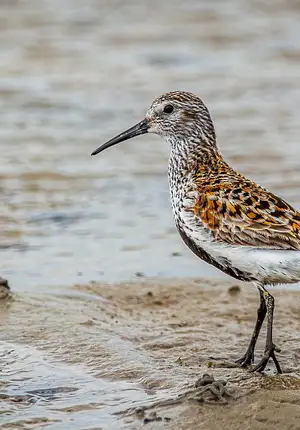 Same family
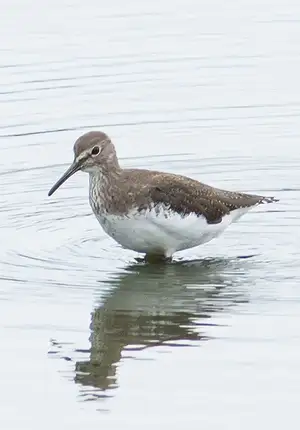 Same family
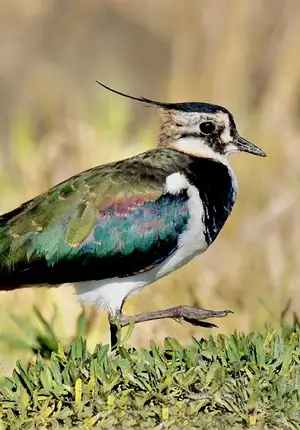 Also in wetlands
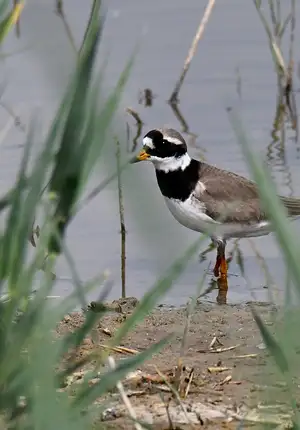 Same order
 Also in wetlands
 Also in wetlands






