Wingspan compared with a person with arms outstretched.
Length
21–24 cm
Wingspan
57–61 cm
Weight
70–110 g
Social life
Usually seen alone or in small groups; both parents take part in incubation and rearing
Lifespan
Record of 15 years and 8 months according to EURING (a bird ringed in Belgium and shot); AnAge gives up to 11.5 years
Conservation status
LC
NT
VU
EN
CR
EW
EX
Global (IUCN)
Least Concern
Spain
Least Concern (LC) as a winter visitor or migrant in the Red Book of the Birds of Spain; on the List of Wild Species under Special Protection, but not in the Spanish Catalogue of Threatened Species
When to see it
Winter visitor
Months of the year when it is present
J
F
M
A
M
J
J
A
S
O
N
D
In Iberia
yes
yes
yes
yes
no
no
yes
yes
yes
yes
yes
yes
Song or voice of the Green Sandpiper
Its most characteristic sound, a «tui uit uit uit» whistle, it gives in flight and also, as an alarm, when it is flushed.
CallGreen Sandpiper
0:00 / 0:21
10 kHz5
The sonogram draws the sound: time runs from left to right, and the higher a trace sits, the higher the note.Recording by Pascal Christe, xeno-canto XC741946 (Suiza) (CC BY-SA 4.0).
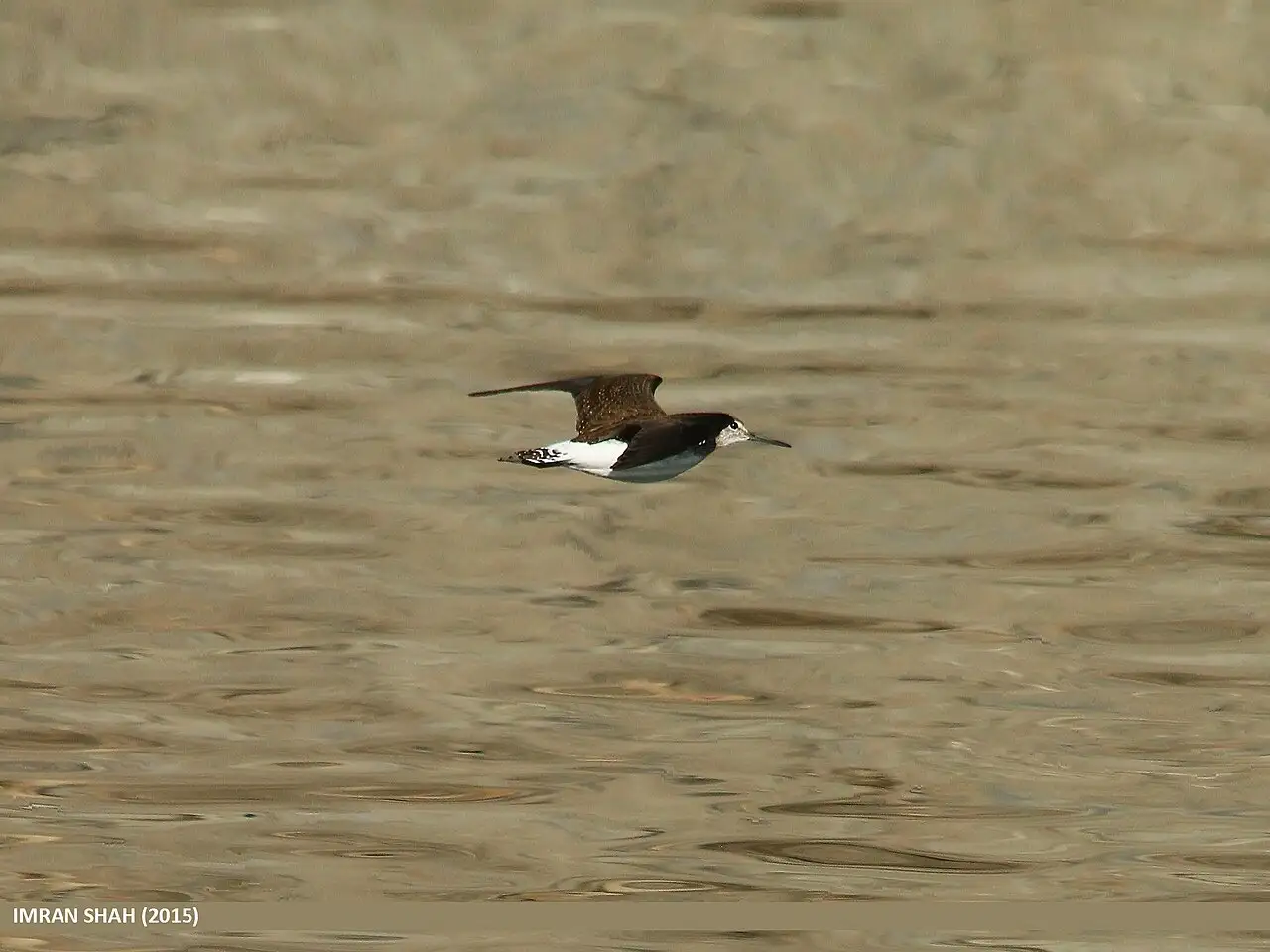
Flight of the Green Sandpiper
It is a shy, nervous bird that is normally not noticed until it takes flight. At that moment it is easy to identify by its very dark colour, against which the white rump and the transverse barring of the tail stand out.
Flight typeDirect and dark, with the white rump clearly visible
It is a shy, nervous bird, which is normally not discovered until it takes flight; only then is it easy to identify.
In the air its very dark colour stands out, with the white rump and the barred tail, and its whistle «tui uit uit uit».
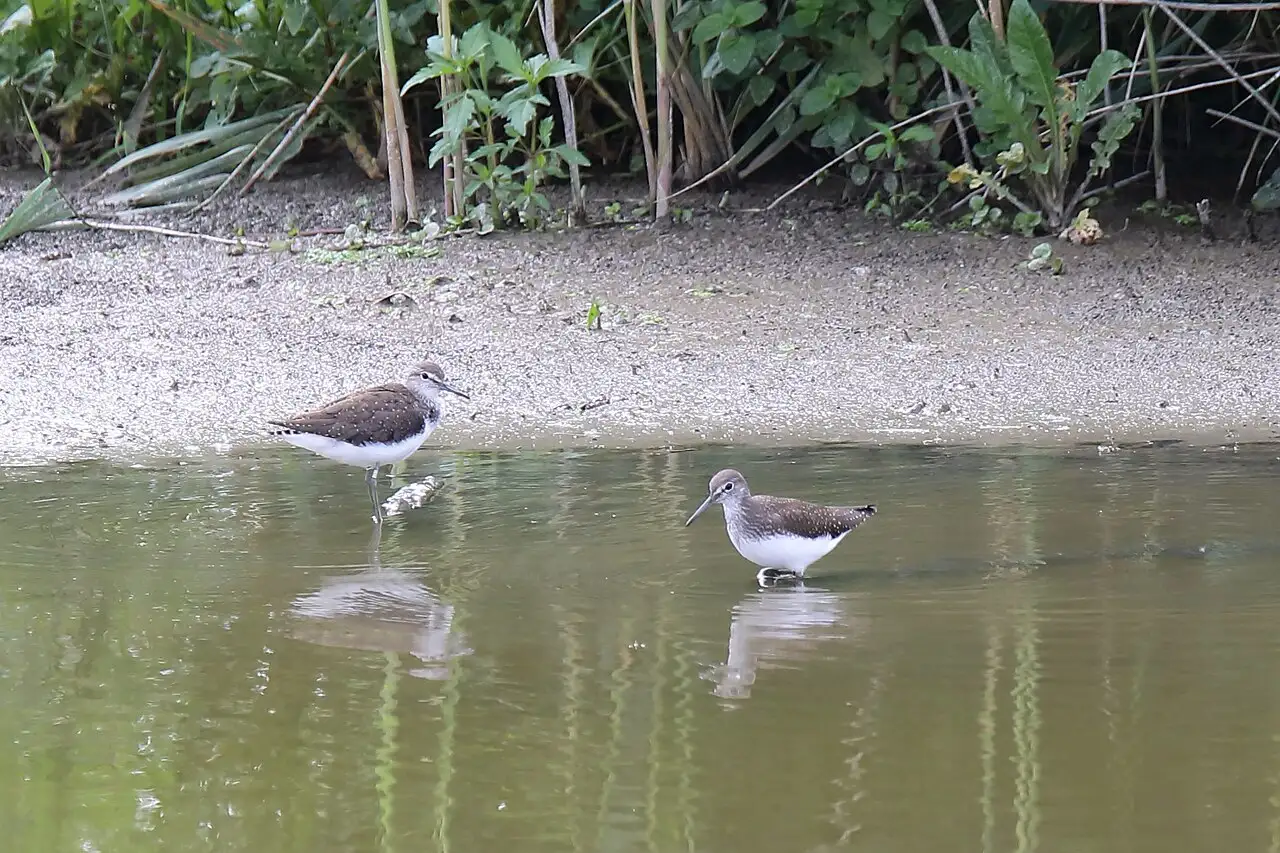
It is seen alone or in small groups, nervously probing the mud and shallow water for invertebrates; perched, it rocks its body continually.
Photo gallery of the Green Sandpiper
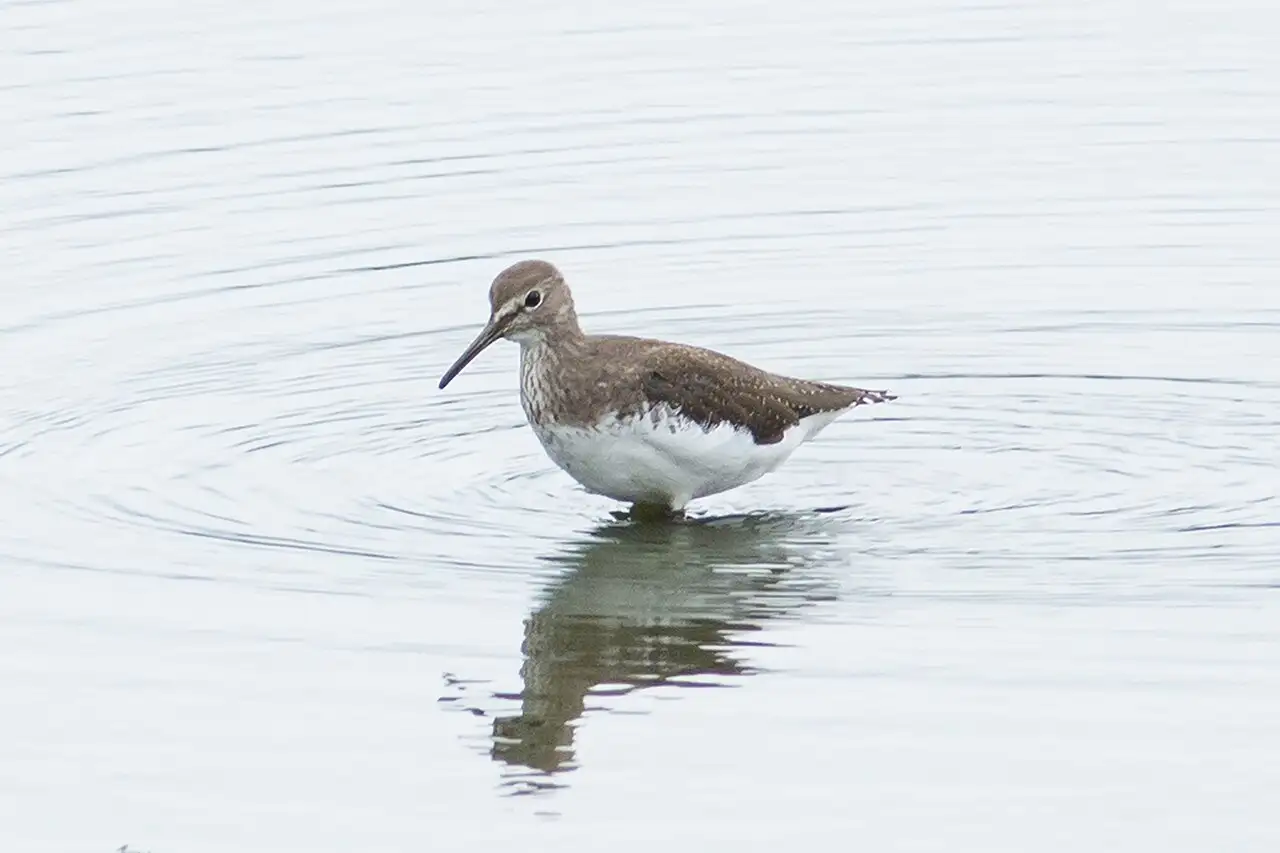
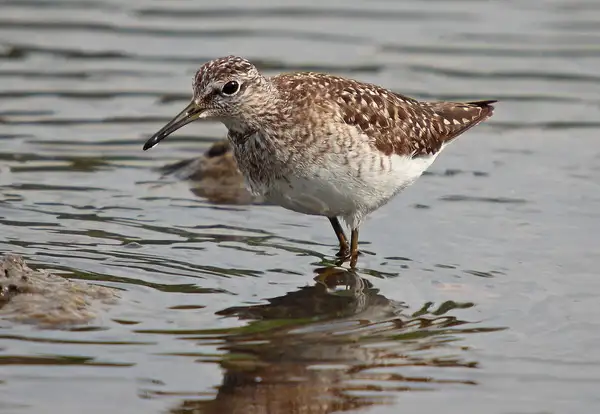
Green Sandpiper wading in shallow water, in profile, with dark brown back, white belly and long straight billPhoto: keith gallie from Warrington, UK, CC BY 2.0Photo 1 of 4
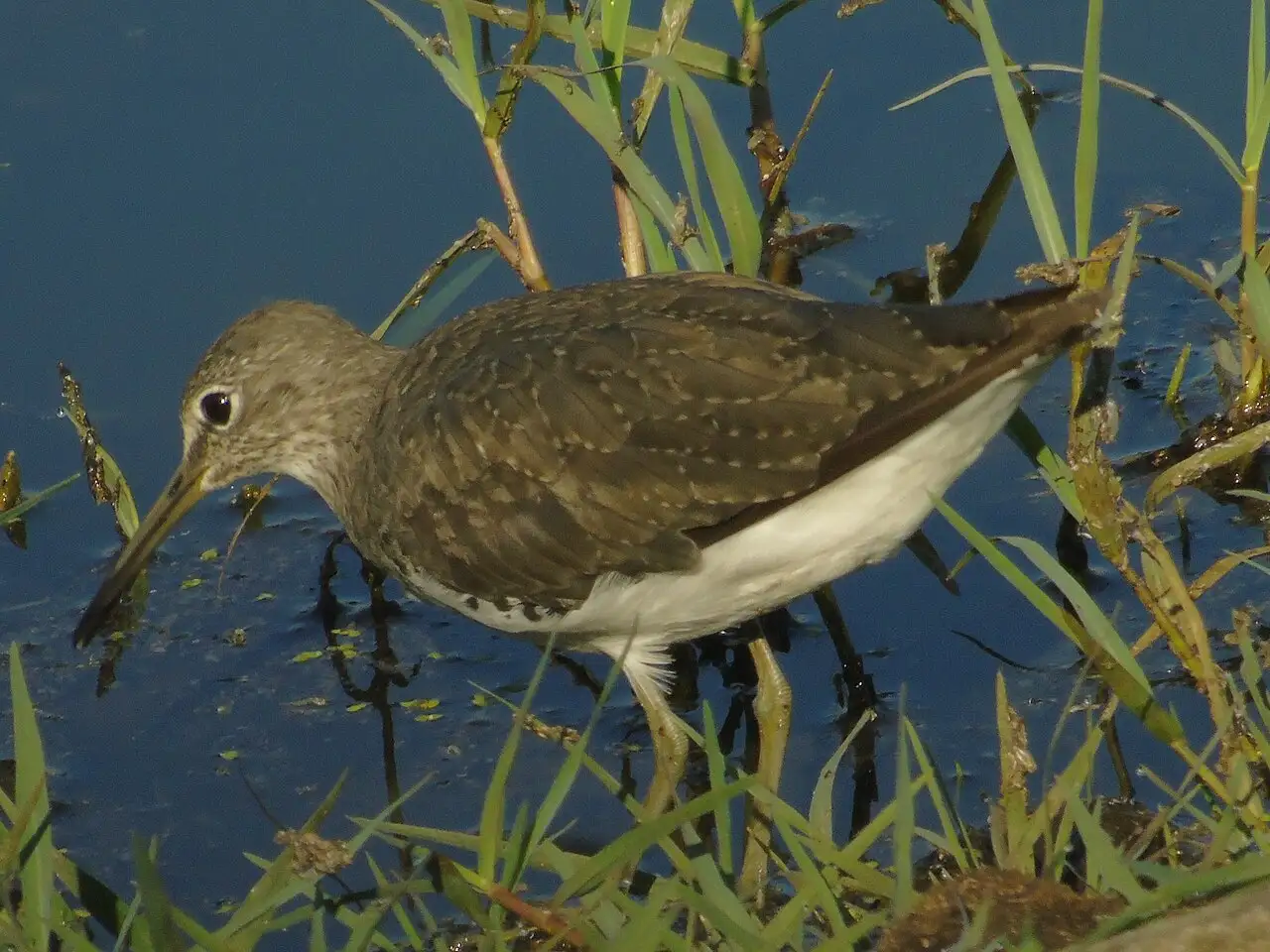
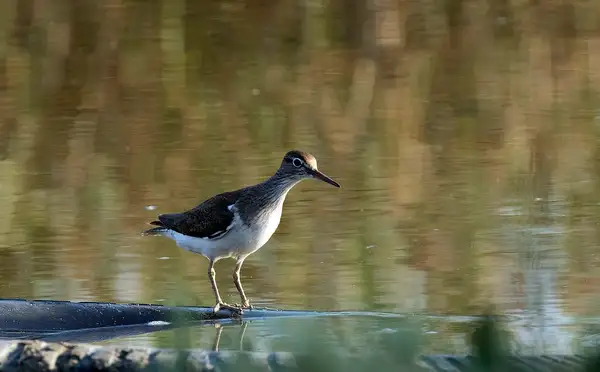
Green Sandpiper close up among the grass of the shore, with brown back dotted with pale, dark eye and thin billPhoto: Murisec 71, CC BY-SA 4.0Photo 2 of 4
Two Green Sandpipers at the edge of a pond, with dark backs and white bellies, beside a sandy shorePhoto: Jac. Janssen from Baarlo lb, NL, CC BY 2.0Photo 4 of 4
1 / 4
Identification of the Green Sandpiper
The Green Sandpiper is a small to medium-sized wader, of slender look, with medium-length legs that barely project beyond the tail in flight, and a bill equal to the length of the head. Like other sandpipers, when perched it usually keeps up a continuous bobbing movement. It is fairly dark on the back, in marked contrast with the white throat and underparts, with a sharp boundary between the dark breast and the white belly. The legs are dark greyish and it shows a short white eyebrow, only between the bill and the eye.
Adult in breeding plumage
Numerous white spots on the upperparts, on a dark brown ground.
Crown, neck and breast streaked brown and white.
Non-breeding and young bird
Non-breeders have less prominent spots, of a dull buff colour, the crown barely streaked with pale and the breast greyish, with more diffuse streaking.
The young bird is similar, but with more conspicuous spots on the upperparts and less defined streaking on the breast.
Habitat and distribution of the Green Sandpiper
It breeds in central and northern Europe and in a broad strip eastwards across Asia. It winters in western Europe, the Mediterranean basin and, above all, in tropical Africa and southern Asia. It has no subspecies.
In Spain it is widely distributed, though very scattered, across the whole Peninsula, where it settles on inland waters of all kinds, from rivers and streams of differing size and water quality to irrigation ditches or canals. It does not breed in Spain: it is a migrant and winter visitor, although it is seen almost every month of the year. In the Balearics it is a moderate migrant and scarce winter visitor, in the Canaries it appears very rarely and there are no observations in Ceuta or Melilla.
It is a species associated mainly with inland waters, flowing or not. Outside the breeding season it avoids coastal areas and prefers inland watercourses. It is an early migrant: the post-breeding passage runs from July to September and the pre-breeding one from March to April, mainly over inland waters.
Areas where it is regularly recorded since 2010Squares of about 25 km where it is recorded regularly (occasional passage records are left out). Data from GBIF.org (173,797 records, retrieved October 2026); outline from Natural Earth.
Etymology of the Green Sandpiper
According to Wikipedia, «Tringa» is the Neo-Latin name that Aldrovandi gave this bird in 1599, from the ancient Greek «trúngas», a thrush-sized wading bird, white-rumped and tail-bobbing, cited by Aristotle; the epithet «ochropus» comes from the Greek «ōkhrós» («ochre») and «poús» («foot»). In other languages it is called «xivita comuna» in Catalan, «bilurico de ala negra» in Galician, «kuliska iluna» in Basque and «green sandpiper» in English1.
Population of the Green Sandpiper
In the 2021 European Red List of Birds the European breeding population is estimated at between 1,180,000 and 1,850,000 mature individuals, with a decreasing trend. There are no recorded population data for Spain. Among the main threats are human disturbance during breeding, illegal hunting and habitat transformation and destruction; these birds are especially sensitive to changes to the small rivers and ponds they use for wintering1.
Nest of the Green Sandpiper
One of the peculiarities of the Green Sandpiper is that it nests high in trees: it uses an abandoned nest of another bird or a squirrel or even a natural accumulation of branches, and less often stumps or heaps of fallen branches. The site may be lined with a little plant material, although sometimes the bird adds none. It does not breed in Spain.
Courtship and breeding of the Green Sandpiper
In its breeding area laying takes place between late April and late May, depending on the region, and consists of three or four cream or olive eggs, heavily speckled with brown, which both adults incubate for 20–23 days. The chicks, which as soon as they hatch can leave the elevated nest and head for the water, develop in about 28 days. It does not breed in Spain.
Diet of the Green Sandpiper
The basis of its diet is a great variety of aquatic and terrestrial invertebrates, which it catches on silty shores and in the water, where it sometimes also gets small fish.
Curious facts about the Green Sandpiper
It is shy and elusive in character, larger and darker than the Common Sandpiper, and one of the most habitual waders in winter in Spain1. It is also very curious that it nests in trees, using old nests of other birds or squirrels. EURING lists a ringed bird from Belgium that lived 15 years and 8 months, against AnAge’s 11.5.
The Green Sandpiper in Cabañeros
The habitat pages of this website do not mention it. GBIF.org records 48 observations of the Green Sandpiper in Cabañeros and its surroundings.
Where to see the Green Sandpiper in Cabañeros
In Cabañeros and its surroundings, in winter and during passages, beside streams, ponds and reservoirs.
When
In winter and on migration passages: the post-breeding one, from July to September, and the pre-breeding one, from March to April.
What time
Calmly and in good light: it is shy and nervous, and is normally not noticed until it takes flight.
Where
On inland waters of all kinds: rivers, streams, irrigation ditches, canals, small lagoons and reservoirs, alone or in small groups.
What to look for
Look for the dark back against the white belly and, in flight, the white rump; listen for the «tui uit uit uit» whistle.



 Same family
 Same family
 Same family
 Same family
 Same order
 Same order
 Same order
 Same order






