Wingspan compared with a person with arms outstretched.
Length
33–36 cm
Wingspan
67–83 cm
Weight
160–200 g
Social life
Gregarious: it normally breeds in colonies, from a few pairs to several hundred, and all defend the territory collectively
Lifespan
Record of 18 years and 9 months according to EURING (a bird ringed in Portugal and identified by its marks in the field), above AnAge's 16 years
Conservation status
LC
NT
VU
EN
CR
EW
EX
Global (IUCN)
Least Concern
Spain
Least Concern (LC) in the Red Book of the Birds of Spain, both as a breeder and as a winter visitor or migrant; on the List of Wild Species under Special Protection, but not in the Spanish Catalogue of Threatened Species
When to see it
Summer visitor
Months of the year when it is present
J
F
M
A
M
J
J
A
S
O
N
D
In Iberia
yes
yes
yes
yes
yes
yes
yes
yes
yes
yes
yes
yes
Breeding season
no
no
no
yes
yes
yes
yes
yes
no
no
no
no
Song or voice of the Black-winged Stilt
It is a calm, silent bird when perched, but quite noisy if disturbed or threatened: it then gives a continuous, piercing «kii-ik, kii-ik». Its commonest call is a «kaiíc, kaiíc» that it repeats rapidly.
CallBlack-winged Stilt
0:00 / 0:24
10 kHz5
The sonogram draws the sound: time runs from left to right, and the higher a trace sits, the higher the note.Recording by Joost van Bruggen, xeno-canto XC431789 (Aznalcázar, Sevilla) (CC BY-SA 4.0).
Flight of the Black-winged Stilt
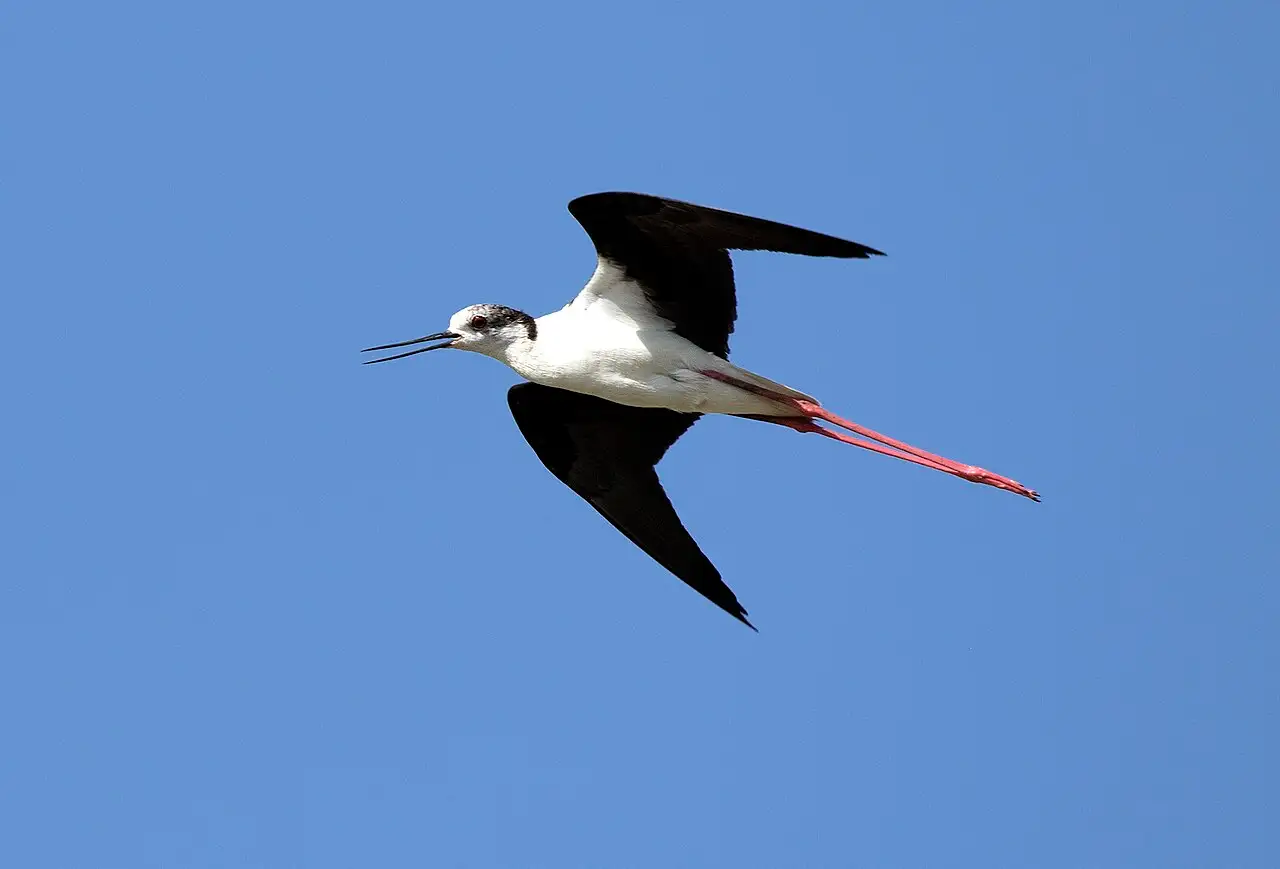
In flight the stilt is also unmistakable: the way it stretches its legs and neck gives it a strangely elongated look.
Flight typeWith legs and neck stretched out, of elongated look
It is a quiet, silent bird when perched, but becomes noisy if disturbed or threatened: it calls and flies in a group.
In flight it is unmistakable: by stretching out its legs and neck, it takes on a strangely elongated look.
It catches aquatic insects with quick pecks at the water surface, on the vegetation or beneath it, and also in flight, with vertical leaps.
Photo gallery of the Black-winged Stilt
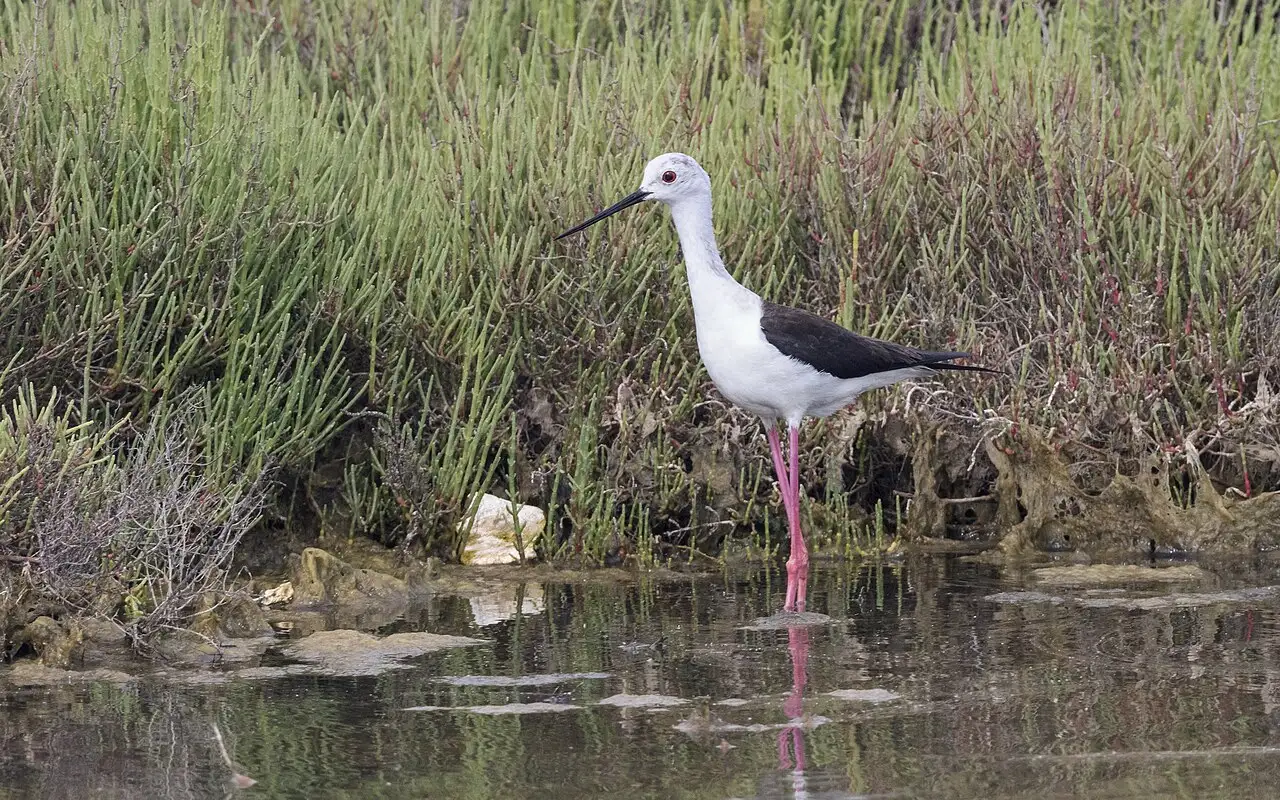
Black-winged Stilt standing among glassworts in a wetland, with very long pink legs, white body, black wings and long, thin billPhoto: Christian Ferrer, CC BY 4.0Photo 1 of 4
Black-winged Stilt in flight against a blue sky, with black wings open and red legs trailing behindPhoto: Zeynel Cebeci, CC BY-SA 4.0Photo 2 of 4
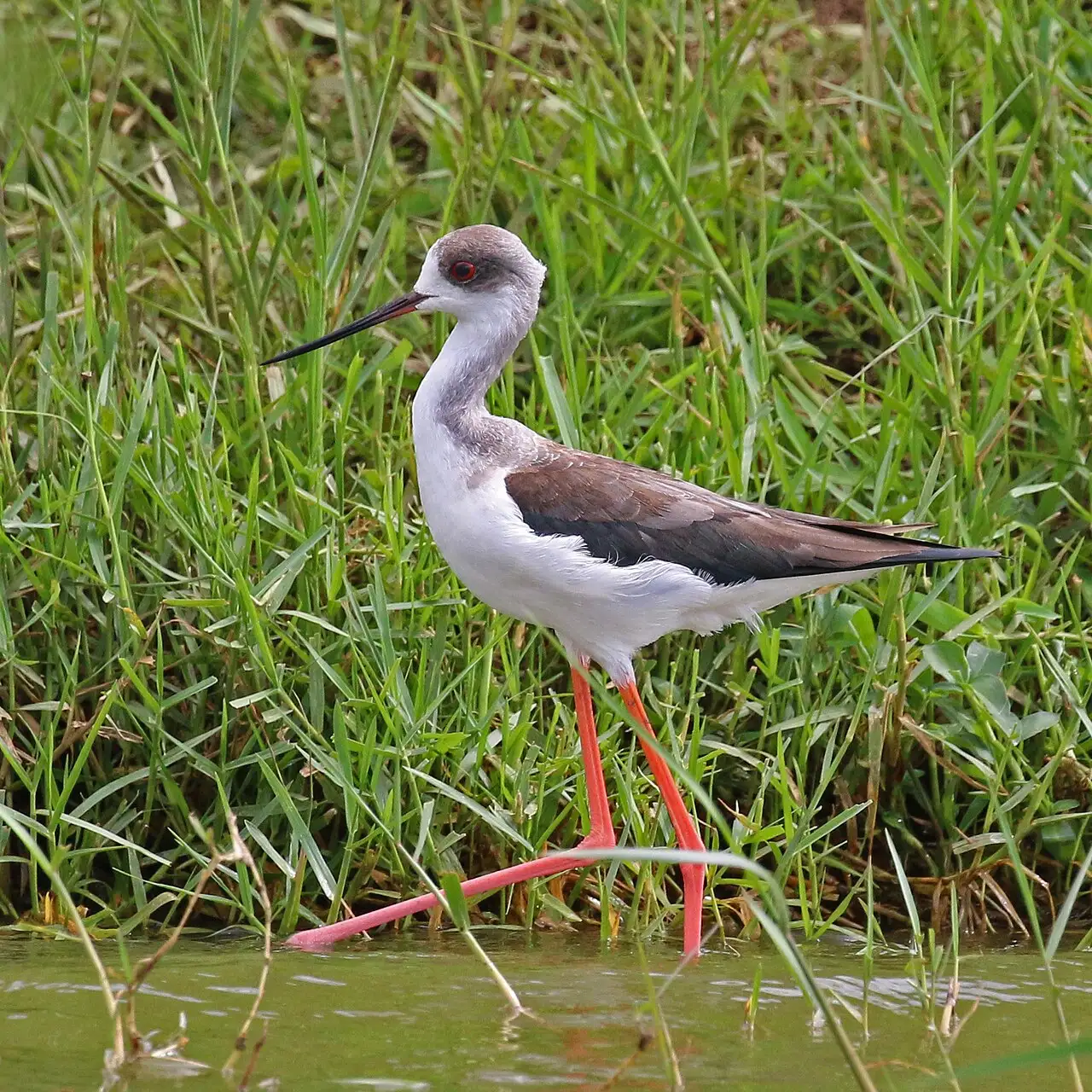
Young Black-winged Stilt among the grass of the shore, with mottled brown back, greyish head and red legsPhoto: Charles J. Sharp, CC BY-SA 4.0Photo 3 of 4
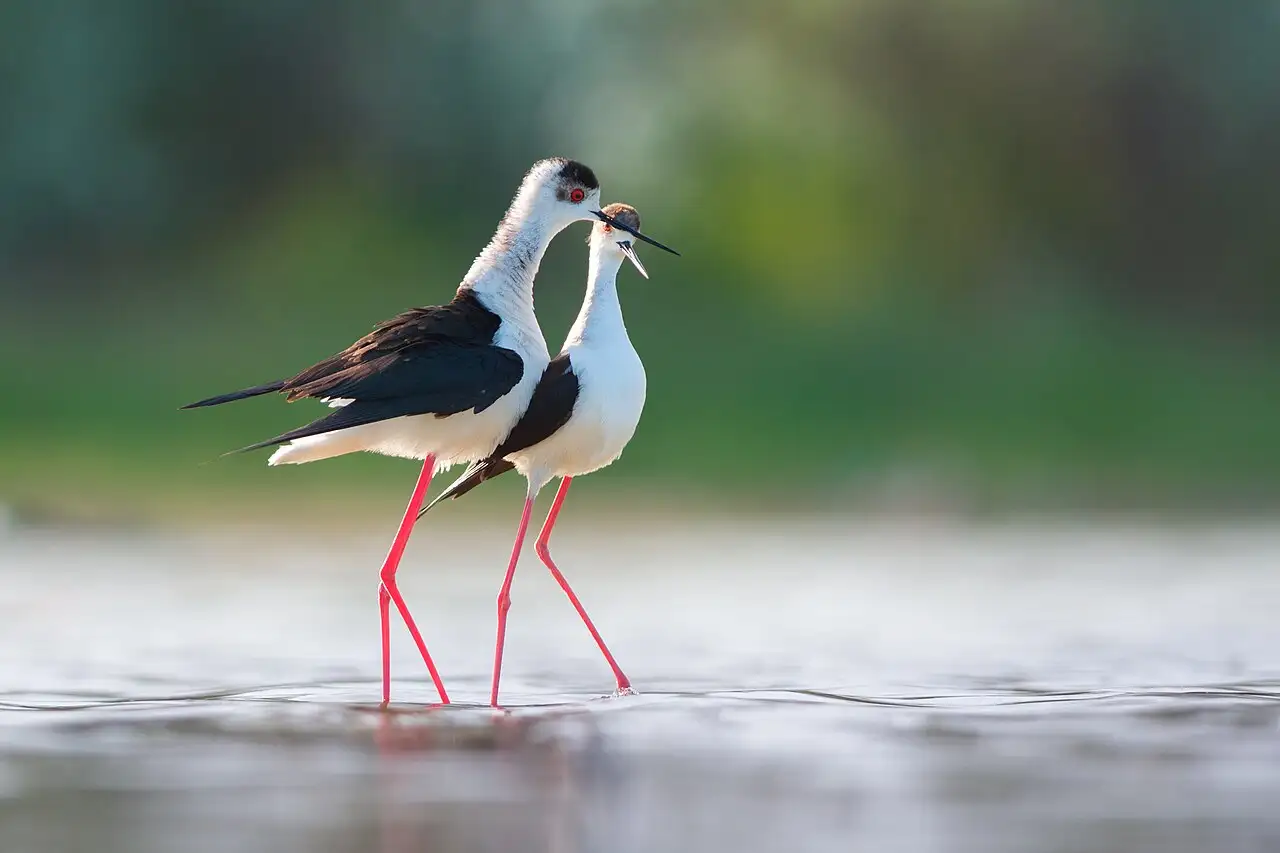
Pair of Black-winged Stilts in shallow water, with red legs and black-and-white body, during courtshipPhoto: Ryzhkov Sergey, CC BY-SA 4.0Photo 4 of 4
1 / 4
Identification of the Black-winged Stilt
The Black-winged Stilt is a wader of peculiar, unmistakable look, characterised above all by its very long red legs and a long, thin, sharp bill. The upperparts are dark, a glossy black in adult males and brownish in females. The neck and crown carry a variable amount of black, according to the individual, and the rest of the body is completely white.
Adult
Very long red legs and long, thin, sharp bill.
Back glossy black (male) or brownish (female).
Neck and crown with a variable amount of black; the rest white.
Young bird
Upperparts mottled brown and underparts white.
Habitat and distribution of the Black-winged Stilt
It is a species of wide distribution. It occupies the western Palaearctic, central, western and southern Asia, southern Australia and New Zealand, Arabia, Africa, Madagascar, Hawaii and the regions of America between 30° north and 40° south latitude. Several subspecies are recognised, of which «himantopus» is the one in Spain and occupies Eurasia and Africa, from southern Europe and Mongolia to South Africa and Madagascar.
In Spain it is the most widespread breeding wader: it is present in almost all autonomous communities, although more than half the population is in the Ebro delta and the Guadalquivir marshes. It is also numerous in inland wetlands of the Peninsula (Castilla-La Mancha, Castilla y León, Extremadura, Aragón, Madrid and La Rioja) and in the Balearics, and scarcer and more localised in the Canaries.
It frequents shallow-water wetlands: deltas, estuaries, coastal lagoons, marshy areas, shallow lakes, salt marshes, marshes, seasonal lagoons and river shores. It often appears in places associated with people, such as irrigated land, rice fields, salt pans, fish farms or sewage works, because it needs waters of fairly high biological productivity.
The Iberian population is mainly a summer visitor, although part migrates south and the rest stay to winter with birds from central Europe. The pre-breeding passage occurs along the Mediterranean coast between March and June and, slightly earlier, through the interior (between February and May); the migratory flow is practically imperceptible on the Atlantic coast and at the Strait of Gibraltar.
Areas where it is regularly recorded since 2010Squares of about 25 km where it is recorded regularly (occasional passage records are left out). Data from GBIF.org (259,219 records, retrieved October 2026); outline from Natural Earth.
Etymology of the Black-winged Stilt
According to Wikipedia, the genus name, «Himantopus», comes from Greek and means «strap foot» or «thong foot», from its legs. Linnaeus described it as «Charadrius himantopus», and Brisson introduced the genus in 1760. In other languages it is called «camallarga comú» in Catalan, «cegoñela común» in Galician, «zankaluzea» in Basque and «black-winged stilt» in English1.
Population of the Black-winged Stilt
In the 2021 European Red List of Birds the European breeding population is estimated at between 101,000 and 269,000 mature individuals, with an increasing trend. In Spain 28,250 pairs are estimated, a figure that can fluctuate greatly between years according to whether they are wet or dry, with the largest concentrations in Doñana, the Ebro delta, the Albufera of Valencia and the Bay of Cádiz. In general it shows a stable or positive long-term trend, with exceptions such as the Bay of Cádiz, where the loss of suitable breeding habitat reverses the trend. The main threat is the degradation or disappearance of wetlands, temporary or permanent; unsuitable farming practices in artificial wetlands, the increase of predators such as dogs and rats and, in particular, the Yellow-legged Gull, with which it competes for breeding territories, also harm it.
Nest of the Black-winged Stilt
The nest, set on the ground, is a shallow hollow lined with plant material, normally placed in open areas and near shallow water, although occasionally it may appear on low vegetation.
Courtship and breeding of the Black-winged Stilt
The breeding cycle lasts about 55 days: 22–25 of incubation and 28–32 of chick development. The chicks, although very active and able to feed themselves as soon as they hatch, are tended by both parents until they learn to fly, above all at night and in rough weather. Most pairs at our latitudes start breeding at the end of April and continue until mid-August. The female lays an average of four brown eggs speckled with dark. It normally breeds in colonies, from a few pairs to several hundred, and all pairs collectively take on the defence of the territory.
Diet of the Black-winged Stilt
It feeds on invertebrates, above all aquatic insects, which it catches when they are perched with quick pecks at the water surface, on vegetation or under it, and also in flight, by vertical jumps. Sometimes it is found with its head and neck completely submerged, but it is rare to see it swim.
Curious facts about the Black-winged Stilt
The repetitive, piercing cry of these long-legged birds is one of the most habitual sounds of many of our wetlands1. They are the commonest and most widespread waders of our fauna and also among the showiest1. EURING lists a bird ringed in Portugal that lived 18 years and 9 months.
The Black-winged Stilt in Cabañeros
The habitat pages of this website do not mention it. GBIF.org records 56 observations of the Black-winged Stilt in Cabañeros and its surroundings.
Where to see the Black-winged Stilt in Cabañeros
In Cabañeros and its surroundings, above all from spring to summer, in shallow lagoons and ponds.
When
Above all from spring to summer; breeding begins at the end of April and runs to mid-August.
What time
In good light and calmly: if it feels threatened, it takes flight and calls as a group.
Where
In shallow-water wetlands: lagoons, ponds, salt pans, rice fields and river shores.
What to look for
Look for the very long red legs, the thin bill and the black-and-white contrast; in flight, its elongated silhouette.
Videos of the Black-winged Stilt
Similar species
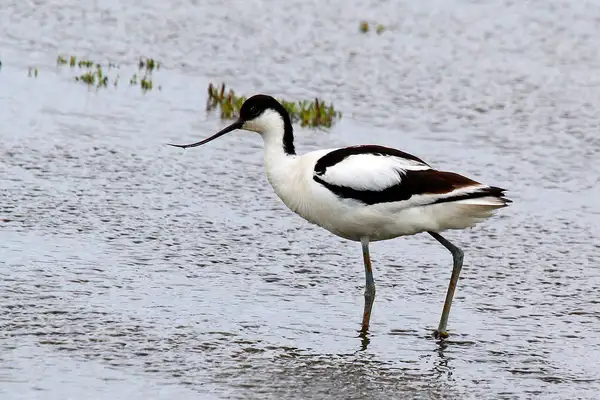
Pied Avocet
Recurvirostra avosetta
How to tell them apart
It is not clearly similar1. The Pied Avocet belongs to the same family, the Recurvirostridae.
Photo: Charles J. Sharp, CC BY-SA 3.0
Other birds
Birds related to the Black-winged Stilt or sharing its habitats in Cabañeros.



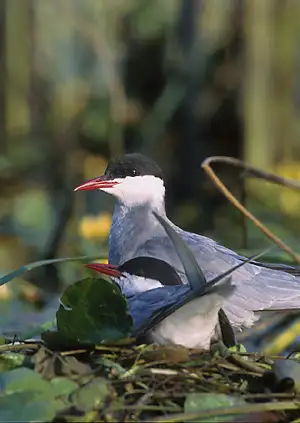 Same order
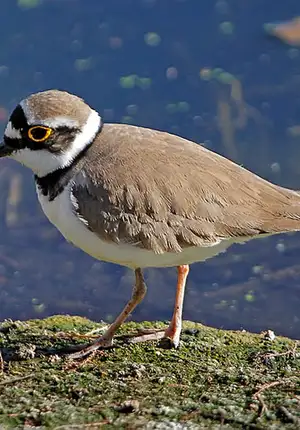 Same order
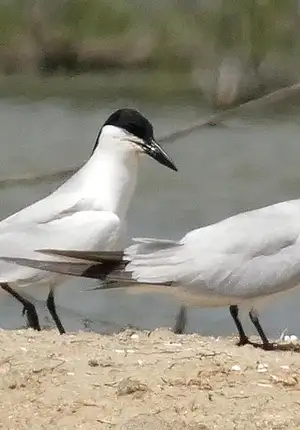 Same order
 Same season in the park
 Same order
 Same order
 Same season in the park
 Same season in the park






