It forms monogamous pair bonds, although cases of polygamy have been recorded
Lifespan
Record of 10 years and 1 month according to EURING (a bird ringed in Sweden and recaptured by a ringer while breeding)
Conservation status
LC
NT
VU
EN
CR
EW
EX
Global (IUCN)
Least Concern
Spain
Near Threatened (NT) in the Red Book of the Birds of Spain; on the List of Wild Species under Special Protection, but not in the Spanish Catalogue of Threatened Species
When to see it
Summer visitor
Months of the year when it is present
J
F
M
A
M
J
J
A
S
O
N
D
In Iberia
no
yes
yes
yes
yes
yes
yes
yes
yes
yes
yes
no
Breeding season
no
no
no
yes
yes
yes
yes
no
no
no
no
no
Song or voice of the Northern Wheatear
Fairly loud and characteristic, it consists of a succession of short phrases that interleave harsh phrases with more melodious motifs. As a call it gives a short, distinguishable click: «chacc, chacc, chacc-uiit…».
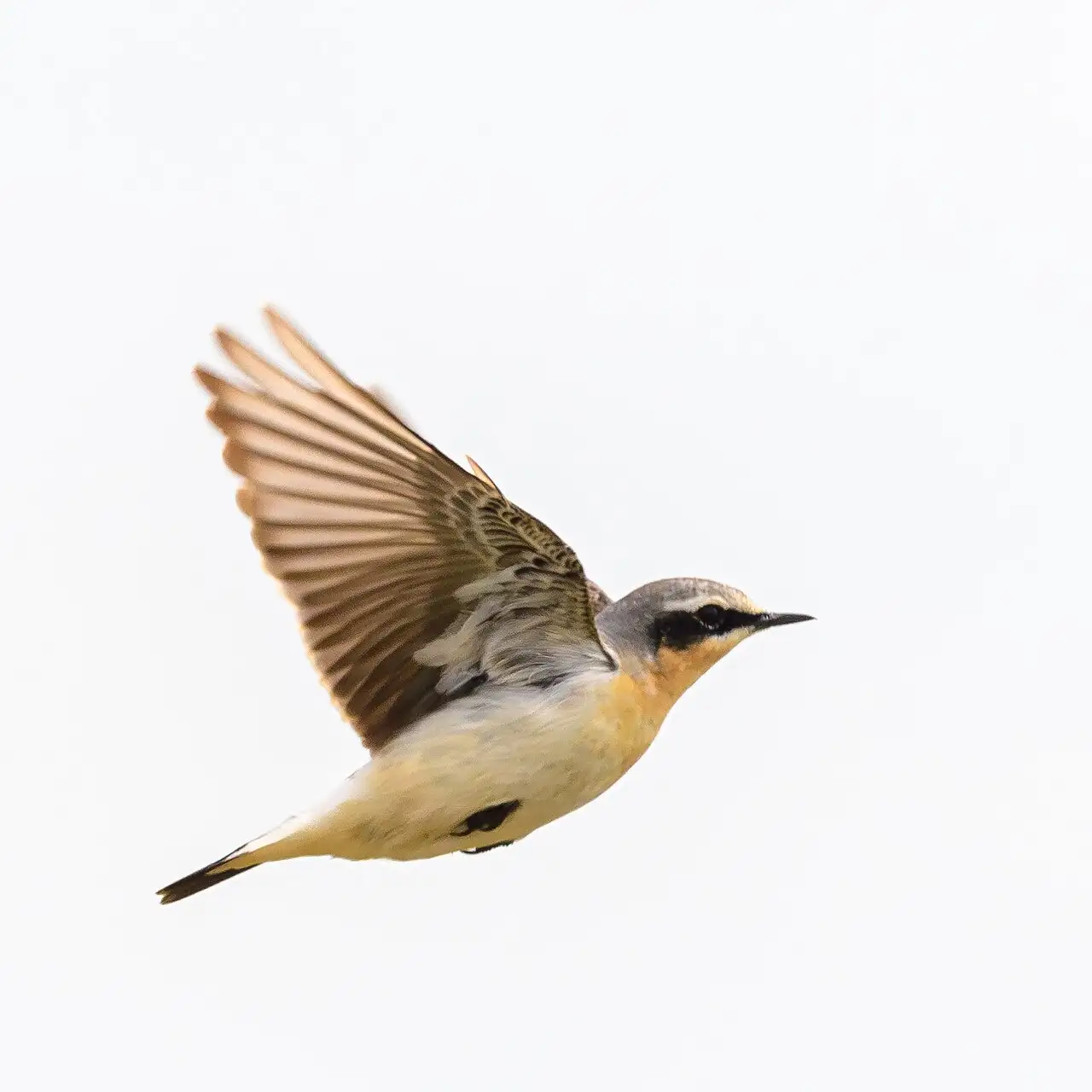
Its flight is direct, with rapid wingbeats. In both sexes the white tail pattern, ending in a black inverted T, is very striking.
Flight typeDirect, with rapid wingbeats
Very terrestrial, it likes to perch, with an upright bearing, on stones, rocks and other prominences of the terrain, and also to walk and hop on the ground.
Its flight is direct, with a quick beating of the wings, and shows the pattern of the tail, white with a black inverted T at the end.
It looks for insects, spiders, snails and other small invertebrates in open spaces, and completes its diet with small fruits and seeds.
Photo gallery of the Northern Wheatear
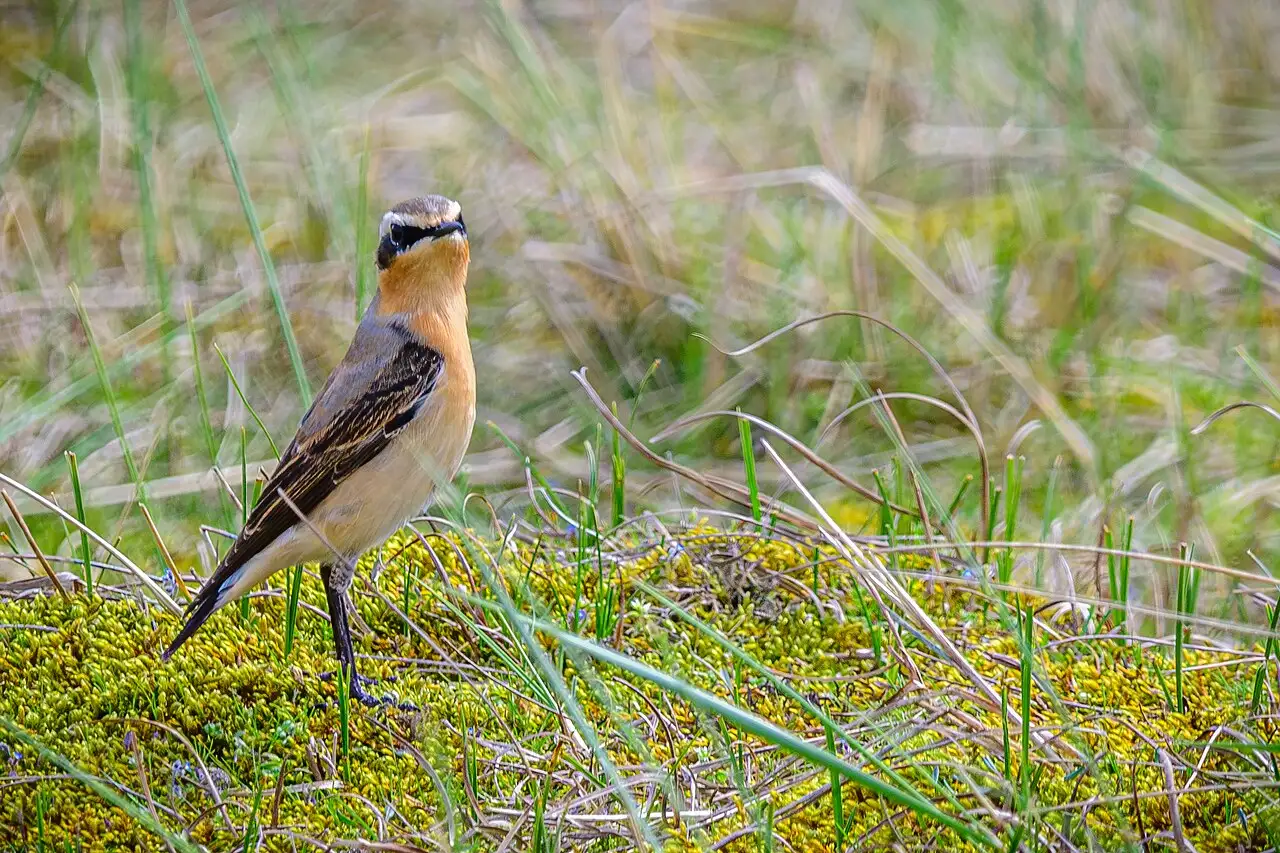
Male Northern Wheatear upright on the grass, with black mask, blue-grey back and ochre breastPhoto: Stephan Sprinz, CC BY 4.0Photo 1 of 4
Male Northern Wheatear in flight, with wings open, black mask and short tailPhoto: Stephan Sprinz, CC BY 4.0Photo 2 of 4
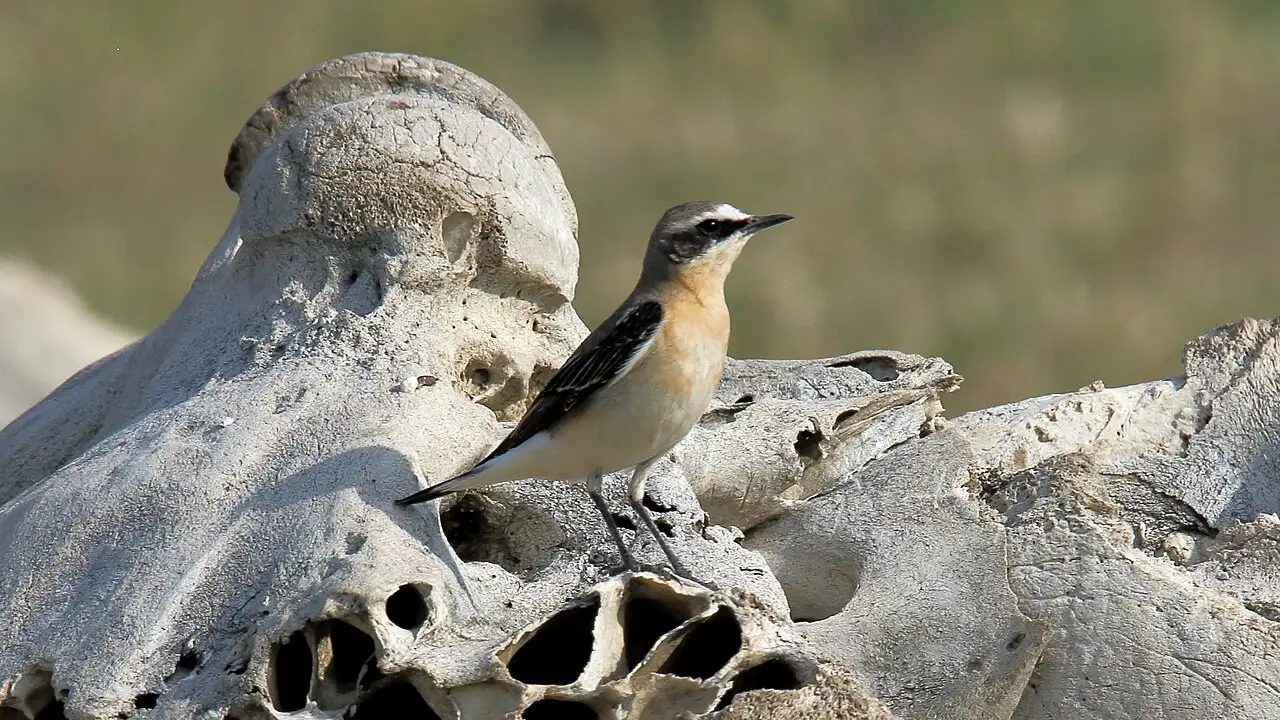
Male Northern Wheatear perched on a white bone, in profile, with black mask and wingsPhoto: Dominic Sherony, CC BY-SA 2.0Photo 3 of 4
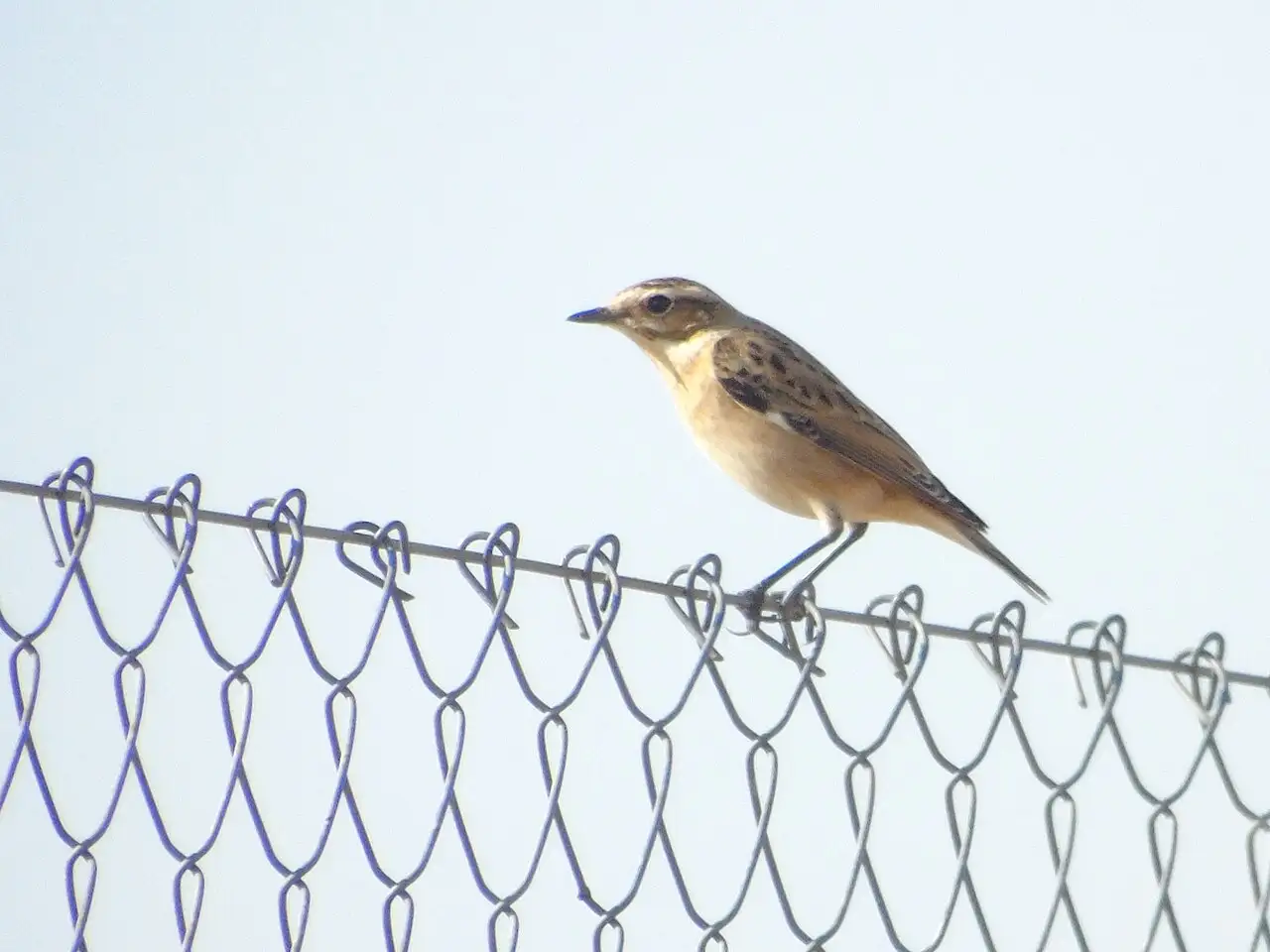
Northern Wheatear, in brown and ochre tones, perched on a wire-mesh fence against the skyPhoto: Murisec 71, CC0Photo 4 of 4
1 / 4
Identification of the Northern Wheatear
The Northern Wheatear has a very characteristic tail pattern. In both sexes the white tail, ending in a black inverted T, typical of all wheatears, is very striking. It is very ground-dwelling: it likes to walk and hop on the ground and also to perch, in an upright stance, on stones, rocks and other promontories of the terrain.
Male
Blue-grey back, on which the black wings stand out.
Ochre underparts and black mask.
Female
Upperparts more ochre.
No mask.
Habitat and distribution of the Northern Wheatear
As a breeding species it is spread across the whole of Europe, northern and central Asia, Greenland and the Arctic areas of North America. It also occupies North Africa and the Arabian Peninsula. It winters in sub-Saharan Africa, from Senegal to Kenya. It has several subspecies, with a slight gradation in appearance from north to south; the one from Iceland and Greenland, «leucorhoa», is larger and more intensely coloured. In Spain the subspecies «libanotica» breeds.
It occupies the northern half of the Peninsula, with a more limited distribution on the Cantabrian slope and Galicia and more extensive in the Duero basin and the neighbouring mountain systems. In the southern half and the Levante it is restricted to high mountain areas, and is absent from the south-western quadrant. In the Balearics it is very localised (Mallorca and Ibiza). During migration it can be seen with some frequency across the whole country. In the last two decades populations have disappeared from the centre-east of Madrid and from various points of both plateaus, the southern Iberian System and the Pre-Pyrenees, while new breeding cores have been found on the Atlantic and Mediterranean coasts, in the Balearics and in the Duero basin.
It is tied to open environments: dunes, grassland, crops, low scrub, crags, high mountain areas, forest clearings, steppes. It needs rocks and stones to nest in and open areas rich in insects; in Spain the highest densities occur in areas of grassland and crags and in deforested high-mountain landscapes. It is present from sea level to the 3,250 metres of altitude in Sierra Nevada.
It is a trans-Saharan migrant. The pre-breeding passage through the Peninsula is detected between March and May and the post-breeding one from September to November, with peaks at the end of September and early October.
Areas where it is regularly recorded since 2010Squares of about 25 km where it is recorded regularly (occasional passage records are left out). Data from GBIF.org (130,776 records, retrieved October 2026); outline from Natural Earth.
Etymology of the Northern Wheatear
According to Wikipedia, the genus name, «Oenanthe», is also that of a plant genus (in English, «water dropworts») and derives from the Greek «oînos» («wine») and «ánthos» («flower»), from the wine-like scent of the flowers. It is also known as «collalba gris»; in other languages it is «còlit gris» in Catalan, «pedreiro cincento» in Galician, «buztanzuri arrunta» in Basque and «northern wheatear» in English1.
Population of the Northern Wheatear
In the 2021 European Red List of Birds the European breeding population is estimated at between 10,800,000 and 29,300,000 mature individuals, with an unknown trend. The Spanish population is put at around 1,400,000 individuals, with the most numerous contingents on the northern Meseta and in the Ebro valley, and its trend is negative, with an average annual decline of 4.3 %. Its main threats are related to the alteration of breeding habitats: agricultural intensification, the expansion of scrub and woods, abandonment of the countryside and reforestation; severe droughts in the wintering areas could also affect it.
Nest of the Northern Wheatear
The nest is set in a hole among stones or in a wall and consists of a small cup of mosses, leaves and lichens.
Courtship and breeding of the Northern Wheatear
It forms monogamous pair bonds, although cases of polygamy have been recorded. The breeding period runs from April to July and it can make up to two clutches a year. The female lays two to nine eggs, which she incubates for 10–16 days. The chicks, cared for by both parents, are able to fly at 15 days, although they become fully independent at a month old.
Diet of the Northern Wheatear
Its diet is based on insects, spiders, small snails and other small invertebrates, which it supplements with small fruits and seeds.
Curious facts about the Northern Wheatear
The north-west African subspecies, «seebohmi», has been considered a separate species since 20221. It is a trans-Saharan migrant and the Iceland and Greenland subspecies is larger and more intensely coloured. EURING lists a bird ringed in Sweden that lived 10 years and 1 month.
The Northern Wheatear in Cabañeros
The habitat pages of this website do not mention it. GBIF.org records 71 observations of the Northern Wheatear in Cabañeros and its surroundings; during migration it can be seen with some frequency across the whole of Spain, and in the southern half it breeds only in high mountain areas1.
Where to see the Northern Wheatear in Cabañeros
In Cabañeros and its surroundings, on migration passages, from March to May and from September to November.
When
On passage: the pre-breeding one, from March to May, and the post-breeding one, from September to November, with peaks at the end of September and early October.
What time
In good light, on open terrain.
Where
In grassland, crops, low scrub and crags; on passage it can appear in any open environment.
What to look for
Look for the white tail with the black T and the upright stance on a stone or promontory.



 Same family
 Same family
 Same family
 Same family
 Same order
 Same order
 Same order
 Same order






